Finding Water — Decision Guide
Water is the one preparation that cannot be deferred. A healthy adult begins suffering cognitive impairment within 24 hours of dehydration and can be incapacitated in 48–72 hours. Before choosing filtration systems, storage tanks, or any other water infrastructure, you need a sourcing plan — a clear answer to the question: where will your water actually come from?
Educational use only
This page is for educational purposes only. Water rights, testing requirements, and legal access vary by jurisdiction. Verify local regulations and consult a qualified professional before installing permanent water infrastructure. Use this information at your own risk.
Action block
Do this first: Walk your immediate area (within 1 mile (1.6 km)) and write down every potential water source you can see — taps, roof catchment surfaces, ponds, streams, and wells (20 min) Time required: Active: 20 min for initial survey; recurrence: annually and after any major land-use change nearby Cost range: — Skill level: Beginner for site survey; intermediate for seasonal assessment and water rights research Tools and supplies: Supplies: notebook and pen, topographic map of your area (USGS 7.5-minute quad or digital equivalent). Infrastructure: none required for initial survey. Safety warnings: See Contamination First Rule below — never approach or collect from any source showing contamination indicators
Minimum Daily Requirements
The U.S. Federal Emergency Management Agency (FEMA) minimum is 1 gallon (3.8 L) per person per day — drinking only, sedentary conditions, no cooking, no hygiene. That number is a survival floor, not a planning target.
A practical planning minimum is 2 gallons (7.6 L) per person per day:
| Use | Quantity per Person per Day |
|---|---|
| Drinking (baseline) | 0.5 gal (1.9 L) |
| Cooking and food prep | 0.5 gal (1.9 L) |
| Hygiene and sanitation | 1.0 gal (3.8 L) |
| Total minimum | 2.0 gal (7.6 L) |
High heat, physical labor, illness, nursing mothers, and children under 12 all increase the drinking requirement. A safe planning number for active adults in summer heat is 3–4 gallons (11–15 L) per person per day when all uses are included.
For a family of four at the 2-gallon minimum: 8 gallons (30 L) per day, 56 gallons (212 L) per week, 240 gallons (908 L) per month.
Source Type Decision Matrix
Before committing to any source, evaluate it against five criteria: reliability, infrastructure dependency, treatment required, legal status, and cost.
| Source | Reliability | Infrastructure Dep. | Treatment Required |
|---|---|---|---|
| Municipal (grid-connected) | High (normal ops) | Critical | None (pre-treated) |
| Private drilled well | High | Moderate (pump power) | Depends on test |
| Dug/driven well | Moderate | Low (hand pump) | Always required |
| Rainwater collection | Variable | Low | Always required |
| Springs | Variable | None | Always required |
| Surface water | Variable | None | Always required |
| Atmospheric (AWG) | Moderate | Electricity required | Recommended |
| Source | Legal Complexity | Setup Cost |
|---|---|---|
| Municipal (grid-connected) | None | None |
| Private drilled well | Permit required | $5,000–$15,000 |
| Dug/driven well | Permit required | $500–$2,500 |
| Rainwater collection | Regulated by state | $500–$3,000 |
| Springs | Varies; land rights | $200–$1,500 |
| Surface water | Minimal | Low |
| Atmospheric (AWG) | None | $1,000–$5,000 |
Priority Order for Emergency Sourcing
When your normal supply fails, work through sources in this order, from most to least reliable:
1. Stored water — What you have already treated and stored. Zero preparation time. See Containers and Bulk Storage.
2. Municipal supply — Even during grid failures, municipal systems often have residual pressure for hours or days. Fill every container the moment you hear of an emergency.
3. Private well with hand pump — Fully grid-independent if you have a manually operable pump. Best long-term rural primary. See Wells.
4. Rainwater collection — Available anywhere it rains. Requires collection surface, storage, and purification. Best as a secondary layer in most climates. See Rainwater.
5. Springs — Excellent quality if properly developed; requires site evaluation, spring box construction, and regular testing. See Springs.
6. Surface water (streams, rivers, lakes) — Always available but highest contamination risk. Never use without treatment. See Surface Water.
7. Atmospheric water generation (AWG) — Energy-intensive, humidity-dependent. Best as a grid-down supplement in humid climates. See Atmospheric Water Generation.
8. Ice and snow melt — Winter-only option; caloric cost to melt, and purification still required. See Ice & Snow.
Contamination First Rule
Never assume any non-stored, non-municipal source is safe to drink without testing or treatment. Groundwater contamination, agricultural runoff, blue-green algae, and industrial pollution are invisible to the eye and odorless at dangerous concentrations. See Water Testing and Filtration.
Finding Water in Nature
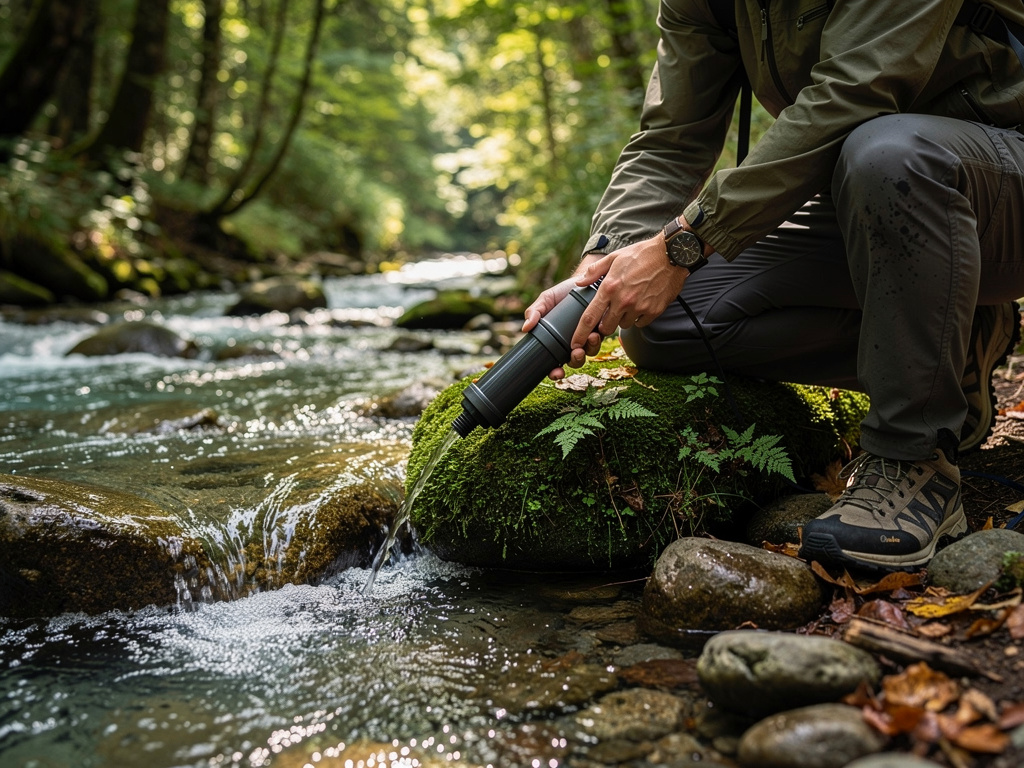
When no stored or infrastructure source is available, read the landscape:
Topographic Indicators
- Valleys and drainages: Water flows downhill. Follow terrain downward; drainage channels often have subsurface water even when dry on the surface.
- Vegetation clusters: Dense green vegetation in an otherwise dry landscape signals subsurface water. Willows, cottonwoods, cattails, and bright-green grass are the most reliable indicators in North America.
- Rock seeps and cliff bases: Porous rock (limestone, sandstone) collects and channels water. Look for dark wet patches on cliff faces, especially on north-facing slopes where evaporation is lower.
- Animal trails: Convergent animal paths often lead toward water. Birds flying low and straight in the morning or evening are typically heading to water.
- Canyon bottoms: In arid regions, dig into dry creek beds at the outside of a bend — subsurface water is often 6–24 inches (15–60 cm) below the surface.
Seasonal Considerations
- Spring snowmelt creates temporary surface water where none exists in summer
- Dry streambeds in summer often have subsurface water reachable by digging
- Morning dew on vegetation can be collected with absorbent cloth before 9 AM
- In coastal regions, moving away from shore reduces salt intrusion in groundwater
Urban Water Sources
- Hot water heaters contain 40–80 gallons (150–300 L) of potable water — drain from the bottom valve
- Toilet tanks (not bowls) typically hold 1.6–3.5 gallons (6–13 L) of clean water
- Swimming pools contain large volumes but require significant treatment for drinking
- Fire hydrants — only access through emergency responders; tap water pressure drops when hydrants are opened without authorization
Contamination Warning Signs
Do not collect from any source that shows these indicators:
- Foam or scum on still water — chemical or biological contamination
- Blue-green or bright green algal mats — cyanobacteria; toxins survive boiling and standard filtration; do not use this water source
- Dead fish, animals, or birds near the water source — acute toxicity event
- Oily sheen on surface — petroleum contamination
- Sulfur or chemical smell — industrial or geothermal contamination
- Unusual colors (orange, red, milky white) — mineral contamination or AMD (acid mine drainage)
- Downstream from agricultural land without buffer zone — nitrate contamination risk; no visual indicator
Field note
If you find water in an emergency and have no test kit, the simplest field screening tool is observation time: fill a clear container, let it settle for 20 minutes, and look for sediment, color, and surface activity. Odor is your second screen — chlorine-free water with no unusual smell is not "safe," but water with a strong sulfur, chemical, or sewage smell is almost certainly unsafe and should be skipped in favor of a worse-looking but odorless alternative. Odorless does not mean clean; it means the contamination threshold is below your nose's detection.
Building a Layered Sourcing Plan
Resilience comes from depth: multiple independent sources that do not share the same failure mode.
Layer 1 — Stored (72-hour minimum): Pre-treated water in sealed containers that requires nothing from infrastructure. See Bulk Storage.
Layer 2 — On-site production: One source that produces water without municipal infrastructure — well, rainwater, or spring. This is your long-term backbone.
Layer 3 — Emergency fallback: A third source method requiring only portable equipment — filter + chemical treatment + surface water collection. This is your last resort that works anywhere.
Source Redundancy Checklist
- Layer 1: Minimum 2 gallons (7.6 L) per person per day × 14 days stored
- Layer 2: Primary production source identified, installed, and tested
- Layer 2: Treatment train defined (test results on file)
- Layer 3: Portable filter, chemical treatment, and collection containers in bug-out bag
- All household members know the layered plan and can execute Layer 3 independently
- Annual water test scheduled for any well, rainwater, or spring source
- Trigger conditions defined: when to move from Layer 1 → 2 → 3
Seasonal source reliability assessment
A source that appears reliable during a site visit may fail precisely when you need it most. Seasonal assessment reveals vulnerabilities that a single-visit evaluation misses.
Springs and seeps: In most temperate climates, spring flow peaks in late winter and early spring as snowmelt recharges the aquifer and drops to its seasonal minimum in late summer and early fall. A spring that produces 5 gallons (19 L) per minute in March may produce less than 1 gallon (3.8 L) per minute in September. Assess spring flow at end of summer, not at first visit. A spring that marginally meets your needs in peak season is unreliable as a primary source — treat it as a secondary layer.
Shallow wells and dug wells: Water table depth fluctuates seasonally by 3–20 feet (1–6 m) depending on geology and regional precipitation. A dug well that tests at 8 feet (2.4 m) of water in spring may run dry to bedrock by August. Any well under 50 feet (15 m) total depth in a dry-summer climate carries seasonal reliability risk and should be backed by a secondary source.
Rainwater collection: Reliability is directly tied to your regional precipitation pattern. Before depending on rainwater, research your area's historical monthly rainfall distribution. A climate with concentrated winter precipitation and dry summers (Pacific Northwest lowlands, Mediterranean California) makes rainwater a poor daily-use source in summer unless you have very large storage capacity — 5,000 gallons (18,900 L) or more for a year-round primary source. In year-round humid climates (Southeast, Pacific Northwest coast), smaller storage is workable.
Surface water (streams and rivers): Peak flow in spring snowmelt periods does not predict late-summer flow. In the western United States, many streams that run strong in April are dry by July. If a stream is your emergency fallback, walk its course in late August to assess dry-season behavior. Also note that low-flow periods concentrate agricultural and mining contaminants — water quality often declines as volume decreases.
Municipal supply during extended outages: Municipal pressure tanks typically maintain flow for 4–12 hours after a power failure. Cities with gravity-fed reservoirs maintain pressure for 24–72 hours. If your area's water utility relies entirely on pumping with no gravity storage, assume a power outage equals immediate water outage.
Water rights research checklist
Before investing in any permanent water source, verify the legal framework. Water rights are property rights, and missing them can make infrastructure unusable or legally challenged.
- Identify your state's water law doctrine (Prior Appropriation in most western states; Riparian Rights in most eastern states; hybrid systems in a few states including California)
- For any proposed surface water diversion (stream, river, spring emerging from public land), contact your state engineer's office or water resources agency — diversion without a permit is illegal in Prior Appropriation states regardless of land ownership
- For rainwater collection, verify your state's regulations: most states allow it; Colorado has historically restricted large-scale collection; Texas actively incentivizes it with tax exemptions. Check with your county extension office for current status
- For new well drilling, obtain the required permit from your state water authority or county health department before drilling begins. The permit documents setback requirements from septic systems, property lines, and surface water
- If purchasing property with existing water infrastructure (well, spring box, cistern), verify the infrastructure appears in the title and that permits are on file — unpermitted water systems can complicate property sales and insurance
- For shared water sources (a stream crossing multiple properties), consult an attorney familiar with water law in your state before building infrastructure
Source testing protocol
Testing is not a one-time event. Sources change over time, and testing frequency should reflect the source type and what surrounds it.
What to test for and when:
| Source type | Minimum testing frequency | Test parameters |
|---|---|---|
| Private well (rural residential) | Annually | Total coliform, E. coli, nitrates, pH |
| Private well (near agriculture) | Every 6 months | Above + arsenic, pesticides, nitrates |
| Private well (new or repaired) | Before first use | Above + total dissolved solids, hardness |
| Developed spring | Every 6 months | Total coliform, E. coli, turbidity |
| Rainwater (domestic use) | Annually | Total coliform, E. coli, pH, lead (from roof materials) |
| Surface water (any use) | Before each use period | Total coliform, E. coli, turbidity; plus nitrates if near agriculture |
How to test without a laboratory: Basic field testing covers turbidity (visual), pH (inexpensive test strips, 6.5–8.5 is acceptable range), free chlorine (pool test strips work), and nitrates (agricultural test strips, threshold 10 mg/L maximum for drinking water). Field testing does not replace laboratory testing — it is a quick-rejection screen for obviously problematic water.
Laboratory testing: County health departments often provide free or low-cost coliform testing for private wells. State-certified laboratories charge moderate rates for a standard potability panel. The Centers for Disease Control and Prevention (CDC) recommends testing private wells at least annually for bacteria and nitrates, and any time the water changes in taste, odor, or appearance, or after flooding.
For a source you intend to use as a long-term primary supply, establish a testing file: date, source, test results, treatment changes. A documented testing history is also required if you ever sell property with a private water supply.
Redundancy planning worksheet
A sourcing plan that works on paper but fails in practice usually fails because all layers share a single vulnerability — power dependency, a single aquifer, or a single treatment method. Map your layers against their failure modes:
| Layer | Source | Failure trigger | Backup when this fails |
|---|---|---|---|
| 1 — Stored | Treated containers | Container failure, extended outage | Move to Layer 2 |
| 2 — On-site production | [your primary] | [power, drought, contamination] | Move to Layer 3 |
| 3 — Emergency fallback | Portable filter + surface water | Filter exhausted or no surface water | Layer 4 or evacuation |
| 4 — Absolute fallback | Atmospheric or rainwater | Low humidity, no rain | Evacuation to resupply |
Fill in the specific failure triggers for your Layer 2 source. A drilled well fails when power is out (add a hand pump to remove this dependency — see Wells). A rainwater system fails during drought (add a stored buffer of 30–60 days). A spring fails in late summer (add a dug or drilled well as Layer 2b).
The checklist to harden your redundancy plan:
- Identify the single failure mode most likely to disable your primary source
- Verify your secondary source does NOT share that failure mode
- Confirm your Layer 3 fallback requires no infrastructure — only portable gear you own today
- Test the transition from Layer 1 to Layer 2 at least once — do not discover the pump doesn't work during an emergency
- Calculate how many days of supply each layer provides before exhaustion at your household's planning daily rate (2 gal (7.6 L) per person)
Legal and Rights Considerations
Water rights are complex and vary dramatically by region:
- Western U.S. states use the Prior Appropriation doctrine ("first in time, first in right"). Surface water diversion may require a permit regardless of land ownership.
- Eastern U.S. states use Riparian Rights — landowners adjacent to water generally have use rights, but commercial diversion may be regulated.
- Rainwater collection is legal in most states but regulated in a few (Colorado historically restricted; Texas actively encourages it with a tax exemption). Check your state water authority before installing a system.
- Well drilling requires a state permit in virtually every U.S. jurisdiction. The permit documents well depth, casing, and location and is required for legal property records.
- Spring use on private land is generally unrestricted; on public land, permits may be required.
Always verify current regulations with your county or state water authority before investing in permanent water infrastructure.
Cross-References
- Purification methods: Boiling — Filtration — Chemical Treatment — UV Treatment — Distillation
- Source-specific guides: Wells — Rainwater — Springs — Surface Water — Atmospheric Water — Ice & Snow
- Testing and safety: Water Testing
- Storage: Containers — Bulk Storage
- Medical: Dehydration Treatment
Sources and next steps
Last reviewed: 2026-05-17
Source hierarchy:
- FEMA Ready.gov — Water (Tier 1, federal emergency management agency — minimum daily water quantities and emergency planning guidance)
- CDC — Drinking Water (Tier 1, federal public health — private well testing frequency, contamination thresholds, post-flood guidance)
Legal/regional caveats: Water rights doctrine varies by state — Prior Appropriation applies in most western states; Riparian Rights in most eastern states. Rainwater collection is regulated in some states (notably Colorado historically). Well drilling requires a permit in virtually every U.S. jurisdiction. Verify current rules with your county or state water authority before building any permanent infrastructure.
Safety stakes: high-criticality topic — recommended to verify thresholds before acting.
Next 3 links:
- → Water Testing — go here first if you've identified a source and need to know whether it's safe to drink
- → Filtration — go here to choose a treatment method matched to your source type and contamination profile
- → Emergency Water Storage — go here to build the Layer 1 stored buffer that buys time while you assess your other sources