Mobility
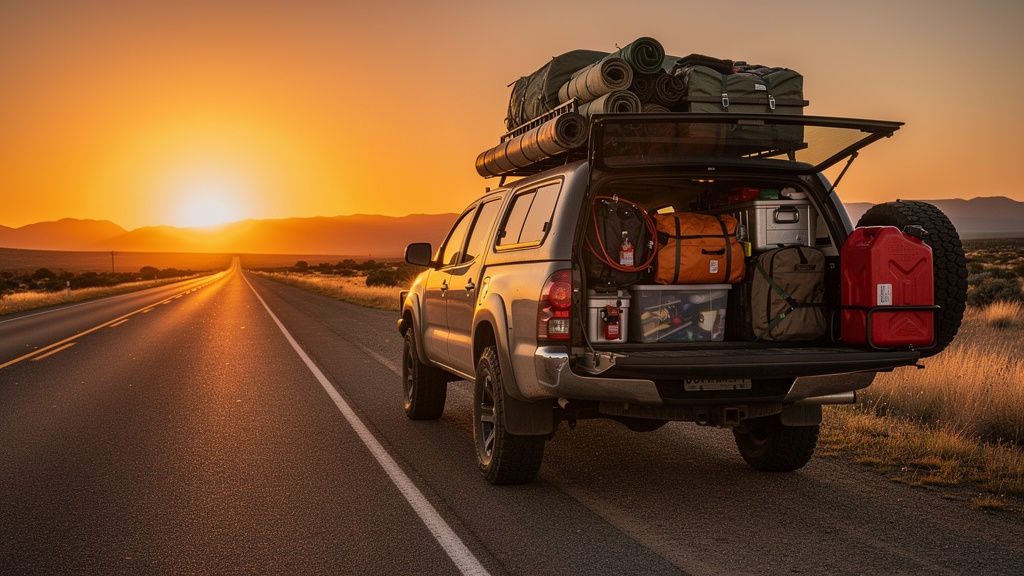
Most emergencies are best survived at home. But wildfires, floods, chemical spills, and civil unrest can make staying a worse option than leaving. When the decision to move comes, it comes fast — often with hours of warning per FEMA Ready.gov, sometimes minutes. The households that move efficiently have three things in place before the crisis: a reliable vehicle with fuel, pre-planned routes with alternatives, and the ability to move without a vehicle if roads fail.
→ Read First 30 Days (mobility chapter, 15 min) Vehicle readiness · Evacuation · Stay or go
Evacuation safety — common failure modes
Evacuation injuries and fatalities are predictable per NHTSA crash data and disaster-response research. Plan ahead of these patterns:
- Don't drive through flooded roadways — per NWS Turn Around Don't Drown: 6 in (15 cm) of moving water can knock down a person, 12 in (30 cm) can carry away a small car, 18–24 in (46–61 cm) can carry away SUVs and trucks. More than half of US flood deaths are vehicle occupants per NWS.
- Don't drive into smoke or active fire — per CAL FIRE / state forestry guidance: visibility collapses to feet in dense smoke, embers ignite vehicle interiors, and fire-perimeter-trapped vehicles can reach lethal temperatures within minutes. If you've waited until you see flames, you've waited too long.
- Don't sleep in a running vehicle with the windows closed — CO accumulates from exhaust leaks per CDC; carbon-monoxide deaths in vehicles peak during snowstorms when tailpipes get buried. Crack a downwind window 1 in (2.5 cm) and clear snow from the tailpipe.
- Don't store more fuel than safety codes permit — most jurisdictions limit gasoline storage to 25 gallons (95 L) residential per IFC 2024 + NFPA 30; never store gasoline indoors / attached garages / basements. Per NFPA: 10 gallons (38 L) of gasoline contains the explosive energy of about 14 sticks of dynamite.
- Pedestrian / bicycle evacuation injury — wear high-visibility clothing, plan routes with shoulder access, never assume drivers can see you in low light or smoke.
For active emergencies, follow official evacuation orders (NWS, FEMA IPAWS, state emergency management) rather than self-managed routing. The evacuation order routing accounts for road closures, fuel availability, and shelter capacity that you cannot assess in real time.
Where to start
Three audience-segmented entry paths matching the most common starting positions:
If you're brand-new (urban / suburban, daily driver as primary mobility):
- Adopt the half-tank rule today per FEMA Ready.gov — never let your fuel gauge drop below half. Costs nothing, guarantees 150–250 mi (240–400 km) of range 24/7.
- Build a vehicle emergency kit per vehicle maintenance — jump starter or cables, tire inflator, basic tools, first aid, 1 gal (3.8 L) water, food bars, blanket, paper map. ~$80–$150 USD assembled.
- Drive 3 evacuation routes out of your area using different road networks (interstate, state highway, back roads). Note chokepoints, fuel stops, bridge crossings. Drive each at least once a year per FEMA evacuation-planning guidance.
If you have basics covered (vehicle kit + half-tank done):
- Store 5–10 gal (19–38 L) of stabilized gasoline per fuel storage — approved containers, ventilated space away from house, IFC 2024 + NFPA 30 compliant. Adds 150–350 mi (240–560 km) of range beyond tank.
- Pre-pack a bug-out bag per bug-out.md and a get-home bag — 72-hour pack at home + workplace-to-home pack in vehicle.
- Establish the stay-or-go decision framework per bug-in.md vs. bug-out.md — write down your trigger conditions in advance so the decision is one-step during an event.
If you live in a setting with non-standard mobility constraints (apartment without car, dense urban, rural with livestock, disabled household member):
- Read urban bug-out without a vehicle — exit on foot or transit, around chokepoints, metro-friendly carry; dense-city residents face a fundamentally different evacuation puzzle.
- Read disabled access for adaptive load strategies and vehicle modifications; coordinate with community vulnerable-members and medical chronic-conditions for full evacuation coverage.
- For rural / livestock contexts: horses cover terrain vehicles and bicycles can't; small boats provide mobility when roads flood in waterway-rich areas.
Field note
The half-tank rule is the single easiest preparedness habit to adopt. Never let your fuel gauge drop below half. It costs nothing, changes no routine, and guarantees you have 150–250 miles (240–400 km) of range at all times — enough to clear most regional emergencies. The discipline is the entire skill; there is no second technique to learn. Adopt it today and you have meaningfully better mobility readiness tomorrow.
What this hub covers — and what it doesn't
This page routes to Survipedia mobility content spanning vehicle readiness through alternative transport. It covers:
- Vehicle readiness — selection, maintenance, vehicle kit, disabled access
- Fuel — storage, stabilization, rotation, container safety per NFPA 30 + IFC 2024
- Routes and navigation — evacuation planning, navigation without GPS, supply caches, urban-bug-out-without-vehicle
- Alternative transport — bicycles, foot travel, small boats, horses
- Stay-or-go decision — bug-in vs. bug-out, permanent relocation, vehicle and personal armor
It deliberately does not cover: commercial transportation (trucking, freight), aviation (private piloting, small-aircraft prep), boating beyond emergency-evacuation scale, equestrian sport, or detailed automotive repair beyond preparedness-relevant maintenance. The A8 "when to seek expert help" criterion is waived for this hub — mobility planning is reader-managed; active threat events route to Threats and follow official evacuation orders.
Vehicle readiness
Your daily driver is your primary mobility asset. A well-maintained vehicle with a full tank of gas is worth more than a purpose-built bug-out truck sitting on bald tires.
- Vehicle selection — 4WD capability, ground clearance, cargo space, fuel efficiency trade off; maintenance matters more than spec
- Vehicle maintenance — oil, tires, brakes, battery, coolant, belts; full vehicle emergency kit (jump starter, tire inflator, tools, first aid, 1 gal (3.8 L) water, food bars, blanket, paper map)
- Disabled access — adaptive load strategies + vehicle modifications for passengers with disabilities or medical equipment
Fuel
Gas stations need electricity to pump per DOE petroleum supply data — during extended power outages, stations close within 2–6 hours.
- Fuel storage — 10 gal (38 L) reserve of stabilized gasoline gives a typical sedan 250–350 mi (400–560 km) additional range; treated gasoline keeps 12–24 months; diesel keeps longer with biocide additive
Fuel storage safety
Store gasoline in approved containers only per NFPA 30 Flammable and Combustible Liquids Code — red for gasoline, yellow for diesel, blue for kerosene. UL-listed only. Keep containers in a ventilated space away from the house, never in a basement or attached garage per IFC 2024 + most local fire codes. 10 gallons (38 liters) of gasoline contains the explosive energy equivalent of about 14 sticks of dynamite per NFPA. Residential storage limit is usually 25 gal (95 L); above that requires commercial permit + flammable-storage cabinet.
Routes
- Evacuation plan — 3 routes using different road networks (interstate, state highway, back roads); drive each at least once a year per FEMA — bridges, chokepoints, fuel stops, terrain
- Navigation without GPS — cell towers and data networks fail under load during mass evacuations; paper road atlas in every vehicle; marked routes + rally points + caches
- Supply caches — pre-positioned supplies along evacuation routes; reduces vehicle load + provides redundancy if primary vehicle disabled
Timing determines whether you evacuate smoothly or sit in gridlock per NHTSA mass-evacuation studies. The window between "officials suggest leaving" and "roads are impassable" can be as short as 2–4 hours during a hurricane or wildfire. Pre-packed vehicle + pre-planned route means you make one decision — go — rather than spending critical time figuring out what to grab and which direction to drive.
Alternative transport
Roads fail. Bridges wash out. Debris blocks highways.
- Bicycles — 10–15 mph (16–24 km/h) on broken pavement; rack-mounted panniers carry 50–80 lb (23–36 kg); no fuel required; mountain or gravel bike + rack + panniers is affordable-to-moderate
- Foot travel — baseline mode that works when everything else doesn't; fit adult with 30–40 lb (14–18 kg) pack sustains 15–20 mi (24–32 km) per day on roads, less on rough terrain; broken-in boots + moisture-wicking socks prevent blisters
- Urban bug-out without a vehicle — dense-city evacuation: foot + transit + chokepoint avoidance + metro-friendly carry
- Small boats — canoes, kayaks, inflatables; mobility when roads flood in waterway-rich areas
- Horses — terrain that vehicles and bicycles can't cover; only relevant for rural properties with existing livestock infrastructure
The stay-or-go decision
The hardest mobility decision isn't how to move — it's whether to move at all.
- Bugging in — sheltering in place; right call for most emergencies; home has supplies + tools + shelter + community
- Bugging out — leaving with whatever fits in vehicle or on back; reserve for situations where staying threatens life
- Relocation — permanent move vs. temporary evacuation; declaring a location permanently untenable; choosing and establishing a new base
- Vehicle and personal armor — high-risk movement through contested areas; realistic protection options and tradeoffs
The decision framework is simple: leave if staying will kill you (fire, flood, chemical plume, structural collapse, hostile takeover). Stay for everything else. If the answer is ambiguous, leave early — the cost of an unnecessary evacuation is a tank of gas and a night in a motel. The cost of leaving too late can be your life. Households with vulnerable members (elderly, infants, medical-device-dependent) should lower the threshold for early evacuation.
Common questions
Do I need a 4WD vehicle for evacuation? No, unless your routes include unmaintained terrain. Most US evacuations happen on paved roads where AWD or 2WD with good tires perform identically. 4WD adds capability for off-road bypass routes and snow / mud / loose terrain — useful in specific scenarios but not universally necessary.
How much fuel storage is reasonable for a household? 5–10 gal (19–38 L) stabilized + half-tank discipline covers most regional events. Above 25 gal (95 L) typically requires commercial permits + flammable-storage cabinet per NFPA 30 + state fire codes. The risk of fire from improper storage rises faster than the benefit per additional gallon stored.
Should I cache supplies along my evacuation route? Depends on route distance and terrain. For short evacuation distances (<200 mi (320 km)) and well-developed routes, caches are unnecessary — your vehicle carries enough. For longer evacuations through remote terrain (rural homesteaders evacuating to a different region), 1–2 caches at trusted intermediate locations can reduce vehicle load and provide redundancy. See caches.md.
Is leaving on foot realistic? Yes for short distances and for evacuating a workplace to a home — that's what a get-home bag is for. Foot evacuation over multi-day distances (>50 mi (80 km)) is realistic only for fit adults with practiced training and is rarely the optimal strategy when any vehicle alternative exists. Most "bug-out on foot" planning over-emphasizes a low-probability scenario.
Your single next step: complete the First 30 Days mobility chapter — it sequences half-tank rule adoption, vehicle-kit assembly, and 3-route evacuation drive into a 30-day plan that builds on this hub's three-pillar framework.