Rocket stoves
A rocket stove uses one-tenth the fuel of an open fire to cook the same meal. That ratio — documented across comparative field studies on biomass combustion — makes it one of the most practical upgrades for any off-grid or emergency cooking setup. The efficiency comes entirely from geometry, not electronics: a J-shaped combustion chamber that draws a focused, hot column of air through a tiny burn zone before directing exhaust through a heat exchanger.
Before you start Skills: Basic masonry stacking; ability to safely manage a small open fire. No prior stove-building experience required for a dry-stacked version — see fire cooking for fire management fundamentals. Materials: 16–20 solid firebricks (refractory-rated, not standard hollow clay bricks); optional fireclay-sand mortar (3:1 ratio) for a permanent build; a flat compacted-earth or concrete base; perlite or vermiculite for riser insulation; a metal grate or flat cooking plate. Conditions: Build outdoors on level, non-combustible ground; maintain at least 10 ft (3 m) clearance from any structure or combustible material. Keep a bucket of water or sand at hand during the first test fire. Time: Dry-stacked cooking stove — 1–2 hours to assemble and cure with a test fire. Mortared permanent stove — 2–4 hours to build, plus 24–48 hours drying before first use. Full rocket mass heater — multi-day project.
Educational use only
This page is for educational purposes only. Hands-on skills should be learned and practiced under qualified supervision before relying on them in emergencies. Use this information at your own risk.
How rocket combustion works
The rocket stove effect is the product of three design elements working together:
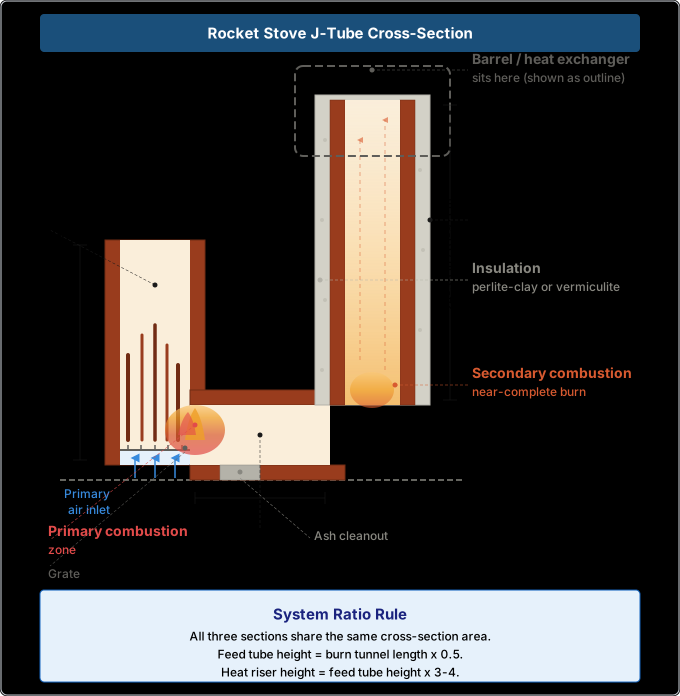
1. The insulated J-tube core. The combustion chamber is an L-shaped (or J-shaped) channel. Fuel feeds horizontally into the bottom of the "J." Air enters below and around the fuel. The fuel burns at the corner — the junction of the horizontal feed tube and the vertical heat riser. This corner is the hot zone; keeping it small and insulated concentrates heat rather than dissipating it.
2. The heat riser. The vertical column above the burn corner is the heat riser. Hot combustion gases rise rapidly through this column due to the temperature differential (the "rocket" effect — a strong convective draft without a blower or fan). The riser must be insulated to prevent heat loss and maintain the column temperature that drives draft.
3. Insulation on all fire-contact surfaces. Refractory or insulating materials at the combustion zone keep internal temperatures above 1,400–1,800°F (760–982°C). At these temperatures, secondary combustion of volatile gases occurs — the smoke burns before it exits. This is why a properly operating rocket stove produces nearly invisible exhaust: the combustion is nearly complete.
Dimensional ratios (J-tube design):
The internal cross-sectional area of the feed tube, burn tunnel, and heat riser must be consistent throughout the core. Reducing the cross-section at any point restricts the draft.
| Component | Recommended dimension (standard 6-inch / 15 cm system) | Notes |
|---|---|---|
| Feed tube internal width | 6 in × 6 in (15 cm × 15 cm) | Square cross-section; can be round |
| Burn tunnel length | 12–16 in (30–41 cm) | Keep as short as practical |
| Heat riser height | 24–36 in (61–91 cm) for cooking; 36–48 in (91–122 cm) for mass heaters | Taller = stronger draft |
| Riser height to burn tunnel ratio | 2:1 to 3:1 | Critical — too short = weak draft |
| Wall thickness of riser | 1–2 in (2.5–5 cm) insulating material | Perlite-clay or refractory brick |
A 6-inch (15 cm) system handles most cooking applications. A 4-inch (10 cm) system works for boiling water and light cooking loads. An 8-inch (20 cm) system is appropriate for larger mass heater applications.
Building an outdoor cooking rocket stove
The simplest outdoor cooking stove can be built from common firebricks with no mortar — useful for testing the concept, field expedient construction, and portability.
Materials for a dry-stacked firebrick cooking stove:
- 16–20 standard firebricks (refractory rated; not standard red clay bricks — ordinary bricks can crack under repeated heating cycles)
- A flat work surface or compacted-earth base
- Optional: fireclay/sand mortar (3 parts sand to 1 part fireclay) for a permanent stacked version
Firebricks cost around $1.50–3.00 USD each at masonry suppliers or big-box building supply stores. For a basic 16-brick stove, the material cost is inexpensive.
Basic dry-stack assembly:
- Set two rows of two bricks flat on the ground, parallel, spaced 6 inches (15 cm) apart. This forms the base on either side of the feed mouth.
- Place one brick across the top of the back end of these two rows. This is the combustion floor of the burn tunnel.
- Stack two bricks on each side to form the side walls of the vertical heat riser, alternating brick courses for stability.
- Bridge the top of the riser with two bricks set parallel, leaving a 3–4 inch (7.5–10 cm) gap in the center for the cooking surface. This gap focuses heat on the cookware base.
- Leave the front of the feed tube open for fuel loading and airflow.
Test with a small fire before cooking on it. Smoke rising from the feed tube indicates poor draft — the riser may need to be taller or the fire needs to develop heat before the draft establishes itself.
Permanent mortared version: Use the same layout with fireclay-sand mortar (3:1 sand to fireclay, consistency of thick peanut butter). Allow 24–48 hours drying time, then cure with three progressively larger fires before heavy use. A permanent mortared stove on a concrete or stone base costs around $30–80 USD in materials and lasts decades with occasional maintenance.
Field note
A rocket stove performs best with pencil-diameter fuel: dry sticks 6–12 inches (15–30 cm) long, slightly smaller in diameter than the feed tube. Small-diameter fuel lights faster, burns cleaner, and is easier to source from pruning and brush clearing than large rounds. You are not operating a wood stove — do not feed large splits or rounds. The burn zone should glow orange to yellow; red or smoldering indicates wet fuel or insufficient air.
Field note
Feed rate matters as much as wood size. Push fuel in steadily as the front end burns down — not in one large push that floods the firebox and chills the combustion zone. The burn corner should stay orange-yellow; if it drops to red or dark orange after you load fuel, you fed too much at once. Let the flame re-establish before adding the next stick. Once you get the rhythm right, a properly built rocket stove is almost hands-free — it wants small sticks fed every two to three minutes, not a load dropped in every ten.
Insulation materials
The heat riser insulation is the most critical build decision. Higher insulation value = higher riser temperature = stronger draft and more complete combustion.
| Material | Insulating value | Notes |
|---|---|---|
| Perlite + clay slip (80:20 by volume) | Good | Inexpensive, widely available; mix perlite into fireclay slip until it clumps but breaks apart easily; pack around heat riser |
| Vermiculite + clay slip (80:20) | Good | Similar to perlite; slightly higher density |
| Lightweight refractory castable | Excellent | Pourable; sets hard; rated to 2,000–2,800°F (1,093–1,538°C); moderate investment; available at masonry suppliers |
| Dense firebrick | Fair | Stores heat well (thermal mass benefit) but loses more heat to environment |
| Standard red clay brick | Poor | Not refractory; cracks under thermal cycling; use only as outer structural shell |
| Ceramic fiber blanket | Excellent | Highest insulation value; rated to 2,300°F+ (1,260°C+); expensive; cuts with scissors; good for wrapping the riser in advanced builds |
Do not use standard concrete blocks or hollow red clay bricks as combustion-zone materials
Standard concrete (CMU) blocks and hollow red clay bricks can crack or explode when heated rapidly by rocket stove temperatures. Explosions from trapped moisture and thermal stress have injured builders. Use only solid firebricks or poured refractory in any surface that contacts the fire. Standard bricks may be used for outer structural walls more than 4 inches (10 cm) from direct flame contact.
Rocket mass heater overview
A rocket mass heater (RMH) extends the rocket stove principle by routing hot exhaust through a large thermal mass before venting outside. The thermal mass — typically a cob, brick, or stone bench or raised platform — absorbs the heat over 2–4 hours of burning and radiates it slowly for 12–24 hours afterward.
Efficiency comparison:
| System | Fuel consumption for equivalent room heat | Notes |
|---|---|---|
| Open fireplace | 100% (baseline) | Most heat exits up chimney |
| Standard non-certified wood stove | 50–55% reduction | Moderate efficiency |
| EPA-certified wood stove | 65–80% reduction vs. open fire | Modern non-catalytic |
| Rocket mass heater | 80–90% reduction vs. open fire | Heat stored in mass; radiated over hours |
A well-built RMH can heat a small to medium home with 2–4 lbs (0.9–1.8 kg) of small-diameter wood per hour during the burn period. The mass then radiates without further fuel for most of the day.
RMH components:
- J-tube or batch-box core: The combustion chamber — same geometry principles as the outdoor cooking stove, scaled up to 6–8 inch (15–20 cm) diameter systems
- Heat riser: Insulated vertical column, typically 36–48 inches (91–122 cm) tall, inside a drum or bell
- Barrel or bell: A 55-gallon (208 L) steel drum inverted over the heat riser is the most common design; it captures the initial heat before exhaust enters the mass run
- Thermal mass run: The horizontal flue run through the bench or floor — typically 20–40 feet (6–12 m) of 6–8 inch (15–20 cm) pipe packed in cob or covered with thermal mass materials
- Exhaust exit: Exits through the wall near floor level; the exhaust is much cooler than a conventional chimney (100–200°F (38–93°C)) which makes rooftop chimney height less critical
RMH cost range: A DIY build using salvaged drums and site materials runs around $50–200 USD in purchased materials. A build using new firebrick, purchased drum, and quality insulation runs $300–500 USD. Professionally built or commercially sourced RMH systems cost significantly more.
Codes, permits, and indoor installations
Outdoor rocket stoves and cooking platforms: Generally no permit required. Treat as an outdoor fire structure and maintain clearances from buildings (10 feet (3 m) minimum) and combustible materials.
Indoor rocket mass heaters: Building permits are required in most jurisdictions for any permanently installed combustion appliance with a flue penetration. RMH units may be classified as masonry heaters under ASTM E 1602 in some areas, which provides a code pathway — but the classification requires documentation and inspection. Contact your local building department before breaking ground on an indoor RMH.
Key differences from a conventional wood stove that affect code compliance: - Near-floor-level exhaust exit (low exhaust temperature) - Long horizontal flue runs through thermal mass (unusual flue configuration) - No certified appliance listing (most DIY RMH builds are not UL listed)
Operating an un-permitted indoor combustion appliance may void homeowner's insurance and create liability. For renters and anyone in an HOA or urban setting, the outdoor cooking rocket stove is the accessible entry point. The fire cooking page covers cooking techniques applicable to rocket stove platforms.
Maintenance
- Remove ash from the burn tunnel weekly during active use; accumulated ash restricts the feed opening and draft
- Inspect mortar joints of permanent stoves at the start of each season; re-point any cracked or missing mortar with fireclay mortar before using
- Check riser insulation integrity annually — perlite-clay mix can settle or crack; patch with the same mix if gaps appear
- Inspect the barrel or bell of an RMH for rust and corrosion annually; a rusted barrel can fail and release hot gases into the room
The rocket stove principle scales from a portable cooking unit to a whole-room mass heater. For the larger context of wood fuel supply, see firewood. For conventional wood stove selection and installation, see wood heat. For cooking directly over open fire and coals, the fire cooking page covers coal management, heat zone testing, and dutch oven technique that applies whether your heat source is a rocket stove or a standard campfire. If you want to reduce how much fuel you need to acquire in the first place, insulation and heating improvements cut the underlying demand before you light the first fire.
Practical checklist
- Select system size: 4-inch (10 cm) for light cooking, 6-inch (15 cm) for general cooking, 8-inch (20 cm) for mass heater applications
- Use only solid firebricks or refractory materials in any surface that contacts the fire
- Maintain consistent cross-sectional area throughout feed tube, burn tunnel, and heat riser
- Insulate the heat riser with perlite-clay mix, vermiculite-clay, or refractory castable
- Make the heat riser at least 2× the length of the burn tunnel
- Test draft with a small twig fire before loading a full cooking fire
- Use dry, pencil-diameter fuel; never wet wood or large splits
- Check local permits before any permanent indoor installation
- Inspect and re-point mortar joints at the start of each season