Boiling water for safety
Educational use only
Food safety procedures carry risk if performed incorrectly. This page is for educational purposes only. Follow current guidelines from official food safety authorities. Use this information at your own risk.
Boiling is the oldest, most universally reliable method for making water biologically safe to drink. Unlike chemical treatments or filters, it requires no consumable supplies beyond fuel, no manufacturer's guarantees, and no expertise — just heat, time, and correct technique. When you follow the CDC and WHO procedure precisely, a rolling boil kills every pathogen capable of making you sick: bacteria like E. coli and Salmonella, protozoa like Giardia and Cryptosporidium, and viruses like Hepatitis A and norovirus.
What boiling does not do: it cannot remove heavy metals, nitrates, pesticides, or chemical contamination. If your source is a flooded agricultural field or a well near industrial activity, boiling alone is insufficient — see Chemical Treatment and Distillation for chemical and metal removal. For field-collected surface water and most emergency scenarios, however, boiling is your most dependable first line of defense.
Before you start - Skills: Source-water threat assessment — identify whether the source risk is biological (typical surface water) or chemical/heavy-metal (agricultural runoff, industrial sites, flooding). Chemical contamination is not addressed by boiling; see Chemical Treatment and Distillation first if that risk is present. - Materials: Heat-safe container rated for boiling (metal pot, stainless bottle — not thin plastic). Heat source with sufficient fuel: wood fire, propane stove, alcohol burner, or solar cooker. Timer (phone, watch, or count). Separate clean covered storage container, pre-rinsed with boiled or bleach-diluted water. - Conditions: Pre-filter turbid water before boiling — suspended particles can shield pathogens from lethal heat (see pre-treatment procedure below). Know your elevation: above 6,500 ft (2,000 m) the boil time extends to 3 minutes. - Time: Pre-filtering 5–10 min for turbid water. Active boil 1 min (sea level to 6,500 ft (2,000 m)) or 3 min (above 6,500 ft (2,000 m)). Cooling before consumption 30–45 min for 1 qt (1 L) at room temperature.
Before you boil: pre-treatment for turbid water
Turbidity — visible cloudiness — is the single most common reason boiling fails. Suspended particles create physical shields around pathogens, protecting them from lethal heat even during a full rolling boil. The CDC guideline is explicit: turbid water must be filtered before boiling.
Pre-filtering procedure:
- Pour water through a clean cloth, coffee filter, or bandana into your boiling container. Multiple layers of tightly-woven cotton are more effective than a single loose layer.
- If you have a commercial sediment filter or a ceramic filter rated at 0.2 microns, pass the water through it. See Filtration for options.
- Let the filtered water sit undisturbed for 30 minutes so fine particles settle, then ladle from the top — leaving the last inch (2.5 cm) of settled silt in the container.
- If water is still visibly cloudy after these steps, repeat. Do not proceed to boiling with turbid water.
Turbid water requires pre-filtering
Particles as small as 1 micron can shield Cryptosporidium oocysts and Giardia cysts from heat penetration. A glass that looks "not too bad" can still carry enough suspended solids to protect pathogens through a boil. When in doubt, filter first.
How long do I boil water to make it safe?
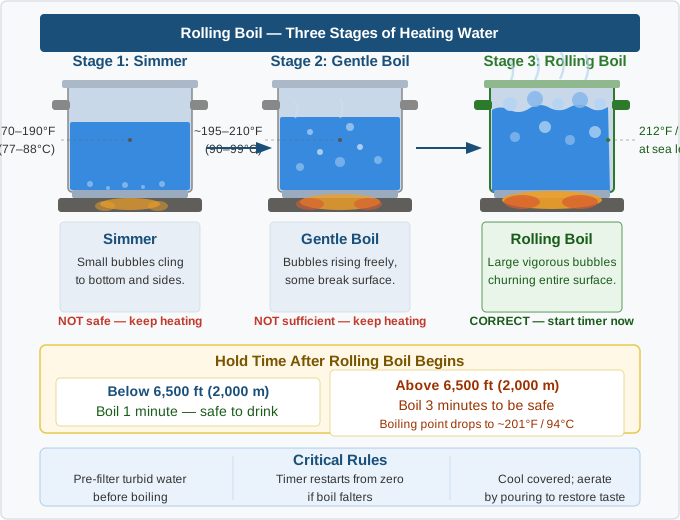
Boil water for 1 minute at elevations below 6,500 ft (2,000 m), or 3 minutes above that elevation — always from a full rolling boil, not a simmer.
A rolling boil means large, vigorous bubbles that continuously break the surface of the water and cannot be stirred down. This is distinct from a simmer (small bubbles clinging to the bottom), a steady boil (intermittent bubbles), or the early heating phase where steam begins to form. The water must look like it is actively churning.
This is not an arbitrary standard. At sea level, water reaches 212°F (100°C) at a rolling boil. At that temperature, even the most heat-resistant pathogens are killed within seconds. The CDC recommends holding the boil for one full minute as a safety margin against brief temperature dips.
Altitude adjustment — critical:
Water boils at lower temperatures at altitude because atmospheric pressure decreases. At 6,500 ft (2,000 m) above sea level, water boils at approximately 201.5°F (94°C) — low enough that some pathogens require additional exposure time.
| Elevation | Boiling Point | Required Hold Time |
|---|---|---|
| Sea level to 6,500 ft (0–2,000 m) | 212–201°F (100–94°C) | 1 minute |
| Above 6,500 ft (>2,000 m) | Below 201°F (<94°C) | 3 minutes |
If you are camping in the Rockies, Sierra Nevada, Andes, or any location above 6,500 ft (2,000 m), set a timer for 3 minutes from the moment the rolling boil begins — not when the pot starts steaming.
Recognizing a true rolling boil
Knowing when you have actually reached a rolling boil is the most consequential skill on this page — and the most commonly misjudged. On an unfamiliar heat source (camp stove, rocket stove, wood-fired grate, induction plate powered by a portable power station), your kitchen-stove intuition may not transfer.
What a rolling boil looks like: Large, vigorous bubbles erupt continuously from the bottom and break the surface across the entire pot. The water churns. You cannot stop the bubbling by stirring. The surface looks turbulent, not placid.
What it does NOT look like:
- Simmering — small bubbles clinging to the bottom or walls, rising slowly. Temperature is typically 185–205°F (85–96°C). Pathogens are being stressed but not reliably killed.
- Gentle boil — intermittent bubbles surfacing in one spot. Often indicates a localized hot spot, not uniform temperature throughout the pot.
- Steaming — visible steam rising from the surface. Water releases steam at roughly 175°F (80°C), well below the pasteurization threshold for viruses (~158°F (70°C) is the pathogen inactivation floor, but requires extended exposure — not a safe stopping point). Steam with no visible surface turbulence means you are not done.
The practical test: if you can see a calm patch on the surface, it is not a rolling boil. Keep heating until there is no calm patch.
Field note
On wood fires and rocket stoves, heat output fluctuates with airflow. Start your timer only when you have a sustained rolling boil — not during the first moment of heavy bubbling, which may drop off as fuel shifts. If the boil breaks during the timed period, bring it back to full boil and restart the timer from zero.
Fuel efficiency by stove type
The amount of fuel required to bring 1 quart (1 L) of water from cold to a 1-minute rolling boil varies widely by heat source. These rough field benchmarks help with planning fuel reserves:
| Heat source | Approximate fuel per quart (1 L) boiled | Notes |
|---|---|---|
| Propane camp stove (high output) | 0.6–0.8 oz (17–23 g) propane | Most fuel-predictable for sizing canisters |
| Alcohol stove (DIY or Trangia-style) | 0.7–1.0 oz (20–28 g) denatured alcohol | Slow but reliable; performance drops below 32°F (0°C) |
| Wood rocket stove | 12–18 oz (340–510 g) dry hardwood twigs | Free fuel; longer ignition cycle |
| Open campfire | 24–40 oz (680–1,130 g) dry wood | Most wasteful; useful only when fuel is abundant |
| Solid-fuel tablet (Esbit/hexamine) | 1 tablet (~14 g) per 1 quart (1 L) | Compact for backup kits; expensive per liter |
Cover the pot with a lid in every case — uncovered boiling adds 30% to the fuel requirement. In cold or windy conditions, a windscreen around the stove cuts fuel use by another 20–40%. For household stockpiling, plan on a 14-day boiling supply at roughly 2 quarts (2 L) per person per day for drinking and cooking, plus a 50% reserve for cleanup, hygiene, and reheating.
Step-by-step boiling procedure
Materials needed
- Clean pot or container with a lid (metal preferred; a lid retains heat and reduces evaporation)
- Heat source: camp stove, wood fire, gas burner
- Timer
- Clean storage container with a tight lid
- Cloth or commercial filter if water source is turbid
Procedure
Step 1 — Pre-filter if needed. If water is visibly cloudy or collected from a surface source such as a stream or pond, filter it as described above. Clear water from a known-good well or sealed municipal source may skip this step.
Step 2 — Fill and cover. Place the covered pot on the heat source. A lid speeds heating significantly — a covered pot reaches a rolling boil roughly 30% faster than an uncovered one, saving fuel. A 2-quart (2 L) pot on a gas camp stove typically takes 8–12 minutes to reach a full rolling boil starting from cold water.
Step 3 — Identify the rolling boil. Bring to a rolling boil — large continuous bubbles churning across the entire pot surface, not just edge nucleation. A few lazy bubbles are not enough. If you can still see a calm patch anywhere on the surface, keep heating.
Step 4 — Start the timer. Once you see a true rolling boil, begin timing: 1 min rolling boil at ≤6,500 ft (2,000 m) elevation; 3 min rolling boil at >6,500 ft / >2,000 m. If the boil falters during the timed period, bring it back to a full rolling boil before restarting the timer from zero.
Step 5 — Remove from heat. Turn off the stove or move the pot away from the fire. Leave the lid on to prevent recontamination while the water cools.
Step 6 — Cool naturally. Do not add ice (recontamination risk). Do not refrigerate immediately in an open container. Cover and allow to cool at room temperature. A 1-quart (1 L) container takes approximately 30–45 minutes to reach a drinkable temperature.
Step 7 — Aerate to improve taste. Boiled water tastes flat because dissolved oxygen is driven off by heat. To restore normal taste, pour the cooled water back and forth between two clean containers 5–10 times, or stir vigorously for 30 seconds. This step has a real effect on palatability and matters for morale during extended emergencies.
Step 8 — Store in a clean, covered container. Transfer to sanitized bottles or jugs. Label with the date and time of boiling. Use within 24–48 hours, or within 6 hours if stored uncovered at room temperature in warm weather. See Containers for storage vessel options.
Field note
Use your pot lid as a pre-filter frame. Drape a bandana or cotton shirt section over the pot opening, secure it loosely, and pour turbid water through it directly into the pot. This takes about 90 seconds and removes most macroparticles without a separate filter vessel. In cold conditions, start heating immediately after filtering — the pre-filtered water is still far from safe.
Fuel requirements
Boiling is not free. Fuel consumption matters for planning multi-day scenarios or long-term grid-down situations. Approximate figures for raising 1 quart (1 L) from ambient temperature to a rolling boil:
| Heat Source | Fuel per Liter Boiled |
|---|---|
| Wood fire (seasoned hardwood) | ~3 oz (85 g) dry wood |
| White gas camp stove | ~0.3 fl oz / 9 mL |
| Propane/isobutane canister | ~0.25 oz (7 g) gas |
| Kerosene stove | ~0.3 fl oz / 9 mL |
| Natural gas (home range) | ~0.05 cu ft / 1.4 L gas |
A family of four drinking the recommended 2 quarts (2 L) per person per day — not including cooking water — needs 8 quarts (8 L) boiled daily. On a wood fire, that requires roughly 24 oz (680 g) of dry wood per day just for drinking water. Over two weeks, that is approximately 21 lb (9.5 kg) of firewood. Factor this into your fuel storage planning.
Wood fire efficiency varies dramatically with design. A rocket stove or Dakota fire pit can reduce fuel consumption by 30–50% compared to an open campfire. A windscreen around a camp stove reduces fuel use by 15–25% in outdoor conditions.
What boiling does not fix
Understanding boiling's limits prevents dangerous overconfidence:
- Chemical contamination: Boiling does not remove chlorine, chloramine, pesticides, herbicides, industrial solvents, or petroleum products. Some volatile organic compounds actually concentrate in the water as pure H₂O evaporates off.
- Heavy metals and nitrates: Lead, arsenic, nitrates, and fluoride are not affected by boiling. See Distillation for contamination of this type.
- Salinity: Boiling does not desalinate water. Seawater boiled and cooled is still seawater.
- Radioactive contamination: Boiling does not address radioactive isotopes dissolved in water.
- Taste and odor from organics: While boiling kills biological threats, some organic compounds that cause taste and odor problems survive. Post-boil filtration through activated carbon addresses these residual issues — see Filtration.
Recontamination prevention
Boiled water is vulnerable to recontamination the moment it contacts an unclean surface. Protect the boil's safety by:
- Using only containers that have been rinsed with boiled water, or with a dilute bleach solution (1 tsp bleach per quart / 1 tsp per liter, 30-second contact time, then rinse with boiled water)
- Keeping containers covered at all times when not actively pouring
- Never pouring boiled water back into the original, potentially contaminated source container
- Washing hands before handling boiled water containers
- Labeling containers clearly so boiled and unboiled water cannot be confused
If you suspect a stored container of boiled water has been contaminated, reboil the contents or treat with chemical disinfection before drinking. See Chemical Treatment for dosing guidance.
Integration with your water system
In a multi-method purification system, boiling pairs effectively with:
- Pre-filtration (ceramic or hollow-fiber filter): Removes sediment and most biological threats before boiling, reducing required boil time and improving output clarity
- Chemical treatment: Use bleach or iodine as a backup when fuel is unavailable; boiling remains the gold standard when fuel is accessible
- Water testing: Testing builds confidence about your source and identifies chemical threats that boiling alone cannot address
For dehydration recognition and treatment if safe water was delayed, see Medical — Dehydration. For waterborne illness that develops despite precautions, see Medical — Infection.
Failure modes
Even with correct technique, boiling fails when one of these five mistakes is made. Each is recognizable in the field and correctable before you drink.
Boil never reached — Recognition: bubbles forming only on the pot bottom or edges, no rolling churn across the entire surface; water looks calm between edge bubbles. Remedy: continue heating until large, continuous, churning bubbles break the surface across the whole pot. At sea level this occurs at ~212°F (100°C). A simmer at ~200°F (93°C) with small, slow-rising bubbles is NOT adequate — pathogens are stressed but not reliably killed.
Field note
A rolling boil means the whole pot churns, not just the edges. Edge nucleation — bubbles forming and releasing along the pot wall — looks convincing but indicates localized hot spots, not uniform lethal temperature. Start your timer only when the entire surface is turbulent.
Hold time too short at altitude — Recognition: you are above 6,500 ft (2,000 m) (Rockies, Sierra Nevada, Andes, high plains) and only held the boil for 1 minute. Remedy: hold a rolling boil for at least 3 minutes at elevations above 6,500 ft (2,000 m) per CDC and WHO guidance. Boiling point drops approximately 1°F per 500 ft (1°C) per 285 m of elevation — at 10,000 ft (3,050 m) water boils at roughly 194°F (90°C), which is adequate for bacteria but requires longer exposure time for spore-forming organisms. The 3-minute hold compensates for that lower thermal kill rate. At sea level to 6,500 ft (2,000 m), 1 minute is sufficient per CDC Emergency Disinfection guidance.
Re-contamination after boil — Recognition: pouring boiled water back into the same vessel that held raw water; touching boiled water with an un-sanitized ladle or cup; removing the lid in a dusty or smoky environment. Remedy: before transferring boiled water, rinse the storage container with a small amount of boiling water — swirl to coat all interior surfaces, then discard the rinse. Never re-dip an un-sanitized utensil. Keep the lid on during cooling. See Filtration and Chemical Treatment for backup disinfection steps if recontamination is suspected.
Chemical contamination assumed killed — Recognition: water source located near agricultural runoff, a mine drainage channel, a fuel spill, or industrial discharge; assumption that boiling clears the hazard. Remedy: boiling kills pathogens but does not remove heavy metals (lead, arsenic), pesticides, petroleum hydrocarbons, nitrates, or dissolved salts. Some volatile organics actually concentrate as water evaporates during a boil. For known or suspected chemical contamination, use distillation, a certified carbon-block filter combined with boiling, or locate an alternative source. See Chemical Treatment for source-assessment criteria.
Scalding from insufficient cool time — Recognition: steam still visible rising from the container; water poured directly from pot to mouth. Remedy: cool to a safe drinking temperature before consumption. Transfer to a wide-mouthed vessel to speed cooling. A temperature of ≤140°F (60°C) is comfortable for cautious sipping; ≤120°F (49°C) is fully safe for skin contact. A 1-quart (1 L) container at room temperature takes approximately 30–45 minutes to reach drinking temperature from a full boil — do not rush this step under stress.
Field checklist
- Water source assessed — surface water or unknown sources flagged for pre-filtering
- Pre-filtering complete if turbidity present
- Rolling boil achieved and confirmed (not just simmering)
- Timer set: 1 minute under 6,500 ft / 3 minutes above 6,500 ft (2,000 m)
- Boil maintained continuously through timer period
- Water cooled in covered container, not refrigerated open
- Aerated by pouring between two containers before drinking
- Stored in labeled, sanitized, covered vessel
- Fuel inventory updated after each boiling session