Perimeter security
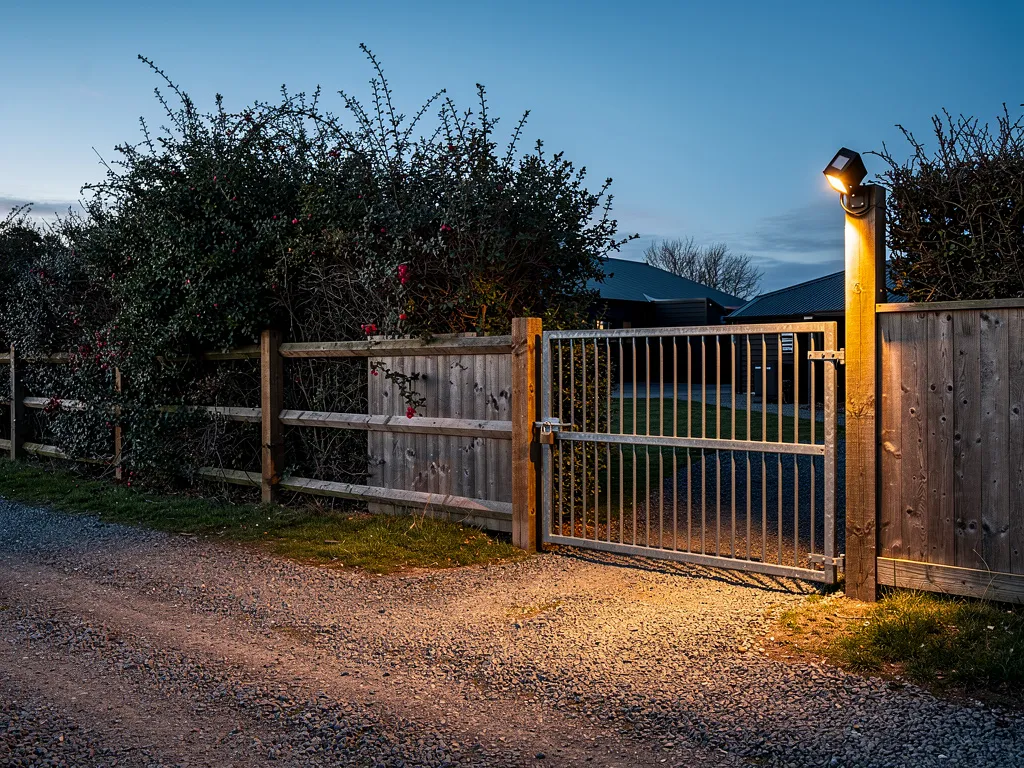
Opportunistic crime follows the path of least resistance. A study of convicted burglars found that the majority selected targets based on visible vulnerability — poor lighting, concealed entry points, no signs of occupancy. Your perimeter does not need to be impassable. It needs to be harder, louder, and more visible than the house next door. Detection, delay, and response form the three-layer logic behind every decision below.
Educational use only
This page is for educational purposes only. Security hardware grades, sensor specifications, and barrier recommendations reflect published industry standards and documented research. Actual results depend on your property layout, local conditions, and threat environment. Use this information at your own risk and adapt every recommendation to your specific situation.
Action block
Do this first: Walk your entire property line at dusk with a flashlight — at every point where a gap in the fence, a blind side of the garage, or shrubs blocking sightlines from the street would let someone approach unseen, mark it with a flag or piece of tape (20 min) Time required: Active: 20 min for the discovery walk; 2–4 hr for initial hardware installation (lights, sensors); recurrence: 15 min weekly maintenance check Cost range: Inexpensive for driveway sensors and solar motion lights; affordable for gate hardware upgrades; moderate investment for chain-link or wrought iron fencing; significant investment for concrete block wall or full perimeter fence replacement Skill level: Beginner for lighting, sensor placement, and gate hardware; intermediate for fence installation; advanced for concrete or masonry barrier work Tools and supplies: Tools: drill, screwdriver, wire strippers, post-hole digger (fencing). Supplies: motion-activated LED floodlights (1,500–2,500 lm), driveway PIR sensor with wireless receiver, hardened-shackle padlock, carriage bolts. Infrastructure: fence line matched to property layout, gate with through-bolted hinges. Safety warnings: See Educational use only above — adapt every recommendation to your local codes, threat environment, and property layout before acting
The three-layer framework
Each layer serves a distinct function, and each layer buys time for the next.
Detection is the outermost ring. Motion-activated lighting, driveway alarms, and perimeter sensors tell you something is approaching before it reaches your walls. Without this layer, your first indication of a problem is often a breach already in progress.
Delay is the middle layer. Fencing, natural barriers, locked gates, and hardened entry points slow an intruder and force them to make noise, spend time, or bring tools they may not have. Every additional 30 seconds of delay is time for you to wake up, call for help, and position yourself.
Response is the inner layer — what you do once you know an incursion is underway. This connects directly to your safe room plan and your household emergency protocol.
Plan your improvements in this order. Buying an expensive fence before you understand where your soft entry points are is the single most common perimeter mistake.

Fencing by material and resistance
Not all fences provide equal security. The material determines both forced-entry resistance and how much visibility — or concealment — you give an intruder.
Wood privacy fencing provides concealment but limited resistance. A standard 6-foot (1.8 m) cedar privacy fence can be forced, pried, or kicked through with basic tools. Its primary value is sight obstruction, which is a double-edged advantage: it hides your yard from casual observation but also hides an intruder once inside the fence line.
Chain-link is transparent, so it denies concealment. Security-grade chain-link uses 9-gauge wire on 1.75-inch (44 mm) mesh with top rail and bottom rail. It can be cut with bolt cutters in under a minute unless you add deterrents. Barbed wire or razor ribbon across the top rail — typically 12 to 18 inches (30 to 46 cm) of overhang — raises the time and visibility cost substantially. This is a mid-range investment for materials alone; professional installation with posts set in concrete adds to the cost.
Wrought iron and steel tube fencing is the strongest common residential option. The vertical pickets cannot be pried apart without specialized tools, and climbing is difficult and slow. A 6-foot (1.8 m) wrought iron fence with anti-climb spear tops is a significant deterrent to everyone except a patient, equipped actor. This is a significant investment — typically several times the cost of wood or chain-link at equivalent height and linear footage.
Concrete block walls are the highest-resistance option, used in high-crime or high-value applications. A standard 8-inch (200 mm) reinforced block wall is extremely difficult to breach and impossible to see through from the street. The tradeoff: you can't see out either. Ground-floor windows overlooking the perimeter provide observation without leaving gaps in the wall.
Natural barriers
Dense thorny plantings provide resistance that fencing alone cannot — they're uncomfortable to push through, loud when disturbed at night, and essentially free once established.
Hawthorn (Crataegus species) is one of the most effective security hedges. Mature specimens have thorns up to 2 inches (50 mm) long on branches dense enough to stop a person. Hawthorn grows to 15 to 30 feet (4.5 to 9 m) if left unpruned, but can be maintained as a 4 to 6-foot (1.2 to 1.8 m) hedge with annual trimming. It is deciduous — it loses some deterrent value in winter.
Pyracantha (firethorn) is evergreen, which means year-round coverage. Some species grow 6 to 12 feet (1.8 to 3.7 m) tall with dense, needle-sharp thorns. When trained along a fence line, it effectively doubles the barrier. It also produces berries that attract birds, so expect occasional traffic from wildlife.
Barberry (Berberis species) grows in a thick, thorny mass 7 to 8 feet (2.1 to 2.4 m) tall and wide. Wintergreen barberry has three-parted spines that are painful enough to stop casual crossing. It can be kept lower with pruning and tolerates poor soil.
Plant natural barriers along fence lines at windows, gates, and corner approaches — the natural choke points an intruder is most likely to use.
Field note
Combine chain-link with a trained pyracantha hedge planted 18 inches (46 cm) inside the fence line. The chain-link blocks casual crossing; the thorns deter anyone who gets through it. The combined cost is significantly less than wrought iron or concrete, but the resistance level approaches it. Maintenance is annual pruning plus fence inspection.
Lighting
Darkness is an intruder's operating environment. Eliminating it is the highest-return investment per dollar spent on perimeter security.
Motion-activated LED floodlights should cover all four sides of the structure. Look for fixtures in the 1,500 to 2,500 lumen range for a standard residential yard. At that output, a light activating on the rear of your property is visible and disorienting from 100 feet (30 m) away. Typical residential fixtures cover 180° at 30 to 75 feet (9 to 23 m) detection range — mount them at 8 to 10 feet (2.4 to 3 m) height to maximize coverage area.
Ensure lighting overlaps so there are no dark lanes between fixtures. The common mistake is lighting the front of the house well and leaving the back and sides in shadow. Walk your property at night, from outside, to check for gaps. Every dark approach lane you find is one you need to close.
Solar-powered motion lights work without grid power and require no wiring runs — relevant for outbuildings, fence corners, and gate approaches. Their lumen output is typically lower (800 to 1,200 lumens) than wired fixtures, so they function better as supplementary coverage than primary perimeter lighting.
Power outage considerations
Grid-connected lights fail during power outages — exactly when security threats may be elevated. Install at least two solar-charged battery-backup lights covering the primary entry approaches. These keep working when nothing else does.
Field note
A mature hawthorn hedge is less expensive than wrought iron, harder to cut through than chain-link, and looks like landscaping rather than a security installation — which matters for OPSEC and neighborhood aesthetics alike. The tradeoff is time: allow three to five years for a newly planted hedge to reach useful height and density. Start it now, while the fencing you install this year does the work in the meantime.
Driveway and approach alarms
For properties with driveways, a dedicated driveway alarm provides the earliest warning layer — notifying you of approach before anyone reaches the structure.
Passive infrared (PIR) sensors are the most common type. They detect heat signatures moving through the detection zone. Better-quality residential units have a detection range of 35 to 100 feet (10.7 to 30.5 m) with adjustable sensitivity. The sensor transmits wirelessly to a receiver inside the home — higher-end systems offer transmission ranges of up to 1,320 feet (402 m), useful for rural properties or long driveways.
Beam-break sensors use an infrared emitter-receiver pair. Anything crossing the beam triggers the alarm. False-trigger rates from wildlife are lower than PIR on cross-beam systems — a consideration if deer or large animals are common on your property.
Place sensors at the driveway entrance and again approximately two-thirds of the way to the house. Two sensors give you approximate travel time — useful for knowing whether to respond casually or immediately.
Gates and access control
A gate that takes 10 seconds to open and close matters. A gate with a broken latch that the neighbor's kid learned to jiggle open does not.
Hardware specifications matter more than price. Gate hinges should be secured with carriage bolts that cannot be unscrewed from outside. The latch or hasp should accept a padlock with at minimum a 1/4-inch (6 mm) hardened steel shackle — standard case-hardened padlocks resist bolt-cutter attack far better than standard shackle padlocks. Slide bolts at top and bottom of a hinged gate add resistance to lifting attacks.
For vehicular gates, a concrete tire stop or steel pipe bollard set in concrete prevents vehicle-ramming. A single 6-inch (150 mm) diameter steel pipe set 4 feet (1.2 m) in the ground in concrete is sufficient to stop most passenger vehicles.
Layered detection sequence
Detection hardware works best when it is designed as a system rather than a collection of individual sensors. A single PIR light covering the back yard tells you something approached. A layered detection system tells you what approached, when, from which direction, and how quickly it reached your structure — giving you escalating warning rather than a single binary alert.
Design your detection system as four concentric zones moving from the property boundary inward.
Zone 1: property boundary
The outermost zone covers the full perimeter of your property — the fence line, driveway entrance, and any pedestrian access points. Detection at this distance provides maximum lead time: anything triggering a Zone 1 alert is still at least 30 to 100 feet (9 to 30 m) from your structure, giving you 15 to 60 seconds depending on movement speed.
Sensor types for Zone 1: Passive infrared driveway sensors are the most practical for most properties. Place them at the driveway entrance and at any secondary pedestrian entrance. Beam-break sensors are useful at gate openings where the detection path can be constrained to a specific crossing point. Game cameras (trail cameras with motion-triggered photos or video) are valuable here for rural and larger suburban properties — they document what triggered the alert without requiring you to be watching in real time.
Limitation: Zone 1 sensors will be triggered by wildlife, delivery vehicles, and pedestrians on or near the property boundary. Set sensitivity and timer duration appropriately — Zone 1 is an awareness alert, not an alarm. A brief chime or a notification to your phone is the right response level, not a panic alarm.
Zone 2: approach to structure
The second zone covers the space between the fence line and the structure itself — a driveway, yard, or path that an intruder must cross after clearing the outer boundary. Detection here confirms that a Zone 1 trigger has continued toward the structure rather than passing by.
Sensor types for Zone 2: Motion-activated floodlights are the primary tool here. Mount them at 8 to 10 feet (2.4 to 3 m) height on each face of the structure, covering the approach areas from Zone 1. A PIR sensitivity range of 30 to 75 feet (9 to 23 m) is typical for residential floodlights. Outdoor motion-activated cameras with two-way audio add a challenge layer — the sound of a camera activating or a recorded voice prompt is a deterrent that lighting alone does not provide.
Integration with Zone 1: The transition from a Zone 1 alert to a Zone 2 activation in sequence is a meaningful pattern — it distinguishes a vehicle that pulled into the driveway and triggered the entrance sensor from someone who parked on the street, approached on foot, and crossed the driveway sensor. Any system that can log timestamp data from both zones lets you see this sequence in review.
Zone 3: structure exterior
The third zone is the immediate exterior of the structure — entry doors, windows, and any direct access point to the building envelope. Detection here means someone is at or attempting to breach the structure.
Sensor types for Zone 3: Contact sensors on all doors and ground-floor windows, glass-break sensors covering interior windows, and cameras with close-range coverage of entry points. At this zone, the alert level escalates: a Zone 3 trigger is not a passerby or a delivery — it is a potential breach attempt. Integrate Zone 3 sensors with an audible alarm and, if you use a monitored system, with dispatch notification.
A camera at the primary entry with real-time view capability (rather than review-only) lets you assess a Zone 3 event while positioned safely inside — you confirm a threat before responding rather than opening the door to investigate.
Zone 4: interior
The innermost zone is inside the structure itself. Interior PIR motion sensors, glass-break sensors inside each room, and any monitored smoke or CO detector fall here. Zone 4 detection means a breach has already occurred and you need to know where the intruder is relative to household members.
Interior sensors serve a secondary function: they detect breaches through entry points that Zone 3 sensors missed — a window left unlocked, a basement access point, a detached garage door that connects to the house. Any interior trigger with no corresponding Zone 3 trigger warrants immediate investigation.
Communication integration and false alarm mitigation
A detection system that produces too many false alerts stops being used. Mitigation strategies by zone:
- Zone 1: Use adjustable sensitivity and a minimum activation timer (5–10 seconds of continuous movement before triggering) to reduce deer and small animal triggers. Choose beam-break sensors over PIR at high-wildlife approaches.
- Zone 2: Set floodlights to a shorter duration (60–90 seconds) so they don't stay active for the full passage of every neighborhood cat. Use dual-technology sensors (PIR + microwave) for zones with significant wildlife activity — both technologies must trigger simultaneously for an alert.
- Zone 3: Contact sensor alerts from entry points that are used regularly (front door, garage) should require confirmation before triggering an alarm — a 30-second entry delay is standard. Contact sensors on windows that are never opened in normal use can have zero delay.
- Zone 4: Interior sensors in pet-occupied spaces require pet-immune PIR sensors rated for your pet's weight range. Standard PIR triggers reliably on animals over 40 pounds (18 kg) unless the sensor specifies immunity at that weight.
Integrate the zones into a single monitoring interface where practical. Even a basic smart home hub that logs activation events from all zones allows you to review a sequence after the fact and identify whether what triggered Zone 1 also triggered Zone 2 — the pattern that distinguishes a genuine approach from background noise. Your neighborhood security network can extend Zone 1 detection further: a neighbor whose property borders yours effectively adds an outer ring that no amount of hardware on your own property can replicate.
Patrol and routine checks
Hardware without maintenance and observation provides a false sense of security. Equipment fails, bushes grow to cover lights, batteries die.
Establish a weekly exterior check: test motion lights by walking in front of them, check gate hardware for loosening, look at camera angles to make sure plants haven't grown into the field of view, and inspect fence integrity at the corners and along likely approach lines. Schedule it the same day you take out the trash or water the garden — whatever you already do reliably.
At night, periodically observe your property from the street before entering. This quick habit calibrates your sense of what your property looks like as an outsider sees it. Bright interior lights while you're watching television from a dark exterior make a surprisingly clear picture of your household's activity and schedule.
Pair perimeter awareness with your situational awareness habits so you notice changes before they become threats.
Perimeter security checklist
- Walk property and identify all approach routes, cover points, and observation gaps
- Map existing lighting and identify unlit approach lanes — install fixtures for each
- Verify gate hardware: hinges bolted through, padlock accepts hardened shackle
- Install at least one driveway or approach sensor with wireless interior receiver
- Plant or plan thorny barrier at fence lines adjacent to windows and gate approaches
- Test all motion lights by walking their coverage areas at night
- Set weekly maintenance check reminder to test lights, inspect hardware, verify cameras
- Confirm overlap between lighting zones — no dark lane wider than 10 feet (3 m) remains
A hardened perimeter buys time, but your response layer has to be ready to use that time. The natural next step is ensuring your interior fallback position — the safe room — is prepared and drilled.
Securing a rural homestead?
Long driveways, outbuildings, livestock, and acres of open perimeter change the security picture completely. Rural homestead security covers driveway sensor selection, game cameras, solar-powered gate systems, predator deterrence, and mutual-watch networks for remote properties.
Sources and next steps
Last reviewed: 2026-05-17
Source hierarchy:
- CISA Physical Security Guidance (Tier 1, federal — threat-agnostic physical security principles including detection layering, delay measures, and perimeter hardening)
- FBI Uniform Crime Reporting — Residential Burglary (Tier 1, federal — target-selection patterns and vulnerability factors documented from convicted offender interviews and crime data)
Legal/regional caveats: Barbed wire and razor ribbon atop fences are regulated by municipal code in many jurisdictions — check with your local zoning authority before installation. Certain barrier plantings (including some barberry species) are classified as invasive in specific states; verify that any thorny hedge species you plant is legal in your region. Driveway alarms and exterior cameras pointed at public streets may be subject to local ordinance; confirm permitted use before installation.
Safety stakes: high-criticality topic — recommended to verify thresholds before acting.
Next 3 links:
- → Safe room design and readiness — the safe room is your inner response layer; a perimeter without an interior fallback position is incomplete
- → Situational awareness — detection hardware supplements but does not replace the human habit of noticing change before it becomes a threat
- → Neighborhood security network — a coordinated neighbor network extends your outer detection zone further than any sensor you can buy