Community
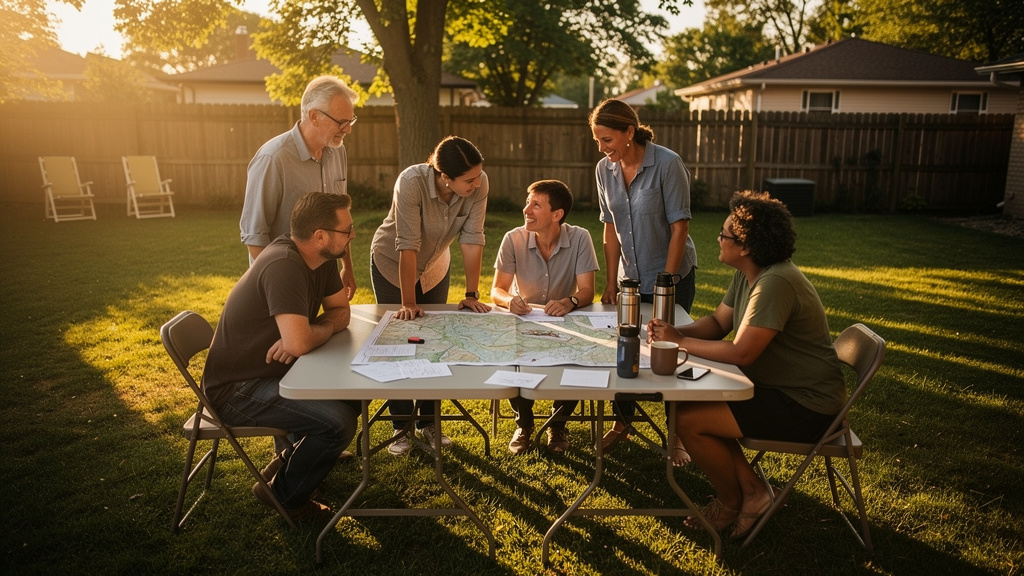
Every disaster after-action report reaches the same conclusion: per FEMA Community Emergency Response Team (CERT) curriculum and Hurricane Katrina + Sandy + Maria + Harvey + Helene research, the people who had relationships with their neighbors before the event fared dramatically better than those who didn't. You cannot stand watch 24 hours a day. You cannot grow every crop, fix every engine, and treat every wound. A single household hits a hard ceiling on capability no matter how well-stocked it is.
Community preparedness has three parts: people (who you trust and what they can do), communication (how you reach them when phones are down), and organization (how the group makes decisions and shares resources under pressure).
→ Read First 30 Days (community chapter, 15 min) Mutual aid · Comms plan · Ham radio
Community-organization friction points to avoid
Community preparedness has predictable failure modes per disaster after-action research and FEMA CERT lessons-learned:
- Avoid forming "prepper groups" with strangers met online — predictable selection bias for ideological alignment over actual capability + trust. Trust is built through years of shared low-stakes events, not through forum recruitment. Per Putnam social-capital research, neighborhood mutual aid runs on accumulated weak-tie relationships, not on intensity of single-event commitment.
- Do not over-disclose specific inventory — per US DOD OPSEC Doctrine, disclosure at the level of mutual aid ("we have a generator, we can help with X") is appropriate; disclosure of full supply depth invites entitlement requests during scarcity.
- Don't depend on a single comms method — every method (cellular, FRS, GMRS, HAM, mesh, satellite) has failure modes. Plan for 2 independent methods per Department of Homeland Security communications resilience guidance.
- For mutual-aid agreements with potentially controversial elements (sharing food during scarcity, sharing firearms, agreeing on watch schedules), put the agreement in writing during a calm period. Stress reveals ambiguity in verbal agreements per conflict-resolution research.
- Conflict will happen — plan for it now per conflict-resolution. Established de-escalation protocols and decision-making processes are what keep a useful alliance from fracturing over a disagreement about watch schedules during week 3 of a real event.
Community preparedness is the highest-leverage preparedness action most people skip — but it is also the most failure-prone if approached as an intense recruitment exercise rather than as slow trust-building.
Where to start
Three audience-segmented entry paths matching the most common starting positions:
If you're brand-new (no neighbor relationships, no community focus):
- Introduce yourself to your 5 nearest neighbors by name — bring cookies, help shovel a driveway, share garden surplus. Learn one useful fact about each household (skills, family composition, medical needs, pets). Cost: zero. Timeline: 2–4 weeks.
- Buy a pair of FRS/GMRS handhelds (~$60–$120 for the pair) per Family Radio Service guidance and test them at realistic distances in your neighborhood. No license needed for FRS; GMRS license ($35 USD 10-year) for higher power.
- Write a one-page household comms plan per comms-plan.md — primary frequency + backup frequency + check-in schedule + code words + rally point. Laminate it. Keep a copy in every household member's go-bag.
If you have basics covered (know your neighbors, basic radio practice):
- Form a 3–8 household mutual aid circle per mutual-aid.md — explicit reciprocal commitments, skills inventory mapping who has what capability, monthly low-stakes meet (potluck or game night) to build the relationship.
- Upgrade to a HAM Technician license per ham-radio.md — free FCC exam, ~25 hours study, opens VHF/UHF + repeater access + digital modes. Pass rate >80% for prepared candidates per ARRL.
- Build out bartering capability — trade goods reserve of consumables (coffee, batteries, lighters, OTC meds, hygiene, seeds); inexpensive-to-affordable investment with significant leverage during cash-flow disruptions.
If you're building rural mutual aid (off-grid, remote, delayed external response):
- Coordinate with neighborhood watch group — rural mutual watch compensates for police response time that may exceed 30–60 minutes in remote areas.
- Install Meshtastic mesh network for off-grid local comms — LoRa-based, no infrastructure dependency, 1–10+ miles range per node per Meshtastic project documentation.
- Pair with satellite communicator (Garmin inReach, ZOLEO, Starlink) + Starlink off-grid power for true infrastructure-independent comms; cross-references Energy for solar power-budget planning.
Field note
The best time to meet your neighbors is before you need them. Bring over food during a holiday. Help shovel a driveway. These small gestures build the trust that mutual aid runs on — you can't manufacture it during a crisis. Per Putnam social-capital research, weak-tie relationships (knowing someone enough to call them by name) accumulate over months to years, not weeks. Start now even if "now" feels too early.
What this hub covers — and what it doesn't
This page routes to Survipedia community-preparedness content spanning neighbor relationships through neighborhood-scale organization. It covers:
- People — neighbors, mutual aid, skills inventory, children-and-education during disruption, vulnerable members, pets
- Communication — comms plan, FRS / GMRS, HAM radio, mesh networks (Meshtastic), satellite (Garmin inReach, Starlink), high-rise comms, signals, weather monitoring
- Organization — leadership structure, conflict resolution, community news (information quality), bartering, local economy, homestead economics, off-grid legal
It deliberately does not cover: formal nonprofit or LLC formation for community projects, multi-jurisdictional emergency-management coordination (CERT formal training covers this), labor organizing, political advocacy, or specific religious or ideological community structures. The A8 "when to seek expert help" criterion is waived for this hub — community organization is reader-managed; specific emergencies route to Threats or Medical.
People
- Neighbors — start with the 10 households closest to yours; skills inventory + family composition + medical needs + pets reveals gaps before they become emergencies
- Mutual aid circles — 3–8 household formalized agreements per FEMA CERT curriculum; no dues, no hierarchy, no uniforms; standing agreement to not wait for outside help during disruptions
- Skills inventory — maps who has what capability across medical, mechanical, gardening, armed, communications, financial domains; surfaces blind spots for cross-training
- Children and education — keeping learning and structure continuous during extended disruptions; group morale stability depends on engaged children
- Vulnerable members — infants, elderly, chronic-condition households, mobility-limited members; coordination with medical chronic-conditions and dedicated emergency-equipment continuity
- Pets — food rotation, evacuation kits, hotel-chain caveats per ASPCA emergency-prep guidance
Communication
Cell towers fail under load within minutes of a regional event per CTIA wireless industry post-disaster data. Landlines depend on the same power grid. Your communication plan needs at least one method that works without infrastructure.
| Method | Range | License needed | Cost |
|---|---|---|---|
| Family Radio Service (FRS) handheld | 1–2 mi (1.6–3.2 km) | No (FCC Part 95) | Inexpensive per pair |
| GMRS handheld + repeater | 1–5 mi (1.6–8 km) handheld, 20+ mi (32+ km) via repeater | Yes ($35 USD, 10-year) | Inexpensive |
| CB radio | 5–15 mi (8–24 km) | No | Affordable |
| HAM radio (VHF/UHF) | 5–50+ mi (8–80+ km) | Yes (Technician exam, free) | Inexpensive to affordable |
| Mesh network (Meshtastic / LoRa) | 1–10+ mi (1.6–16+ km) | No | Inexpensive per node |
| Satellite communicator (Garmin inReach, Starlink Mini) | Worldwide | No (subscription required) | Moderate investment + subscription |
- Comms plan — agreed-upon frequencies, check-in times, code words, fallback schedule; laminated card in every household member's kit per US Army field communications doctrine
- GMRS — repeater networks that extend range across entire neighborhoods
- Signals — low-tech alerting (flags, mirrors, chalk marks) that works when batteries are dead per US Army FM 21-60 visual signaling
- Weather monitoring — NOAA Weather Radio + apps + reading-the-sky; group timing of movement and decisions around incoming conditions
- Starlink off-grid power — 2026 Mini + Standard Gen 3 firmware power budgets, solar sizing, DC-direct option that meaningfully extends battery runtime
- High-rise comms — handheld VHF/UHF range collapses indoors in concrete-and-steel buildings; measured Meshtastic indoor attenuation, rooftop antenna access for renters, intercom-as-comms backup
Don't rely on a single communication method
Every method in the table above has failure modes per DHS CISA emergency communications guidance. Radios need charged batteries. Mesh nodes need line of sight. Satellites need a clear sky and a subscription. Plan for at least two independent methods.
Organization
- Leadership structure — who coordinates, who makes medical decisions, who handles logistics; consensus for planning, designated coordinator for active emergencies; established before it's needed
- Bartering — consumables that hold the most trade value during disruptions (coffee, batteries, lighters, OTC meds, hygiene, seeds); inexpensive-to-affordable investment with significant leverage when cash stops flowing
- Local economy — community-supported agriculture, credit unions, local purchasing; builds same resilience networks during normal times that barter relies on during disruptions
- Homestead economics — financial sustainability side: income streams from land, quantified savings from self-sufficiency, tax considerations for agricultural operations
- Off-grid legal — building codes for alternative structures, composting toilet legality, rainwater harvesting laws, state-by-state regulation comparisons
- Conflict resolution — de-escalation + decision-making protocols established beforehand; group stress over time fractures alliances over watch schedules without explicit process
- Community news — information-quality assessment and resistance to rumor spread that accelerates panic during regional events
Common questions
How do I avoid the "prepper group" pitfall while still building community? Build trust through low-stakes events repeated over months — potlucks, garden-surplus sharing, mutual help with driveways and small projects. Avoid recruitment-style commitments before relationships have formed. The neighbors you've known for 5 years are the mutual-aid foundation; people met through online forums are not.
What if I don't trust my neighbors at all? Start with what you can build: knowing names, having addresses written down for emergency contact, identifying who has vulnerable members for first-on-scene notification. Even without warm relationships, basic awareness of who lives near you is more capability than most households have.
Is HAM radio actually useful or is GMRS enough? GMRS handles 90% of household + neighborhood communication needs at lower cost and effort. HAM Technician opens regional + emergency-network access (ARES, RACES, repeater networks) and digital modes (Winlink, APRS) — worth the ~25 study hours if you're building out community-coordination capability beyond a single neighborhood, or living in a rural area where regional comms matter.
Should mutual-aid agreements be written down? Yes for anything potentially controversial (food sharing during scarcity, firearms, watch schedules, decision authority). Verbal agreements work in low-stress conditions and degrade rapidly under disaster stress. A one-page laminated agreement with names and explicit commitments takes a single coffee meeting to draft and prevents most conflict in week-3-of-disruption scenarios.
Your single next step: complete the First 30 Days community chapter — it sequences the 5-neighbor introduction, FRS/GMRS radio test, and one-page comms-plan drafting into a 30-day plan that builds on this hub's three-part framework.