Evacuation planning
The decision window for safe evacuation is often shorter than people expect. During Hurricane Katrina, New Orleans Mayor Ray Nagin issued the mandatory evacuation order 19 hours before landfall — too late for the roughly 150,000–200,000 people who could not self-evacuate even when they wanted to. For those with vehicles and resources, the window closes faster still: during Hurricane Rita the following month, three million Texans tried to evacuate simultaneously, producing gridlock so severe that drivers covered 50 miles (80 km) in 4–5 hours. Evacuation planning is mostly pre-event work. The execution window is typically too narrow to improvise well.
Wildfire evacuation readiness — 2026
With the NIFC 2026 outlook showing above-normal risk in several regions and western drought driving earlier-than-usual fire starts, the go-bag and vehicle-readiness steps below should be in place before May 1 in TX/FL/GA/Carolinas and before June 1 in the interior West. Practice one timed evacuation drill with your household this spring.
Educational use only
This page provides general educational information for emergency preparedness scenarios. It is not a substitute for official evacuation orders or guidance from local emergency management. Always follow instructions from local authorities during an actual emergency. Use this information at your own risk.
Evacuation zone tiers
Most coastal and flood-prone jurisdictions use zone-based evacuation systems that tier the risk by geography. Common systems use letters (A, B, C, D) or numbers, with Zone A (or 1) representing the highest-risk areas that receive mandatory orders first.
Zone A / Zone 1: Immediately adjacent to water, storm surge zones, floodplains. Mandatory orders come first and earliest. If you are in Zone A, your departure timeline is measured in hours from order issuance, not days.
Zone B / Zone 2: Moderate risk — lower elevation inland areas, areas with documented flood history. Often ordered shortly after Zone A.
Zone C and higher: Lower immediate risk; may receive voluntary orders or orders only in the most extreme events.
Know your zone before any event season. In Florida, the lookup is available at floridadisaster.org/knowyourzone; most states and counties have equivalent tools. This is a 5-minute task done once and reviewed annually.
Mandatory vs. voluntary orders: Research consistently shows that the word "mandatory" produces significantly higher compliance rates than "voluntary" or "recommended." If the order is mandatory for your zone, treat it as a hard deadline. Voluntary orders for lower-risk zones are a signal to prepare to move, not to wait.
Go / no-go decision framework
The evacuation decision reduces to five observable conditions. Track each as a storm or threat develops. When three or more shift to the "go" column, depart — do not wait for all five.

| Observable condition | Stay (shelter-in-place) | Go (evacuate) |
|---|---|---|
| Official zone status | No watch or voluntary recommendation for your zone | Mandatory order issued for your zone, or voluntary order and you are in Zone A/B |
| Road access | All routes are open and passable | One or more primary routes closed, flooding anticipated within 12 hours, or a bridge/tunnel on your only route |
| Household mobility | All members can move quickly with 15 minutes' notice | Household includes elderly, mobility-limited, or medically dependent members who need extra loading time |
| Shelter quality | You are in a multi-story reinforced structure above likely flood level | You are in a single-story home, mobile home, or in a floodplain; basement flooding is possible |
| Fuel and vehicle | Tank is at or above three-quarters; vehicle is in good condition | Tank is below half; vehicle has unresolved mechanical issues; no vehicle available |
None of these is an automatic trigger by itself. A mandatory order for Zone A when you live in Zone C is noise. A mandatory order for Zone A when you are in Zone A and have a flooded-prone first floor is a hard go signal. Read the full picture.
The asymmetry of the decision: leaving early and returning to an undamaged home costs one to three days of inconvenience. Leaving late into gridlock, or not leaving at all, can cost your life. When in genuine doubt, go.
When to leave: the departure decision
The safest departure is before the mandatory order is issued — what emergency managers call "shadow evacuation" or voluntary early departure. This is not paranoia; it is the operational reality that most major evacuation corridors cannot clear the population they serve if everyone leaves at the mandatory order simultaneously.
Leave early when:
- A significant storm is within 72 hours and you are in Zone A or B
- Your route involves a bridge, tunnel, or single-access corridor that will be overwhelmed
- You have household members with mobility or medical needs that increase departure time
- Your vehicle or fuel situation is uncertain
The cost of leaving a day early and returning to an undamaged home is low. The cost of leaving late into gridlock or not at all is potentially catastrophic.
Staged departure checklist by time window
Different departure windows require different packing discipline. If you have an hour, you can load more than if you have five minutes. Knowing which window you are in — and acting accordingly — prevents the common failure mode of spending 40 minutes loading non-essential items and leaving without documents.
5-minute departure (immediate threat, move now):
- Prescription medications — grab the bottles, no sorting
- Wallet, phone, car keys
- Go-bag if already staged by the door
- Every person and every pet — that is the complete list
15-minute departure (threat imminent, zone order just issued):
Everything in the 5-minute list, plus:
- ID documents and passports (keep in one waterproof folder you know the location of)
- Phone chargers and a power bank
- Minimum 1 gallon (3.8 L) water per person for the journey
- Cash in small bills
- Insulin, EpiPens, or other temperature/time-sensitive medications
- Pet carrier and pet food for 3 days
1-hour departure (watch issued, order expected, preparing to move):
Everything in the 15-minute list, plus:
- 3–5 days of clothing per person
- Food for the journey and first day at destination
- Sleeping supplies if destination is uncertain
- Laptop or hard drives with irreplaceable data
- Irreplaceable small items (photos, heirlooms that fit in a bag)
- Insurance documents and property records (photographed and emailed to yourself if not already)
- Livestock loaded or released to high ground with water access
Field note
Pre-stage your 15-minute load. Keep a waterproof folder with copies of all critical documents in the same drawer where you store your go-bag. Label it. Run a timed drill once a year — the first time you try to grab everything in 15 minutes, you will discover that you cannot find half of it. The second time, you can.
Evacuation timing: when early departure saves hours
Traffic modeling from past major evacuations consistently shows that departure timing determines journey length more than destination distance. During Hurricane Rita's 2005 Texas evacuation, drivers who left 24 hours before mandatory orders completed journeys in 3–4 hours. Drivers who left after mandatory orders sat in traffic for 12–24 hours covering the same distance.
The highway capacity math explains why: most major metropolitan corridors can process 1,500–2,000 vehicles per lane per hour under ideal conditions. A city of 500,000 that tries to evacuate in four hours needs to move 150,000–200,000 vehicles simultaneously — a physical impossibility on roads designed for normal flow.
Optimal departure windows by storm timeline:
- 72+ hours before landfall: Normal traffic conditions. Full fuel availability. No contraflow. Maximum shelter options. This is the ideal window.
- 48 hours before landfall: Light elevated traffic. Most fuel stations still stocked. Hotels filling at 200–300 miles from impact zone. Still an easy departure.
- 24 hours before landfall: Mandatory order window for highest-risk zones. Moderate to heavy traffic. Fuel stations in major corridors running low. Hotel availability minimal.
- 12 hours before landfall: Conditions at landfall minus 12 are typically dangerous for departure. Traffic jams at contraflow entry points. Fuel stations dry. Roads may be starting to flood in low-lying areas.
- Under 12 hours: If you have not departed by this point, you are likely better served by sheltering in the sturdiest, highest point available and waiting for conditions to pass.
The pattern is the same across hurricane, wildfire, and flood evacuation events: the people who leave early have easy trips. The people who leave with everyone else have terrible trips. The people who leave last often can't leave at all.
Route planning and contraflow awareness
Map three routes before any event:
- Primary route: Your fastest normal-condition route to your destination
- Alternate route: A secondary route avoiding major highways, prioritizing US and state routes through smaller towns
- Last-resort route: Rural county roads that add distance but bypass all major intersections
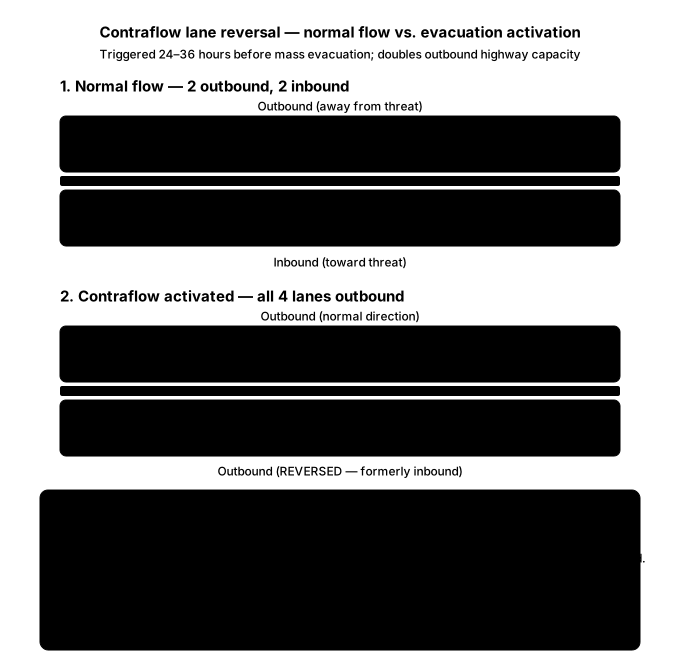
Contraflow: During large hurricane evacuations in coastal states, traffic engineers reverse inbound highway lanes for outbound travel, effectively doubling the outbound capacity. In Louisiana, Texas, and Florida, contraflow plans are pre-designed and well-publicized. Know which highways in your region implement contraflow, which entry and exit points the contraflow uses, and — critically — that the terminus of the contraflow creates a bottleneck where traffic merges back to normal lanes.
If you have printed route cards for all three routes, you can navigate without phone service. Download offline maps for your routes on every phone in the household before any developing situation.
What to take: the departure priority list
The household that leaves with documents, medications, and water in the first 10 minutes will not need the items that take 40 minutes to load.
Tier 1 — load before anything else: - Documents (ID, passports, insurance, property records) — waterproofed - Essential medications, minimum 7-day supply - Water, minimum 1 gallon (3.8 L) per person for the journey - Phone chargers and a charged portable power bank - Cash in small bills - Go-bag if pre-staged
Tier 2 — load if time and space permit: - Clothing, 3–5 days - Food for the journey - Sleeping supplies if destination is uncertain - Pet supplies and carriers - Irreplaceable items (photos, heirlooms that are physically small)
Tier 3 — leave it: - Furniture, appliances - Non-essential electronics - Items that require significant time to load
Field note
An overloaded vehicle is slower, handles worse, and breaks down more often. More than one family has had to abandon their car in evacuation traffic because they overloaded it trying to bring things they could replace. People first, documents second, everything else as time and space allow.
Fuel discipline during evacuation
Gas stations along major evacuation routes run dry within hours of a mandatory order. Maintain at least three-quarters of a tank during any monitoring period for a developing storm. If you leave before the order, fuel availability is normal; after the order, expect queues of 1–3 hours or no fuel at all at major corridor stations.
For longer routes, identify fuel stops 100–150 miles (160–240 km) apart and mark stations that are slightly off the main corridor, where lines are shorter. See fuel storage for how to pre-position fuel as part of your preparedness baseline.
Shelter options
Private destinations (family, friends, pre-arranged property) are the best option: no registration, no capacity limits, no shelter rules, and you know the conditions. Confirm the destination is accessible and ready before departure.
Hotels and motels: Call ahead. During major evacuations, rooms fill quickly within 200–300 miles (320–480 km) of the affected area. Reserve a room at the first opportunity when a storm track becomes likely — cancellation is easy, finding a last-minute room is not. If you travel with pets, confirm pet policies before assuming; hotels are not required to accept pets even during emergencies.
Public emergency shelters: Most counties open emergency shelters at schools, community centers, and fairgrounds. Capacity at public shelters is limited and conditions are basic. Shelters are designed for 8–10 days of operation. Pets are generally not permitted except in designated pet-friendly shelters. Service animals are always permitted.
Pet and livestock evacuation
Federal law (the PETS Act of 2006) requires states to include pet evacuation in their emergency plans, but implementation varies. Do not assume your preferred emergency shelter accepts pets — most Red Cross shelters do not (service animals excepted). Look up pet-friendly shelters in your destination area before the event.
For pets: prepare a carrier for each animal, a 5-day supply of food and water, vaccination records, and a photograph of yourself with the pet (for recovery if separated). Microchipping significantly improves reunification success.
For livestock: the decision to evacuate large animals must be made early — 48–72 hours before conditions deteriorate. Trailers must be arranged in advance; livestock transport capacity is limited and competitors for that capacity increase fast as a storm approaches. If animals cannot be evacuated, identify the highest ground on the property and ensure they have access to it.
When you miss the departure window
If you cannot evacuate before conditions make road travel unsafe:
- Move to the highest floor in a sturdy structure — never shelter below grade in a flood threat zone
- Shelter away from windows (interior rooms)
- Signal for help once conditions allow: a written sign in an upstairs window, a whistle, a bright-colored fabric visible from the street or air
- Do not attempt to walk or drive through standing water — 6 inches (15 cm) of moving water can knock down an adult; 12 inches (30 cm) can sweep a car
This is the failure mode that makes departure timing critical. See bug-in planning for how to sustain a shelter-in-place if departure becomes impossible.
Practical checklist
- Look up your evacuation zone and post it — this is a one-time task done before any event season
- Map three routes to your primary destination; pre-drive at least one alternate per year
- Know whether your routes include contraflow-capable highways and where the contraflow terminates
- Pre-load Tier 1 items in a go-bag staged for immediate loading
- Maintain at least three-quarters tank fuel during any monitoring period
- Reserve lodging early when a storm track becomes likely; confirm pet policy if applicable
- Have a written pet evacuation plan: carrier, food, records, and destination shelter verified
- Run one timed departure drill per year; target 15 minutes from decision to rolling
- Download offline maps for all routes on every phone in the household
For the broader decision between evacuating and staying, see bug-in planning. For vehicle preparation and maintenance before any departure, see vehicle choice.