Safe room design and readiness
A safe room is not the same thing for everyone, and the design must match the threat. A room built to Federal Emergency Management Agency (FEMA) P-320 specification for tornado survival requires reinforced concrete or steel anchored to the foundation and rated to resist 250 mph (402 km/h) winds and a 15-lb (6.8 kg) 2×4 projectile fired at 100 mph (161 km/h). A room designed primarily to delay an intruder and give your household time to communicate with emergency services requires a solid-core door, a Grade 1 deadbolt, and a reinforced frame. These are different problems requiring different designs, and conflating them produces a room that does neither well. Households with a basement have a natural starting point — see basement conversion and hardening for how to bring a below-grade space to P-320 standards or configure it as a dual-purpose shelter and safe room.
Decide your primary threat before you spend anything.
Educational use only
This page is for educational purposes only. Design specifications and hardware grades reflect FEMA P-320 and BHMA published standards; actual installation requirements depend on your home's construction and local building code. Use this information at your own risk and consult a licensed contractor for structural work.
Action block
Do this first: Walk your home's interior and identify the room farthest from exterior walls with a solid door and a lockable interior handle (15 min) Time required: Active: 15 min for room selection and threat decision; 2–4 hr for door and lock retrofit; recurrence: quarterly drill (15 min) Cost range: Inexpensive for supply staging and communications gear; moderate investment for intruder-resistance door and hardware retrofit; significant investment for FEMA P-320 tornado-rated construction Skill level: Beginner for room selection and staging supplies; intermediate for door and lock replacement; expert+licensed for structural storm-shelter construction Tools and supplies: Tools: drill, screwdriver, permanent marker. Supplies: water (1 gal (3.8 L) per person), battery-powered flashlight or lantern, first aid kit, two-way radio. Infrastructure: solid-core door (≥1.75 in (44 mm)), Grade 1 deadbolt, 18-inch (46 cm) 16-gauge security strike plate with 3.5-inch (89 mm) screws. Safety warnings: See Common installation failure below — deadbolt grade alone does not prevent kick-in if the strike plate and frame screws are not upgraded simultaneously; see Carbon monoxide risk in sealed rooms below — never operate a generator, propane heater, or combustion device inside or adjacent to a sealed safe room.
Tornado and extreme-wind safe rooms
FEMA's P-320 standard ("Taking Shelter from the Storm") defines the engineering specifications for a residential safe room that provides near-absolute protection during tornadoes. The key performance requirements:
- Wind load: withstand 250 mph (402 km/h) design wind speed, which exceeds the documented wind speed of almost all recorded tornadoes including EF5 events
- Debris impact: withstand a 15-lb (6.8 kg) 2×4 board fired at 100 mph (161 km/h), simulating debris carried by extreme winds
- Foundation anchoring: anchored with a continuous load path to a reinforced concrete foundation using engineered connection hardware
- Ventilation: minimum 4 square inches (26 cm²) of vent opening per occupant (per International Code Council (ICC) 500 §702.1, which FEMA P-320 incorporates by reference for residential storm shelters), routed so vents do not compromise structural integrity
- Minimum door opening: 24 inches × 30 inches (61 cm × 76 cm) clear opening for entry and rescue access
FEMA P-320-compliant rooms are built from reinforced concrete (cast-in-place or precast) or from FEMA-spec cold-formed steel framing with specific panel thickness and connection requirements. Poured concrete safe rooms using the FEMA plans start at approximately $6,000 to $10,000 installed for a residential room sized for a family of four, depending on region and contractor. Prefabricated steel above-ground units start at a moderate investment in the $4,000 to $8,000 range installed, with premium units accommodating larger groups running higher.
FEMA periodically offers mitigation grants for safe room construction in tornado-prone regions, which can cover a significant portion of the cost. Check with your state emergency management agency.
Below-ground vs. above-ground
Underground tornado shelters provide excellent protection from debris but flood risk is a real concern in many regions — particularly in areas where the water table is high or flash flooding accompanies severe storms. FEMA P-320 covers both above-ground and below-ground designs; choose based on your local soil drainage and flood history, not purely on price. For properties in high-wind corridors, storm hardening addresses the structural reinforcement of the building itself — which reduces debris loads and may eliminate the need for a separate shelter structure in lower tornado-risk regions.
Intruder-resistance retrofit
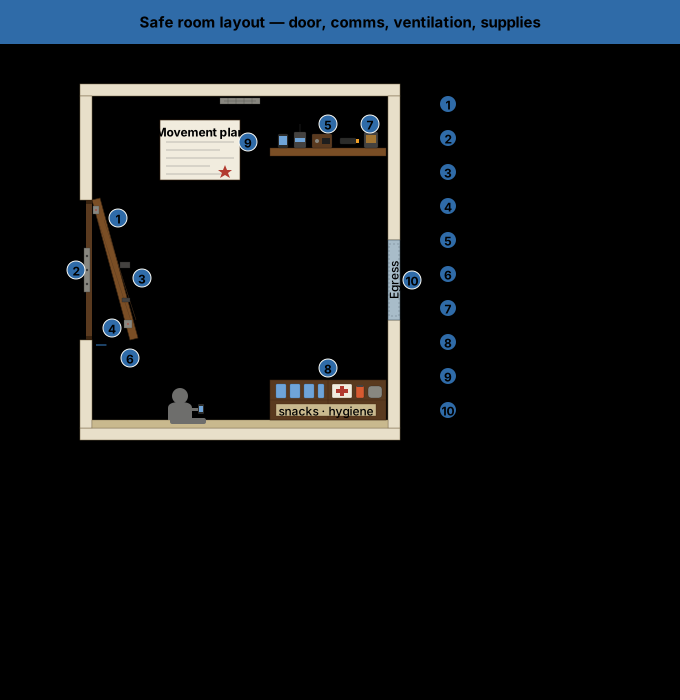
An intruder-resistant safe room does not require structural construction. It uses existing interior space — typically an interior bedroom, bathroom, or closet — hardened to give your household 3 to 10 minutes of resistance while you communicate with emergency services, reach your family members, and prepare to respond.
This is the more practical upgrade for most households. Cost ranges from around $500 to $2,000 depending on what the existing door and frame require.
The door
The door is the critical component. Most interior doors are hollow-core — an empty cardboard honeycomb inside a thin wood skin — and will fail in a single kick. Replace it. The same door specifications — solid-core thickness, deadbolt grade, and frame reinforcement — that apply to exterior entry hardening are covered in depth in door hardening, which also addresses sliding doors and outswing configurations.
A solid-core door — wood composite or steel — must be at least 1.75 inches (44 mm) thick. Exterior-grade solid-core doors are standard at 1.75 inches; some retailers stock heavier 2.25-inch (57 mm) commercial-grade steel doors that are significantly more resistant. The door frame must support the door; a solid-core door in a weak frame will fail when the frame splinters.
The frame and strike plate
This is where most doors actually fail — not through the door itself but through the frame at the strike plate, where the deadbolt bolt engages the door jamb. Standard residential strike plates use 3/4-inch (19 mm) screws that anchor only into the door jamb, which is a thin piece of wood trim. One or two solid kicks can split it.
Replace the strike plate with an extended security plate — 18 inches (46 cm) long, made from 16-gauge steel — and use 3.5-inch (89 mm) hardened screws that pass through the jamb and anchor into the wall stud behind it. This spreads the force of a kick over 18 inches of stud instead of 2 inches of trim. The hardware cost is low; the installation takes about 30 minutes.
Do the same for all hinge-side screws: replace them with 3-inch (76 mm) screws reaching the stud.
The lock
A Grade 1 deadbolt is the minimum for a safe room door. Grade 1 is the BHMA (Builders Hardware Manufacturers Association) top classification under ANSI/BHMA A156.36, the standard for auxiliary deadbolts. Grade 1 deadbolts are tested to withstand a graduated series of strike impacts (two blows each at 60, 90, 120, and 150 ft-lbf of impact energy) and approximately 1,350 lbf (6,000 N) of sustained pull/push force applied at the bolt. The bolt must extend at least 1 inch (25 mm) from the door edge.
Add a secondary door bar or security bar brace as a backup. A steel bar that angles from the door to a floor bracket provides supplemental resistance even if the deadbolt bolt is forced.
Common installation failure
A Grade 1 deadbolt installed in an existing door with the original jamb screws is only as strong as the jamb screws. The lock hardware will hold; the frame will fail. Always upgrade the strike plate and frame screws at the same time as the lock. This is the most common safe room retrofit mistake.
Field note
A safe room's communication capability matters more than its door strength in almost every real-world scenario. An intruder who knows you are behind a hardened door and that police are 4 minutes away will typically leave. An intruder who does not know you have called — or who believes you cannot call — has no such incentive. Test your cell signal specifically inside the room, not just in the hallway outside it. Interior rooms in masonry or concrete structures often have one to two fewer bars than the rest of the house.
Communications
A safe room without reliable communications is just a delay — it buys time you cannot use. Before you close that door you need the ability to call for help and know what's happening outside.
- Cell signal booster: Many interior rooms have poor cell coverage. A wired cell signal booster (amplifier + outdoor antenna) improves signal reliability in a specific location. Install the indoor antenna in or near the safe room and route the cable to an outdoor antenna with a clear sky view.
- Landline telephone: A corded landline works during power outages and many disruptions that take cellular networks down. Route a phone jack into the room or use a 25-foot (7.6 m) phone extension cord to the nearest jack.
- General Mobile Radio Service (GMRS) or Family Radio Service (FRS) radio: A charged handheld radio lets household members communicate during and after evacuation to the safe room without relying on any network infrastructure.
- Charged tablet or phone: Keep a spare device in the safe room charged, not your daily phone. If you're sheltering in place, your primary device needs to stay charged for calls.
Room contents
A safe room is not a supply depot. The contents should support one purpose: sustaining the occupants for the time it takes to communicate, wait, and exit safely. For tornado use, that is typically 30 to 60 minutes. For intruder scenarios, typically 15 to 30 minutes.
Minimum staged contents:
- 1 gallon (3.8 L) of water per person — minimum 24-hour supply
- Flashlight with fresh batteries (test monthly), or a battery-powered lantern
- First aid kit: tourniquet, pressure bandages, gloves, basic wound care
- Charged communication device (radio plus a backup phone or tablet)
- Printed list of emergency contacts — phones can fail and you may need to relay numbers to a 911 dispatcher
- Self-defense option appropriate for your household and legal jurisdiction
- Hearing protection — if you're sheltering during a tornado or using a firearm in an enclosed space, ear protection matters
- Medications: a 72-hour supply of any daily prescription for each household member
Keep a printed copy of your local emergency map and closest shelter location. During a tornado, power and cellular can fail simultaneously, and a paper map doesn't need a signal.
Field note
Run the drill with the lights off and a 60-second timer once per quarter. The combination of darkness, adrenaline, and time pressure is where people discover that the flashlight has dead batteries, the door bar doesn't fit properly when you're rushing, and the kids don't remember the route. Each practice session produces one item to fix and one piece of confidence.
Carbon monoxide risk in sealed rooms
Never operate a generator, propane heater, camp stove, charcoal grill, or any combustion device inside a safe room or in an adjacent space with shared airflow. Carbon monoxide is colorless and odorless — it accumulates rapidly in a sealed interior space and can incapacitate occupants before they recognize the danger. Safe rooms are not ventilated for combustion. If you need heat for extended shelter periods exceeding 24 hours, use battery-powered warming devices only. For extended occupancy, also ensure passive ventilation: ICC 500 §702.1 (incorporated by reference in FEMA P-320 for residential storm shelters) requires a minimum of 4 square inches (26 cm²) of vent opening per occupant; replicate this in any improvised shelter-in-place room. A safe room is also not a substitute for a tornado shelter unless it is rated to ICC 500 or FEMA P-320 standards — an interior room with a hardened door provides intruder resistance, not structural protection from EF3–EF5 tornado debris.
Family movement plan
A safe room with no drill plan is furniture. The drill creates muscle memory that functions under stress when cognitive performance degrades.
- Designate a single alert word or phrase — clear, unambiguous, one or two syllables. "Safe room" or "shelter now" work. Vague phrases like "come here" do not.
- Every household member has an assigned role. Who carries the youngest child? Who grabs the bag? Who is last out and closes the door? Write it down.
- Practice the route under low-light conditions at least once. The path your family takes at 2 a.m. is not the same as the path they take at 2 p.m.
- Designate a secondary room in case the primary is inaccessible. Know the alternate route.
- Debrief after each drill — no longer than five minutes — and note one specific thing to fix.
For larger households or households with children with different mobility or cognitive needs, also work through a scenario where the primary adult is occupied in another part of the house when the alert sounds.
Safe room checklist
- Identify primary threat (tornado/severe weather or intruder resistance) and design accordingly
- For tornado use: research FEMA P-320-compliant prefabricated units or poured concrete plans; request state mitigation grant information
- For intruder resistance: replace hollow-core door with 1.75-inch (44 mm) solid-core door
- Install Grade 1 deadbolt with 1-inch (25 mm) bolt throw
- Replace strike plate with 18-inch (46 cm) security plate using 3.5-inch (89 mm) stud-anchoring screws
- Replace all hinge screws with 3-inch (76 mm) screws reaching wall stud
- Verify or install cell signal coverage in room; add corded landline or radio as backup
- Stage water, flashlight, first aid kit, printed contact list, and communications device in room
- Brief every household member on the alert word and their specific role
- Conduct one drill per quarter; debrief and fix one item per drill
With interior fallback positions established, the outer layer of your security system — the perimeter — provides the early warning that determines how much time you have to reach the safe room in the first place. For nuclear or chemical, biological, radiological, and nuclear (CBRN) scenarios where a safe room doubles as a shelter-in-place location, see nuclear fallout for the 48-hour minimum shelter duration, decontamination procedures, and radiation exposure thresholds that govern when it is safe to exit. The door specifications for safe room entry — solid core thickness, deadbolt grade, and strike plate anchoring — are covered in depth alongside the rest of your home's vulnerable entries in door hardening. For safe rooms that also need to resist fire during a wildfire or structural fire event, see fire-resistant construction.
With a hardened door, staged supplies, a communication plan, and a practiced drill, your safe room functions as a system, not a fortified closet — and a system has the redundancy to keep working when one element fails under stress.
Sources and next steps
Last reviewed: 2026-05-17
Source hierarchy:
- FEMA P-320 — Taking Shelter from the Storm (Tier 1, federal — residential safe-room design standard for tornado and extreme-wind protection; includes wind-load, debris-impact, and ventilation specifications)
- CISA Active Shooter Preparedness (Tier 1, federal — Run-Hide-Fight framework and guidance on secure room delay time requirements for active-threat scenarios)
Legal/regional caveats: Castle doctrine and duty-to-retreat rules vary significantly by state — sheltering in a hardened room is not an automatic authorization for defensive force; consult your state's use-of-force statutes. Structural modifications (new walls, door frame reinforcement requiring permits) may need a local building permit even for interior work; check with your local AHJ (authority having jurisdiction). Some states offer income-tax credits for ICC 500-rated storm-shelter installation — check your state emergency management agency.
Safety stakes: high-criticality topic — recommended to verify thresholds before acting.
Next 3 links:
- → Firearms for home defense — if intruder resistance is your primary threat, understand the legal and practical requirements for defensive tools kept in the safe room
- → Perimeter security — early detection at the perimeter determines how much time you have to reach the safe room; address this layer first
- → Communications plan — coordinate household movement and external contact protocols so the safe room drill has a signal to respond to