Bleeding control
Uncontrolled hemorrhage is the leading cause of preventable death in trauma — accounting for roughly 90% of preventable combat fatalities and a significant proportion of civilian trauma deaths. A person with a severed femoral artery can bleed to death in under three minutes. The bystander who acts in the first two minutes saves more lives than any hospital intervention that follows. These skills are for that person.
Educational use only
This page provides general educational information for emergency preparedness scenarios when professional medical care is unavailable. It is not a substitute for professional medical advice, diagnosis, or treatment. Always seek the advice of a qualified healthcare provider. Use this information at your own risk.
Before you start - Skills: Patient assessment — confirm scene safety and rule out spinal injury before moving the patient (see Emergency medical assessment). Know bleeding classification: arterial vs. venous vs. capillary determines your first intervention. - Materials: Nitrile gloves (2 pairs minimum). Hemostatic gauze (Combat Gauze, QuikClot, or Celox — 1 roll) or plain gauze pads and rolls. Elastic bandage (ACE wrap, 1 roll). Commercial windlass tourniquet (CAT or SOFTT-W — 1 per kit; carry 2 for multi-casualty scenarios). Permanent marker for tourniquet time marking. Trauma shears. - Conditions: Scene confirmed safe — no ongoing threat, fire, or structural hazard. Patient accessible and positioned on a firm flat surface where possible. Personal protective equipment on before contact. - Time: Tourniquet application target under 60 seconds for a trained layperson (windlass tightening itself 15–30 seconds once the device is seated). Direct pressure hold at least 5 minutes continuous per ACS Stop the Bleed, extending to 10 minutes if bleeding has not clearly stopped. Wound packing pressure hold 3 minutes with hemostatic gauze, 5 minutes with plain gauze. Full MARCH sequence (all steps) 2–5 minutes.
Action block
Do this first: Apply direct pressure with both hands to the bleeding site and hold continuously for at least 5 minutes without lifting the dressing — extend to 10 minutes if bleeding has not clearly stopped (active: 5–10 min) Time required: Active: at least 5 min direct pressure (extend to 10 if bleeding has not clearly stopped — per ACS Stop the Bleed); 3 min hemostatic / 5 min plain-gauze wound-packing pressure hold; tourniquet application target under 60 sec for a trained layperson (windlass tightening itself 15–30 sec once seated); recurrence: reassess hemorrhage control and mental status every 5 min during monitoring Cost range: Inexpensive for gloves and gauze; affordable for a complete bleed kit with commercial tourniquet Skill level: Beginner for direct pressure; intermediate for tourniquet placement; advanced for wound packing with hemostatic agents Tools and supplies: Tools: commercial windlass tourniquet, trauma shears, permanent marker. Supplies: hemostatic gauze, plain gauze pads and rolls, elastic bandage, nitrile gloves. Safety warnings: See Tighten until bleeding STOPS — not until it slows below — under-tightening a tourniquet causes venous congestion and is worse than no tourniquet; tissue tolerance is approximately 2 hours before permanent injury risk climbs
Bleeding classification
Not all bleeding is equal. Knowing what you are looking at determines your response in the first 30 seconds.
Arterial bleeding: Bright red, oxygen-rich blood. Characteristically spurts or pulses in rhythm with the heartbeat. Even a small arterial bleed can be rapidly fatal if the vessel is large. The femoral artery (groin/thigh), brachial artery (upper arm), popliteal artery (behind the knee), and radial/ulnar arteries (wrist) are the most commonly injured in trauma. A tourniquet is indicated for arterial bleeding on a limb — do not waste time on direct pressure alone.
Venous bleeding: Dark red, deoxygenated blood. Flows continuously and steadily rather than pulsing. Still serious but more controllable with pressure. Venous bleeding from large veins (femoral vein, jugular vein) can be rapidly fatal, but most venous bleeding from extremity wounds responds to sustained direct pressure.
Capillary bleeding: Slow seep from the wound surface. Bright red but very low volume and pressure. This is the bleeding from abrasions, minor cuts, and surface lacerations. It almost always stops spontaneously with simple pressure.
Internal bleeding: Not visible externally. Signs include distension of the abdomen, bruising over the flank (indicating kidney or aortic injury), a rapidly expanding thigh without external wound (indicating femoral vessel or femur fracture), and progressive shock signs (pale, cold, confused, weak rapid pulse) without visible bleeding. Internal abdominal and thoracic hemorrhage cannot be managed in the field — recognition and rapid evacuation are the only interventions. See shock for the full shock management protocol.
The three-zone decision framework
| Bleeding zone | Description | First response |
|---|---|---|
| Extremity | Arm, leg — below shoulder and hip | Tourniquet first for arterial or massive bleed |
| Junctional | Groin, axilla (armpit), neck, shoulder | Wound packing — tourniquet cannot be placed here |
| Truncal | Chest, abdomen, back | Packing if accessible; stabilize and evacuate |

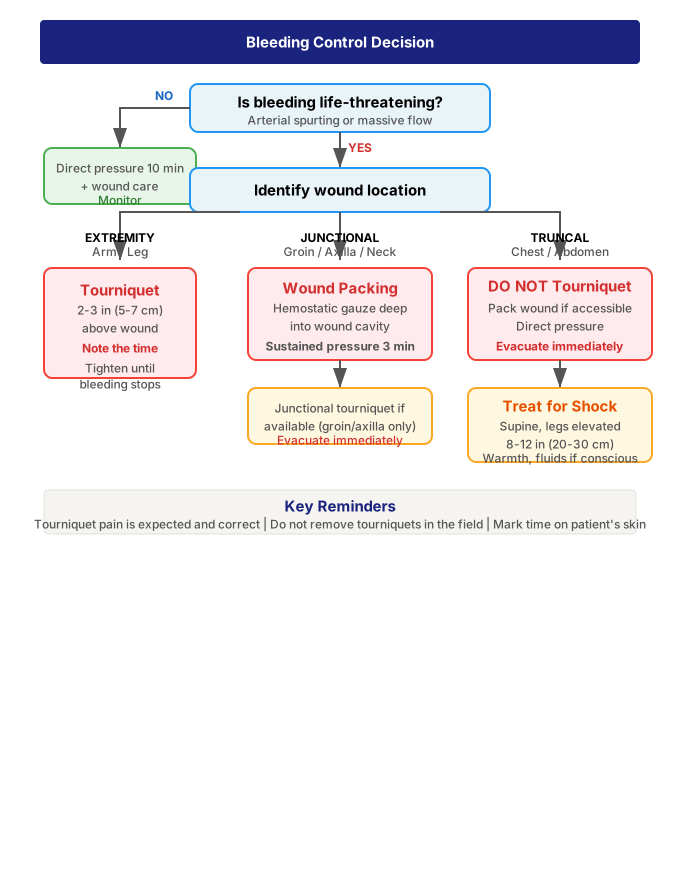
Direct pressure
Direct pressure is the correct first intervention for most wounds that are not life-threatening limb hemorrhage. It is also the preparation step before deciding whether to escalate to packing or tourniquet.
When direct pressure is appropriate
- Venous bleeding from any location
- Moderate soft tissue bleeding from the trunk, face, or scalp
- Extremity bleeding where arterial involvement is uncertain
- Any wound in a junctional area (groin, armpit) as the primary method
Technique
- Expose the wound — cut or tear clothing away. You cannot control bleeding through fabric.
- Put on gloves if available. If not, use the victim's own hands to apply initial pressure while you prepare.
- Fold two or three gauze pads together into a firm pad. If gauze is unavailable, use the cleanest available cloth — a shirt, bandana, or folded towel.
- Place the pad directly on the wound and apply firm, continuous pressure using the heel of both hands stacked on top of each other.
- Press hard. Most people who apply "pressure" use about 10% of the force required. The landmark for adequate pressure: you should be pressing with enough force that your own arms fatigue within a few minutes. For a head wound, use firm pressure. For a thigh wound, use your full body weight leaning through your arms.
- Maintain continuous, uninterrupted pressure for at least 5 minutes (ACS Stop the Bleed minimum) without lifting the pad to check. If the bleed is high-volume or you are uncertain, extend the hold to a full 10 minutes — additional time only helps the clot. Looking at the wound every 30 seconds breaks the forming clot and restarts the bleeding clock.
- At 5–10 minutes, gently lift the pad. If bleeding has stopped or significantly slowed, add a second dry pad over the first (do not remove the original — the clot is attached to it) and secure with a circumferential wrap.
- If bleeding has not slowed after 5–10 minutes of correct technique, escalate to wound packing (for accessible deep wounds) or tourniquet (for extremity wounds).
Checking too soon is a common fatal error
The most common mistake in bleeding control is lifting the dressing to check progress. Each time you lift, you disrupt the clot forming at the wound. Studies of trauma first aid failures frequently cite early dressing removal as the reason direct pressure failed. Set a timer. Do not lift. If blood saturates through, add more material on top and press harder.
Wound packing
Wound packing is indicated when a wound is deep and cannot be closed by surface pressure alone, when the wound is in a junctional area where tourniquets cannot be applied, or when direct pressure has failed after 5–10 minutes on a deep wound. Packing fills the wound cavity with material that creates a pressure tamponade against the bleeding vessel.
Equipment
Hemostatic gauze (Combat Gauze, QuikClot, Celox) is the military standard and preferred when available. Combat Gauze is impregnated with kaolin clay, which activates Factor XII in the clotting cascade and accelerates clot formation. Celox uses chitosan. Both work significantly faster than plain gauze and are the CoTCCC (Committee on Tactical Combat Casualty Care) hemostatic dressing of choice.
Plain gauze: Works well when hemostatic gauze is unavailable. The mechanism is purely mechanical — packing creates pressure, and sustained pressure causes clotting. It requires longer pressure application (5+ minutes versus 3 minutes for hemostatic gauze).
Do not use: Cotton balls, wadded tissue, sanitary pads without gauze, or non-sterile cloth as your packing material if better options exist. These materials can fragment inside the wound and are very difficult for surgeons to fully remove later.
Packing procedure
- Put on gloves. If you need to use bare hands, do it — dying from infection later is better than dying from hemorrhage now.
- Identify the deepest visible point of the wound cavity. This is where you start.
- If using a roll of hemostatic gauze, keep it continuous — do not cut pieces. You want one continuous strip that the surgeon can pull out cleanly.
- Press a folded portion of the gauze firmly into the deepest point of the wound with your finger. Use deliberate downward force — hesitant patting does not create tamponade.
- Continue pressing gauze into the wound, feeding the roll in behind your finger and packing it tightly in layers. Fill the cavity from the deepest point upward until gauze is level with or slightly above the skin surface.
- Once the cavity is filled, apply immediate, hard pressure with both hands on top of the packed wound. Use your full body weight if necessary.
- Maintain hard pressure for 3 minutes with hemostatic gauze or 5 minutes with plain gauze. Do not reduce pressure during this window.
- After the pressure hold, do not remove the packing. Apply a pressure dressing over the top — additional gauze secured with an elastic wrap or bandage — and maintain moderate pressure during transport.
- Mark the time of packing application on the patient (permanent marker on the forehead or tourniquet card if available).
Field note
Proper wound packing requires genuine force. In training, most people pack too gently because packing a wound looks and feels aggressive. The feedback from a real packed wound is the feeling of firm resistance from tissue when each layer is fully compressed. If your finger goes straight in without resistance, you have not packed tightly enough. Pack until the cavity is genuinely filled and hard.
Packing junctional wounds
Junctional wounds (groin, axilla, neck junction at the shoulder) are the hardest to manage because tourniquets cannot reach these locations and the wound geometry often makes consistent pressure difficult to maintain.
For groin wounds: the femoral triangle is a deep space. Pack aggressively and maintain sustained pressure. Have the patient lie flat with the leg straight. Apply packing and then press down through the packing toward the femoral head (hip socket). If a second rescuer is present, one person maintains pressure while the other stabilizes the patient.
For axilla (armpit) wounds: pack the space and have the patient lower their arm over the dressing to create body-weight pressure on the wound. This is imperfect but extends the effectiveness of packing when direct pressure cannot be maintained.
Tourniquet application
A tourniquet is a circumferential compression device applied to a limb to completely stop blood flow distal to the wound. It is the fastest and most reliable intervention for life-threatening extremity hemorrhage and is appropriate as the first intervention for arterial limb bleeding — not as a last resort after direct pressure fails.
When to apply a tourniquet
Apply a tourniquet immediately (before direct pressure) when: - Arterial bleeding is present on an extremity — bright red, pulsing - Amputation or near-amputation with severe bleeding - Limb wound with bleeding that is clearly life-threatening in volume - Blast or high-energy trauma to a limb with uncontrolled hemorrhage
Apply a tourniquet when direct pressure fails when: - 5–10 minutes of firm direct pressure has not significantly controlled the bleed - Wound is too large or inaccessible for sustained pressure - Single rescuer must leave the patient temporarily
Do not apply a tourniquet for: - Junctional wounds (groin, axilla) — use packing - Truncal (chest, abdomen) wounds — pack and stabilize - Wounds that are adequately controlled by direct pressure
Equipment
Commercial tourniquets (CAT — Combat Application Tourniquet, SOFTT-W, TMT) are the standard of care. They are designed for one-handed application and have a windlass mechanism that allows the rescuer to tighten past initial resistance to true arterial occlusion.
Improvised tourniquets: A tourniquet improvised from a belt, cravat, or strip of cloth with a windlass stick can work in a complete absence of commercial equipment, but they fail at a much higher rate, are harder to tighten adequately, and slip. If you are building a preparedness kit, a commercial tourniquet is a high-priority, affordable addition — do not improvise when you can avoid it.
Application procedure (CAT or similar windlass tourniquet)
- Expose the limb — cut or tear the sleeve or pant leg. Apply only to bare skin; applying over clothing reduces effectiveness.
- Route the tourniquet around the limb 2–3 inches (5–7.5 cm) above the wound. If the wound location is unclear or if the wound is very high on the limb (mid-thigh or upper arm), apply the tourniquet as high on the limb as possible — directly in the groin or axilla crease.
- Thread the strap through the buckle and pull it through until all slack is taken up. The strap should be snug before the windlass is engaged.
- Twist the windlass rod until: (1) all bright-red bleeding stops completely, (2) the distal pulse is no longer palpable (radial for arm, dorsalis pedis for leg), AND (3) windlass resistance becomes firm — a commercial CAT typically requires 3–5 full rotations. Reducing bleeding but not stopping it creates venous congestion without arterial occlusion, which is worse than no tourniquet. If the patient tells you it hurts, that is expected. If the patient is conscious, explain what you are doing.
- Lock the windlass rod into the retention clip or holder.
- Secure the windlass clip with the hook-and-loop retention strap (if present on the device).
- Write the time of application directly on the patient's skin with a permanent marker (recommended location: the patient's forehead) or on a tourniquet card. Write "TQ" and the time in 24-hour format. This is not optional — this information directly determines the treatment decisions at the hospital.
- Do not cover the tourniquet. It must remain visible to receiving medical personnel.
- Do not remove or loosen the tourniquet in the field. Conversion to a pressure dressing is a hospital-only procedure requiring crystalloid IV access and resuscitation capability; field conversion guidance from older sources is obsolete per TCCC 2019 and later. Leave it on until definitive surgical care is available.
Tighten until bleeding STOPS — not until it slows
The most common tourniquet failure in civilian use is under-tightening. A tourniquet that reduces but does not stop blood flow creates venous congestion (blood pooling below the tourniquet) without stopping arterial flow — this is worse than no tourniquet at all. If you see oozing from the wound after tourniquet application, tighten further. If the windlass is already locked and bleeding continues, apply a second tourniquet immediately above the first.
Failure modes
Even correctly-positioned tourniquets fail when applied incorrectly. These are the five most clinically significant failure modes, ranked by frequency in civilian and TCCC after-action data.
Tourniquet placed too distal Recognition: Continued active bleeding at or above the wound after the windlass is locked; blood pooling under the TQ site. Remedy: Reposition 2–3 inches (5–7.5 cm) above the wound on bare skin. If wound location is unclear or wound is high on the limb, go "high and tight" — as proximal as possible, directly in the axilla or inguinal crease.
Insufficient tightening Recognition: Distal pulse is still palpable (radial for arm, dorsalis pedis for leg); oozing or pulsing continues from wound; windlass completed fewer than 3 full rotations. Remedy: Continue turning the windlass. A properly occluding CAT typically requires 3–5 full windlass rotations. Stop only when: (1) all bright-red bleeding ceases, (2) distal pulse is no longer palpable, AND (3) resistance in the windlass becomes firm. If the windlass is already at maximum travel and arterial bleeding continues, apply a second tourniquet immediately proximal to the first — do not loosen the first.
Improvised tourniquet with wrong material Recognition: Rope, wire, or paracord narrower than 1 inch (2.5 cm) cutting into tissue; skin blanching in a narrow stripe proximal to wound; patient reports sharp localized pain at TQ site rather than aching limb pain. Remedy: A safe improvised tourniquet must be 1–1.5 inches (2.5–4 cm) wide minimum — a folded triangular bandage or belt edge. Narrow-cord improvised TQs cause focal nerve and vascular injury without reliably stopping arterial flow. An improvised TQ is a bridge to a commercial device, not a substitute. If a commercial CAT or SOFTT-W is available, use it every time.
One-handed self-application failure Recognition: Dominant-arm wound; patient cannot pull the strap tight or turn the windlass without slipping; TQ is seated but not occluding. Remedy: Pre-position the TQ as high on the limb as possible before securing it. Thread the strap through the buckle, then anchor the windlass handle against the patient's own thigh or a hard surface. CAT Gen 7 is designed for one-handed self-application on the upper arm using this anchor method — practice this scenario before you need it.
Time of application not recorded Recognition: Arriving EMS or a second responder asks when the TQ was applied and there is no marking on the patient. Remedy: Write "TQ" and the time in 24-hour format directly on the TQ strap or on the patient's forehead with a permanent marker — do this immediately after locking the windlass, not later. Limb tissue tolerates tourniquet ischemia to approximately 2 hours with low risk of permanent injury; meaningful rhabdomyolysis and nerve injury risk accumulates beyond that window, with significant tissue loss risk beyond 6 hours.
Field note
The tourniquet time marking is not a documentation formality — it is a clinical decision input. EMS, OR nurses, and trauma surgeons use the application time to decide whether to attempt limb salvage or proceed directly to damage-control surgery. If the time is unknown, the clinical team assumes worst-case and acts accordingly. Mark the time every time, before you do anything else after locking the windlass. Permanent marker on forehead is not disrespectful — it is the international standard practiced from TCCC to civilian Stop the Bleed.
For MARCH context, massive hemorrhage is the M step: application of a tourniquet or hemostatic packing is the action that opens every subsequent intervention. See ifak for MARCH-M kit build, and shock for managing hemorrhagic Class III/IV after bleeding is controlled.
Tourniquet time and tissue safety
Safe tourniquet duration based on Tactical Combat Casualty Care (TCCC) research:
- Under 2 hours: Considered safe for healthy tissue. Conversion to other hemorrhage control methods should be evaluated during this window when definitive care is available.
- 2–4 hours: Increasing risk of nerve and muscle injury. Conversion should happen at the earliest safe opportunity with physician involvement.
- 4–6 hours: Significant tissue ischemia. Conversion without physician supervision and monitoring capability is not recommended.
- Over 6 hours: Severe tissue injury likely. Amputation risk increases substantially. Do not convert without surgical capability available.
In a prolonged field care scenario where evacuation is unavailable and the tourniquet has been in place for more than 2 hours with no signs of continued major bleeding — re-assess carefully. Do not remove the tourniquet without physician guidance, but loosen it very slowly to assess whether hemorrhage control can be maintained with wound packing and direct pressure instead. If bleeding immediately resumes upon loosening, re-tighten and maintain.
MARCH protocol overview

The Massive hemorrhage, Airway, Respiration, Circulation, Hypothermia (MARCH) mnemonic is the tactical trauma care sequence from TCCC (Tactical Combat Casualty Care). It prioritizes interventions in the order they prevent death, which differs from the traditional first-aid "airway first" approach for trauma with hemorrhage.
M — Massive hemorrhage: Address life-threatening external bleeding first. Apply tourniquet for extremity arterial bleeding. Pack junctional wounds. Apply direct pressure for other wounds. This step happens before the airway assessment because hemorrhage kills faster than airway obstruction in most trauma scenarios.
A — Airway: Assess whether the patient has an open airway. A conscious, speaking patient has a patent airway. An unconscious patient needs their airway opened with a jaw thrust or head-tilt/chin-lift, or a nasopharyngeal airway (NPA) if available. Do not move a suspected spinal injury patient without log-roll technique.
R — Respiration: Assess breathing rate and depth. Normal rate for adults is 12–20 breaths per minute. Look for labored breathing, paradoxical chest movement (one side of the chest moving in when the other moves out — indicates tension pneumothorax or flail chest), or severe tracheal deviation. A sucking chest wound — where you hear or see air moving through a chest wall wound — requires an occlusive seal (see chest injuries).
C — Circulation: After hemorrhage is controlled, assess and support circulation. Check pulse (rate, strength, regularity). Treat for shock — see the shock prevention section below.
H — Hypothermia / Head injury: Prevent hypothermia (the lethal triad of trauma is hypothermia, acidosis, and coagulopathy — hypothermia makes all three worse). Cover the patient. Address significant head injury with monitoring for altered consciousness.
Shock prevention and management
Hemorrhagic shock occurs when blood volume drops enough that the heart cannot maintain adequate perfusion. Recognizing it early and supporting circulation while stopping bleeding is the field management sequence.
Signs of developing shock
| Sign | Description |
|---|---|
| Skin color | Pale, gray, or mottled (blotchy) |
| Skin temperature | Cool, clammy skin — feel the back of the neck and inner arm |
| Mental status | Anxiety, confusion, combativeness, then unresponsiveness |
| Pulse | Rapid and weak — greater than 100 bpm, difficult to feel at the wrist |
| Capillary refill | Press the fingernail; color should return in under 2 seconds. Over 2 seconds indicates poor perfusion |
Field management of shock
- Lay the patient flat on their back. Do not leave a severely injured patient sitting up.
- Unless head, neck, spinal, chest, or abdominal injury is suspected, elevate the legs 8–12 inches (20–30 cm) to shift blood volume toward the core.
- Cover the patient with a blanket, emergency mylar blanket, or any available insulating material. Keep them warm. Hypothermia drastically impairs clotting — a cold, shocked patient bleeds worse.
- Do not give fluids by mouth to an unconscious or semi-conscious patient — aspiration risk. For a conscious, alert patient without abdominal injury in a prolonged field care scenario (no evacuation possible for many hours), oral hydration with water or oral rehydration solution may be appropriate in small sips.
- Do not apply heat directly — hot water bottles, heating pads, or open flame. Warming the skin dilates peripheral blood vessels and may redirect blood away from the core.
- Monitor mental status every 5 minutes. Deteriorating mental status (increasing confusion, decreased responsiveness) indicates progressive shock.
- Continue reassessing hemorrhage control — a tourniquet or packed wound that was controlled may fail and resume bleeding. Check the wound site or tourniquet with every round of monitoring.
Bleeding control kit
A dedicated bleeding control kit — sometimes called an IFAK (Individual First Aid Kit) or bleed kit — belongs in every home, vehicle, and workspace. For the full build, see ifak.
| Item | Quantity | Function |
|---|---|---|
| Commercial tourniquet (CAT or SOFTT-W) | 2 | Life-threatening limb hemorrhage |
| Hemostatic gauze (Combat Gauze or Celox), 3-inch roll | 2 | Wound packing — junctional and deep wounds |
| Plain gauze rolls, 3-inch (7.5 cm) | 4 | Direct pressure; packing when hemostatic unavailable |
| Gauze pads, 4×4 inch (10×10 cm) | 10 | Direct pressure dressings |
| Israeli bandage or similar pressure dressing | 2 | Maintain pressure on controlled wounds during transport |
| Medical tape (1-inch (2.5 cm)) | 1 roll | Secure dressings |
| Nitrile gloves (paired) | 4 pairs | Universal precautions |
| Emergency mylar blanket | 1 | Hypothermia prevention in shock |
| Permanent marker | 1 | Document tourniquet time |
| Trauma shears | 1 | Expose wounds quickly |
Bleeding control readiness checklist
- Assemble a bleeding control kit for home, each vehicle, and workplace
- Practice tourniquet application until you can apply it correctly in under 60 seconds — practice on your own thigh, then on a training partner
- Practice wound packing on a training manikin or practice wound pad until finger placement and pressure feel instinctive
- Know the three-zone framework by memory: extremity = tourniquet first; junctional = packing only; truncal = pack and evacuate
- Write today's date on your tourniquets and replace them every 3–5 years (rubber degrades)
- Teach every household member to apply a tourniquet — the injured person cannot do it on themselves in most scenarios
- Pair this training with wound care for post-hemorrhage wound management
Hemorrhage control is the rare preparedness skill where proper equipment and 20 minutes of practice genuinely saves lives. The techniques are not complicated. The challenge is the psychological freeze in a real bleeding emergency. Practice removes the freeze. Pair this page with shock for managing what comes after the bleeding stops, and wound care for the ongoing care of the wound site.
Sources and next steps
Last reviewed: 2026-05-17
Source hierarchy:
- American College of Surgeons — Stop the Bleed Program (Tier 1, federal/professional-society — foundational hemorrhage-control training program for layperson bystanders; direct-pressure and tourniquet application protocols align with this page's procedures)
- Committee on Tactical Combat Casualty Care (CoTCCC) — TCCC Guidelines (Tier 1, military medical standards body via the Defense Health Agency's official Deployed Medicine distribution channel — tourniquet-first protocol for arterial limb bleeding, 2–3 inch placement above wound, windlass rotation standards, 3-minute hemostatic-gauze pressure hold, 2-hour tissue tolerance threshold per TCCC Guidelines 25 January 2024)
Legal/regional caveats: Scope-of-practice applies. Direct pressure, tourniquet application, and wound packing with hemostatic gauze are within layperson scope in all U.S. jurisdictions — Good Samaritan laws protect bystanders acting in good faith emergencies. Surgical hemorrhage control (vascular ligation, operative packing) is a clinical procedure requiring licensure. Hemostatic gauze is available over-the-counter without prescription in the U.S.
Safety stakes: life-safety topic — verify against current local/professional guidance before acting.
Next 3 links:
- → Wound care — next step after bleeding is controlled — irrigation, closure, infection monitoring
- → Shock — parallel concern — recognize and manage hypovolemic shock when blood loss is significant
- → IFAK — kit build — assemble the trauma kit whose tourniquet, hemostatic gauze, and pressure dressing components this page depends on