Medical
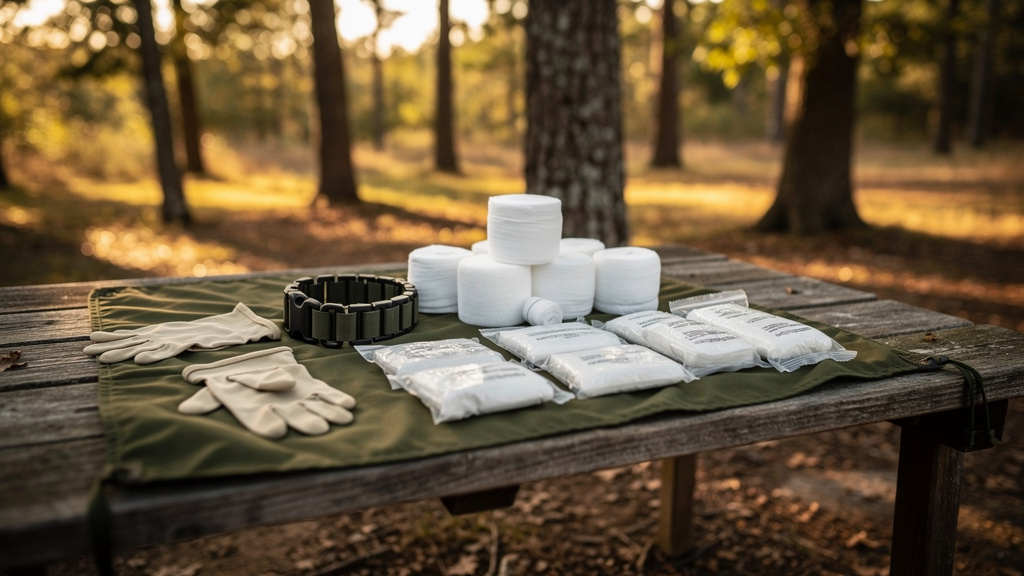
In a normal Tuesday, an ambulance reaches you in 8–12 minutes . During a regional disaster, that response time stretches to hours. In a prolonged grid-down scenario, it may not come at all. The gap between when someone gets hurt and when professional medical care arrives is your responsibility to bridge.
Medical preparedness covers three capabilities: stop the bleeding (trauma skills that prevent death in the first minutes), treat the common (managing wounds, illness, and infection over days to weeks), and sustain health (medication strategy and hygiene that keep chronic conditions managed and disease at bay).
→ Read First 30 Days (medical chapter, 15 min) Trauma · Infection · Stockpile
When to seek professional help — non-negotiable thresholds
These conditions require immediate professional medical care (call 911 / activate EMS / arrange immediate transport). If transport is genuinely impossible, the procedures on this site buy time — they are not a substitute for definitive care:
- Uncontrolled hemorrhage that doesn't stop with direct pressure within 2–3 minutes (tourniquet buys 2–6 hours, not a cure)
- Penetrating chest or abdominal wound, any chest pain with shortness of breath, suspected internal bleeding
- Anaphylaxis (severe allergic reaction with airway swelling or shock) — administer epinephrine and seek emergency care
- Loss of consciousness, stroke symptoms (face droop / arm weakness / speech difficulty per AHA FAST guidance), seizure lasting >5 min, suspected spinal injury
- Fever ≥104°F (40°C) in adults, ≥100.4°F (38°C) in infants under 3 months, or any fever with stiff neck, confusion, or rapid breathing (sepsis indicators per ACEP)
- Severe burns covering >10% body surface area in adults, >5% in children, OR any burn to face, airway, hands, genitals, or major joints
Educational content on this site assumes professional care is delayed or unavailable. Do not use it to avoid professional care when professional care exists.
Where to start
Three audience-segmented entry paths — start with the one that matches your current household:
If you're brand-new to medical preparedness (single household, urban or suburban, no chronic conditions):
- Take a Stop The Bleed class — free, 2 hours, available at stopthebleed.org (American College of Surgeons program). The single highest-return medical training for non-professionals.
- Build a basic home medical kit — beyond the drugstore version: thermometer, pulse oximeter, oral rehydration solution (ORS) ingredients, broad-spectrum antibiotic ointment, sterile wound supplies, blood pressure cuff.
- Stock a 30-day buffer of every prescription medication in your household per stockpiling strategy. Most US insurance plans allow 90-day fills with prescriber consent.
If you have basics covered (kit built, medications stocked, looking to deepen):
- Wilderness First Aid or Wilderness First Responder certification (16 hr WFA, 80 hr WFR — moderate to significant investment) expands your competence dramatically beyond Stop The Bleed.
- Build a dedicated individual first aid kit (IFAK) for trauma response separate from the home kit — CAT or SOFTT-W tourniquet, chest seals, wound packing gauze, pressure bandage, trauma shears.
- Learn triage — the START system for sorting multiple casualties when help is overwhelmed.
If you serve vulnerable populations (infants, elderly, chronic conditions, medical devices in-home):
- Inventory medication temperature requirements (insulin, biologics) and pair with Energy planning for refrigeration backup during outages.
- Build redundancy: 90-day medication buffer, oxygen concentrator backup power, glucose monitor strips at 2× usual consumption, durable medical equipment manual reserves.
- Coordinate with community vulnerable-members planning — neighbors, mutual-aid groups, and disability-services contacts who can help if you become incapacitated.
Field note
Build two kits, not one. An individual first aid kit (IFAK) rides on your person or in your bag — it handles trauma in the field. A home medical kit lives in your house with broader supplies for ongoing care: wound management, OTC medications, prescription reserves, dental emergency supplies, and reference materials. The IFAK has 6–8 items optimized for the first 10 minutes; the home kit has 60+ items optimized for the first 30 days.
What this hub covers — and what it doesn't
This page routes to the Survipedia medical content intended for non-professionals when professional help is delayed. It covers:
- Trauma and wound care that buy time until definitive medical care
- Common conditions (infection, dehydration, hypothermia, heatstroke, allergic reactions)
- Sustaining health during prolonged disruptions (medication stockpiling, hygiene, dental)
- Specialized scenarios (childbirth, gunshot wounds, mass-casualty triage, pandemic, herbalism)
It deliberately does not cover: surgical procedures, ventilator management, ICU-level critical care, controlled-substance dependency management, chronic-disease drug titration, or psychiatric crisis management beyond stabilization and 988 routing. Those domains require formal training, current credentials, and supervised practice that this site cannot provide.
Stop the bleeding
Uncontrolled hemorrhage is the number-one preventable cause of death in trauma per Tactical Combat Casualty Care (TCCC) guidelines and the Stop The Bleed program (American College of Surgeons). The skills to stop it are simple, teachable in an afternoon, and have saved more lives outside hospitals than any other intervention since the practice expanded post-9/11.
- Direct pressure and wound packing — the foundation skill that handles most serious bleeds; works on extremity, junctional (neck/groin/axilla), and truncal wounds
- Tourniquet application — correctly applied to a limb, buys 2–6 hours for definitive care per TCCC; CAT and SOFTT-W are the field-proven designs
- Chest seal placement — manages penetrating chest wounds and prevents tension pneumothorax (air trapped in the pleural space that progressively crushes the lung and heart) until surgical intervention
Training is not optional
A tourniquet applied wrong is worse than no tourniquet. A chest seal placed without understanding tension pneumothorax creates a false sense of security. Take a Stop The Bleed class (free, 2 hours, available in most US counties) or a Wilderness First Aid certification (16 hours, affordable to moderate investment). Practice quarterly at minimum — perishable skills decay within 6 months without repetition per Red Cross retraining guidance.
Treat the common
After the immediate emergency, medical care shifts to managing what happens over the next days and weeks.
- Wound care — cleaning, closing, dressing, monitoring; prevents small injuries from becoming life-threatening when antibiotics are scarce
- Burns — depth-based assessment, cooling protocol, when to evacuate
- Fractures — splinting principles for forearm / lower leg / upper arm / femur using SAM splints or improvised materials
- Shock — hypovolemic, anaphylactic, septic, neurogenic — recognition and immediate management
- Infection — the real killer in prolonged scenarios; warning-sign timeline and decision tree for empiric antibiotic use when professional care is unreachable
- Dehydration — the most common medical problem in disaster settings; ORS dosing protocols per WHO 2002 formula and severity-based escalation from oral to rectal to IV rehydration
The single highest-value formula on this page: oral rehydration solution (ORS) per WHO 2002 reduced-osmolarity guidance: 1 liter (34 oz) clean water + 6 teaspoons sugar (sucrose) + 1/2 teaspoon salt + (if available) 1/2 teaspoon salt substitute (potassium chloride) . ORS saved more lives in the 20th century than any single antibiotic. Learn it by heart.
When clean drinking water itself is the constraint, route to Water — dehydration management is downstream of water sourcing.
Sustain health
Chronic conditions don't pause for emergencies. If anyone in your household takes daily medication — blood pressure, thyroid, insulin, psychiatric — a stockpiling strategy is essential. Most US insurance plans allow 90-day fills per CMS Part D guidance. Ask your doctor for an extra prescription citing emergency preparedness. Rotate stock using the oldest first.
For refrigerated medications (insulin, biologics, some vaccines): the Energy Foundation covers backup power for medical-device continuity during outages. Per CDC vaccine-storage guidance, the cold-chain window is 12–48 hours depending on product — verify your specific medication's manufacturer datasheet.
- Hygiene and sanitation — prevents waterborne illness, which kills more people post-disaster than the disaster itself per CDC Emergency Preparedness guidance
- Dental emergencies — temporary cement, clove oil for pain, abscess antibiotic protocol; a cracked tooth or lost filling is incapacitating without professional care
- Herbal and alternative remedies — honey as wound dressing has Cochrane-reviewed evidence; willow bark contains salicin (aspirin's precursor); supplements conventional medicine, doesn't replace it
Specialized trauma and conditions
Some injuries require specific assessment and treatment protocols beyond basic wound care.
- Gunshot wounds — rapid hemorrhage control, exit-wound management, casualty positioning by wound location
- Emergency childbirth — delivery procedures when hospital transport is impossible; cord management, postpartum hemorrhage response, newborn assessment
- Triage — the START (Simple Triage And Rapid Treatment) system for sorting multiple casualties by treatment priority; critical in any mass casualty scenario
- Allergic reactions — anaphylaxis (severe systemic allergic reaction with airway/circulatory compromise) requires immediate epinephrine and airway management
Environmental conditions create their own medical emergencies.
- Hypothermia — passive rewarming (insulation + warm fluids) for mild cases, active rewarming (cold-water immersion contraindicated; bair hugger or warm-water lavage indicated) for moderate-to-severe per Wilderness Medical Society staging
- Heatstroke — rapid cooling to below 102°F (38.9°C) per Korey Stringer Institute consensus; cold-water immersion is the gold-standard intervention
- Pandemic preparedness — personal protective equipment (PPE) protocols, quarantine planning, surge-capacity planning per CDC pandemic guidance
- Tick bites and Lyme disease — field-removal procedure, when prophylactic doxycycline is indicated per IDSA 2020 guidelines, symptom timeline distinguishing Lyme from common viral illness
Herbalism and natural medicine
- Medicinal herbs — 15 plants with documented therapeutic use — echinacea, chamomile, yarrow, elderberry, and others — that offer supplemental treatment when conventional medicine is unavailable
- Herb safety rules — drug interactions (St. John's wort affects CYP450 liver enzymes; valerian potentiates CNS depressants); pregnancy contraindications; Clark's Rule pediatric dosing
- Herb preparation methods — tinctures (alcohol extraction), infusions (water extraction of leaves/flowers), decoctions (water extraction of roots/bark via simmer), salves (oil + wax topical), poultices (mashed plant directly on skin); each extracts different compounds with different shelf lives
- Drying and storage — 95–115°F (35–46°C) dehydrator temperatures, amber glass containers, below 60% RH per USDA NCHFP guidance; preserves potency 1–5 years
- Medicinal garden design — integrates these plants into a practical growing plan with companion planting and seasonal calendars
Common questions
How much should a basic home medical kit cost? A useful kit runs $150–$300 USD assembled from individual components; pre-packaged "deluxe first aid kits" are usually overpriced and underspec'd. Build component-by-component from the home medical kit list.
Are fish antibiotics safe for humans? This is genuinely complicated. See veterinary antibiotics for the evidence-based assessment and the specific scenarios where this is a defensible last-resort decision.
What single training class should I take first? Stop The Bleed — free, 2 hours, available nationwide. Then a Wilderness First Aid (WFA) certification if you'll be far from medical infrastructure. Wilderness First Responder (WFR) for serious wilderness or off-grid living.
Does Survipedia replace a doctor? No. This site is for situations where professional care is delayed or temporarily unavailable. Use it to extend the window during which conventional medicine reaches you, not to avoid medical care that exists.
Your single next step: complete the First 30 Days medical chapter — it sequences trauma readiness, kit assembly, and prescription stockpiling into a 30-day plan that builds on this hub's three-capability framework. For the foundational assessment and treatment skills that underpin every other page in this Foundation, see first aid basics. For formal certification beyond Stop The Bleed, see training.