No power + medical-device household — quick playbook
Life-safety scenario
If anyone is unresponsive, severely short of breath, or showing signs of diabetic ketoacidosis (deep rapid breathing, fruity breath, confusion), call 911 first and stay on the line. This playbook is for households where the patient is currently stable but device-dependent. It does not substitute for emergency medical care when symptoms are active.
Page Action Block
- Do this first: Open the device priority list below and identify which device in your house has the shortest battery runtime. That's your first priority. For most households this is a CPAP (overnight) or a continuous oxygen concentrator (hours).
- Time required: 15 min stabilize → 72 hr maintenance
- Cost: free (using on-hand battery) to significant investment (renting a generator mid-outage at $150–$400/day)
- Skill level: beginner to intermediate (some routing depends on knowing how to read your device's manual)
- Tools needed: device manuals, a battery-powered or hand-crank radio, your phone with charger, written list of medications and physicians, power station or portable generator if available, cooler workflow materials for refrigerated meds
- Safety warnings: Running a gasoline generator indoors or in an attached garage kills people every outage. Carbon monoxide is odorless and acts in minutes. See
energy/generators.md§ Carbon monoxide safety. - Legal / regional caveats: Many U.S. utilities maintain a "medical baseline" or "life-support" registry that prioritizes restoration for registered addresses. If you have not yet registered, do so during the outage and again afterward — it doesn't help this incident but it helps the next one.
- Last reviewed: 2026-05-19
- Source hierarchy: American Association for Respiratory Care Patient Assessment in the Home and Alternate Site (Tier 1), American Diabetes Association Standards of Care in Diabetes 2025 (Tier 1), CDC Power Outages and Medical Devices (Tier 1), FEMA Functional Needs Support Services (Tier 1).
- Next 3 links: Chronic conditions in emergencies, Cold chain during power outages, Medical-dependent household preparedness.
Trigger and pre-conditions
The precipitating event is loss of household electrical power — utility outage, weather event, equipment failure, or planned shutoff — affecting a household that includes at least one member who depends on a powered or refrigerated medical device for daily function or survival. This playbook assumes the patient is currently stable (not in active medical crisis), there is no immediately available alternate power source plumbed into the home (no whole-house generator or solar-with-battery), and that the household has — at minimum — the device's standard accessories and the patient's documented medication list within reach. The 72-hour outcome this playbook delivers: continuous device operation through the outage window, no medication degradation, no preventable clinical decompensation, and a clear escalation point if the outage extends beyond device endurance.
T+0 to T+15 minutes — Stabilize
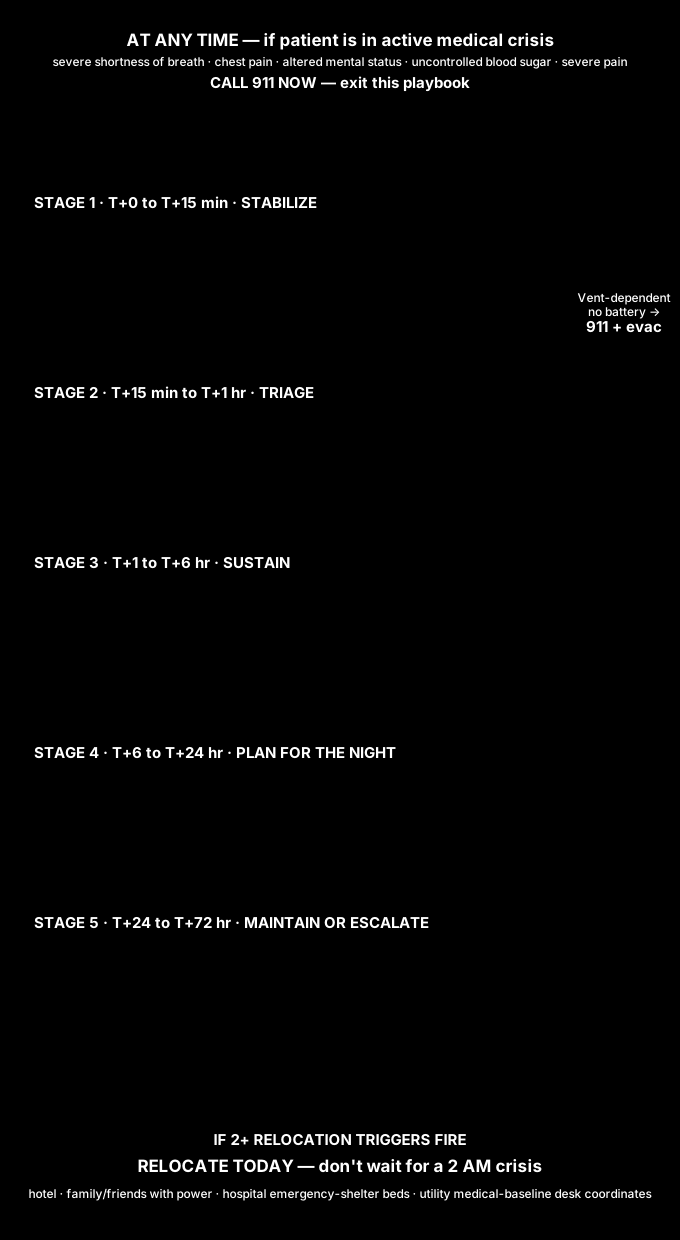
Goal: Confirm the patient is stable. Identify which device in the house has the shortest endurance under its current power source. Decide if 911 or an emergency department visit is the right call right now.
- Check the patient first. Are they breathing comfortably? Conscious and oriented? Not in pain beyond their baseline? If a device just stopped working (e.g., CPAP shut down mid-sleep, oxygen concentrator alarmed) and the patient is now uncomfortable or symptomatic, this is a clinical event, not just a power outage — call 911. Do not stay in this playbook if the patient is decompensating.
-
List every powered or refrigerated medical item in the house. Common examples and their typical endurance without grid power:
Device Typical endurance off-grid Battery / backup needed CPAP / BiPAP 0 (most have no battery) Manufacturer battery pack or 12V DC adapter + power station Stationary oxygen concentrator 0 Backup oxygen cylinders (E or M tanks) Portable oxygen concentrator 2–8 hours on internal battery Spare batteries + AC charger backup Home hemodialysis machine 0 (must continue at center) Transportation, not power, is the answer Peritoneal dialysis cycler 6–8 hours via manual exchange Manual PD supplies + clean technique Insulin (refrigerated) 24–48 hours at room temp safely Cooler workflow + ice Refrigerated biologics (e.g., Humira, Enbrel) Drug-specific: 14 days to room-temp ruined depending on label Cooler workflow per drug Powered wheelchair 12–24 hours from full charge depending on use DC charger + power station, or accessible alternative Stair lift / patient lift 0–8 hours (depends on built-in battery) Patient transfer plan if elevator/lift fails TENS / pain pump (implanted) Days to weeks on internal battery Schedule refill or recharge before deplete Cardiac monitor / Holter 24–72 hours Spare batteries Nebulizer 0 (some have battery option) Battery model or rescue inhaler as backup -
Rank the devices by remaining endurance. Whichever device runs out first is your first priority. For most households this is CPAP (zero internal battery, overnight need) or a continuous oxygen concentrator (zero internal battery, hours-to-days need).
- Call the utility's outage line and confirm you're on the medical-baseline list (if registered). Many U.S. and Canadian utilities prioritize restoration for registered addresses. If you're not registered, ask to be added now — the call counts as documentation and may influence current-incident response.
- Check the time. Outage at 2 PM with CPAP need at 10 PM gives you 8 hours of daylight to source backup power. Outage at 11 PM with the same need gives you minutes. Time-of-day shapes everything below.
Decision criteria:
- IF the patient is in active medical crisis (severe shortness of breath, chest pain, altered mental status, uncontrolled blood sugar, severe pain beyond baseline) → 911 immediately. This playbook resumes after they're stable.
- IF the patient is on home hemodialysis and a treatment is missed → contact the dialysis center within 1 hour, not 24. Centers have emergency protocols and may run the patient at the center on a different power system.
- IF the patient is dependent on an electrically powered ventilator and there is no immediate battery backup → 911 and prepare for evacuation to a hospital or alternate care site. Ventilator-dependent patients are not a 72-hour-playbook scenario; they are a 60-minute-evacuation scenario.
Failure modes:
- "It's just a short outage": Most outages do end in <4 hours, but the 90th-percentile outage during a major weather event runs 24–48 hours. Plan for the long tail; you can stand down later.
- Battery showing "full": A 5-year-old internal battery rated for 8 hours new often delivers 1–2 hours in real use. Trust empirical run-time from your last test, not the spec sheet.
- Forgetting about the implanted device: Pacemakers, ICDs, deep-brain stimulators all run on internal batteries with months-to-years endurance — usually not an immediate concern, but verify the device's last interrogation date and battery status.
T+15 minutes to T+1 hour — Triage and contain
Goal: Connect every priority device to a working backup power source. Start the refrigerated medication cooler workflow. Notify the people who need to know.
- Inventory available power sources. In order of preference:
- Manufacturer-spec medical battery pack designed for the device (CPAP battery, portable oxygen battery). Best option — designed for the load and the device's startup current.
- Power station (lithium-iron-phosphate preferred for medical loads — pure sine wave output is mandatory; modified sine wave damages CPAP humidifier circuits and some oxygen concentrators).
- DC adapter for the device, paired with a vehicle running outdoors or a marine deep-cycle battery. Note: most modern CPAPs are 24V native internally (ResMed AirSense 10/11, AirCurve 10, Lumis VPAP all run on 24V DC at the device input — per the ResMed Power Supply Compatibility List). They run from a 12V source only through a manufacturer-spec 12V-to-24V DC converter (typically 90W, accepting 9–32V DC input). Plugging a 12V cigarette-lighter cord straight into a CPAP designed for 24V will either not power it or will under-power and damage the humidifier circuit. Verify the converter is the manufacturer's spec or a UL-listed equivalent. Portable oxygen concentrators are typically 19–24V DC and ship with a vehicle adapter; check the manual.
- Portable generator sited safely outdoors per
energy/generators.md§ Carbon monoxide safety — never inside, never in an attached garage, never within 20 ft (6 m) of any window, door, or vent. CDC and CPSC recommend a battery-powered or battery-backup CO alarm outside every sleeping area whenever any combustion equipment (generator, kerosene heater, gas stove for heat) is in use; if you do not currently have one, this is the most important $25 purchase in this scenario. - Pre-arranged neighbor with a generator or power station — call them now, not at midnight.
- Connect priority devices in order:
- Continuously-operating life-support (oxygen concentrator if currently dependent, ventilator).
- Soon-needed devices (CPAP if night is approaching).
- Refrigerated medication preservation (run the fridge intermittently — see step 3).
- Mobility / lift devices (powered wheelchair charging, stair lift battery).
- Communication (phones, hand-held radios).
- Start the cooler workflow for refrigerated meds. The full procedure is in
medical/cold-chain.md. The short version:- Identify what needs to stay cold: insulin, biologics like Humira / Enbrel / Stelara, some antibiotics, some chemotherapy drugs. Many other refrigerated items (some eye drops, GLP-1 agonists like Ozempic that are in use) have surprisingly long room-temperature tolerance — check each drug's label.
- Pull cold items into a cooler with ice or frozen gel packs. Add a thermometer.
- Target zone is 36–46°F (2–8°C). Below 32°F (0°C) freezes most biologics, which destroys them.
- Keep the fridge closed except during planned transfers; an unopened fridge holds safe temperatures for ~4 hours.
- Tell the right people:
- The patient (calmly): which devices are running, on what power, for how long.
- A second responsible adult in the household: where the device manuals are, the medication list, and the emergency-contact list.
- The treating physician's office or on-call line if the outage is expected to extend beyond device or medication endurance.
- The utility's medical-baseline desk (if you're registered).
- A neighbor or nearby family who can help if something escalates while you're managing the patient.
Decision criteria:
-
IF you have a generator: site it outdoors, ≥20 ft (6 m) from openings, then connect directly to devices via heavy-duty extension cords. Never backfeed the panel without a transfer switch.
The generator-to-device rule in 4 lines: - Cord ampacity: 12 AWG minimum to 50 ft (15 m) at 15 A; 10 AWG for longer runs or higher current. Cord rating must exceed device draw; ground conductor intact. - Cord pass-through: foam-strip pass-through, window cord port, or flat-profile cord only — a round cord pinched in a closing door damages insulation and starts fires. - Never: plug the generator into a wall outlet ("suicide cord" — backfeeds the grid and can electrocute utility workers); daisy-chain power strips on a single run. - Weather: no rain on the unit unless it has an outdoor-rated weather cover.
Full NEC Article 702 + Article 400 detail in
energy/generators.md. - IF you have no immediate backup and the device that runs out first is needed within 2 hours → start sourcing now. Hardware stores, big-box retailers, and rental yards stock generators and power stations during outages. Stores closer to the outage edge are more likely to have inventory; stores deep in the outage zone may be closed or have run out. - IF the device is a CPAP and the outage is during daylight → you have until bedtime. Treat this as urgent but not immediate; you can address generator sourcing and other priorities in parallel.
Failure modes:
- Generator damages a CPAP: A modified-sine-wave inverter (common in cheap generators and many vehicle inverters) can damage CPAP humidifier electronics. Pure sine wave only for medical devices, full stop.
- Cooler temperature unmonitored: A cooler without a thermometer is just a box. Drugstore-grade refrigerator thermometers cost $5–$15 and are mandatory in a medication cooler.
- Freezing insulin: Direct contact between an insulin vial and an ice pack will freeze the insulin and destroy it. Wrap vials in a clean cloth and keep them on a divider above the ice. See
medical/cold-chain.md§ Cooler workflow.
T+1 to T+6 hours — Sustain
Goal: Operate the devices reliably on backup power. Manage the patient's daily routine without grid power. Source additional power if endurance is short.
- Establish a power rotation. With limited battery capacity, you can't run everything continuously. Decide:
- What runs continuously (the oxygen concentrator if currently in use, the cooler thermometer if powered).
- What runs intermittently (the fridge — run for 30 min every 4 hours to keep contents below 40°F / 4°C is roughly right but watch the thermometer).
- What charges between uses (CPAP battery for the night, wheelchair battery overnight).
- What's off entirely (lights, entertainment, non-essential appliances).
- Monitor the patient's clinical baseline. Anything that's normally measured (blood glucose, blood pressure, oxygen saturation, peak flow) should be measured at least every 4 hours during the outage and logged with the time. Patterns matter — a single high reading at hour 3 followed by a higher reading at hour 6 is a worsening trend even if both numbers are individually "acceptable."
- Run the medication routine on time. Power outages don't change dosing schedules. The bigger risk is missed doses because the routine got disrupted, not because the medication degraded. Use phone alarms (or a battery-powered timer) and pre-position doses next to a flashlight.
- Manage the cooler actively. Check the thermometer every hour. Add ice or fresh gel packs before the temperature crosses 46°F (8°C); do not wait until the cooler is warm. Stores sell ice during outages; freezers a few miles outside the outage zone are sources for gel packs if you have access.
- Plan for the next 18 hours. Most outages restore within 6 hours. If yours hasn't, you're now in the long-tail outage. Three escalation triggers:
- Power source endurance — your current backup will not last until expected restoration. Source more capacity now.
- Medication supply — refrigerated medication endurance (in cooler at safe temperature) will run out before pharmacy access returns. Plan replacement.
- Patient deterioration — clinical baseline is drifting. Contact treating physician or move to a healthcare facility.
- Coordinate with neighbors and community. A neighborhood-level outage means the people nearby are in the same situation. If you have surplus capacity, offer it; if you have shortfall, ask. See
community/mutual-aid.md§ Rapid response. Even one neighbor with a working generator can host the household's CPAP for the night.
Decision criteria:
- IF the outage is expected to exceed 12 hours and you have insufficient power capacity → escalate to one of: (a) generator rental from a local rental yard ($150–$400/day plus fuel), (b) relocate the patient to a friend, family, hotel, or emergency shelter with power, (c) call the utility's emergency social-services line — many have warming/cooling centers with medical accommodations during extended outages.
- IF the patient is on continuous oxygen and the concentrator's runtime won't reach restoration → switch to backup oxygen cylinders per the prescription's emergency plan. Most oxygen patients receive an emergency-cylinder allocation from their durable-medical-equipment (DME) provider — typically 2 E cylinders (660 L each). At a 2 L/min flow rate, that's ~5.5 hours per cylinder. See
medical/chronic-conditions.md§ Oxygen therapy. - IF the patient is on peritoneal dialysis and the cycler is down → switch to manual exchanges per the patient's training; the cycler is a convenience over manual, not a clinical necessity. Contact the dialysis center for confirmation.
Failure modes:
- "The fridge is staying closed so the meds are fine": A standard household fridge holds 36–40°F for about 4 hours when closed. Beyond that, you need active cooling — the cooler workflow.
- Trusting a phone's emergency alert to wake you: A dead phone is silent. Charge phones whenever you have spare power-station capacity.
- Skipping the clinical-baseline check because "nothing has changed": The patient's worsening trend during an outage is gradual and easy to miss. The 4-hour vital-signs check exists for exactly this reason.
T+6 to T+24 hours — Plan for the night
Goal: Run the priority devices safely through the night. Make sleep work for the patient and the caregivers. Don't let exhaustion erode the response.
- Charge everything that needs to be charged, in priority order, before nightfall:
- CPAP battery to full.
- Phone(s) to full.
- Powered wheelchair to full if it's been used today.
- Spare lithium-ion batteries for portable oxygen / power station.
- Headlamps and flashlights.
- Pre-position everything for the night. Bedside: the patient's medication for any nighttime dose, a phone with the on-call physician number, a flashlight, the CPAP battery and tubing, a glass of water (uncontaminated if there's a separate water issue). Bathroom: a flashlight, any required mobility aids that don't need power. Cooler: a thermometer reading taken at lights-out.
- Set up the caregiver shift. If two adults are present, agree on who is "on" first half of the night vs. second half. A medical-dependent household during a power outage is not a normal night — assume both adults will not sleep through it. If only one caregiver is present, set phone alarms every 2–3 hours to check on the patient, the cooler, and the devices.
- Plan tomorrow's meals around the constraints. The fridge has been cycling on and off for 6+ hours; treat perishables with caution. Eat what's near the threshold first: dairy, leftovers, opened meat products. Save unopened canned and dry goods. See
food/pantry-meals.md§ No-cook meals. If the household includes someone with chronic conditions that constrain diet (diabetes, kidney disease, celiac), plan their meals first. - Run the device check at lights-out:
- CPAP/BiPAP: connected to charged battery; battery rated for the patient's typical sleep cycle (8–10 hours); humidifier off if low on power or use waterless mode if available.
- Oxygen concentrator: running, cannula confirmed in place; backup cylinders staged within reach.
- Cooler: thermometer reading in safe range; spare ice or gel packs ready in a separate cooler.
- Powered wheelchair: parked within reach of the bed, fully charged.
- Phones: charged, on silent for the patient but the caregiver's phone audible for the on-call physician's office.
- Document the day for the medical record. Times of every device change, every medication dose, every clinical-baseline measurement. This document goes to the treating physician at the next contact and to the emergency department if escalation becomes necessary. It also helps if insurance or DME providers question coverage for emergency battery or generator costs.
Decision criteria:
- IF the outage is expected to extend through the next day → start planning the relocation now. Hotels closest to the outage zone fill first; calling at 8 PM gives more options than calling at 8 AM the next morning.
- IF the caregiver(s) are exhausted to the point of impaired judgment → ask a neighbor, family member, or friend to come stay for the night. This is one of the strongest indicators for a temporary relocation to family or friends' housing.
- IF the patient's clinical baseline is drifting (oxygen saturation slowly dropping, blood glucose rising despite dosing) → contact the on-call physician tonight, not "first thing in the morning." Overnight drift in a powered-device-dependent patient is a meaningful trend.
Failure modes:
- Caregiver sleeps through device alarm: Position devices so audible alarms reach the caregiver's bed; use a baby monitor or smart-speaker intercom if the patient is in a separate room.
- Battery percentage misread in the dark: Verify every device's charge level under good light before bedtime; alarms in the middle of the night with no charge are too late.
- Forgetting to keep refilling the cooler: A cooler going from 38°F to 50°F overnight ruins the insulin. The thermometer check at lights-out is mandatory.
T+24 to T+72 hours — Maintain or escalate
Goal: Run the established rhythm reliably. Make the call about whether to keep going in place or relocate. Coordinate with the broader response system.
- Daily morning check:
- Patient clinical baseline at full assessment depth (vitals, symptoms, mental status, mobility).
- Every device's remaining endurance.
- Medication supply (refrigerated and shelf-stable).
- Cooler temperature trend over the last 12 hours.
- Utility restoration update.
- Fuel/charge supplies for the day's power needs.
- Sustain the routine through the second day. The mid-incident slip is real: caregivers tire, routines drift, the fridge gets opened "just once" because someone forgot. The morning brief and a written daily checklist counteract this. Print or write today's checklist and tape it to the kitchen counter.
- Coordinate with the treating clinician daily if the outage extends past 24 hours. Many physicians' offices will pre-authorize an extra refrigerated medication delivery, an emergency prescription refill, or a temporary alternate medication if the cold-chain workflow can't be sustained. Pharmacies in unaffected areas can sometimes ship overnight to your address.
- Watch for cascade. The 72-hour outage is rarely just about power. Sewer pumps may fail, water pressure may drop in some neighborhoods, traffic signals are out, gas stations may not be pumping. If the outage is part of a regional event, the response widens — see
guides/grid-down-survival.mdandscenarios/winter-outage-72hr.mdif cold weather is also involved. -
Make the relocate-or-stay decision deliberately. The triggers for relocation:
- Backup power capacity has dropped to <12 hours of remaining device runtime with no clear refresh.
- Refrigerated medications are at hour 36 of cooler operation with no fresh ice expected.
- The patient's clinical baseline has drifted beyond acceptable margins.
- The caregiver(s) are exhausted to impaired-judgment level.
- The outage ETA has shifted from "tomorrow" to "we don't know."
If two or more of those are true, relocate today. Don't wait for a crisis. Hotels, hospitals' emergency-shelter beds, family or friends with power, and (in registered states) community emergency shelters with medical accommodations are all options. The utility's medical-baseline desk often coordinates this. 6. When power returns: - Don't immediately disconnect the cooler. Verify the household fridge is back to 36–40°F (2–4°C) before transferring medications back. A "power back" event is often followed by a second outage within 2–4 hours as the utility stabilizes the grid; the first return is sometimes a partial restoration. - Run every device on AC power for an hour before relying on it for the patient; some devices have fault states after sudden shutdown and need a clean restart. - Document the incident timeline and total cost (rented generator, fuel, hotel, replacement medications, lost food). The treating physician should see this at the next visit; some costs are reimbursable through the utility's medical-baseline program, homeowner's or renter's insurance, or (during declared disasters) FEMA Individual Assistance.
Decision criteria:
- IF the patient develops a new symptom that wasn't present before the outage (chest pain, worsening shortness of breath, confusion, fever) → escalate to clinical care immediately. Power outages cause real clinical decompensation in medically-fragile patients; don't dismiss new symptoms as "just tiredness."
- IF the utility's restoration ETA stretches past 5 days → relocation is almost certainly the right call. A 5-day outage exceeds most household battery, fuel, and medication-cooler capacity, and exhaustion alone makes errors more likely.
- IF a second outage hits during initial restoration (common with weather events) → return to T+0 with the assumption that endurance budgets are now half what they were originally; you've used the first day's reserves.
Failure modes:
- Caregiver minimizes the patient's symptoms because the outage is "almost over": Optimism bias kills patients in outages. Treat symptoms on their own merits; don't grade them against the expected timeline.
- Returning meds to the fridge before it's cold: A medication going through a second warming cycle (cooler → not-yet-cold fridge → eventual cold fridge) is at higher risk than one held in the cooler the whole time. Verify fridge temperature first.
- Discarding lessons from the incident: A 72-hour outage that you survived is the cheapest training you'll ever get for a longer one. Document what worked, what didn't, and update the household's emergency plan before the next outage.
Cross-Foundation routing
| If this becomes a problem | Read this |
|---|---|
| Refrigerated medication temperature breach | medical/cold-chain.md § Cooler workflow |
| Generator carbon-monoxide concern | energy/generators.md § Carbon monoxide safety |
| Need to size or buy a power station for medical loads | energy/power-stations.md § Runtime calculations for critical loads |
| Oxygen cylinder math and emergency reserve sizing | medical/chronic-conditions.md § Oxygen therapy |
| Manual peritoneal dialysis without the cycler | medical/chronic-conditions.md § Dialysis |
| Insulin storage edge cases (frozen, warm, in-use vs. unopened) | medical/cold-chain.md § Insulin |
| Wheelchair / mobility lift backup planning | mobility/disabled-access.md |
| Coordinating with neighbors during outage | community/mutual-aid.md § Rapid response |
| Cold weather adds to the outage | scenarios/winter-outage-72hr.md |
| Extended outage shifts to regional grid-down | guides/grid-down-survival.md |
| Caregiver coordination and burnout | medical/elder-care.md § Caregiver burnout |
| Medical-dependent household reference hub | guides/medical-dependent-household.md |
Printable summary
No power + medical-device household — 72-hour playbook
T+0–15 min — Stabilize 1. Check patient: stable? If decompensating → 911. 2. List every powered/refrigerated medical item; rank by remaining endurance. 3. Identify shortest-endurance device — that's priority #1. 4. Call utility outage line; confirm medical-baseline registration. 5. Note the time-of-day. Watch for: Old batteries deliver fraction of rated time.
T+15 min–1 hr — Triage 1. Inventory backup power: manufacturer batteries → power station → 12V/vehicle → generator → neighbor. 2. Connect priority devices in order: life-support → soon-needed → fridge → mobility → comms. 3. Start cooler workflow for refrigerated meds (target 36–46°F). 4. Notify: patient calmly, 2nd adult, physician's office, utility medical desk, nearby neighbor. Watch for: Modified-sine-wave inverter destroys CPAP — pure sine wave only.
T+1–6 hr — Sustain 1. Set up power rotation: continuous / intermittent / charging / off. 2. Clinical-baseline check every 4 hr (BG, BP, SpO2, peak flow as applicable). 3. Run medication schedule on time — phone alarms. 4. Manage cooler every hour; add ice before warm. 5. Plan next 18 hr; escalate if endurance won't reach restoration. 6. Coordinate with neighbors. Watch for: Fridge holds safe temp ~4 hr closed only — cooler is required after.
T+6–24 hr — Plan for the night 1. Charge everything to full before nightfall. 2. Pre-position bedside: meds, phone, flashlight, CPAP battery, water. 3. Set caregiver shift; alarms every 2–3 hr if solo. 4. Plan tomorrow's meals around constraints; eat near-threshold first. 5. Lights-out device check: CPAP, oxygen, cooler, wheelchair, phones. 6. Document the day. Watch for: Cooler drifts overnight — thermometer at lights-out is mandatory.
T+24–72 hr — Maintain or escalate 1. Morning check: patient, devices, meds, cooler, utility, fuel. 2. Coordinate with treating clinician daily if outage extends. 3. Watch for cascade (sewer, water, traffic, fuel). 4. Relocate if 2+ triggers fire (endurance <12 hr, cold-chain at 36+ hr, baseline drift, exhaustion, ETA "we don't know"). 5. When power returns: verify fridge cold before transferring meds; run devices on AC for 1 hr before reliance; document. Watch for: Optimism bias near restoration — symptoms still need treatment.
FAQ
How long can insulin sit at room temperature before it's ruined?
Per FDA emergency-preparedness guidance and manufacturer labels: insulin vials and pens (opened or unopened) may be kept at controlled room temperature (59–86°F / 15–30°C) for up to 28 days and remain effective for most insulin formulations. Some specific formulations (Tresiba, Levemir, certain mixes) have different windows on the label — always check the package insert. The 28-day clock for in-use pens/vials starts when the insulin first reaches room temperature. The risk in a power outage is not normal room temperature — it's freezing (which destroys insulin instantly and irreversibly) or sustained heat above 86°F / 30°C (which degrades insulin gradually). See medical/cold-chain.md § Insulin for the full table by formulation.
Can I run my CPAP from my car?
Yes, with caveats. Most modern CPAPs (ResMed AirSense 10/11, Philips DreamStation, AirCurve, Lumis) are 24V DC native at the device's input jack — they do not accept a raw 12V feed and require the manufacturer's 12V-to-24V DC converter (typically a 90W unit accepting 9–32V DC). Some older units accept a true 12V DC adapter directly; check the manual and the label on the device's DC port. Once you have the correct adapter or converter, connecting to a running vehicle is the easiest path; the vehicle must be running, the cabin must be ventilated, and the vehicle must not be inside a garage attached to the house (carbon monoxide). A better long-term solution is a small power station (300–500 Wh) with pure-sine-wave AC output, which can run a CPAP for 8–10 hours without humidifier or 5–7 hours with humidifier — and which avoids the DC-converter compatibility question entirely by powering the CPAP through its standard AC brick. The cheapest immediate-incident path is the car; the cheapest long-term path is the power station. See energy/power-stations.md § Runtime calculations for critical loads.
What's the difference between modified sine wave and pure sine wave, and why does it matter for medical devices?
Modified sine wave inverters approximate AC power with a stepped waveform; pure sine wave inverters produce a smooth sinusoid identical to grid power. Many medical devices — particularly CPAPs with heated humidifiers, oxygen concentrators, and some infusion pumps — have power-conditioning circuits that misbehave or fail on modified sine wave. The damage is usually permanent and not always immediate; a CPAP might run on modified sine for a week before the humidifier circuit fails. Pure sine wave is non-negotiable for medical devices. Most power stations marketed for medical use are pure sine wave by default; cheap vehicle inverters and budget generators are usually modified sine wave.
Should I register on the utility's medical baseline list during the outage?
Yes, even though it doesn't help this specific outage. Registration creates a record that influences utility decisions during future outages (restoration prioritization, advance notification of planned shutoffs, sometimes utility-coordinated wellness checks during extended outages). Some utilities also offer financial assistance with backup power purchases for registered medical-baseline households. The call also creates a paper trail in case insurance or assistance program reimbursement comes into play later.
Is it safe to leave the patient on backup oxygen overnight without a caregiver awake?
Generally yes if the patient was clinically stable before the outage, the oxygen flow rate is the same as their prescribed setting, and the cylinder math shows endurance through the night with a 25% reserve. Monitor remotely with a smart-speaker intercom or baby monitor if you can; set caregiver phone alarms every 2–3 hours; brief the patient on how to call for help if they wake feeling worse. The caveat: any patient who is acutely requiring oxygen — not just chronically on it — should not be left without an awake caregiver during a power outage.
Can I use a portable oxygen concentrator's "pulse dose" mode to extend battery life if the patient is normally on continuous flow?
Only if the prescribing physician has documented that pulse dose is acceptable. Pulse dose mode delivers oxygen only during inhalation, which extends battery life significantly but doesn't suit every patient — those with high oxygen needs, fast respiratory rates, or specific clinical conditions (some pulmonary fibrosis, some advanced COPD) may not get adequate oxygenation on pulse mode. Don't switch modes without physician guidance. The right answer for most continuous-flow patients during an outage is to source more battery capacity, not to switch modes.
What about dialysis — can I skip a session?
For home hemodialysis: contact the dialysis center immediately, not "in a few hours." The center has emergency protocols and may treat the patient at the center if the center has power — note that only roughly a third of U.S. dialysis centers have on-site backup generators, but dialysis facilities are on the utility's priority-restoration list under CMS Emergency Preparedness Rule (42 CFR 494). The center will either run the patient locally, route to a partner center with power, or coordinate emergency transport. Skipping a session is medically dangerous and risks fluid overload, electrolyte derangement, and emergency hospitalization — patients with anuria can develop life-threatening hyperkalemia or pulmonary edema within 1–3 days of a missed session. For peritoneal dialysis: switch to manual exchanges per the patient's training; the cycler is convenience, manual is clinically equivalent (ISPD guidance). See medical/chronic-conditions.md § Dialysis.
How do I know when to give up on staying home and relocate?
Two-plus triggers fired means relocate today. Those triggers are: backup power capacity dropped to <12 hours of remaining device runtime, refrigerated medications at hour 36+ of cooler operation with no fresh ice, patient clinical baseline has drifted beyond acceptable margins, caregivers exhausted to impaired-judgment level, utility restoration ETA shifted from "tomorrow" to "we don't know." Two of those is the threshold. Don't wait until a crisis forces the move at 2 AM in the dark; make the call deliberately in daylight when you can pack medications carefully and choose a relocation destination that suits the patient's needs.
When to escalate beyond this playbook
This playbook is the right tool when one or more household members are stable but device-dependent, the outage is bounded (hours to a few days), and home is still a viable care environment. Switch out of this playbook when any of these are true: the patient becomes clinically unstable (active medical emergency — go to 911 and emergency-department care), the outage is part of a regional event lasting more than 5 days (go to guides/grid-down-survival.md for the longer arc), the patient requires care that this playbook isn't designed for (active labor, post-surgical recovery, acute mental-health crisis), or the household environment becomes unsafe for other reasons (no heat in winter, no cooling in summer above 95°F/35°C, structural damage, evacuation order). For the cold-weather case, see scenarios/winter-outage-72hr.md. For the extended-arc case with a medical-dependent household, see guides/medical-dependent-household.md for the full reference.
Tier 1 sources
- American Association for Respiratory Care. Patient Assessment in the Home and Alternate Site. AARC Clinical Practice Guidelines, accessed 2026-05-19.
- American Diabetes Association. Standards of Care in Diabetes — 2025. Diabetes Care, 2025;48(Suppl 1).
- Centers for Disease Control and Prevention. Power Outages and Medical Devices. Accessed 2026-05-19. https://www.cdc.gov/disasters/poweroutage/index.html
- Centers for Disease Control and Prevention. Carbon Monoxide Poisoning — Prevention. Accessed 2026-05-19. https://www.cdc.gov/carbon-monoxide/prevention/index.html
- U.S. Consumer Product Safety Commission. What to Know About Generators and Carbon Monoxide (CO). Publication 468, 2022. https://www.cpsc.gov/s3fs-public/468-WhattoKnowGenerators_2022.pdf (20-foot generator siting rule and battery-powered CO alarm guidance.)
- National Fire Protection Association. NFPA 70: National Electrical Code, 2023 edition. Article 702 — Optional Standby Systems (transfer switch requirements for any generator connection to premises wiring; prohibits parallel operation with utility — i.e., no "suicide cord" backfeeding). Article 400 — Flexible Cords and Cables (cord ampacity and protection-from-damage requirements for extension-cord runs). Article 210.8 (GFCI requirements in kitchens, bathrooms, laundry, basements, and within 6 ft of sinks).
- Underwriters Laboratories. UL 1741: Standard for Inverters, Converters, Controllers and Interconnection System Equipment for Use With Distributed Energy Resources, latest edition. (Pure-sine-wave output and total-harmonic-distortion requirements for inverters powering sensitive loads including medical devices.)
- ResMed. Power Supply Unit / Device Compatibility List. Document 10113885. https://document.resmed.com/documents/products/serviceandsupport/power-supply-unit-device-compatibility/10113885_psu-device_compatibility-list_glo_eng.pdf (24V DC native architecture of AirSense 10/11, AirCurve 10, Lumis VPAP, AirStart series; 12V-to-24V converter spec.)
- U.S. Federal Emergency Management Agency. Functional Needs Support Services Guidance. Accessed 2026-05-19. https://www.fema.gov/emergency-managers/individual-communities/individuals-access-functional-needs
- U.S. Centers for Medicare & Medicaid Services. Emergency Preparedness Rule for Healthcare Providers and Suppliers, 42 CFR 482, 483, 484, and 494 (ESRD/dialysis). (For provider-side dialysis center, home health, and hospice obligations during emergencies.)
- U.S. Food and Drug Administration. Information Regarding Insulin Storage and Switching Between Products in an Emergency. Accessed 2026-05-19. https://www.fda.gov/drugs/emergency-preparedness-drugs/information-regarding-insulin-storage-and-switching-between-products-emergency
- U.S. Food and Drug Administration. Drugs@FDA prescribing information for Humira (adalimumab), Enbrel (etanercept), Ozempic (semaglutide), and other refrigerated biologics — consult the current package insert for any drug-specific room-temperature window.
- U.S. Department of Agriculture, Food Safety and Inspection Service. Food Safety During Power Outages. (4-hour refrigerator rule.) https://www.fsis.usda.gov/food-safety/safe-food-handling-and-preparation/emergencies/keep-your-food-safe-during-emergencies
- International Society for Peritoneal Dialysis. Practice Recommendations (manual exchanges as clinical equivalent to cycler-assisted PD).
- Wilderness Medical Society. Clinical Practice Guidelines for Accidental Hypothermia: 2019 Update. (For cold-environment scenarios — referenced when winter outage is concurrent.)
Last reviewed: 2026-05-20 · Page Action Block: STANDARDS § 13 · Scenario format spec: SCENARIO-PLAYBOOK-FORMAT.md v1.1