Food
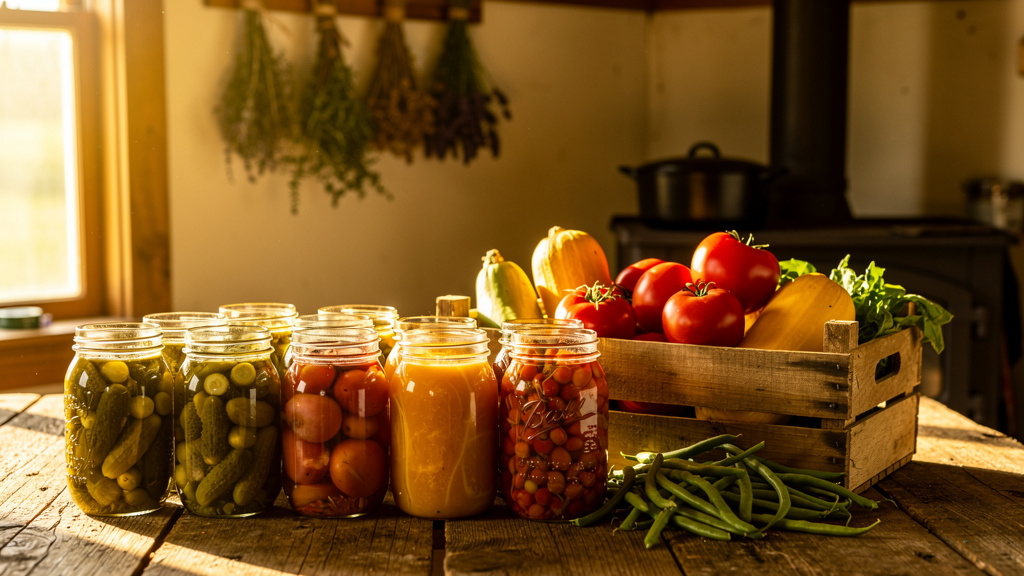
Grocery stores operate on a 3-day resupply cycle . When that cycle breaks — trucking disruptions, panic buying, regional disasters — shelves empty faster than most people believe possible. The 2020 supply-chain shocks proved this isn't theoretical: stores fully stocked on Monday had bare shelves by Wednesday per USDA Economic Research Service market analysis of pandemic disruptions.
Food preparedness works in three layers: pantry stock you eat and rotate daily, long-term storage that lasts years without refrigeration, and production capability that makes you independent of supply chains entirely. Each layer buys time for the next. A stocked pantry handles a 2-week disruption per FEMA Ready.gov. Long-term storage extends that to months. Growing, preserving, and harvesting your own food removes the ceiling.
→ Read First 30 Days (food chapter, 15 min) Storage · Canning · Gardening
When to seek professional help — food-safety thresholds
Food-safety errors can cause serious or fatal illness. These conditions require immediate medical attention (call Poison Control 1-800-222-1222 or 911) — and prevention is non-negotiable:
- Suspected botulism (Clostridium botulinum from improperly canned low-acid food) — blurred or double vision, drooping eyelids, difficulty swallowing, slurred speech, descending muscle weakness. Fatality rate without antitoxin: 5–10% per CDC. Never water-bath-can low-acid food; never eat from bulging, leaking, or off-smelling home-canned jars.
- Severe foodborne illness — bloody diarrhea, fever ≥101.5°F (38.6°C) lasting >3 days, dehydration with reduced urination, neurological symptoms (suspect E. coli O157:H7, Salmonella, Listeria per FDA Bad Bug Book).
- Suspected mold ingestion from grain storage — vomiting, headaches, neurological symptoms after consuming visibly moldy grain or flour (aflatoxin / mycotoxin exposure per FDA).
- Wild plant or mushroom ingestion with delayed symptoms 6+ hours after eating — high suspicion for Amanita or similar hepatotoxic species per the North American Mycological Association — survival depends on getting to an ER before liver failure begins.
Educational content here assumes you are managing food preservation and production correctly. When in doubt about a stored food's safety, the USDA rule applies: when in doubt, throw it out. Botulism is invisible, odorless, and survives modest heat — visual inspection alone is insufficient for jars processed without pressure.
Where to start
Three audience-segmented entry paths — pick the one matching your current household:
If you're brand-new (apartment or small household, no preparedness routine):
- Buy 2 extra of every shelf-stable item on your next 4 grocery trips per FEMA Ready.gov food guidance — builds a 2-week surplus without lifestyle change.
- Start one container garden this week: a 5-gallon (19 L) bucket with drainage holes, potting soil, and a single tomato, pepper, or herb plant. Total cost: under $25.
- Run a "pantry weekend" — eat only from stored food for 48 hours. You'll discover what's actually missing (typically: fats, spices, comfort items, fresh produce).
If you have basics covered (2-week pantry stocked, looking to scale to months):
- Build long-term storage of bulk staples: white rice + dried beans + rolled oats + sugar + salt in mylar bags with 300 cc oxygen absorbers inside food-grade 5-gallon (19 L) buckets per BYU food storage research.
- Learn one preservation method — water-bath canning is the easiest entry (no pressure equipment needed, but limited to high-acid foods per USDA NCHFP).
- Plan your first real garden — see gardening fundamentals, year-round planning, and your USDA Hardiness Zone last-frost date.
If you're building production capability (rural property, working toward independence):
- Expand to pressure canning for low-acid foods (vegetables, meats, soups) per USDA NCHFP — required for botulism safety, opens the full preservation range.
- Invest in food forest design, permaculture, small livestock, or aquaculture per your land and climate. Cross-references to Energy for cold-chain backup and Water for irrigation become structural.
- Run the caloric self-sufficiency math against your actual yields — most homesteads underestimate calorie deficit by 30–50% in year one.
Field note
Run a "pantry weekend" — turn off the grocery store for 48 hours and feed your household from stored food only. You'll immediately discover what's missing. Most people find they have plenty of carbs but almost no fats, spices, or comfort items like coffee. The gap between "I have stored food" and "I can actually live on stored food" is bigger than people expect, and it's better to find it during a Saturday-Sunday than during week 2 of a real disruption.
Planting window open: late April – May 2026
For most of the US, this is direct-sow and hardening-off season. If you want food independence this year, start now:
- Gardening fundamentals — soil, beds, spacing, and zone basics
- Seeds: sourcing and selection — open-pollinated vs. hybrid, heirloom varieties that store seed well
- Seed saving — capture next year's garden from this year's harvest
Your USDA zone determines last-frost date. Check your zone before direct-sowing warm-season crops.
What this hub covers — and what it doesn't
This page routes to Survipedia food content spanning short-term stockpiling through full production independence. It covers:
- Pantry and long-term storage — what to buy, how to package, how long it actually lasts
- Preservation — canning (water-bath + pressure), dehydrating, smoking, fermenting, salting, root cellaring
- Production — gardening, seed saving, soil building, livestock, aquaculture, foraging, hunting, fishing
- Caloric and nutrition planning — calorie math, macronutrient balance, micronutrient gaps
It deliberately does not cover: commercial food-manufacturing regulations (FDA FSMA compliance for sellers), large-scale agriculture beyond household scale, gourmet recipe development for non-preparedness purposes, restaurant-style cooking technique, or detailed nutritional analysis for clinical conditions (diabetes management, allergy-restricted households — a special-diets.md page is queued POST-SPRINT in BACKLOG.md).
Food preparedness compounds across other Foundations. Foraging + hunting + fishing tools come from Tools (Gear). Cold-chain backup for refrigerated medications routes through Medical. Cooking-without-power depends on Energy thermal systems. The Water Foundation is upstream of every preservation method.
Pantry stock (days to weeks)
The simplest starting point is buying extra of what you already eat. Two cans instead of one. An extra bag of rice. A spare bottle of cooking oil. Over a few weeks of normal shopping, you build a 2-week surplus per FEMA Ready.gov targets without changing your diet or your budget by more than 10–15%.
Store what you eat and eat what you store. The most common beginner mistake is buying 50 pounds (23 kg) of hard red wheat with no idea how to cook it.
- Pantry organization — FIFO (First-In-First-Out) rotation, category grouping, and labeling practices that prevent waste and forgotten inventory
- Pantry meals — tested recipes built entirely from shelf-stable ingredients requiring no refrigeration
- Comfort classics — morale-boosting breads, stews, and desserts that sustain willpower as much as calories during long disruptions
- Storage methods → stockpiling — the 72-hour kit → 2-week → 1-month progression with quantities per person
White rice, dried beans, pasta, canned vegetables, peanut butter, oats, salt, sugar, and cooking oil form a practical baseline. Your household will actually consume these.
Long-term storage (months to years)
When properly packaged, white rice, dried beans, rolled oats, hard wheat, sugar, salt, and powdered milk last 10–30 years per BYU food storage research and Utah State University Extension. The method matters: mylar bags with 300 cc oxygen absorbers inside 5-gallon (19 L) food-grade buckets is the standard. A month's calories for one adult (roughly 60,000 kcal) is inexpensive in bulk staples.
- Emergency food storage — step-by-step from 72-hour kit through 3-month supply: FIFO rotation, container selection, calorie math, packaging protocol per USDA NCHFP
- Long-term storage methods — the 10–30 year horizon: mylar + oxygen absorbers, temperature constancy, brown-rice-vs-white-rice rancidity, hard-shell bean development
- Freeze-dried food — variety + 25-year shelf life at higher cost per kcal — supplements bulk staples for menu variety rather than replacing them
- Inventory system — spreadsheet vs. app; what to label (contents, weight, kcal, packaging date); audit cadence
Caloric math is unforgiving
An active adult needs 2,000–2,500 kcal/day per USDA Dietary Guidelines for Americans 2020–2025 . A family of four needs 8,000–10,000 kcal daily. A 50-pound (23 kg) bag of rice contains roughly 82,000 kcal — about 8–10 days for that family. Do the math before you assume your supply is sufficient. Caloric self-sufficiency planning walks the full calculation.
Production (independence)
Gardening is the transition from consumer to producer. A 200 square foot (19 square meter) raised bed produces meaningful vegetable volume — not full caloric independence, but a significant supplement that also builds critical skills. In an apartment, container gardening on a balcony or windowsill grows herbs, greens, peppers, and tomatoes year-round.
- Seeds: sourcing and selection — open-pollinated vs. hybrid; heirloom varieties that store seed well
- Seed saving — isolation distances, processing, drying, building a multi-year seed library
- Soil building and composting — turn kitchen waste into the fertility that feeds next year's garden
- Greenhouse — extends growing season by 2–4 months in most climates
- Year-round food planning — month-by-month calendar integrating growing, preserving, and storing across all four seasons
Preservation converts seasonal abundance into year-round supply per USDA NCHFP:
- Canning — water-bath for high-acid foods (pH ≤4.6 per USDA), pressure canning for everything else; using the wrong method on low-acid food is the leading cause of home-canned botulism per CDC
- Water bath vs. pressure canning — decision guide for choosing the right method by food acidity
- Dehydrating — temperature zones, moisture-content targets, shelf-life by food type
- Smoking — cold (68–86°F (20–30°C)), warm (77–140°F (25–60°C)), hot (225–275°F (107–135°C)) zones with bacterial-danger overlay
- Fermenting — lactic acid fermentation pH targets per Cornell extension; salt-concentration math for vegetables and meat
- Salting — Prague Powder #1 at 0.25% meat weight for cured meats; non-iodized salt for fermentation
- Root cellaring — cool + humid + dark storage for produce that needs no processing
Nutrition planning prevents the most common long-term mistake: building calorie reserves with major micronutrient gaps. Sprouting, foraging, and vitamin supplementation fill the gaps that bulk staples leave.
Cooking without power is a prerequisite for using your stored food when the grid fails. Rocket stoves, Dutch ovens, and solar ovens each serve different scenarios. Outdoor cooking covers open-fire, camp stove, and Dutch oven techniques. The recipe hub organizes grid-down cooking by method and ingredient type. For the energy systems behind cold-chain backup and refrigeration during outages, route to Energy.
At scale, small livestock — chickens for eggs, rabbits for meat, goats for milk — provides animal protein on minimal land. For full homestead operations — breed selection, feed self-sufficiency, breeding programs, dairy, and butchering — see livestock systems.
- Aquaculture — pond or tank fish farming sized to property; protein source independent of land area
- Beekeeping — hive types (Langstroth / top-bar / Warré), Varroa mite management per EPA Reg No 91266-1, honey yields per hive
- Foraging — positive-ID checklist (6-step), seasonal North American calendar, deadly look-alike comparisons (comfrey vs. foxglove, elderberry vs. pokeweed, yarrow vs. hemlock)
- Fishing — trotline + handline + spear; trotline check interval 2–4 hr food-safety optimum vs. 12–24 hr legal floor
- Hunting — small / medium / large game by caliber; max-range hold-off threshold
- Trapping — snare / deadfall / box; dispatch-intensity success criterion
- Permaculture — integrated design that requires less input each year
- Food forest design — fruit, nut, and berry production that compounds over decades
- Caloric self-sufficiency planning — the calorie math behind a real production target
Common questions
Can I really live on rice and beans for months? Nutritionally yes, but only if you supplement micronutrients. Pair white rice + dried beans with multivitamins, sprouted grains (vitamin C + B-complex), and stored fats per USDA DGA 2020–2025. Without supplementation, multi-month rice-and-beans diets cause B vitamin deficiencies and skin/eye problems within 60–90 days.
Is freeze-dried food worth the premium? For variety and menu morale during a 1–2 month disruption: yes — pair with bulk staples. For multi-year independence: no — calorie cost is 5–10× bulk dried beans per kcal stored. Use freeze-dried as the "comfort" layer on top of bulk staple foundation.
How do I prevent home-canned botulism? Three rules per USDA NCHFP and CDC: (1) Never water-bath-can low-acid foods (vegetables, meats, soups) — use pressure canning at 10 PSI minimum (15 PSI above 1,000 ft (305 m)); (2) Discard any jar that bulges, leaks, smells off, or shows mold — without exception; (3) Verify processing times against current USDA-tested recipes — recipes from grandmother's era are pre-USDA and not safe.
What's the realistic startup cost for a 1-month family-of-four supply? Bulk staples: $150–$300 USD assembled from grocery-store rice/beans/oats/sugar/salt + mylar bags + oxygen absorbers + buckets. Freeze-dried equivalent: $800–$2,000. Most households start with the inexpensive baseline + a small freeze-dried supplement for variety.
Your single next step: complete the First 30 Days food chapter — it sequences pantry-surplus building, long-term-storage assembly, and first-garden setup into a 30-day plan that builds on this hub's three-layer framework.