Gear
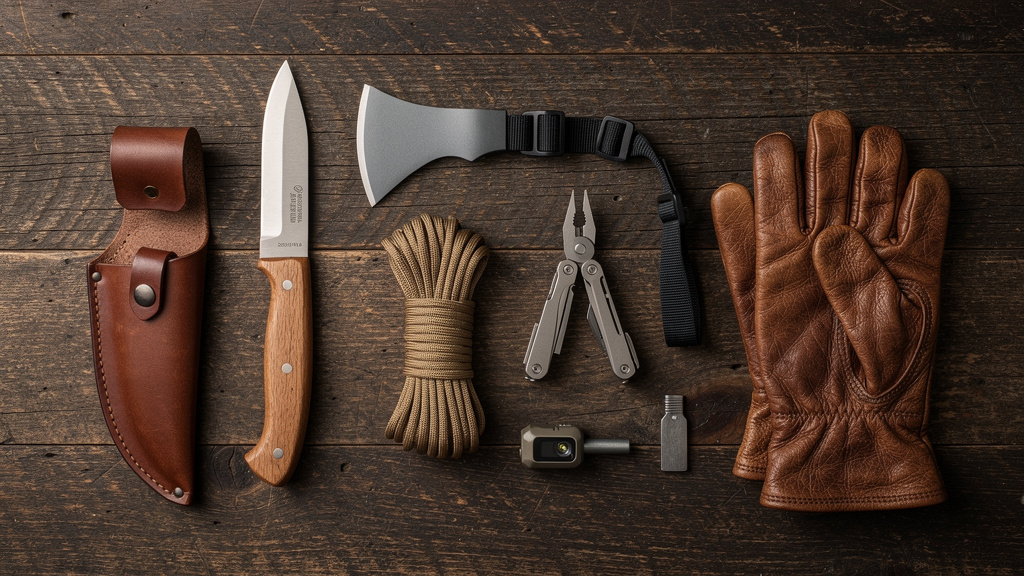
A person with a sharp axe, a fixed-blade knife, and 50 feet (15 meters) of cordage can build a shelter, process firewood, prepare food, and signal for help. A person with bare hands and a garage full of freeze-dried food cannot. Tools are force multipliers — they convert effort into results at a ratio that bare hands can't match.
Tool preparedness has three layers: essential tools (the core items that handle 80% of tasks), kits (purpose-built loadouts for specific scenarios), and maintenance (keeping everything sharp, functional, and ready).
→ Read First 30 Days (gear chapter, 15 min) Knives · Bug-out bag · Maintenance
Tool-handling safety — non-negotiable practices
Preparedness tools cause more emergency-room visits than the disasters they're meant to mitigate. Per US CPSC injury data and OSHA hand-tool safety standards:
- Chainsaw operation requires PPE — chaps rated to ASTM F1414, helmet with face shield + hearing protection, steel-toed boots, gloves per OSHA 1910.266. Chainsaw injuries are the leading cause of preparedness-tool ER visits per CPSC NEISS data; most are leg lacerations from missing chaps.
- Axe + maul work — wide stance, no one within axe-blade-length plus one stride of the swing arc, never swing toward a foot, never swing fatigued. Splitting maul injuries are common and severe.
- Generator + small-engine fuel handling — never refuel a hot engine, store gasoline in approved cans only (UL listed), keep below 100°F (38°C) per OSHA fuel-storage guidance. Static-electricity ignition during refueling causes routine residential fires.
- Knife sharpening + use — cut away from body, never toward fingers; a sharp knife is safer than a dull one (less force needed, more predictable cut) per Cornell Cooperative Extension kitchen-safety guidance.
- Power-tool electrical safety — GFCI protection on outdoor work, never operate in wet conditions, inspect cords for damage per NEC 590 temporary wiring.
For commercial use of any tool (chainsaw professional work, generator commercial installation, electrical service), licensing and OSHA compliance apply. Educational content here is for personal preparedness within reasonable competence — get training (a half-day chainsaw safety class is ~$50–$100 and prevents the most common injuries).
Where to start
Three audience-segmented entry paths matching the most common starting positions:
If you're brand-new (urban / suburban, no preparedness tool kit yet):
- Buy one quality fixed-blade knife (4–5 inch (10–13 cm) full-tang, Scandi or flat grind, ~$60–$120 USD). Learn to sharpen it on a whetstone per sharpening. The knife is the foundation tool — the only one you can't substitute.
- Assemble a basic home repair toolkit — hammer, screwdriver set, pliers, adjustable wrench, tape measure, work gloves. ~$50–$100 USD for mid-grade. Handles 90% of residential maintenance and emergency repairs.
- Build a vehicle emergency kit — jump starter or cables, tire inflator, basic tools, first aid, 1 gallon (3.8 L) water, blanket, paper map. ~$80–$150 USD assembled. Sits in your trunk indefinitely.
If you have basics covered (knife + hand tools + vehicle kit done):
- Add a chopping tool: 2 lb (0.9 kg) boy's axe or 2.5 lb (1.1 kg) hatchet for camp tasks, 3.5 lb (1.6 kg) splitting maul for firewood at home heating scale. Both require regular sharpening and handle maintenance.
- Add a saw: 21-inch (53 cm) bow saw + a folding saw is the inexpensive baseline; a chainsaw is moderate investment for serious wood processing (chains + bar oil + fuel-rotation discipline required).
- Build a bug-out bag AND a get-home bag — the bug-out bag is the 72-hour pack at home; the get-home bag is the workplace-to-home pack in your car or under your desk.
If you're building production capability (homestead, off-grid property, scale beyond household):
- Invest in garden tools — pointed shovel, hoe, garden rake, bypass pruners + broadfork. Quality matters: mid-grade fiberglass-handle shovels outlast budget ones by 3–5× per US Forest Service tool-life data.
- Add come-along + rigging — hand winch + 20 ft (6 m) rated rigging chain + shackles. Solves vehicle-extraction, fallen-tree, structural-beam problems that no other equipment handles at homestead scale.
- Build a maintenance routine — quarterly inspection + annual deep service. Cross-references improvised tools for when manufactured replacements aren't available.
Field note
Buy the best quality you can afford for the three tools you'll use most: your knife, your axe, and your primary saw. These are the tools that get used under stress, in bad conditions, when failure has real consequences. Save the budget options for screwdrivers and tape measures. A $120 fixed-blade knife from a reputable maker outperforms a $25 knife by 5–10× in lifetime cuts and resistance to chipping; the cost per year of ownership is essentially identical.
What this hub covers — and what it doesn't
This page routes to Survipedia gear content spanning essential field tools, purpose-built kits, and maintenance practices. It covers:
- Essential tools — knives, axes, saws, hand tools, garden tools, lighting, measuring, come-along/rigging, fasteners
- Kits — everyday carry (EDC), bug-out bag, get-home bag, vehicle emergency kit
- Maintenance — sharpening cadence, small-engine care, improvised-tool fabrication
It deliberately does not cover: tactical gear loadouts (rifle-attachments, plate carriers, mil-spec hardware — outside preparedness scope), high-end collector / luxury knives, commercial-grade tool selection (skid steers, excavators — beyond household scale), or detailed brand-comparison reviews (gear research goes stale within 2–3 years; this hub stays principles-focused).
The A8 "When to seek professional help" criterion is waived for this hub — tools alone are not life-safety; their misuse creates injury, which routes to the Medical Foundation for response. The tool-handling safety admonition above covers the relevant pre-event guidance.
Tools compound across other Foundations: Skills is the partner Foundation — a sharp axe and the skill to use it safely together solve problems that neither half handles alone. The vehicle emergency kit covered here pairs with Mobility routing and Shelter emergency-shelter planning. Garden tools are downstream of Food production capability.
Essential tools
- Knives for preparedness — single most used tool in field or emergency scenarios; fixed-blade for heavy work, folder for daily carry, multitool for tasks neither handles well
- Axes — 2 lb (0.9 kg) boy's axe or hatchet for camp, 3.5 lb (1.6 kg) splitting axe for firewood; both require sharpening and handle maintenance
- Hand saws — 21 in (53 cm) bow saw clears trail and bucks logs; folding saw fits in pack; both inexpensive
- Chainsaw — storm cleanup and firewood at scale; depends on fuel + maintenance; moderate investment for serious wood processing
- Hand tools for home repair — hammer, screwdriver set, pliers, adjustable wrench, tape measure, level, pry bar — handles 90% of residential maintenance
- Garden tools for food production — pointed shovel, hoe, garden rake, bypass pruners — minimum for food production; broadfork breaks compacted soil without rototiller
- Emergency lighting — headlamp for hands-free work + lantern for camp/shelter + chemical backup = three-tier lighting system
- Measuring tools — tape measures, levels, squares required for any structural repair
- Come-along and rigging — mechanical advantage for moving loads no single person can shift — stuck vehicles, downed trees, structural beams
- Fasteners and repair supplies — adhesives, tapes, wire, cordage; consumables that hold everything together
Kits
A kit is a pre-packed collection of tools and supplies built for a specific scenario. Packing one in advance means you grab it and go rather than searching your house during an emergency.
- Everyday carry (EDC) — what rides on your person daily: folding knife + small flashlight + lighter + multitool; principle is "if I walked out right now, could I handle a flat tire / minor injury / power outage?"
- Bug-out bag — 72-hour pack: shelter (tarp, bag), water (filter, container), food (bars, dehydrated), fire (lighter + ferro rod), first aid (IFAK), navigation (compass + map), communication (radio + whistle); target weight 25–35 lb (11–16 kg) — heavier sacrifices speed
- Get-home bag — smaller, single-task: workplace-to-home; walking shoes + water + snack + flashlight + phone charger + cash + paper map; lives in car or under desk
- Vehicle emergency kit — trunk-permanent: jump starter or cables, tire inflator, basic tools, first aid, 1 gal (3.8 L) water, blanket, paper map
Maintenance
Tools that aren't maintained are tools that fail when you need them. Tool maintenance and repair is a scheduled activity, not a reaction to a problem.
- Edged tools — sharpen after every significant use; dual-grit whetstone + 10 min maintains every knife, axe, and hoe per sharpening. Oil carbon steel blades after use to prevent rust per Sandvik knife-care guidance.
- Power tools and small engines — fuel system cleaning, spark plug inspection, air filter checks, oil changes per Briggs & Stratton seasonal-storage guidance. A generator unused for 8 months won't start during the outage it was meant for.
- Improvised tools — fabrication from scrap when manufactured replacements aren't available: pry bar from rebar, mallet from hardwood billet, needle from fish bone
Inspect before you need it
A cracked axe handle, a rusted blade, or a dead headlamp battery discovered during an emergency is a crisis on top of a crisis. Inspect every critical tool quarterly: check handles for cracks, blades for chips, batteries for charge, and moving parts for function. A 30-minute quarterly inspection round catches 80% of pre-failure indicators.
Common questions
Should I buy one premium tool or several budget tools? For the three tools you'll use most — knife, axe, primary saw — buy premium per Field Note above. For everything else (screwdrivers, tape measures, levels), mid-grade outperforms both budget and premium on cost-per-year-owned because the failure mode is loss/misplacement, not wear.
Is a multitool a knife replacement? No. Multitools (Leatherman, Gerber, Victorinox) handle dozens of small tasks well but are weak at the two things knives must do: efficient cutting + batoning. Carry both — the multitool handles the 50 small tasks per week, the fixed-blade handles the rare task that demands a real blade.
How much should I spend on a bug-out bag total? ~$300–$800 USD assembled from quality components covers the 72-hour scenario well. Inexpensive bug-out bags fail at the durability points that matter most (zippers, buckles, water filter, sleeping bag). Premium bug-out bags ($1,500+) add convenience but rarely meaningful capability beyond the $800 tier.
What's the single most overrated preparedness tool? Combat-style knives with serrated spines, partially-serrated blades, and grippy textured handles — marketed as "tactical" or "tanto" — underperform a simple full-tang Scandi-ground blade at every task except cosmetics. The serrations resist sharpening, the grippy textures abrade hands during sustained use, and the tanto tip is weak at piercing. Buy a working knife, not a magazine-cover knife.
Your single next step: complete the First 30 Days gear chapter — it sequences essential-tool acquisition, vehicle-kit assembly, and quarterly-maintenance calendar setup into a 30-day plan that builds on this hub's three-layer framework.