Skills
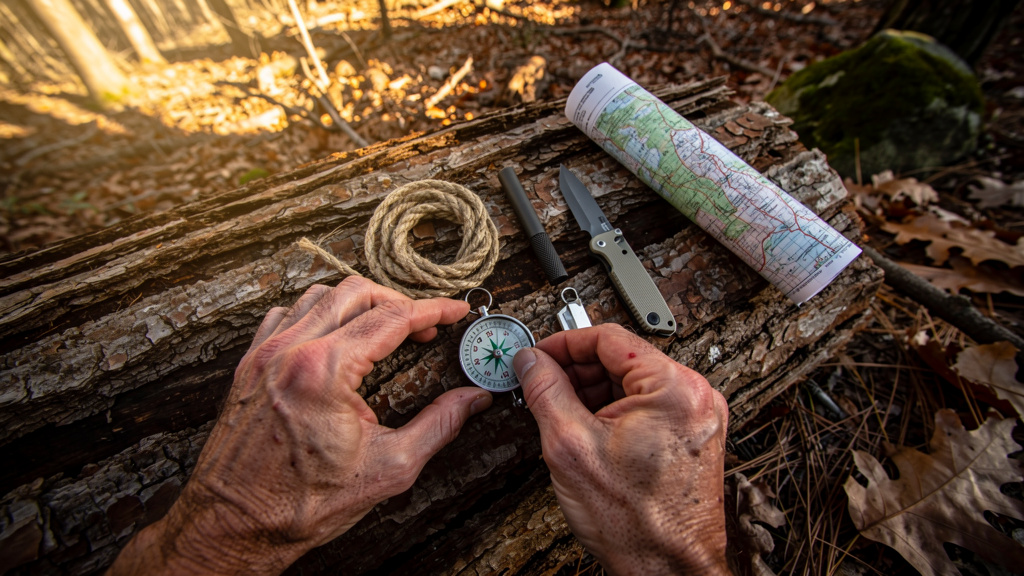
A $300 knife is a prying tool in the hands of someone who can't sharpen it. A ferro rod is a paperweight if you've never struck one in the rain. Gear extends capability, but skill is capability. The distinction matters most exactly when it's hardest to buy replacements — during prolonged disruptions where supply chains are broken and what you know becomes more valuable than what you own.
The skills that matter for self-reliance fall into three categories: field skills (fire, navigation, rope work), craft skills (carpentry, metalwork, sewing), and maintenance skills (sharpening, engine repair, welding). Each category has a few foundational abilities that unlock everything else in that domain.
→ Read First 30 Days (skills chapter, 15 min) Fire · Knots · Sharpening
Skill practice safety — common injury patterns
The skills on this page produce more emergency-room visits than the disasters they prepare you for. Per CPSC NEISS injury data, the most-common preparedness-skill injuries are predictable and preventable:
- Chainsaw + axe + maul — leg lacerations (chainsaw chaps rated to ASTM F1414 + helmet + face shield + steel-toed boots per OSHA 1910.266). Don't swing an axe at a target between your feet; don't run a chainsaw with the bar above shoulder height.
- Knife and whetstone — finger lacerations during sharpening (cut away from body, never toward fingers; secure the stone). A sharp knife is safer than a dull knife per Cornell extension.
- Welding without PPE — arc-flash retinal burn ("welder's eye"), spatter burns, electric shock from damaged cords (auto-darkening helmet rated to AWS Z87.1, leather welding gloves, dry footing, no contact with grounded metal during operation per OSHA 1910.252).
- Forge / blacksmithing — burns from heated steel and slag, carbon monoxide buildup in poorly ventilated shop (CO alarm rated UL 2034 in any forge space).
- Fire-starting practice — burns from technique gone wrong (clear a 5 ft (1.5 m) radius of combustibles, have water or dirt staged before striking the first spark per NFPA outdoor-fire safety).
Educational content here assumes you have basic safety training or will acquire it before practice. Most local fire departments, community colleges, and trade schools offer 1–2 day safety classes for chainsaw, welding, and blacksmithing — typically $50–$200 USD. This is the least expensive insurance against the most common injury patterns.
Where to start
Three audience-segmented entry paths matching the most common starting positions:
If you're brand-new (no field-skill background, want a base layer):
- Five-knot drill — learn the bowline, trucker's hitch, clove hitch, taut-line, and square knot per knots. Practice each until you can tie it by feel in under 30 seconds. Cost: a 50-foot piece of paracord ($10) + 30 min/day for 2 weeks.
- Ferro-rod fire — learn fire-starting with a ferrocerium rod and natural tinder per fire-starting. Cost: a ferro rod ($15) + practice attempts in your backyard until reliable. Cross-reference fire types for different scenarios.
- Map + compass navigation — complete one 2-mile (3.2 km) navigation exercise with only a topographic map and a baseplate compass per map-compass. No phone allowed.
If you have basics covered (5 knots + ferro fire + map nav done):
- Sharpening discipline — dual-grit whetstone + 10 min/week per sharpening. Master your kitchen knives first (free, immediate feedback), then extend to axes, hoes, mower blades.
- Carpentry hand-tool basics — one weekend project (raised bed, simple shelf, sawhorse) using only hand tools per carpentry. Builds the joinery + framing baseline for later structural repair under stress.
- Practice in real conditions — repeat any of the above skills in degraded conditions (wet, dark, cold, fatigued). The gap between knowing the steps and performing them under field conditions is the real skill.
If you're building production / repair capability (homestead, off-grid, scale beyond household):
- Small-engine repair — generators + chainsaws + tillers + water pumps; most failures are fuel system (carb cleaning, fuel line), ignition (spark plug), air filter per small-engine.md. $30 of consumables + a service manual covers 80% of field repairs.
- Welding — stick welder ($150–$400) runs on standard household power; handles mild steel up to 1/4 inch (6 mm) per welding. Most versatile repair skill for metal infrastructure.
- Blacksmithing or pottery — depending on your interests and material availability. Blacksmithing makes hooks, brackets, hinges, blades; pottery makes cooking and storage vessels from clay + pit firing without manufactured inputs.
Field note
Learn knots with your eyes closed. In a real situation you'll be tying them in the dark, in the cold, with wet hands, under stress. If you can tie a bowline behind your back by feel, you can tie it anywhere. The same principle applies to fire-starting, navigation bearings, and sharpening angle — the eyes-closed test is the difference between knowing a skill and owning it.
What this hub covers — and what it doesn't
This page routes to Survipedia skills content spanning core field skills, craft skills, and maintenance skills. It covers:
- Field skills — fire (starting, types, cooking), navigation (map + compass, GPS, natural, weather reading), knots, lashing, cordage, tracking, swimming
- Craft skills — carpentry, sewing, fiber arts, blacksmithing, pottery
- Maintenance skills — knives, sharpening, small-engine repair, welding, maintenance cycles
It deliberately does not cover: competitive sports (climbing-as-sport beyond rescue applications, marathon running, etc.), formal certifications (Wilderness EMT, ANSI welding, etc. — beyond personal preparedness), advanced craft (jewelry, fine furniture, etc.), or commercial-grade trade skills. The A8 "when to seek expert help" criterion is waived for this hub — skill development is reader-managed; injuries during practice route to Medical. The safety warning admonition above covers the relevant injury-prevention guidance.
Skills compound across other Foundations. Fire-starting + cordage + knots are prerequisites for Shelter field-shelter building. Knife skills + sharpening + small-engine repair underpin every tool in the Gear (Tools) Foundation. Foraging + tracking + butchering carry into Food production from wild sources.
Field skills
- Fire starting — 3 methods baseline (lighter + ferrocerium rod + friction or magnification method) per Bushcraft USA fundamentals
- Fire types — Dakota hole (concealment), long fire (warmth along body), keyhole (cooking + heating), teepee, log cabin, star — match fire architecture to scenario
- Cooking over open flame — temperature zones (low 250–325°F (120–163°C), medium 350–450°F (175–230°C), high 450–700°F (230–370°C)), grate height, fuel control
- Map and compass navigation — per US Army FM 3-25.26: orient map, take bearing, follow bearing, triangulate; account for magnetic declination per NOAA NCEI data
- GPS devices — waypoints, tracks, offline maps; faster + more precise when batteries and signal hold
- Natural navigation — sun position, star navigation (Polaris in Northern Hemisphere), prevailing wind patterns, vegetation indicators; supplements instruments when nothing else available
- Weather reading — cloud formations (cumulonimbus / nimbostratus / cirrus → 6–24 hr forecast windows), barometric pressure changes, wind shifts per NWS basic weather observation
- Knots — 5 essential per US Army + BSA (bowline / trucker's hitch / clove hitch / taut-line / square); plus sheet bend, figure-eight, prusik, double fisherman's
- Lashing — binding poles together for shelters, rafts, elevated platforms; square / diagonal / shear / round lashing each for different structural roles
- Cordage making — plant fibers (dogbane, nettle), bark strips, animal sinew twisted into functional line using techniques that predate manufactured cord
- Tracking — ground sign, gait patterns, disturbance reading; applications for hunting, security, search-and-rescue
- Swimming — open-water crossing technique, flash-flood survival, vessel-failure response; baseline competency at 100 yd (90 m) endurance
Craft skills
- Carpentry — hand tools (saw, hammer, chisel, square); basic joinery (butt, lap, mortise-and-tenon); framing principles for structures, shelves, doors, raised beds, animal pens
- Sewing — hand stitching for clothing, tarp repair, pack repair, canvas covers; basic kit (needles + heavy thread + thimble + patches) weighs nothing
- Fiber arts — spinning, weaving, felting; processing raw wool, plant fiber, or animal hair into yarn and fabric without manufactured inputs
- Blacksmithing — coal or propane forge + anvil + hammer; hooks, brackets, hinges, blades, metal-tool repair; deeper investment but enormous value in prolonged grid-down
- Pottery — hand-built + pit-fired vessels for cooking, storage, water treatment without manufactured inputs; one of the oldest + most undervalued preparedness technologies
Maintenance skills
- Knife selection and use — blade geometry + steel type for actual tasks; safe control under field conditions; entry point to maintenance-skill stack
- Sharpening — whetstone for knives + axes + chisels + hoes + mower blades; proper angles (15° kitchen, 20° general field, 25–30° chopping) + technique = 30 minutes to learn, lifetime to maintain
- Small engine repair — carb cleaning + fuel line + spark plug + air filter handles 80% of field repairs; service manual + $30 consumables cover the rest per Briggs & Stratton service guidance
- Welding — stick welder ($150–$400) on standard household power; handles mild steel up to 1/4 in (6 mm); most versatile repair skill for metal infrastructure
- Maintenance cycles — month-by-month calendar — spring fencing inspection, summer irrigation, fall winterization, winter tool repair — into repeatable annual cycle so nothing falls through cracks
Practice with real conditions, not ideal ones
Starting a fire in your backyard on a dry afternoon teaches you the mechanics. Starting a fire in the rain with soaked wood after hiking 5 miles (8 km) teaches you the skill. Every skill on this page has a gap between knowing the steps and performing them under field conditions. Close that gap before you need to. The practice does not need to be costly or extreme — pour a bottle of water over your wood pile before lighting it; navigate at dusk instead of noon; tie knots while wearing thin gloves. Real conditions are not a step up in equipment; they are a step up in deliberate friction.
Common questions
Which is the highest-return single skill to learn first? Knots. Five knots tied by feel cover an enormous range of scenarios (shelter, rescue, securing loads, repair) and the learning curve is steepest in the first 2 weeks then plateaus — meaning you get most of the value quickly. Fire-starting and basic sharpening are close seconds; both have similarly steep early curves.
Do I need a certification or formal training? Depends on the skill. Wilderness First Aid + Stop The Bleed are worth formal training (perishable skills, life-safety domain). Knots + fire + navigation can be self-taught with books and practice — most US Boy Scouts learn them this way. Welding + chainsaw + small-engine benefit from a 1–2 day safety class ($50–$200) to avoid the common injury patterns; you can self-teach the technique afterward.
Is bushcraft different from preparedness skills? Overlapping but distinct. Bushcraft emphasizes the wilderness scenario (sustained living from the land with primitive tools). Preparedness skills emphasize the home + community + grid-down scenario (sustaining a household through disruptions using a mix of stored and improvised resources). Many skills appear in both (fire, navigation, knots, sharpening); the bushcraft canon also includes traps, snares, primitive shelter, foraging, and primitive technology that's less essential for household preparedness.
How long does it take to be "competent" at any of these skills? Per Anders Ericsson deliberate-practice research, ~20 hours of focused practice reaches a useful operating level for most physical skills; ~100 hours reaches consistent reliability; 1,000+ hours reaches expert performance. For preparedness purposes, the useful operating level is the target — you don't need expert-grade skill at sharpening, you need it good enough to maintain working tools.
Your single next step: complete the First 30 Days skills chapter — it sequences the five-knot drill, ferro-rod fire practice, and map-compass navigation exercise into a 30-day plan that builds on this hub's three-category framework.