Supply caches
A supply cache is pre-positioned gear, food, water, or fuel stored in a location you can reach during movement. The concept comes from military resupply doctrine — units pre-position materiel along planned routes so they can sustain operations past the range of what they carry on their back. The civilian application is more modest but functionally identical: a cache along your evacuation route means you carry less weight on departure and have a fallback if your primary supplies are lost, damaged, or consumed.
A single cache placed 40–60 miles (64–96 km) along your primary bug-out route can extend a 72-hour bag into a 5-day plan without adding weight to your pack.
Cache types
Not all caches serve the same function. Understanding the four types before you start building saves you from placing the wrong cache in the wrong location.
Vehicle caches: Supplies stored in or on your vehicle — in the trunk, under seats, in a locking truck bed box, or in a rooftop carrier. These are the most accessible and easiest to maintain. The limitation is that a vehicle cache fails if you abandon the vehicle, the vehicle is stolen, or you evacuate on foot. Vehicle caches are supplements to your bag, not replacements.
Structural caches: Supplies hidden within a structure — behind false walls, in floor voids, under basement stairs, inside hollow furniture, or in a disused utility space. Structural caches are the hardest for outside parties to discover, require no digging, and can hold significant volume. The risk is that if the structure becomes inaccessible (fire, collapse, occupation), the cache is lost.
Buried caches: Supplies sealed in waterproof containers and buried below ground on property you control. Buried caches are the most durable option for long-duration pre-positioning — they are invisible above ground, survive most weather events, and cannot be casually stumbled upon. The cost is retrieval time: you need a tool to dig, you need to know exactly where to dig, and you need the physical ability to do it.
Dead drop caches: Small, lightweight caches hidden in plain sight or in accessible but non-obvious locations — inside a hollow fence post, behind a loose cinder block, in a drain pipe. Dead drops prioritize fast retrieval over volume. They are useful for fire-starting tools, cash, a spare key, or a short message — not for substantial supplies.
The most resilient cache network uses more than one type. A vehicle cache for immediate access, a buried cache for mid-route resupply, and a destination cache at your end point create redundancy across the full route.
Container selection
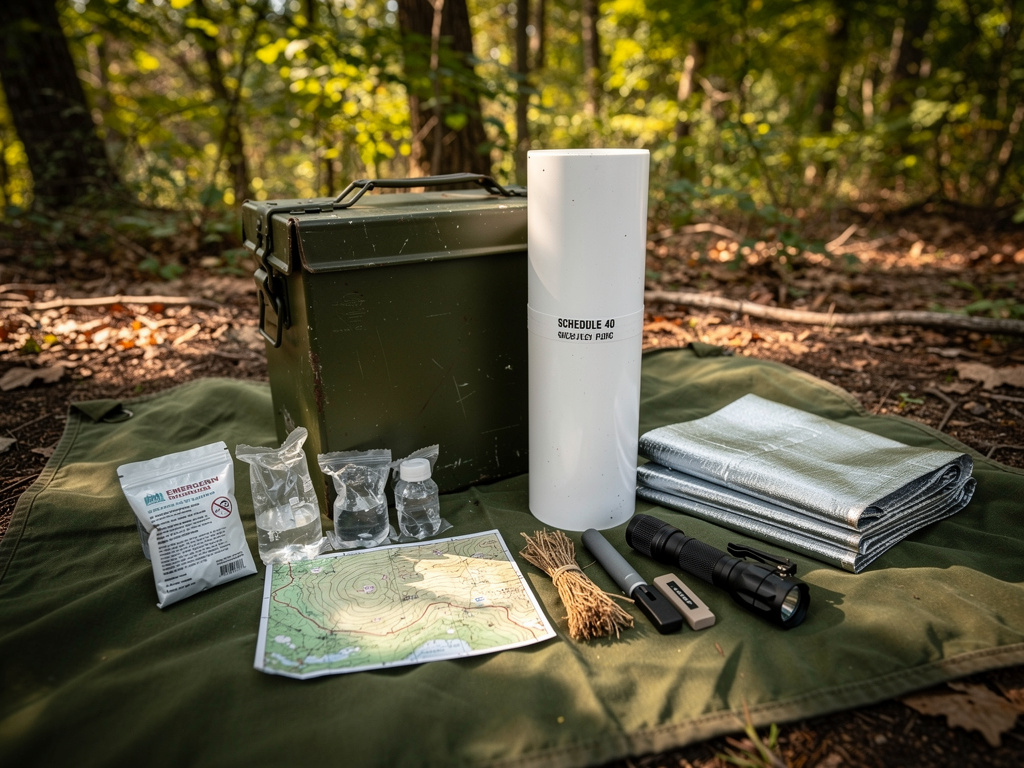
The container is as important as the contents. A cache that fails its container — wet, corroded, frozen, or cracked — is worse than no cache, because it generates false confidence.
Military surplus ammo cans (30 cal, 50 cal): Steel ammo cans with rubber-gasketed lids are affordable, stackable, and familiar to anyone who has bought them at a surplus store. A 30-caliber can measures approximately 11 × 7 × 4 inches (28 × 18 × 10 cm) and holds about 3.5 liters. A 50-caliber can holds roughly 10 liters. Both seal tightly when the latch is closed. Limitation: they are made of ferrous metal, which corrodes in acidic or high-moisture soil. If burying in wet ground, coat the exterior with rubber sealant or wax before burial and inspect for corrosion at every maintenance visit.
PVC pipe caches: Schedule 40 PVC pipe in 4-inch (10 cm) or 6-inch (15 cm) diameter with threaded or glued end caps is inexpensive, widely available at hardware stores, and engineered to be buried underground. It is waterproof when sealed correctly, resists rodents and UV, and is non-ferrous — meaning no corrosion in wet soil. A 4-inch (10 cm) pipe section 24 inches (61 cm) long holds approximately 1.3 liters — enough for fire-starting tools, a water filter straw, small food items, and documents. Larger diameter pipe scales proportionally. Seal the cap threads with PVC primer and cement for permanent burial; use Teflon tape only if you intend to reopen the end cap.
Food-grade buckets: 5-gallon (19 L) food-grade buckets with gamma-seal lids offer substantially more volume than pipe caches and are suitable for above-ground or partially buried storage. Seal the lid thread with O-ring grease. Add a 1-ounce (28 g) silica gel desiccant pack inside to manage moisture. Buckets are not suitable for deep burial in heavy soil — the walls flex under compressive load.
Hard cases (Pelican and equivalents): Waterproof hard cases rated to IP67 or better protect sensitive items (electronics, optics, documents) and resist compression loads from burial or stacking. They are a significant investment compared to PVC or buckets, but appropriate for caches that hold high-value or moisture-sensitive items.
Check seals before burying
Every container should be tested before burial. Fill with crumpled paper, seal, and submerge in a bucket of water for five minutes. Any air bubble trail indicates a leak. A container that fails this test above ground will fail underground after the first rain cycle. Replace the gasket or reseal the joints before committing the container to the ground.
Field note
Double-bag everything inside the container regardless of container type. Sealed PVC is still vulnerable to condensation cycling over months and years. Contents in zipper-seal bags inside the container stay dry even if the container fails partially.
Site selection
Cache site selection balances concealment, accessibility, and stability. A cache you cannot find under bad conditions at night is not a cache.
Legal considerations: Burying anything on public land, national forest, or land you do not own may violate trespass or littering laws. Legitimate cache sites include your own property, a trusted neighbor's property, and pre-arranged locations with explicit permission. Roadside verges and trail shoulders are legally problematic.
Physical factors:
- Choose ground that drains well — low points accumulate water and accelerate container degradation
- Avoid flood plains or seasonal stream channels
- Avoid sites under large trees, whose roots grow around and compromise buried containers
- Ideal burial depth for a PVC cache is 18–24 inches (46–61 cm) — adequate below the frost line in warm and moderate climates; in cold climates (northern tier states, Canada) where frost depths reach 36–72 inches (91–183 cm), bury to local frost depth or use a structural or dead-drop cache instead of buried PVC
Accessibility: The cache must be retrievable with the tools you will have during the scenario. A cache requiring a shovel is only useful if you have a shovel. A cache requiring no excavation (above-ground, inside a structure) is retrievable bare-handed.
Field note
Cache locations you can find at night, in rain, under stress — not just in ideal conditions. Walk the retrieval route at night before committing. Count your paces under actual conditions. Landmarks that are obvious in daylight can be invisible at 2 a.m. in the rain. If you can't find it then, you won't find it when it matters.
Marking and retrieval
The most reliable cache is one you can find without digital tools, because digital tools fail at the worst times.
GPS coordinates: Record precise GPS coordinates — latitude and longitude to five decimal places — in your cache log. Verify the coordinate against the physical site after recording, not just after entering. A transposed digit moves a cache hundreds of meters.
Landmark-based marking: As a backup to GPS, describe the cache location using triangulation from permanent landmarks — "35 paces from the northeast corner of the concrete bridge abutment, 8 paces due west." Landmarks that survive storms, road changes, and seasonal variation are preferred over trees, temporary signs, or movable objects.
Cache log security: The log that records all cache locations must be protected. Compromised cache location information eliminates the operational security (OPSEC) value of the cache entirely. Store the log in encrypted digital form (a password-protected file on an encrypted drive) and a single written hard copy in a secure location at home, not with your bag.
Contents by cache type
Different caches serve different purposes. Build your contents list around the mission before you buy anything.
Route support cache (mid-route resupply along an evacuation corridor): - Water: minimum 1 gallon (3.8 L) per person per day × 3 days, or a water filter straw plus chemical treatment tablets as a lighter alternative - Food: 1,800 kcal per person per day × 3 days minimum — calorie-dense, shelf-stable options (jerky, nut butter packets, compressed bars, freeze-dried pouches) - Fuel supplement: small fuel canister or 8 oz (237 mL) white gas bottle for a stove - First aid consumables: bandages, antiseptic wipes, blister treatment pads, personal medications for 3–5 days - Navigation: printed paper map of the next route segment, compass, written route card - Cash: small-denomination bills — ATMs fail in extended power outages; cash remains functional when electronic payments don't - Fire-starting redundancy: two independent fire-starting tools (lighter plus ferrocerium rod)
Emergency fallback cache (worst-case — your bag is lost, stolen, or destroyed): - Fire-starting kit: waterproof matches, lighter, ferrocerium rod - Emergency blanket or compact bivy - Water container plus treatment (filter or tablets) - 1,800 kcal per person — compact, no-cook food - Whistle, signal mirror - Basic wound care (bandages, antiseptic, tape) - Duplicate identification documents in waterproof sleeve
Destination cache (pre-positioned at or near your bug-out destination): - Longer-duration food supply: 30-day shelf-stable supply per person — bulk grains, canned goods, or freeze-dried - Extra clothing and footwear for the expected climate - Hand tools: folding saw, hand axe, multi-tool, 50 ft (15 m) of cordage - Extended medications: 30–90 day supply of any prescription medications - Reference materials: printed copies of key documents, maps, and reference guides
Water quantity planning
One gallon (3.8 L) per person per day is the survival minimum — enough for drinking and minimal sanitation. Plan for 1.5–2 gallons (5.7–7.6 L) per person per day if the cache will be used by anyone doing physical labor, if the climate is hot, or if young children are involved. Water is heavy at 8.3 lbs (3.8 kg) per gallon — a water filter straw plus treatment tablets is the practical cache alternative for route caches where weight and volume matter. See food storage planning for long-duration caloric planning at destination caches.
Maintenance cycle
A neglected cache provides false confidence — and false confidence in a crisis is worse than no cache at all. Build a maintenance schedule into your calendar before the cache goes in the ground.
Every 6 months (minimum for food and water items):
- Check container integrity before opening — look for water intrusion, cracking, corrosion, or compression damage
- Replace any food item within 90 days of its expiration date; don't wait for expiration
- Rotate water: replace stored water and re-treat fresh water if caching water directly
- Replace batteries in any battery-powered items (flashlights, radios)
- Verify location markings are still accurate — landmarks shift, trees fall, structures change
Every 12 months (minimum for all caches):
- Test all electronic items for function
- Rotate water treatment chemicals — iodine and potassium permanganate tablets have 2–4 year effective lives; check for color change or clumping
- Inspect cash for legibility and replace damaged bills
- Update printed maps if route planning has changed
- Verify medications have not expired; replace as needed
Note the inspection date on a piece of tape inside the container lid and update your cache log. A log that shows no entries for 18 months is a warning sign — the cache has likely degraded and may not be serviceable when you need it.
Operational security
A cache that someone else knows about is a liability. Cache locations revealed to third parties — even trusted friends — are no longer truly controlled by you.
Keep cache locations out of digital communications entirely: no texts, emails, or cloud notes with addresses or GPS coordinates. If you must share a location with a family member for emergency access, use a written hand-off procedure — a sealed envelope at home with the cache log, opened only in the event of your incapacitation.
Bury caches in a way that leaves no visible surface disturbance after the initial soil settles (1–2 weeks). After burial, tamp the soil firmly and scatter natural debris (leaves, pine needles, small stones) to match the surrounding ground. Avoid creating obvious geometric marks or using surface markers that look deliberate. If returning for maintenance, approach from different angles to avoid creating a worn trail.
Never discuss cache locations, contents, or routes with anyone outside your immediate household. The value of a cache is entirely dependent on the supplies being there when you arrive.
Supply caches checklist
- Define the mission of each cache (route support, fallback, destination) before purchasing any supplies
- Test container seal integrity with a water submersion test before loading
- Double-bag all contents in zipper-seal bags inside the container regardless of container type
- Select legally permissible cache sites — your own property or with explicit written permission
- Bury at 18–24 inches (46–61 cm) in warm/moderate climates, or to local frost depth in cold climates — on well-drained ground, away from flood plains, tree roots, and frost heave zones
- Record GPS coordinates (latitude/longitude to five decimal places) and landmark bearings in a secured cache log
- Walk the retrieval route at night and in poor conditions before finalizing the site
- Store cache log in encrypted digital form plus one written hard copy in a secure location at home
- Schedule maintenance calendar reminders at 6-month intervals for food/water caches
- Inspect every 6 months; replace food within 90 days of expiration; rotate water annually
Caches work alongside route planning and pre-positioned fuel to make bug-out planning viable over distances longer than a single day's travel. For marking routes and navigating to cache sites without digital tools, see navigation.