Wound care
Infection kills more people from wounds than the original injury does. In a hospital, a contaminated laceration gets irrigated, debrided, and observed by trained staff. In the field or during a grid-down scenario, you are the hospital. The difference between a wound that heals and one that sends bacteria into the bloodstream is usually irrigation volume, closure timing, and daily inspection discipline — not antibiotics, not fancy dressings.
Educational use only
This page provides general educational information for emergency preparedness scenarios when professional medical care is unavailable. It is not a substitute for professional medical advice, diagnosis, or treatment. Always seek the advice of a qualified healthcare provider. Use this information at your own risk.
Before you start - Skills: Bleeding control — if active hemorrhage is present, apply a tourniquet or pressure dressing first (see Bleeding control). Sterile field setup: clean work surface, hands washed or gloved. - Materials: Nitrile gloves (2 pairs minimum). Irrigation fluid: 250–500 mL (8–17 fl oz) potable water or saline per wound, delivered via a 30 mL (1 fl oz) syringe with 18-gauge catheter tip for a 7–10 psi (48–69 kPa) jet. Sterile gauze 4×4 in (10×10 cm) (4–6 pads). Adhesive bandages or self-adherent wrap (cohesive bandage or equivalent). Antiseptic: 2% chlorhexidine solution OR 10% povidone-iodine. Wound-closure strips (adhesive closure strips or equivalent) or suture/staple kit for wounds less than 12 h old. Antibiotic ointment (mupirocin 2% or triple-antibiotic). Tetanus booster status checked. - Conditions: Bleeding controlled — no active arterial bleed. Patient stable and not in shock (see Shock). Adequate lighting (headlamp or phone flashlight). Wound less than 12 h old (24 h for facial wounds) if primary closure is planned; older wounds are dressed open for secondary intention healing. - Time: Irrigation 5–10 min. Closure (if indicated) 10–20 min. Dressing 5 min. Re-check dressings every 24 h.
Action block
Do this first: Control active bleeding with direct pressure for 5–10 minutes, then irrigate the wound with clean water or saline (5–10 min active) Time required: Active: 20–40 min (pressure + irrigation + dressing); recurrence: daily inspection (2–5 min) Cost range: Inexpensive for basic wound kit (gloves, gauze, irrigation syringe, adhesive closure strips); moderate investment for a fully stocked wound module Skill level: Intermediate for layperson wound care; advanced for suturing or deep closure Tools and supplies: Tools: 35–60 mL irrigation syringe with 18–19 gauge tip, nitrile gloves, trauma shears, penlight. Supplies: sterile gauze pads (4×4 in (10×10 cm)), non-adherent dressing, conforming roller bandage, adhesive closure strips, antiseptic solution (chlorhexidine or povidone-iodine), permanent marker. Safety warnings: See Escalation criteria below — red streaks, fever above 102°F (38.9°C), or numbness/loss of motion distal to the wound mean stop field care and seek professional help immediately
How do I tell if a wound needs stitches?
Before treating anything, classify the wound. Depth and wound type together determine whether closure is appropriate — a wound that reaches fat or muscle, or one with edges that gap open, needs closure; shallow abrasions and punctures do not. Each type carries a different infection risk and a different approach to cleaning and closure.
Abrasion: Friction removes the outer skin layers. The wound bed is usually contaminated with road debris, dirt, or gravel. No closure required — the priority is thorough scrubbing to remove embedded particles. An abrasion that is not scrubbed clean will heal with embedded debris (traumatic tattooing) and may become infected.
Laceration: A cut through skin, ranging from superficial to deep. A shallow laceration through the epidermis and upper dermis can close on its own or with strips. A deep laceration that reaches the fat layer or muscle requires closure and monitoring for dead space underneath. Jagged-edged lacerations from blunt trauma carry more contamination than clean knife cuts.
Puncture wound: A narrow, deep channel driven by a nail, wire, thorn, or blade. The opening is small but the depth is deceptive. Punctures are among the most dangerous wounds to manage because the narrow track traps bacteria and debris deep in tissue, irrigation cannot fully reach the base, and the entry wound closes over quickly — sealing contamination inside. Never close a puncture wound. Leave it open, irrigate as deeply as possible, and watch obsessively for infection.
Avulsion: A flap of skin or tissue is partially or completely torn away. If the flap is still attached and blood supply appears intact (the tissue is pink, not white or black), fold it back into position and hold with a light dressing. Do not remove it — even a badly damaged flap may survive with intact subdermal vessels. If the flap is fully detached and small, keep it moist in saline-soaked gauze in case a surgeon can reattach it; otherwise treat the wound bed as an open wound.
Bite wound (animal or human): Among the highest-risk wound types. The oral cavity contains aggressive bacteria — Pasteurella multocida from dog and cat bites, Eikenella corrodens from human bites — that flourish in closed tissue. Do not close bite wounds, especially on the hand. Irrigate aggressively, leave open, and start antibiotics (amoxicillin-clavulanate, or doxycycline as second choice) if available. Cat bites are more dangerous than they look; the narrow puncture tooth drives bacteria deep and seals shut.
Crush injury: Caused by a heavy impact that compresses tissue rather than cutting it. The external wound may look minor while significant damage exists underneath — dead muscle, hidden bleeding, and disrupted microcirculation. Infection risk is high because crushed dead tissue is a feeding ground for bacteria. Watch for swelling that continues to worsen after the first 24–48 hours, which can indicate compartment syndrome — see fractures and splinting for assessment protocol.
Depth and contamination decision grid
| Wound type | Closure? | Antibiotic coverage? | Watch for |
|---|---|---|---|
| Clean abrasion | No — leave open | Not usually | Retained debris; reassess at 48 h |
| Clean laceration, <6–8 h old | Yes — strips or sutures | Not usually | Infection signs |
| Laceration, >8–12 h old | Delayed or none | Consider | Infection first, close later if clean |
| Puncture | No | Yes if deep or dirty | Abscess forming under skin |
| Bite (dog, cat, human) | No | Yes — start now | Rapid cellulitis within 12–24 h |
| Avulsion with attached flap | Approximate; do not remove flap | Consider | Flap necrosis, dark color |
| Crush injury | No | Consider | Progressive swelling, numbness |
Irrigation and cleaning
Irrigation is the single most effective intervention in wound care. Research from the American College of Surgeons defines high-pressure lavage as 35–70 pounds per square inch (psi) (241–483 kPa). This range removes bacteria and debris without driving contaminants deeper or damaging viable tissue — pressures above 70 psi (483 kPa) begin to cause tissue injury. The trick is achieving adequate pressure with available equipment.
Building your irrigation setup
A 35–50 mL syringe with an 18–19 gauge angiocatheter tip or blunt needle produces approximately 25–40 psi (172–276 kPa) when you push the plunger firmly with both hands. A 20 mL syringe with an 18-gauge angiocatheter delivers approximately 12–13 psi (83–90 kPa) — still within the low-end therapeutic range and acceptable when that is all you have. A squeeze bottle with a small-diameter tip produces unpredictable pressure. Do not use a squeeze bottle for contaminated wounds if a syringe is available.
Saline vs. clean water: Normal saline (0.9% sodium chloride) is the gold standard because its osmolality matches tissue fluids, preventing cell damage. In field conditions, clean potable water is an acceptable substitute for most wounds. Use it rather than waiting for saline. Do not use hydrogen peroxide — it damages healing tissue and is no better at reducing infection than saline.
Irrigation procedure
- Put on gloves. If gloves are unavailable, wash your hands thoroughly with soap and water for at least 20 seconds.
- Fill a 35–60 mL syringe with saline or clean water. Attach an 18–19 gauge tip.
- Hold the syringe tip 1–2 inches (2.5–5 cm) from the wound surface — not pressed against it.
- Push the plunger firmly and continuously. Aim the stream into the deepest visible part of the wound.
- Use at least 100–250 mL of fluid per inch (2.5 cm) of estimated wound depth as a practical baseline. Recheck debris removal and refill repeatedly until the effluent runs clear.
- For contaminated wounds with visible dirt or debris, physically scrub the wound bed with a gauze pad after irrigation to dislodge embedded particles. Scrub firmly — gentle dabbing does not remove adherent contamination.
- For abrasions, use a stiff-bristled brush or coarse gauze and scrub the wound surface under running water. This is painful but necessary to remove embedded particles.
- For puncture wounds: insert the syringe tip gently into the wound entrance and irrigate into the channel with each syringe fill. You will not reach the bottom, but you will reduce the bacterial load at accessible depths.
- Blot the wound dry with clean gauze after irrigation. Do not rub.
Field note
If you have no syringe, a clean plastic bag with a pinhole, a water bottle with a small-hole cap, or a squeeze bottle can approximate low-pressure irrigation. Fill, squeeze firmly, aim at the wound. It is imperfect but far better than no irrigation. Volume matters more than perfect pressure.
When should I close a wound vs. leave it open?
Leave a wound open when it is a puncture, bite, older than 8–12 hours, or shows any sign of infection. Close clean lacerations under 1 inch (2.5 cm) in low-tension areas using closure strips. Closing a contaminated wound creates an abscess.
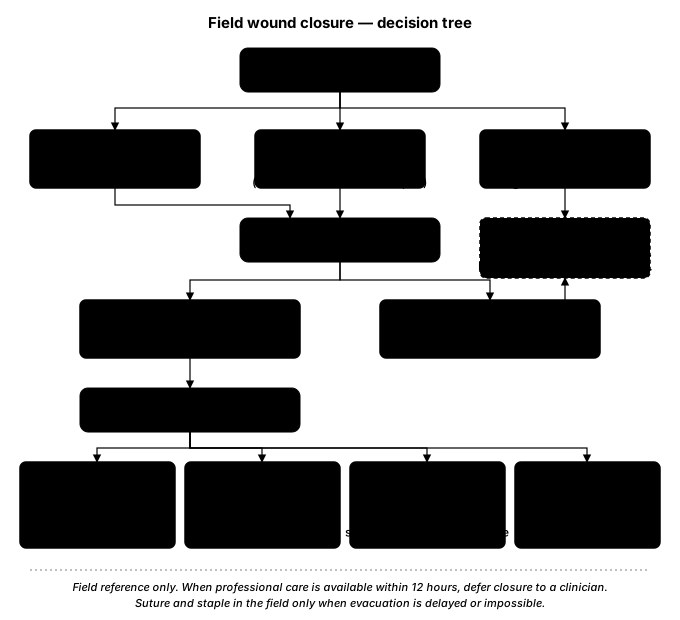
Closing a wound brings the edges together to reduce dead space, protect the bed, and speed healing. But a closed wound that is contaminated creates an abscess. The decision to close must account for wound age, wound type, contamination level, and available supplies.
When NOT to close
Do not close any of the following, regardless of appearance: - Puncture wounds - Animal or human bites - Any wound more than 8–12 hours old (or more than 24 hours on the face, which has excellent blood supply) - Any wound with visible signs of infection: pus, surrounding redness expanding past the wound margin, warmth, fever - Heavily contaminated wounds that you cannot be certain are clean after irrigation - Wounds over joint spaces (high tension prevents closure strips from holding)
Wounds that should not be closed may be managed as delayed primary closure — irrigate and dress daily, and close with strips once they remain clean for 72–96 hours and infection has not developed.
Closure strips (adhesive closure strips or butterfly closures)
The right tool for most field lacerations. They reduce infection risk compared to sutures because they do not puncture the skin. They are appropriate for: - Clean, low-tension lacerations less than 1 inch (2.5 cm) long - Shallow wounds not extending into fat or muscle - Wounds in areas with loose, mobile skin (forehead, shin) - Wounds in patients where the risk of suturing-related infection is high
Applying closure strips:
- Dry the wound edges completely. Strips do not adhere to wet skin. Use gauze to blot moisture, and if available, apply a small amount of tincture of benzoin to the skin immediately adjacent to the wound (not inside it) to improve adhesion.
- Hold the wound edges together with your fingers, bringing them into full contact.
- Apply the first strip perpendicular to the wound, anchoring one end 1/2 inch (1.2 cm) from the wound edge on one side. Pull gently across and press the other end down 1/2 inch (1.2 cm) on the opposite side.
- Apply strips every 1/4 inch (6 mm) along the wound length.
- Apply a second layer of strips parallel to the wound on each side, connecting the ends of the perpendicular strips to form a ladder pattern. This redistributes tension and prevents the strips from peeling off.
- Do not cover strips with occlusive tape — the wound needs to breathe.
Sutures (if trained and equipped)
Sutures are appropriate for deep lacerations with dead space underneath, wounds with wound edges that cannot be approximated by strips, and scalp lacerations. The suturing technique itself (simple interrupted) requires training and practice. If you have not practiced on a suturing kit beforehand, strips are safer. A poorly placed suture in contaminated tissue creates an abscess under a false seal.
Staples are faster than sutures for long scalp lacerations and trunk wounds and carry a similar infection risk to sutures. They are less useful on face, hands, or over joints where skin is thin or under tension.
Dressing and bandaging
A wound dressing has three functional layers. Get this wrong and the dressing either sticks to the healing wound bed (damaging it on removal) or does not absorb enough drainage and becomes a moist bacterial medium.
The three-layer system
Layer 1 — Non-adherent contact layer: Sits directly on the wound bed. Petroleum-impregnated gauze (Adaptic, Xeroform), silicone dressings, or a commercial non-stick pad. This layer protects the healing tissue from being pulled off when the dressing is changed. Do not use plain dry gauze directly on a wound bed — it adheres to granulation tissue.
Layer 2 — Absorbent layer: Standard gauze pads (2×2 or 4×4 inch (5×5 or 10×10 cm)). These absorb drainage and wick it away from the wound surface. Use more than one pad for heavily draining wounds.
Layer 3 — Securing wrap: Conforming bandage roll (Kerlix, Kling) or self-adhesive cohesive wrap. Wrap snugly but not tight enough to impair circulation. A test: you should be able to slide one finger under the wrap easily. Check capillary refill — press on the nail bed distal to the dressing and release; color should return in under 2 seconds.
Dressing change frequency
- First 24 hours: Leave the first dressing undisturbed unless it becomes soaked, falls off, or becomes visibly contaminated. Disturbing a fresh wound disrupts early clot formation.
- 24–72 hours: Change daily or when the outer layer is saturated.
- After 72 hours with no infection signs: Every 48–72 hours. Healing wounds need less frequent changes once granulation (new pink tissue) begins forming.
- Any time: If the dressing is wet from external contamination, falling off, has visible pus underneath, or the patient reports significant increase in pain.
Wet wounds and maceration
A constantly wet wound bed is as dangerous as a dry one. Prolonged moisture softens healthy skin around the wound (maceration), making it fragile and susceptible to infection. If a wound drains heavily, increase the absorbent layer thickness. If a wound is on a limb that gets wet (sweat, rain, water work), seal the dressing edges with tape and change it promptly if it gets wet.
How do I tell if a wound is infected?
Redness and warmth at the wound margin in the first 48 hours is normal inflammation, not infection. Infection is indicated by redness expanding past the wound edge after 48 hours, increasing pain, cloudy or colored discharge, or fever above 100.4°F (38°C). Red streaks running toward the body core are a medical emergency requiring immediate antibiotic treatment.
Infection begins at the cellular level before any visible sign appears. By the time you see redness or pus, the process is already 24–48 hours along. Understanding the timeline helps you catch it earlier.
Infection timeline
| Time since injury | What is happening | What you see |
|---|---|---|
| 0–24 hours | Normal inflammatory response | Redness and warmth at wound edge; swelling; this is expected |
| 24–48 hours | Bacterial colonization of wound bed | Wound may produce cloudy discharge; normal wound fluid is clear to straw-colored |
| 48–72 hours | Early infection, if present | Increasing redness beyond the wound margin; increasing pain rather than decreasing; yellow-green or opaque discharge |
| 3–5 days | Spreading cellulitis | Redness expanding outward daily; marked warmth; red borders you can trace; fever above 100.4°F (38°C) |
| 5–7 days | Systemic involvement | Fever above 102°F (38.9°C); red streaks running from wound toward trunk; lymph node swelling in groin, armpit, or neck |
| 7+ days | Bacteremia / sepsis risk | Confusion, rapid heart rate, falling blood pressure, extreme weakness |
What to look at daily
Every wound assessment takes less than two minutes. Do it the same time each day.
- Remove the dressing. Note the smell — infected wounds have a distinctive foul odor that clean wounds do not.
- Observe the wound discharge: clear or lightly pink is normal. Cloudy yellow, green, or brown discharge indicates infection.
- Measure the redness boundary. Mark it with a pen or note a landmark. If redness has expanded since yesterday, that wound is actively infected.
- Check skin temperature around the wound: hot and radiating outward is abnormal beyond 48 hours.
- Check for red streaks (lymphangitis) running from the wound toward the body core. These are a sign that bacteria are in the lymphatic vessels and moving toward systemic circulation. This is an emergency — it requires antibiotics immediately and evacuation if available.
- Check the patient's temperature. Fever above 100.4°F (38°C) associated with a wound requires antibiotic treatment.
- Re-dress with a fresh dressing after assessment.
Field note
Use a permanent marker to outline the edge of any redness on the skin. Date and time the line. This simple technique turns a subjective "it looks bigger" into objective documentation — either the redness is outside the line tomorrow or it is not. Hospital emergency departments use this same technique for tracking cellulitis.
Escalation criteria
Some wounds cannot be managed in the field regardless of your skill level. Knowing when to stop trying is as important as knowing how to treat.
Escalate immediately (seek professional care urgently, or administer antibiotics without delay if unavailable):
- Red streaks extending from the wound toward the body core (lymphangitis)
- Fever above 102°F (38.9°C) associated with a wound
- Swelling that is hard, tense, and disproportionate to the injury, especially if accompanied by intense pain — possible abscess requiring drainage
- Wound discharge that is thick, copious, and foul-smelling despite daily cleaning
- Any wound on the hand, foot, or over a joint that is not improving after 72 hours — these locations have high infection consequence
Escalate urgently (arrange transport or begin antibiotics, do not delay dressing changes):
- Wounds with numbness, tingling, or loss of movement distal to the injury — possible nerve or tendon damage
- Wounds that actively bleed with each dressing change despite appropriate treatment
- Any wound in an immunocompromised person (diabetes, HIV, steroid use) that is not improving within 48 hours — immune suppression dramatically accelerates infection
Manage and monitor (continue field care, no immediate escalation):
- Normal redness and warmth at the wound edge within 48 hours
- Clear to slightly cloudy discharge in a wound with no odor
- Mild pain that is decreasing over the first 48–72 hours
For the intersection of wound infection and systemic illness management, see infection. For bleeding control before wound care can begin, see bleeding control.
Wound care kit
Assemble a wound module inside your home medical kit. Every item below serves a specific function — there is no padding on this list.
| Item | Quantity | Function |
|---|---|---|
| Saline solution (0.9%), 500 mL bag or bottle | 2–4 | Irrigation; wound rinse |
| 35–60 mL syringes | 4 | High-pressure irrigation delivery |
| 18–19 gauge angiocatheters or blunt irrigating tips | 6 | Achieve 25–40 psi from syringe |
| Non-adherent dressings (non-adherent pad or Adaptic-style), 3×3 inch (7.5×7.5 cm) | 20 | Contact layer — prevents wound bed disruption |
| Gauze pads, 4×4 inch (10×10 cm), sterile | 30 | Absorbent layer; wound cleaning |
| Gauze pads, 2×2 inch (5×5 cm), sterile | 20 | Smaller wounds; packing support |
| Conforming gauze roll (Kerlix), 3 inch (7.5 cm) | 6 | Securing wrap layer |
| Medical tape (1 inch (2.5 cm)) | 2 rolls | Securing dressings |
| Closure strips (adhesive closure strips), 1/4 inch × 3 inch (6 mm × 7.5 cm) | 4 packs | Primary closure for clean lacerations |
| Tincture of benzoin swabs | 10 | Adhesion enhancement for strips |
| Nitrile gloves (medium and large) | 10 pairs | Universal precautions |
| Irrigation splash guard (optional) | 1 | Protect eyes during high-pressure flush |
| Permanent marker | 1 | Track cellulitis margins |
| Penlight | 1 | Wound depth inspection |
| Stiff-bristled scrub brush (sterile or clean) | 2 | Abrasion decontamination |
| Antiseptic wipes (chlorhexidine or povidone-iodine) | 20 | Skin surface prep around wound |
Wound care readiness checklist
- Assemble the wound module and store it in the home medical kit
- Practice the irrigation setup — fill a 35 mL syringe, attach the tip, and practice pushing pressure on a wet sponge before you need to do it on a wound
- Memorize the wounds-not-to-close list: punctures, bites, old wounds, contaminated wounds, infected wounds
- Stock a permanent marker specifically for tracking cellulitis margins
- Review the infection timeline table monthly — it is easy to forget that redness in the first 48 hours is expected, while redness at day 3–5 is not
- Cross-reference your antibiotic stock: amoxicillin-clavulanate covers bite wounds; the dental kit's amoxicillin is second choice
- Know when escalation is not optional — red streaks, high fever, numbness distal to wound
Good wound care keeps the bacteria out, supports the body's own healing, and catches the 10% of wounds that are heading in the wrong direction before they turn into a systemic problem. For injury scenarios where bleeding control must happen before wound care is possible, see bleeding control. For the downstream problem of a wound that progresses to systemic infection, see infection.
Failure modes
Most wound-care failures are predictable. They follow a short list of recognizable errors, and each has a defined remedy. Knowing the failure pattern before it happens is what separates field care from improvised guesswork.
Wound closed over contaminated tissue
Recognition: Increasing pain after 24–48 hours post-closure (pain should be decreasing, not increasing), pus or turbid discharge from wound edges, fever above 38°C (100.4°F), expanding erythema — redness that has grown past the boundary you marked on the skin the day before. This is the most common serious wound-care failure.
Remedy: Remove all closure strips or sutures. Open the wound completely. Irrigate aggressively with 500–1,000 mL (17–34 fl oz) of saline or clean potable water at 7–10 psi (48–69 kPa) (an 18-gauge catheter on a 30 mL syringe achieves this; push firmly with both hands). Leave the wound open. Pack loosely with moistened gauze and allow it to heal by secondary intention — granulation tissue fills the space from the base upward. Do not re-close until 72–96 hours of infection-free, clean healing confirms the tissue is safe.
Field note
Never primary-close a bite wound — ever. Cat bites, dog bites, and human bites seed bacteria into deep tissue through a puncture that seals shut within hours. Even a bite that looks minor on the surface can develop into a closed-space infection within 12–24 hours. Irrigate copiously, leave fully open, and start antibiotics immediately if available. Amoxicillin-clavulanate 875/125 mg every 12 hours is first-line for bite prophylaxis; doxycycline 100 mg twice daily is the backup if that is unavailable. See infection for antibiotic selection and cellulitis decision criteria.
Missed deeper structure injury
Recognition: Persistent bright-red bleeding past the expected clotting window (more than 10–15 minutes of direct pressure), loss of sensation or movement distal to the wound (a cut finger that cannot bend, a wrist laceration with a numb hand), or visible tendon, bone, or fascial tissue in the wound bed.
Remedy: Do not close. Apply a bulky pressure dressing — multiple gauze layers compressed firmly with a conforming wrap. Immobilize the limb. Evacuate to surgical care. Field closure of a wound with structural damage creates a closed contaminated space over a structure that requires surgical repair. For hemorrhage control while preparing for evacuation, see IFAK and massive hemorrhage control.
Bite wound closed (animal or human)
Recognition: Any wound caused by teeth — regardless of how small the puncture appears.
Remedy: Remove closure if already applied. Irrigate with a minimum of 500 mL (17 fl oz) per puncture site directed into the wound channel. Leave fully open. If oral antibiotics are available, start immediately: amoxicillin-clavulanate 875/125 mg every 12 hours (first choice); doxycycline 100 mg twice daily (second choice). Monitor closely — Pasteurella multocida from cat bites can produce spreading cellulitis within 12 hours.
Delayed primary closure — window missed
Recognition: A wound more than 12 hours old (more than 24 hours on the face, which has exceptional blood supply) is brought in or recognized late, and there is an impulse to close it to speed healing.
Remedy: Do not close. The primary closure window for most body locations is 8–12 hours post-injury. Past that threshold, the bacterial burden in the wound bed makes primary closure likely to trap infection. Instead: irrigate thoroughly, dress it open with a non-adherent contact layer, and inspect daily. Delayed primary closure — approximating the edges at day 4–5 once granulation tissue is visible and infection has not developed — is the correct next step, not immediate closure. Wounds left to heal fully by secondary intention (no closure at all) have lower infection rates than wounds closed too late.
Tetanus status unknown
Recognition: Any wound in a patient who cannot confirm their tetanus vaccination history — common during grid-down scenarios when vaccination records are unavailable.
Remedy: If the last tetanus booster was more than 5 years ago and the wound is contaminated (puncture wound, animal bite, or visibly dirty wound — soil, manure, rust, or fecal matter) or a puncture, or more than 10 years ago for any wound type, a Td or Tdap booster is urgent. The window for post-exposure booster is within 72 hours of injury. If boosters are unavailable, there is no field remedy for tetanus exposure — prevention is the only option. This is a strong argument for keeping tetanus boosters current as part of baseline prepping, not waiting until a wound occurs. Flag this for evacuation if the patient develops progressive muscle rigidity or trismus (jaw stiffness) in the days following injury.
Pressure dressing applied too tight
Recognition: The limb or digit distal to the dressing is cool, bluish, or numb. The patient reports tingling or cannot feel the fingertips or toes. Capillary refill at the nail bed is slower than 2 seconds, or there is no palpable pulse at the distal radial or dorsalis pedis artery.
Remedy: Loosen the wrap immediately. Remove the outer securing layer and re-examine. Add a bulkier absorbent layer between the wound and the securing wrap to distribute pressure more evenly. Re-wrap with elastic bandage at moderate tension — you should be able to slide one finger under the wrap. Reassess distal pulse and capillary refill within 2 minutes of adjustment. A pressure dressing that sacrifices distal circulation causes ischemic injury compounding the original wound; it is not a safer version of a tourniquet — it is simply a poorly applied dressing. See IFAK and massive hemorrhage control for the distinction between a pressure dressing and a deliberate tourniquet.
Operational infection criteria
Vague language kills in field medicine. If you are monitoring a wound and asking "does this look infected?", replace that question with specific thresholds:
- Expanding erythema: redness growing outward more than 1 cm (0.4 in) beyond the wound margin in a 24-hour period, as measured from a pen line drawn the day before
- Increasing pain: pain at the wound site that is greater at 48 hours than it was at 24 hours — healing wounds hurt less over time, not more
- Fever: temperature above 38°C (100.4°F) associated with a wound site
- Purulent drainage: discharge that is yellow-green, brown, or opaque with or without odor
- Lymphangitic streaking: red lines running from the wound toward the nearest lymph node cluster (groin, armpit, or neck) — this is a systemic emergency requiring immediate antibiotics
Mandatory escalation triggers — these go beyond field management regardless of resource constraints:
- Deep laceration crossing a joint space
- Exposed tendon, bone, or deep fascia visible in wound bed
- Animal or human bite on the hand, face, or over a joint
- Wound more than 12 hours old at time of initial assessment
- Any sign of vascular or nerve injury (absent pulse, numbness, loss of motor function distal to wound)
- Wound that cannot be fully cleaned despite thorough irrigation
Common questions
How deep does a wound need to be before it needs stitches?
A wound that penetrates through the dermis into subcutaneous fat or deeper requires closure to eliminate dead space and support healing. In the field, you can estimate depth by probing gently with the corner of a gauze pad: if the wound bed is yellow (fat) or red-pink muscle, closure is needed. Wounds confined to the outer skin layers — where the wound bed looks pink and the edges approximate on their own — can often heal without closure. Depth is only one factor; wound age and contamination level matter equally.
Can I use super glue on a wound?
Medical-grade cyanoacrylate (Dermabond, LiquidBandage) is designed for skin and is a reasonable field option for small, superficial lacerations with dry edges. Hardware-store super glue contains solvents toxic to tissue and should be avoided if a medical-grade alternative is available. If hardware super glue is the only option and the wound is small and clean, it has been used in emergencies — apply only to the skin surface, not inside the wound channel. Closure strips are safer and should be the first choice. Never close a contaminated, deep, or bite wound with any adhesive.
How do I tell if a wound is infected?
Use the daily inspection protocol: remove the dressing, observe discharge color (clear is normal; yellow-green or brown indicates infection), measure the redness boundary (mark it with a pen and check the next day), feel for spreading warmth, and check body temperature. The most reliable early sign is redness expanding past the margin you marked 24 hours earlier — a wound getting smaller in redness is healing; a wound getting larger in redness is infected. Red streaks running toward the trunk are lymphangitis — treat immediately with antibiotics and escalate to professional care.
What's the longest you can wait to clean a wound?
Irrigate as soon as possible — within 1–2 hours is ideal. Bacterial colonization of a contaminated wound begins immediately, and each hour of delay increases infection risk. USDA wound research shows substantially lower infection rates in wounds irrigated within 6 hours. After 8–12 hours, the window for primary closure has closed: irrigate the wound thoroughly, dress it open, and plan for delayed closure (72–96 hours later) if it remains clean. Face wounds are an exception — the rich blood supply makes closure safe up to 24 hours post-injury.
Sources and next steps
Last reviewed: 2026-05-16
Source hierarchy:
- American College of Surgeons — Stop the Bleed (hemorrhage control) (Tier 1, professional medical society — cited on page for direct-pressure-first bleeding control and the 35–70 psi high-pressure lavage definition)
- Wilderness Medical Society — Practice Guidelines for Basic Wound Management in the Austere Environment (2014 update) (Tier 1, peer-reviewed field-medicine consensus — supports potable water for irrigation, Grade 1A; syringe-pressure ranges)
- American College of Emergency Physicians — Tap Water for Wound Irrigation (Resolution 59, 2024) (Tier 1, professional medical society — supports clean water as acceptable irrigation fluid; escalation criteria for acute laceration care)
- Red Cross — First Aid: Wound Care (Tier 1, authoritative layperson protocols — infection signs, escalation criteria for layperson responders)
Legal/regional caveats: Scope-of-practice applies. Suturing and wound stapling are clinical procedures requiring training and, in most jurisdictions, licensure or supervision. This page covers layperson-level wound care (irrigation, dressing, closure strips, monitoring) — it is educational material, not clinical authorization.
Safety stakes: life-safety topic — verify against current local/professional guidance before acting.
Next 3 links:
- → Bleeding control — address active hemorrhage before any wound treatment can begin
- → Infection — what to do when a wound progresses to systemic infection or cellulitis
- → Water filtration — ensure your irrigation water is clean and safe before using it on a wound