Water filtration methods
Filtration is one of the most misunderstood topics in water treatment. People buy a filter, assume it solves all problems, and skip the questions that actually matter: what exactly does this filter remove at its stated pore size, and what does it leave behind? A filter that stops bacteria is useless against viruses. A filter rated for protozoa has a different pore size than one rated for bacteria.
Activated carbon that removes chlorine taste does nothing for Giardia. No single filter type addresses every threat.
This page covers the four practical filter categories available to preparedness-minded households: ceramic pot filters, hollow-fiber membrane filters, activated carbon, and DIY biosand filters. For biological threats that survive filtration (viruses, in most cases), combine filtration with Boiling or Chemical Treatment. For chemical contamination that filters cannot address, see Distillation.
Educational use only
This page is educational. Treat any water source you suspect is contaminated as life-threatening until tested or treated correctly. Where municipal water service is intact, follow your local utility's guidance. CDC and EPA emergency-water guidance supersedes anything on this page.
Before you start - Skills: Source-water threat assessment — identify whether your risk tier is biological (backcountry bacteria/protozoa), viral (sewage-impacted, international, post-disaster municipal failure), or chemical/heavy-metal (agricultural runoff, industrial sites). See Water Testing for coliform, nitrate, and chemical screening. Container hygiene: maintain strict dirty-side / clean-side discipline throughout (backflow is Failure mode 4 below). - Materials: Field filter rated for your threat tier — bacteria + protozoa rated at 0.1–0.2 µm (100–200 nm) for backcountry; virus-rated 0.02 µm (20 nm) OR UV pen OR chemical disinfection (see Chemical Treatment) for sewage-impacted, international, or post-disaster use. Pre-filter cloth or 15–30 min settling time for visibly turbid source water (target ≤1 NTU before the filter). Two separate containers: 1 dirty-side (source water) and 1 clean-side (filtered output), minimum 1 qt (1 L) each. Activated-carbon block stage or distillation if heavy-metal, pesticide, or VOC contamination is suspected. - Conditions: Filter integrity confirmed — no impact damage, no freeze cycles since last inspection (freeze cracks hollow-fiber elements invisibly; see Failure mode 1 below). Source water identified and threat tier known before you start. Temperature above freezing during operation if using a hollow-fiber filter. - Time: Pre-filter or settling 15–30 min for turbid water. Active filtration 2–10 min per quart (1 L) depending on flow rate (Sawyer Squeeze ~1 qt/min; gravity systems ~1 qt per 5–10 min). Discard or re-treat stored treated water after 48 h in non-sterile containers. See Boiling as a parallel treatment option if fuel is available.
Action block
Do this first: Fill a clear glass with your prospective water source, hold it to the light, and note color, turbidity, smell, and any visible particulates — this tells you which filter category you actually need (5 min) Time required: Active: 5 min assessment + 2–10 min per quart (1 L) filtration; wait: 15–30 min settling for turbid water; recurrence: repeat assessment any time source changes Cost range: Inexpensive for hollow-fiber squeeze filters and carbon pitcher filters; moderate investment for gravity ceramic systems and virus-rated filters Skill level: Beginner for hollow-fiber and ceramic gravity systems; intermediate for biosand construction and multi-stage setups Tools and supplies: Tools: pre-filter cloth or bandana; backflush syringe (included with most hollow-fiber filters); soft scrub brush for ceramic candles. Supplies: hollow-fiber membrane filter (0.1–0.2 µm for biological threats) or ceramic candle filter; separate dirty-water and clean-water containers (minimum 1 qt / 1 L each); activated-carbon block stage if chemical or taste removal is needed. Infrastructure: stable flat surface or hanging point for gravity-feed systems. Safety warnings: See Crack inspection is non-negotiable below and See Failure modes below
Understanding Pore Size and Pathogens
Filter effectiveness is determined by pore size, measured in microns (µm). Pathogens vary in size:
| Pathogen Category | Size Range | Example Organisms |
|---|---|---|
| Protozoa / cysts | 1–15 µm | Giardia lamblia, Cryptosporidium parvum |
| Bacteria | 0.2–10 µm | E. coli, Salmonella, Vibrio cholerae |
| Viruses | 0.02–0.3 µm | Hepatitis A, norovirus, rotavirus |
What this means in practice: - A 0.2-micron ceramic filter removes all protozoa and nearly all bacteria, but viruses pass through freely - A 0.1-micron hollow-fiber filter removes all protozoa and all bacteria rated at that pore size, but viruses still pass through - No consumer mechanical filter reliably removes viruses without additional treatment
In North American backcountry and most emergency scenarios, viruses are a lower-risk threat than bacteria and protozoa. In international travel, flood events, or sewage contamination scenarios, viral risk rises significantly and filtration must be combined with chemical or UV treatment.
Filter Type 1: Ceramic Filters (0.2 Micron)
What they remove: All protozoa, all bacteria down to 0.2 microns What they do not remove: Viruses, heavy metals, nitrates, chemical contaminants
Ceramic filters use a fired clay media with pores nominally rated at 0.2 microns. Water is forced through the pores by gravity or hand pressure, and pathogens are physically excluded by pore size. High-quality ceramic candles (such as those made with diatomaceous earth or silver-impregnated ceramic) also have a bacteriostatic effect that inhibits regrowth of captured bacteria in the filter itself.
Berkey gravity filter systems (a significant household purchase for 2-candle stainless units) use a proprietary black carbon ceramic hybrid element. They can process 1–4 gallons (4–15 L) per hour depending on candle count. The Berkey system does not reliably remove fluoride without the separate PF-2 fluoride reduction element (an inexpensive add-on). Fluoride limitation is not disclosed prominently in Berkey marketing — if fluoride removal is your goal, also see Distillation.
EPA Stop-Sale Order on Berkey (2023–2026)
The US Environmental Protection Agency has classified Black Berkey filter elements as unregistered pesticide devices and issued a Stop-Sale Order affecting US distribution. The order is still active as of 2026. If you already own a Berkey, it still filters water — but new US purchases are uncertain. Consider these alternatives instead: ProOne G2.0, Alexapure Pro, British Berkefeld, Waterdrop WD-BB9-2, Phoenix New Millennium. Outside the US, Berkey remains available.
Operating a ceramic gravity filter:
- Prime new ceramic candles by soaking in clean water for 30 minutes before first use
- Pre-filter turbid source water through cloth to remove macroparticles — turbidity clogs ceramic pores rapidly
- Fill the upper chamber with source water. Do not overfill.
- Allow gravity to draw water through the candles into the lower chamber. Do not force or pressurize.
- Dispense from the lower chamber spigot. Never allow lower-chamber water to contact upper-chamber walls.
- Maintenance: scrub the outside of ceramic candles monthly (or when flow rate drops by 50%) with a soft brush under running clean water. Do not use soap.
- Inspect candles for cracks every time you clean them. A cracked candle must be replaced immediately — it provides zero filtration.
Crack inspection is non-negotiable
A ceramic candle with even a hairline crack provides zero protection. To test: remove the candle and hold it up to a bright light. Any crack will appear as a bright line. Alternatively, submerge the candle in water — bubbles streaming from one spot indicate a crack. Replace any cracked candle before continuing use.
How long do ceramic filter elements last?
Ceramic candles typically process 1,000–2,000 gallons (3,785–7,570 L) of water before exhaustion, though this number depends heavily on source-water turbidity. Heavily turbid water can clog candles in a fraction of that volume. Flow rate is your primary indicator: when rate drops more than 50% after a thorough scrub cleaning, replace the candle. Candles that have been cracked must be replaced immediately regardless of processing volume. On a clear mountain spring, a single pair of candles may last a household a year of regular use; on sediment-heavy river water, months.
Filter Type 2: Hollow-Fiber Membrane Filters (0.1 Micron)
What they remove: All protozoa and bacteria down to 0.1 microns What they do not remove: Viruses, dissolved chemicals, heavy metals
Hollow-fiber filters use bundles of U-shaped tubes with microscopic pores. Water is drawn or pushed through the walls of the hollow fibers, with pathogens blocked at the membrane surface. They are lightweight, fast-flowing, and can be backflushed to restore flow rate.
Important pore-size and virus limitation: All hollow-fiber filters listed below (except the MSR Guardian) are rated at 0.1–0.2 microns — effective against bacteria and protozoa, but viruses (0.02–0.3 microns) pass through freely. In North American backcountry and typical emergency scenarios, viral risk from surface water is low. In flood events, international travel, or any scenario with sewage contamination, treat filtered water with Chemical Treatment or Boiling to cover viruses.
Platypus QuickDraw (inexpensive) — rated 0.2 microns with a flow rate of approximately 3 liters (0.8 gal) per minute, making it one of the fastest gravity filters available. Weighs 2.9 oz (82 g). Named "Best Overall" backpacking water filter by OutdoorGearLab, GearJunkie, and Treeline Review for 2026. Best general-purpose choice for bug-out bags and field use when flow speed matters.
Sawyer Squeeze (inexpensive) — rated 0.1 microns with a lifetime rating of 100,000 gallons (378,000 L). Weighs 3 oz (85 g) and threads onto standard 28mm bottles. Flow rate approximately 1.7 liters (0.45 gal) per minute when squeezed. Most cost-effective per-liter filter at scale; widely available replacement parts.
Katadyn BeFree (inexpensive) — rated 0.1 microns with a flow rate of approximately 2 liters (0.5 gal) per minute. Comes as a collapsible 0.5 L, 1 L, or 3 L soft flask integrated with the filter. Compact and well-suited for trail runners and those who prefer a single integrated vessel over separate filter and bottle.
LifeStraw Peak (inexpensive) — rated 0.2 microns with a flow rate of approximately 3 liters (0.8 gal) per minute. Available as a squeeze filter or gravity filter. The original straw-style LifeStraw remains available but cannot fill a container and has no gravity-feed capability, limiting its utility for group use or cooking water.
MSR Guardian (moderate investment) — rated 0.02 microns and the only filter in this list capable of removing viruses mechanically (without chemical assistance). Self-cleaning hollow-fiber design maintains flow rate without manual backflushing. Flow rate approximately 2.5 liters (0.66 gal) per minute. The correct choice for international travel, post-flood water, or any source downstream of significant human activity.
Filter comparison:
| Filter | Micron rating | Virus-safe? | Flow rate | Cost tier |
|---|---|---|---|---|
| Platypus QuickDraw | 0.2 | No | 3 L (0.8 gal) per min | inexpensive |
| Sawyer Squeeze | 0.1 | No | 1.7 L (0.45 gal) per min | inexpensive |
| Katadyn BeFree | 0.1 | No | 2 L (0.5 gal) per min | inexpensive |
| LifeStraw Peak | 0.2 | No | 3 L (0.8 gal) per min | inexpensive |
| MSR Guardian | 0.02 | Yes | 2.5 L (0.66 gal) per min | moderate investment |
Operating a Sawyer Squeeze:
- Fill the included squeeze pouch with source water (pre-filter for turbidity if needed)
- Attach the Sawyer filter to the pouch. Squeeze firmly and steadily — do not force or you will damage the membrane.
- Drink directly from the filter outlet, or direct flow into a clean container
- To backflush: attach the included syringe to the clean-water outlet and push clean water backward through the filter at moderate pressure. Repeat 5–10 cycles. Do this after every use in turbid conditions and weekly in normal field use.
- Critical: never allow the filter to freeze when wet — ice crystals rupture the hollow-fiber membrane and destroy filtration integrity. Dry the filter completely or keep it in an inside pocket in freezing conditions.
- Flow rate drops over time even with backflushing. If flow rate falls below 50% of original after thorough backflushing, replace the filter.
Field note
The Sawyer Squeeze is the best inline field filter at its price point, but it has one critical weakness: the supplied squeeze pouches fail at the seams after 10–20 uses. Replace them with a standard 28mm-thread 1-liter Smartwater bottle (inexpensive, empty). The rigid bottle is more durable, easier to fill in shallow water, and threads onto the Sawyer filter identically. Carry two Smartwater bottles — one dirty, one clean — and never cross-contaminate.
Filter Type 3: Activated Carbon Filters
What they remove: Chlorine, chloramines, many organic chemicals, pesticides, herbicides, some heavy metals (lead, mercury at high-quality carbon), taste and odor compounds What they do not remove: Bacteria, protozoa, viruses, nitrates, fluoride, most dissolved minerals
Activated carbon is produced by heating organic material (charcoal, coconut shells) in low-oxygen conditions to create a highly porous structure with enormous surface area — one gram of activated carbon can have a surface area of 500–1,500 square meters. This surface area adsorbs organic molecules and some metals on contact.
Activated carbon is not a biological filter. It removes chemical threats and improves taste, but bacteria and protozoa pass through freely. Its primary role in a preparedness water system is:
- Post-treatment of boiled or chemically treated water to remove residual chlorine taste
- Treatment of water from municipal sources during boil-water advisories (combined with boiling)
- Removal of taste/odor compounds from collected rainwater or stored water
Pitcher filters (Brita, PUR) typically contain granular activated carbon plus an ion-exchange resin. They remove chlorine taste and some lead but are not rated for bacterial or viral removal. Filter life is 40 gallons (150 L) per cartridge — an inexpensive ongoing cost per liter treated.
For preparedness use, carbon block cartridges rated by NSF Standard 42 (aesthetic) or NSF Standard 53 (health effects) provide more consistent performance than granular carbon in a pitcher.
Filter Type 4: DIY Biosand Filter
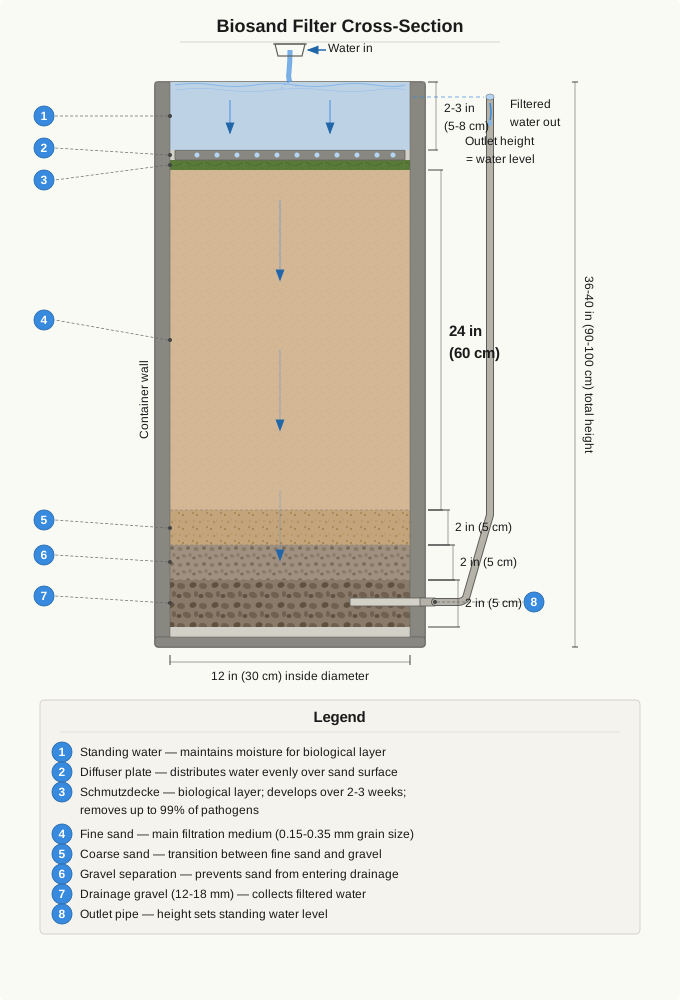
What they remove: 90–99% of bacteria, most protozoa, turbidity; biological activity also reduces viruses over time What they do not remove: Viruses (reliably), dissolved chemicals, heavy metals
A biosand filter is a slow sand filter adapted for household use, with a biological layer (schmutzdecke) that forms at the sand surface. The biological layer — a community of predatory microorganisms — is responsible for up to 99% of pathogen removal, exceeding what the physical filtration of sand alone provides. It is the most sophisticated DIY filter achievable without manufactured components.
Biosand filter construction:
Dimensions: 24 inches × 12 inches (60 cm × 30 cm) container, 36–40 inches (90–100 cm) tall. A concrete or plastic container works; a 55-gallon drum cut to 40 inches is a common choice.
Layer composition from bottom to top:
| Layer | Material | Depth |
|---|---|---|
| Drainage | Coarse gravel, 1/2–3/4 in (12–18 mm) | 2 in (5 cm) |
| Transition | Fine gravel, 1/8–1/4 in (3–6 mm) | 4 in (10 cm) |
| Fine sand | Washed sharp sand, 0.15–0.35 mm grain | 24 in (60 cm) |
| Water standing layer | Clean water above sand | 2–3 in (5–7 cm) |
Construction procedure:
- Drill a 1/2-inch (12 mm) outlet hole 1 inch (2.5 cm) above the bottom of the container. Install PVC pipe fitting with watertight sealant.
- Wash all gravel and sand thoroughly until rinse water runs completely clear.
- Add coarse gravel drainage layer (2 in (5 cm)).
- Add fine gravel transition layer (4 in (10 cm)).
- Add fine sand layer to 24 inches (60 cm) depth.
- Slowly pour clean water to establish the standing water layer above the sand — never let the sand surface dry out after initial wetting.
- Ripening period: Pour 2–5 gallons (8–19 L) of dirty source water through the filter daily for 7–14 days before using output for drinking. The schmutzdecke biological layer must establish before the filter provides biological protection.
- During ripening, treat all output water with boiling or chemical treatment.
- After ripening, flow rate should be 0.5–1.5 gallons (2–6 L) per hour. Faster flow means inadequate biological contact time — adjust sand depth or reduce pour rate.
Ongoing maintenance: - Never let the sand surface dry out — this kills the biological layer and requires re-ripening - When flow rate drops below 0.3 gallons (1 L) per hour, perform a "wet harrowing": scrape off and discard the top 0.5 inch (1.2 cm) of sand, then re-add clean sand to restore depth. Re-ripen for 1 week. - Clean the container walls monthly
Field note
The most common biosand failure is impatience. Users skip the ripening period or let the sand dry out once during a move, then trust the output as fully treated. A biosand filter without an established schmutzdecke is basically a sand-bed sediment filter — it removes particles but not pathogens effectively. Treat all output as pre-filtered, not finished, until you have 14 days of consistent operation documented.
Turbidity vs. Pathogen Removal
Turbidity is not equivalent to contamination — and clear water is not equivalent to safe water.
- Turbid water (visible cloudiness) almost always contains particles, organic matter, and elevated pathogen loads — but the danger is the pathogens, not the cloudiness itself.
- Clear water can contain Giardia, Cryptosporidium, bacteria, and viruses at dangerous levels with no visual indication.
Turbidity matters for filter operation because: 1. High turbidity (>10 NTU) rapidly clogs fine-pore filters (ceramic, hollow-fiber), reducing flow and requiring more frequent cleaning 2. Turbidity above 1 NTU significantly reduces UV treatment effectiveness (see UV Treatment) 3. Particles physically protect pathogens during boiling and chemical treatment
For practical field use: reduce turbidity first (coarse pre-filtering or settling), then treat for biological threats. Check Water Testing for turbidity measurement options.
Which water filter is right for emergency use?
The right filter depends on your scenario: speed and portability favor hollow-fiber squeeze filters; home gravity filtration favors ceramic systems; long-term homestead use favors biosand; post-flood viral risk requires the MSR Guardian or chemical backup.
| Scenario | Recommended Filter |
|---|---|
| Backpacking, bug-out bag — speed priority | Platypus QuickDraw (inexpensive) |
| Backpacking, bug-out bag — longevity priority | Sawyer Squeeze (inexpensive) |
| Home gravity system, grid-down (US) | ProOne G2.0, Alexapure Pro, or ceramic bucket filter (significant investment) |
| Home gravity system, grid-down (outside US) | Berkey or British Berkefeld (significant investment) |
| Chemical/taste removal only | Carbon block pitcher filter (inexpensive) |
| Long-term village/homestead with labor time | DIY biosand (inexpensive materials) |
| International travel or post-flood viral threat | MSR Guardian (moderate investment) + chemical treatment |
No filter alone is complete. For comprehensive coverage, pair mechanical filtration with Boiling or Chemical Treatment when viral risk is elevated, and with activated carbon post-treatment when taste matters. See Sourcing for identifying what contaminants your specific water source is likely to carry.
Field note
If you are specifying a permanent treatment system for a well, spring, or cistern — one that filters every tap in the house — see Whole-house water filtration for the full sediment-to-carbon-to-UV chain, flow rate sizing, and iron and manganese treatment options.
How do I prevent cross-contamination when filtering?
Cross-contamination — touching the clean output port with dirty hands, mixing dirty and clean containers, or storing filters without caps — is the most common filtration failure and happens entirely after the filter has done its job.
The most common failure mode in filtration is not filter failure — it is user contamination of the clean side:
- Always label dirty-water and clean-water containers distinctly (different colors, tape, marker)
- Never touch the clean output port of any filter with unwashed hands
- Store filters with end caps in place; bacteria grow in moist, dark filter media when not in use
- Do not share personal filters (LifeStraw, Sawyer personal) between users without disinfecting the mouthpiece
- When in doubt about whether a container has been cross-contaminated, treat the contents as untreated
Failure modes
Filters fail quietly. Unlike a snapped strap or an empty fuel canister, a compromised filter keeps flowing and looks like it is working. Every failure mode below has cost people their health — or their lives — because the filter appeared functional until it wasn't.
Field note
Freeze damage is the single most underestimated hollow-fiber failure. A Sawyer Squeeze, Katadyn BeFree, or MSR Trail Shot left in a vehicle overnight at 28°F (-2°C) can shatter internal fibers without leaving a visible crack or external mark. The filter still passes water — faster than usual, actually, because the compromised membrane offers less resistance. That speed is the tell. After any suspected freeze event, replace the cartridge. No field integrity test is reliable enough to confirm safety after a freeze.
Filter freeze-cracked between uses Recognition: A previously slow-and-reliable filter suddenly flows fast and clear. The hollow-fiber or ceramic element was fractured by ice crystal expansion during a freeze-thaw cycle — internally, with no exterior sign. For the Sawyer Squeeze specifically, an instrument-free flow proxy: if squeezing a full 1 L (34 fl oz) pouch to dry takes more than 60 seconds, the filter is nearing the replacement threshold and backflushing is overdue — if that pace persists after a thorough backflush, or if it suddenly becomes noticeably faster than usual after a cold night, suspect freeze damage. Remedy: Protect filters from freezing — sleep with them in your bag in winter, never leave a wet filter in a cold vehicle overnight. After any suspected freeze, replace the cartridge. Do not rely on a back-pressure integrity test to confirm safety; freeze damage to hollow fibers is distributed and microscopic.
Wrong pore size for the threat present Recognition: A filter rated for bacteria and protozoa — 0.1–0.2 µm (100–200 nm) — used in a virus-risk scenario: post-flood, international travel, or any source downstream of sewage contamination. Viruses range from 0.02–0.3 µm (20–300 nm) and pass freely through most backpacking filters. Remedy: For virus-risk water, use a filter rated below 0.02 µm (20 nm) — only the MSR Guardian hits this threshold mechanically — OR follow filtration with boiling, chemical treatment, or UV. North American backcountry threat is dominated by protozoa and bacteria; viral risk rises sharply with sewage input or post-disaster municipal failure.
Chemical or heavy-metal contamination not removed Recognition: Water drawn from near agriculture, mining, industry, or wildfire ash runoff, treated only with a ceramic or hollow-fiber filter. Remedy: Standard filters do not remove dissolved heavy metals (lead, arsenic), pesticides, fuel, or salts. For chemical contamination, use an activated-carbon block stage rated to NSF/ANSI 53 (health effects), or distillation, or reverse osmosis. If your source is in a known mining or wildfire-ash zone, test for lead and arsenic through your county health department or state extension service before trusting any filter-only approach.
Backflow contamination of the clean side Recognition: Shared ports, shared containers, or hands that touched dirty water contacting the clean-side outlet. Remedy: Dedicate one container to dirty (source) water and one to clean (filtered) water — mark them permanently and never swap. Never blow back through a filter to clear a clog; pressure applied to the clean-side outlet pushes pathogens from the outlet into the filtration media and contaminates every liter you filter afterward. If you must clear a blockage, backflush with clean water using the included syringe, not lung pressure through the outlet.
Bypass via cracked seal or housing Recognition: Visibly faster flow after an impact, fall, or freeze event. Water shows unexpected turbidity or silt taste from a filter that previously ran clear. Remedy: Run an integrity test at the start of each season — most pump and gravity filters document a back-pressure test procedure in their manual. Replace any filter whose housing seal is visibly cracked or deformed. When in doubt after a drop or impact, replace the cartridge. Replace cartridges per manufacturer liter rating, after any freeze event, or when flow rate drops below 50% of new after thorough backflushing — whichever comes first.
Bacterial regrowth in stored filtered water Recognition: Filtered water stored more than 24–48 hours in a non-sterile container develops a biofilm odor or visible film. Remedy: Filtered water is safe to drink only when: (1) the filter is rated for the threat tier present, (2) filter integrity has been verified, (3) no backflow has occurred, and (4) the water is consumed within 48 hours or re-treated. For water stored beyond 48 hours, add 2 drops of 5–6% unscented household bleach per 1 liter (34 fl oz) — or 8 drops per 1 gallon (3.8 L) — and wait 30 minutes before drinking. Rotate stored filtered water at 24–48 hour intervals rather than accumulating it. See Chemical Treatment for full EPA bleach dosing guidance.
Field Checklist
- Contamination type identified (biological, chemical, turbidity, or combination)
- Correct filter type selected and matched to threat category
- Turbidity pre-filtered before running through fine-pore filter
- Filter primed per manufacturer instructions before first use
- Flow rate within rated range (not forced)
- Clean and dirty containers labeled and kept separate
- Backflushing or cleaning performed per schedule
- Ceramic candles inspected for cracks
- Filter stored dry (hollow-fiber) or wet (biosand) per type requirements
- Viral-risk scenarios identified and combined treatment planned
Common questions
Will a Berkey remove viruses?
Standard Black Berkey filter elements are ceramic-carbon hybrids rated to approximately 0.2 microns — effective against bacteria and protozoa, but not against viruses (which range from 0.02 to 0.3 microns). No consumer-grade mechanical filter reliably removes viruses without additional treatment. If viral risk is present (post-flood conditions, international travel, sewage contamination), pair any ceramic or hollow-fiber filter with chemical treatment or UV. The only mechanical filter on the comparison table above rated to remove viruses is the MSR Guardian (0.02 microns).
What's the difference between 0.2 and 0.1 micron filters?
The pore-size difference is significant for bacteria but not for viruses. A 0.2-micron filter removes all protozoa and nearly all bacteria; a 0.1-micron filter closes the remaining gap for smaller bacteria. In practice, both ratings provide equivalent protection for the threats you are most likely to encounter in North American emergency scenarios. Neither removes viruses. For the full pathogen-size breakdown, see the pore-size table at the top of this page.
How often do I need to replace my filter elements?
It depends on the filter type and your source water. Hollow-fiber filters like the Sawyer Squeeze carry a manufacturer-rated 100,000-gallon (378,000 L) life but should be replaced when flow falls below 50% of original speed after thorough backflushing. Ceramic candles typically last 1,000–2,000 gallons (3,785–7,570 L) and must be replaced at any visible crack. Activated carbon cartridges follow manufacturer guidance — typically 40–100 gallons (150–380 L) for pitcher filters. When in doubt, replace: a failed filter provides false security, not filtration.
Can I filter pool water for drinking?
Pool water contains residual chlorine and often algaecides, which mechanical filters (ceramic, hollow-fiber) do not remove. To make pool water safe to drink: pre-filter through cloth to remove debris, then run through activated carbon to remove chlorine and chemical taste. Do not drink pool water without carbon treatment — the residual chemicals are not acutely toxic at pool concentrations but will cause GI distress. For other unusual source waters, see Water Testing to assess what contaminants you are actually dealing with.
Sources and next steps
Last reviewed: 2026-05-17
Source hierarchy:
- WHO Guidelines for Drinking-water Quality, 4th ed. (Tier 1, World Health Organization — pathogen size ranges, treatment efficacy standards)
- EPA Emergency Disinfection of Drinking Water (Tier 1, US EPA — viral risk, bleach dosing, NSF reference)
- NSF/ANSI 53 — Drinking Water Treatment Units: Health Effects (Tier 1, NSF International — activated-carbon health-effects claims)
- NSF/ANSI P231 — Microbiological Water Purifiers (Tier 1, NSF International — virus-rated filter performance threshold)
Legal/regional caveats: US EPA Stop-Sale Order on Black Berkey elements (2023–2026) is US-specific; readers outside the US are unaffected. NSF/ANSI standards are North American; equivalent international standards include WHO scheme for household water treatment and EN 14652. Filter pore-size ratings vary by test protocol — verify NSF or equivalent certification before purchase.
Safety stakes: life-safety topic — verify against current local/professional guidance before acting.
Next 3 links:
- → Boiling water for safe drinking — required paired treatment when viral risk is elevated; filtration alone is insufficient
- → Chemical water treatment — bleach and iodine protocols for post-flood and sewage-contaminated sources
- → Water testing and source assessment — identify your actual contamination profile before selecting a filter