Balcony solar for renters
Plug-in balcony solar — a 200–400 W panel connected to a microinverter that backfeeds your home's circuit through a standard outlet — is the only solar path available to millions of renters and condo owners who have no right to attach equipment to the roof. The concept is mature in Europe and is now arriving in the United States, but 2026 is the inflection point: a new safety standard (UL 3700) just launched, only three states have explicit laws on the books, and the brand most people associate with balcony solar is not certified for US use. Before buying anything, read the compliance landscape.
US compliance: 2026 status
Before purchasing or installing any plug-in solar system in the US, read this in full.
(a) UL 3700 — the new US safety standard. On January 8, 2026, UL Solutions launched UL 3700 — the first US certification framework specifically for plug-in solar (formally: Interactive Plug-In PV Equipment and Systems). It requires anti-islanding protection (automatic shutdown when the grid drops), automatic plug-prong de-energization within one second of disconnect (shock prevention), overload and reverse-current protection, ground-fault protection, and weatherproofing. As of April 2026, no commercial product has completed UL 3700 certification. Manufacturers are working toward it; certified products are expected later in 2026.
(b) State legality — only three states have passed explicit laws. Utah was first (HB 340, signed March 25, 2025, effective May 7, 2025 — up to 1,200 W to a dedicated circuit). Virginia passed HB 395 / SB 250 in March 2026 (effective January 2027 — up to 1,200 W). Maine passed LD 1730 on April 6, 2026 (effective July 2026 — up to 1,200 W with a certified electrician). Approximately 34 states have legislation in progress as of April 2026, but that legislation is not yet law. In all other states, plug-in solar occupies a gray zone: it is not explicitly illegal, but there is no enforcement framework and your utility may not honor the grid-tie arrangement.
(c) Anker SOLIX balcony kits are EU products and are NOT certified for the US market. Anker SOLIX balcony solar systems — the most widely searched brand in this category — are designed for the European market, carry CE certification, and are sold only through ankersolix.com/eu. They are not UL-listed, not NEC-compliant for US grid-tie use, and are not available through US retail channels. A reader who purchases an Anker SOLIX balcony kit for grid-tie use in the US is operating with uncertified equipment outside NEC 705 compliance. Do not buy this product for US grid-tie use.
US-market options to watch: EcoFlow STREAM Ultra (announced for US, pursuing UL 3700 certification, launching in Utah first), NuWatt Energy (actively working toward UL 3700 compliance), and Bluetti BalconyPower (targeting US market). None had completed UL 3700 certification as of April 2026. If you are in Utah, Virginia, or Maine (after July 2026) and want to proceed, verify UL 3700 listing before purchase. If you are in any other state, the sound posture is wait-and-watch until your state passes enabling legislation and a certified product is available.
How plug-in solar works
A plug-in solar system has two components: one or two photovoltaic (PV) panels and a grid-interactive microinverter mounted on the panel's back or integrated into a combined unit. The microinverter converts DC from the panel to 120V AC and injects it backward through a standard outlet into your home's circuit.
The physics is straightforward: your apartment's electrical circuit does not care whether power flows in from the utility or from a panel on your balcony. When the microinverter is producing power, it reduces the draw from the utility meter. A 300 W system running at full output for three hours offsets the same energy as turning off a 300 W load for three hours.
What plug-in solar is not. The system operates in grid-tie mode only. Anti-islanding protection — required by both UL 3700 and NEC 705 — means the microinverter detects a grid outage and shuts itself down within milliseconds. A plug-in solar system gives you zero backup power during an outage. If outage resilience is your goal, you need a portable power station paired with solar panels, not a grid-tie plug-in kit.
The inverter's output is also limited by NEC 705 and NEC 210.20: a standard 15A household circuit can accept a maximum continuous backfeed of 12A (80% of the 15A breaker rating). At 120V, that is 1,440 W maximum continuous injection into a 15A circuit. The 800–1,200 W caps in state legislation are conservative relative to this ceiling and exist for practical safety reasons, not because the circuit cannot handle more.
UL 3700 and why it matters
The European balcony solar market developed ahead of the US. German VDE-AR-N 4105 and similar standards created a well-defined safety framework that enabled millions of installs. The US had no equivalent until January 2026.
What UL 3700 requires:
- Anti-islanding protection: The inverter detects grid loss and stops generating within the IEEE 1547 required time window. This protects utility workers from energized lines they believe are de-energized.
- Automatic plug de-energization: When the plug is disconnected from the outlet, the prongs must de-energize within one second. Without this, a disconnected plug can remain at 120V AC in direct sunlight — a shock hazard.
- Output current limiting: The system must not exceed the circuit's safe backfeed capacity. For a 15A circuit, this means design-limited output below NEC 210.20's 12A continuous ceiling.
- AFCI and GFCI compatibility: The inverter must be compatible with arc-fault circuit interrupter (AFCI) and ground-fault circuit interrupter (GFCI) protection that is standard on modern residential branch circuits.
- Weatherproofing: Outdoor microinverters must meet appropriate ingress protection ratings.
Until a product completes this certification, buyers cannot verify these protections are present. European products often meet VDE standards but not UL/NEC requirements — the circuit protection schemes differ. This is the direct reason Anker SOLIX and similar EU-certified products cannot be installed legally for grid-tie use in the US.
State-by-state legality
The table below reflects the status of explicit state plug-in solar laws as of April 2026. "Gray zone" means the state has no explicit prohibition but also no enabling legislation — the legal status is ambiguous and utilities are not required to accommodate the system.
| State | Status | Cap | Notes |
|---|---|---|---|
| Utah | Legal (HB 340, May 2025) | 1,200 W | Dedicated circuit required; no utility interconnection agreement needed |
| Virginia | Legal (HB 395/SB 250, effective Jan 2027) | 1,200 W | In force January 2027; installations before that date are in the gray zone |
| Maine | Legal (LD 1730, effective July 2026) | 1,200 W (electrician-installed) or 420 W (self-installed) | Takes effect 90 days after the 2026 legislative session closes |
| ~34 other states | Legislation in progress | Varies | Not yet law; gray zone |
| Remaining states | Gray zone | None | Not explicitly illegal, but no enforcement framework |
Field note
The legal landscape is changing fast — at least a dozen state bills advanced in the first quarter of 2026 alone. Check your state legislature's website and the NRCM (Natural Resources Council of Maine) plug-in solar tracker before making a purchase decision. What is a gray zone today may be legalized in the same calendar year.
Your utility matters even when the law says yes. Even in Utah and Virginia, individual utilities may impose additional requirements or move slowly to update their interconnection rules. Contact your utility's distributed generation department before installing. This takes 15 minutes and prevents disputes that take months to resolve.
Output expectations
A plug-in system produces proportionally to its size, local sun hours, and panel orientation. The following estimates use NREL PVWatts default derate factor (0.83) for a south-facing panel at 20° tilt — the typical balcony rail orientation.
| System size | Mid-US summer (avg daily) | Mid-US winter (avg daily) | Annual (mid-US estimate) |
|---|---|---|---|
| 200 W | 0.8–1.0 kWh | 0.25–0.45 kWh | ~175–225 kWh |
| 300 W | 1.2–1.5 kWh | 0.4–0.7 kWh | ~260–335 kWh |
| 400 W | 1.6–2.0 kWh | 0.55–0.9 kWh | ~350–450 kWh |
"Mid-US" covers the Dallas–Denver–Chicago corridor: approximately 4.0–5.0 peak sun hours per day as an annual average. Southwest locations (Phoenix, Albuquerque) run 15–25% higher. Pacific Northwest and New England run 20–30% lower.
What this actually offsets. A 300 W system producing 1.2–1.5 kWh per day on a good summer day offsets:
- Your WiFi router running 24 hours (roughly 0.05–0.10 kWh/day)
- Your apartment refrigerator cycling for 8–10 hours (roughly 0.3–0.5 kWh/day)
- LED lighting for an entire evening (roughly 0.05–0.15 kWh/day)
- Laptop charging cycles through the day (roughly 0.05–0.15 kWh/day)
A 300 W balcony system covers approximately 10–20% of a typical apartment's monthly electricity use during summer, depending on your usage patterns. It will not run an air conditioner, an electric stove, or a clothes dryer. The value is real but modest — honest framing matters.
Winter output drops significantly. The same 300 W south-facing system in Chicago produces roughly 0.4–0.6 kWh on a clear January day. At 20° tilt on a balcony railing, you are also losing some winter production compared to latitude-optimized tilts (Chicago's latitude is 41°N; optimal winter tilt is 56°). A steeper mounting bracket improves winter yield meaningfully.
Railing and balcony mounting
Most renter-accessible mounting is done with clamp-on railing brackets that grip the rail tube without drilling or permanent attachment. These are the correct approach for renters because they leave no holes and are fully reversible.
Load math for a standard residential balcony. Residential balconies in the US are designed to a minimum live load of 40 pounds per square foot (psf) (195 kg/m²) per the International Residential Code. A 300 W monocrystalline panel weighs roughly 35–45 lb (16–20 kg). On a railing mount, the panel load path transfers primarily to the railing, not the deck surface — this distinction matters.
Rail loads are governed by the railing's structural design, which varies by building. Most code-compliant residential railings are designed for a 200 lb (91 kg) concentrated load at the top rail. A single panel at 45 lb (20 kg) is well within this. Two panels at 90 lb (41 kg) total approaches the limit and warrants a structural conversation with your property manager or building engineer before installation.
Wind load. Wind pressure scales with the square of wind speed (ASCE 7 simplified form: P = 0.00256 × V², with V in mph and P in psf). A 300 W panel has a face area of roughly 17–18 ft² (1.6 m²). On a routine breezy day at 30 mph (48 km/h), pressure on the panel face is only about 2.3 psf (0.11 kPa) — roughly 40 lb (18 kg) of total force. That is well within what properly torqued railing clamps handle. The picture changes fast at storm wind speeds: at 60 mph (97 km/h) pressure climbs to about 9 psf and total force to roughly 160 lb (73 kg); at 90 mph (145 km/h) — a typical IRC design wind speed for inland regions — pressure is about 21 psf and total force on a single panel reaches roughly 360 lb (163 kg). Coastal and hurricane zones design to 110–150+ mph and see proportionally higher loads. This is why the right operational rule is to bring panels in or lay them flat against the railing before any forecast high-wind event, and why railing clamps for permanent outdoor mounting must be rated for the local design wind speed, not just everyday breezes. Undersized or corroded clamps can loosen or fail in gusts. Use brackets rated for outdoor exposure, verify clamp torque specifications, and inspect before and after any storm.
Wind events require action
If a strong wind event or thunderstorm is forecast, bring the panels indoors or tilt them flat against the railing to minimize wind load. A panel that breaks free from a railing clamp at height is a falling-object hazard to people below. This is not a theoretical risk — it is the primary incident type reported in European balcony solar accident data.
Lease and HOA considerations. Most residential leases include language prohibiting "permanent modifications to the building exterior." Railing clamps without drilling are almost universally considered non-permanent — they are removable in minutes and leave no trace. The gray area is whether the panel itself, visible from outside the building, constitutes an exterior modification. Get written approval from your landlord before installing. A brief email exchange establishing consent takes less time than a lease dispute.
Insurance disclosure. A 200–400 W plug-in system is below the threshold that triggers most renters' insurance policy exclusions. However, disclosure is good practice. Notify your carrier in writing, get written acknowledgment, and keep the record. In the unlikely event the system contributes to an electrical incident, an undisclosed modification complicates your claim.
Grid-tie vs outage backup: understanding the gap
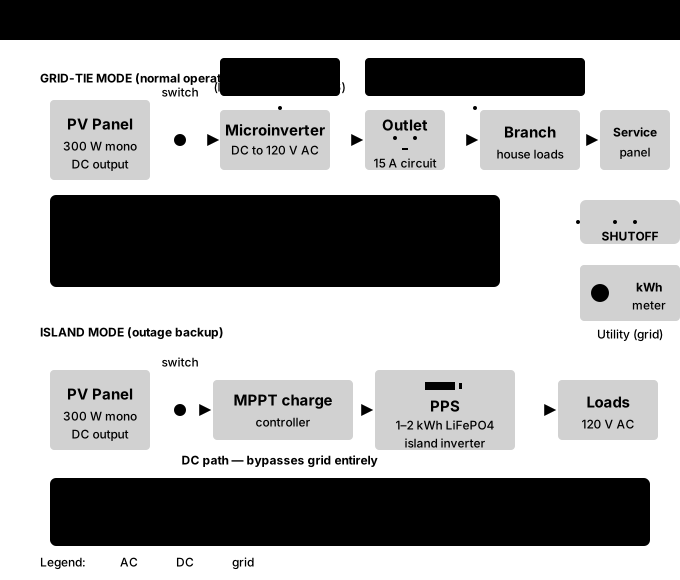
This is the most important operational misunderstanding in the balcony solar category: a plug-in grid-tie system provides zero outage protection.
When the utility grid goes down, anti-islanding protection — required by UL 3700, NEC 705, and IEEE 1547 — shuts the microinverter down within milliseconds. This is intentional and non-negotiable: the alternative is energizing lines that utility workers expect to be dead, which kills people. There is no way around this with a grid-tie system.
If your goal is resilience during a power outage, your path is different:
- Portable power station (PPS) as your storage layer — see portable power stations for sizing guidance.
- Off-grid-capable solar panels connected to the PPS — panels with a compatible MPPT input plug directly into the PPS and charge it without touching the grid. This is a separate, parallel setup from a plug-in grid-tie system.
- The plug-in grid-tie system reduces your utility bill in normal times; the PPS covers you during outages. These are complementary, not competing.
The EcoFlow STREAM Ultra, one of the US-market plug-in systems in development, includes a built-in 1.92 kWh LiFePO4 battery and a hybrid inverter that can switch between grid-tie and island modes — this is the architecture that resolves the outage gap. When UL 3700-certified hybrid systems become commercially available, they will provide both bill reduction and outage backup from a single device. Until then, the two-device approach is the practical path.
Inverter types in plug-in systems
Most plug-in balcony kits on the US market (when they arrive) use one of two architectures:
Integrated microinverter. The inverter is mounted directly to the back of the panel as a factory unit. The panel output comes out as 120V AC. These are the simplest systems: one AC cable from panel to outlet. They are also the dominant architecture for UL 3700 certification because the safety features are designed into the panel-inverter unit as a whole system.
Panel + separate microinverter. Some systems connect panels to a standalone box via DC cables, then output AC. These are more flexible (you can mix panel brands) but require careful verification that the inverter meets US safety requirements. Never connect a European microinverter — including EU-certified Hoymiles, APSystems EU, or similar models — to a US household circuit without verifying US-specific UL listing.
For deeper coverage of inverter types, waveform quality, and sizing for off-grid applications, see inverters.
Practical setup checklist
Before purchasing any equipment:
- Confirm your state has passed explicit plug-in solar legislation, or accept that you are in the gray zone
- Verify the specific product you are considering has completed UL 3700 certification (as of April 2026, none have — verify before buying)
- Confirm Anker SOLIX balcony products are EU-only and not UL-listed for US use — do not purchase for US grid-tie
- Check your lease for "exterior modification" clauses; get written landlord approval
- Identify which circuit you will backfeed; confirm it is a 15A or 20A breaker with no AFCI/GFCI incompatibility with the planned inverter
- Contact your utility's distributed generation department if you are in Utah, Virginia (after Jan 2027), or Maine (after July 2026)
- Verify railing load capacity with your property manager before mounting more than one panel
- Notify your renters' insurance carrier in writing
- Inspect railing clamps and torque specifications; bring panels indoors before significant wind events
For installation:
- Mount panels at 20° tilt for summer optimization; consider a steeper-tilt bracket for winter improvement
- Run the AC output cable through a dedicated outlet — do not daisy-chain extension cords
- Confirm the outlet is on a correctly rated circuit (not a GFI-tripped bathroom circuit)
- Verify inverter is producing power using the system's monitoring app or a clamp meter on the circuit
- Review your utility bill over the first 30–60 days to confirm offset is registering
The realistic case for balcony solar in 2026
A renter in Utah or Maine installing a 300 W kit (once UL 3700-certified products arrive) in a south-facing apartment can expect to offset 10–20% of their electricity bill during summer. The system is removable, requires no structural modification, and costs a moderate investment compared to the solar alternative (a rooftop system they cannot install). The annual production — roughly 260–335 kWh in a mid-US location — reduces grid dependency in a meaningful if not dramatic way.
The case is more complicated in other states. Gray-zone installs carry real compliance risk and no clear utility recourse if disputes arise. The responsible approach for readers outside Utah, Virginia, and Maine is to monitor state legislation and wait for both an explicit state law and a UL 3700-certified product before proceeding.
Understanding what this system does not do — it provides zero outage backup — is as important as understanding what it does. Pair the grid-tie panel with a portable power station for resilience, and read solar basics to understand panel sizing, peak sun hours, and production math before committing to a specific system size.