Fish farming and aquaculture
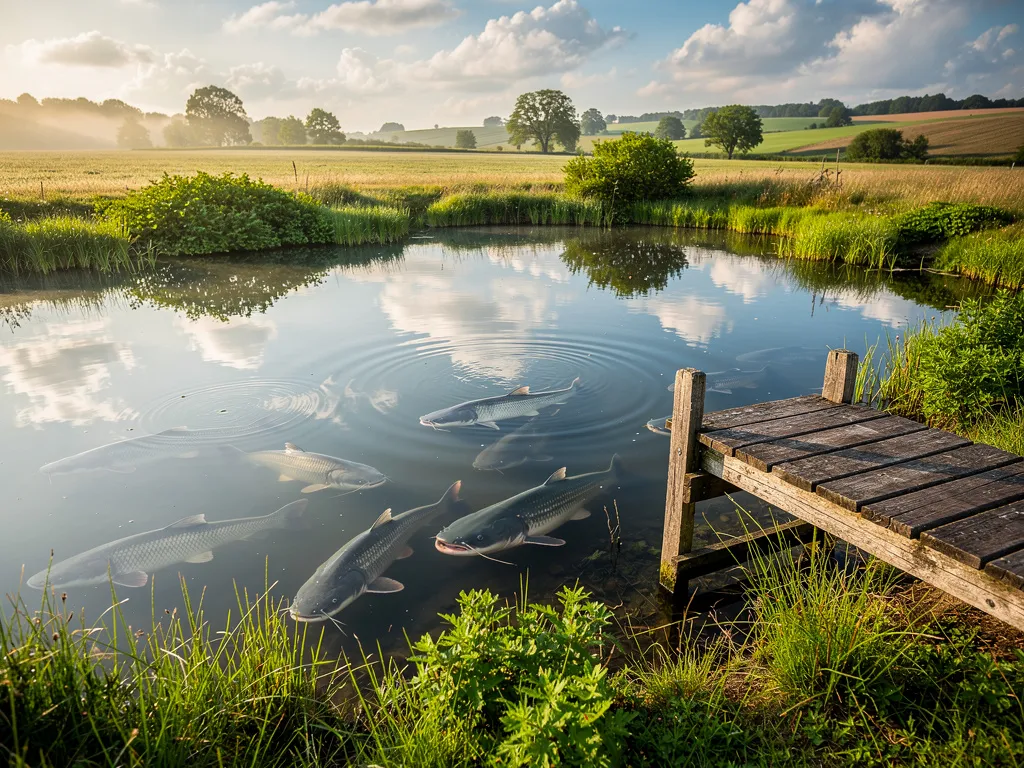
A well-managed half-acre (0.2 ha) pond stocked with channel catfish can produce 500 lbs (227 kg) of fish per year — enough to supply a family of four with a significant protein source that requires no hunting license, no foraging, and minimal daily labor once the system is established. Aquaculture integrates cleanly with existing garden and livestock operations: fish waste fertilizes plants, kitchen scraps supplement feed, and the water itself serves as a thermal buffer and drought reserve. For homesteads without pond space, aquaponics scales the same biology down to a backyard tank-and-grow-bed system that produces both fish and vegetables in 50–300 gallons (190–1,135 L) of water.
For wild-catch fishing techniques and gear, see fishing for food. For integrating fish production with garden systems and perennial yields, see permaculture and food forest design.
Before you start Skills needed: water-quality testing basics (dissolved oxygen, pH, ammonia); aerator and pump maintenance; species selection matched to your climate zone (see species table below). Materials: liner-pond or earthen-pond site of at least 100 sq ft (9 m²); air pump or paddlewheel aerator sized for stocking load (1–2 W per fish is a practical minimum for warm-water species); water test kit covering dissolved oxygen (DO), ammonia (NH₃), pH, and nitrite; fish stock sourced from a regional hatchery or licensed aquaculture supplier. Conditions: site has a reliable water source (well, spring, or rainwater catchment); soil holds water with at least 20% clay content, OR a pond liner is installed; partial shade is preferred to limit summer heat stress on warm-water species. Time commitment: Site prep and pond construction: 1–3 days for a 100–500 sq ft (9–46 m²) lined pond. Daily maintenance: 5–15 minutes for feeding and visual fish health observation. Weekly water-quality check: 15–30 minutes. Note: dissolved oxygen should not drop below 4 mg/L for fish survival; target 5–9 mg/L for optimal growth (USDA NRCS aquaculture guidelines). For integrating fish production with garden systems, see permaculture.
Pond construction and sizing
Minimum viable pond
The practical minimum for a production-oriented pond is a half-acre (0.2 ha) of surface area with a deepest zone of at least 6–8 feet (1.8–2.4 m). Shallower ponds overheat in summer, develop excessive aquatic vegetation, and cannot support a healthy standing crop of fish through temperature extremes. A quarter-acre (0.1 ha) pond can work with single-species stocking (channel catfish only) and supplemental feeding, but it demands closer water quality monitoring.
Site selection criteria:
- Watershed area: For a pond fed by surface runoff, you need 5–10 acres (2–4 ha) of drainage area per surface acre of pond to maintain water level through dry summers. Poorly sited ponds go partially dry by August.
- Soil: Clay soil (at least 20% clay content) is essential. Sandy soils leak. Cut a test pit 3–4 feet (0.9–1.2 m) deep — if the soil crumbles dry and drains immediately, a pond liner or extensive bentonite clay treatment is required.
- Sun exposure: Full sun promotes algae growth, which supports zooplankton and the base of the food chain. Ponds shaded heavily by trees grow slowly and accumulate leaves that decompose and deplete oxygen.
- Spillway: Design the emergency spillway before excavating. A pond that overtops an unprotected dam during heavy rain will lose the dam entirely.
Excavation and depth profile
Grade the pond floor with a gradual slope from the shallow end (2–3 feet (0.6–0.9 m)) to the deep zone (8–12 feet (2.4–3.7 m)). The shallow littoral zone supports aquatic vegetation that fish use for spawning cover. The deep zone is the thermal refuge where fish retreat during heat or cold stress.
A drain pipe through the dam — a monk drain or siphon outlet — is worth the installation cost. It lets you partially drain for selective harvest and completely empty the pond every several years to break disease and parasite cycles. Without a drain, complete harvest requires seine nets and much more labor.
Permits before you dig
Most jurisdictions require permits for pond construction that affects natural drainage or wetlands. Contact your county conservation district or state environmental agency before excavating. Violations can require costly pond removal.
Small-scale containers and tanks
Where ground construction is impractical, Intermediate Bulk Container (IBC) totes (275–330 gallons (1,040–1,250 L)), stock tanks, or purpose-built aquaculture tanks serve as production units. These systems require mechanical aeration — the water volume is too small for natural oxygenation to work — and more frequent water exchanges to control ammonia buildup. A single 300-gallon (1,135 L) tank can produce 50–60 lbs (23–27 kg) of catfish or tilapia per year with daily management.
Species selection by climate
Species choice is the single most important production decision. Stocking a warm-water fish in cold water — or a cold-water fish in summer heat — produces slow growth, disease problems, and mortality.
Tilapia (warm climates — Zones 8–10)
Nile tilapia (Oreochromis niloticus) is the default warm-climate aquaculture fish worldwide for good reasons: it tolerates poor water quality better than almost any other species, grows rapidly, and accepts a wide variety of feeds including duckweed, kitchen scraps, and commercial pellets. In a warm-water pond maintained at 77–86°F (25–30°C), tilapia fingerlings (juvenile fish, typically 2–4 inches (5–10 cm)) reach harvest weight of 1–1.5 lbs (450–680 g) in 6–9 months.
The critical limitation is cold sensitivity. Tilapia show stress below 60°F (15°C) and begin dying below 50°F (10°C). In Zones 7 and colder, outdoor pond tilapia require annual restocking — they will not overwinter without heated water. Many northern homesteaders raise tilapia in greenhouse tanks or treat them as a warm-season annual crop.
Pond stocking rate: For unfed extensive culture, 300–500 fingerlings per acre (740–1,235 per hectare) is the practical ceiling limited by natural pond productivity. With supplemental feeding and aeration, monosex male ponds routinely support 3,000–5,000 fingerlings per acre (7,400–12,350 per hectare) and yield 2–4 tons per acre per season. Start at the lower end and scale up once you have water quality monitoring in place. Tilapia reproduce prolifically — if you stock both sexes in a pond, the population will overshoot the carrying capacity within two seasons, producing stunted fish. Stock only one sex (all-male fingerlings are available from most aquaculture suppliers), or separate by sex before introducing them to the pond.
Channel catfish (temperate climates — Zones 5–9)
Channel catfish (Ictalurus punctatus) is the standard production species for temperate North America. It overwinters under ice, tolerates water temperatures from 40–95°F (4–35°C), and accepts commercial pellet feed with excellent feed conversion — roughly 1.5–2 lbs (0.68–0.91 kg) of feed per pound of weight gained.
Without supplemental feeding, a channel catfish pond supports 100–150 fingerlings per acre (250–370 per hectare) on natural productivity alone. With an automatic or demand feeder supplying high-protein pellets (32–36% protein), that ceiling rises to 500 per acre (1,235 per hectare). A well-fed catfish pond can produce 500–1,000 lbs (227–454 kg) of fish per acre per year.
Catfish reach harvestable size (1–1.5 lbs (450–680 g)) in 12–18 months at stocking densities typical for pond culture. In tank systems with aeration and filtration, they can reach market weight in 8–10 months.
Rainbow trout (cold climates — Zones 3–7)
Rainbow trout (Oncorhynchus mykiss) require consistently cold, well-oxygenated water. Optimal growth happens between 54–61°F (12–16°C). Above 68°F (20°C), growth slows significantly; above 75°F (24°C), mortality risk increases sharply. This makes rainbow trout ideal for properties with a spring-fed pond, a stream-fed system, or locations where summer water temperatures stay reliably cool.
Rainbow trout grow about 1 inch (2.5 cm) per month under ideal conditions and reach harvest size of 12–16 inches (30–41 cm) and 0.75–1.5 lbs (340–680 g) in 12–18 months. They require dissolved oxygen above 7 mg/L — higher than warm-water species — and are sensitive to ammonia and pH swings that catfish or tilapia would tolerate.
Brook trout (Salvelinus fontinalis) are more cold-sensitive in the other direction: they require water below 65°F (18°C) and are better suited to spring-fed headwater streams. Brown trout tolerate slightly warmer water (up to 72°F or 22°C) and are more resistant to disease pressure than rainbows.
Yellow perch and bluegill (multipurpose ponds)
Yellow perch (Perca flavescens) and bluegill (Lepomis macrochirus) are native to most of North America and thrive across a wide temperature range. They reproduce naturally in ponds, making them low-maintenance production species that self-sustain once established. A bluegill-largemouth bass combination is the classic farm pond system: bluegill reproduce rapidly and serve as forage; bass control bluegill numbers and provide a high-quality eating fish.
For a production-focused pond without bass, stock bluegill at 500–1,000 per acre (1,235–2,470 per hectare). They reach a harvest size of 6–8 inches (15–20 cm) in 2–3 years on natural forage supplemented with a feeder. Yellow perch are slower-growing but highly prized for eating; stock at 200–400 per acre (495–990 per hectare).
| Species | Optimal temp range | Time to harvest | Best climate |
|---|---|---|---|
| Tilapia | 77–86°F (25–30°C) | 6–9 months | Zones 8–10 (no overwinter; lethal below 50°F or 10°C) |
| Channel catfish | 70–85°F (21–29°C) | 12–18 months | Zones 5–9 (overwinters well) |
| Rainbow trout | 54–61°F (12–16°C) | 12–18 months | Zones 3–7 (cold hardy; overwinters well) |
| Bluegill | 65–80°F (18–27°C) | 24–36 months | Zones 4–9 (overwinters well) |
| Yellow perch | 65–75°F (18–24°C) | 24–36 months | Zones 3–8 (overwinters well) |
Field note
For beginners in temperate North America (Zones 5–9), channel catfish is the strongest starting species. It overwinters under ice, tolerates a wide temperature range, converts commercial feed efficiently (1.5–2 lbs of feed per pound gained), and reaches harvestable size in 12–18 months with minimal intervention. Start with catfish, learn your pond's behavior for a full year, then consider adding a second species.
Feed systems
Natural pond productivity
An unfed pond produces food for fish through its existing ecology: algae, zooplankton, aquatic insects, small invertebrates, and terrestrial inputs like leaves and insects that fall into the water. This natural productivity supports roughly 100–150 lbs (45–68 kg) of fish per surface acre (0.4 ha) per year. For a family operation, natural feeding alone is usually insufficient to produce meaningful yields without a very large pond.
Supplementing with on-farm inputs:
- Duckweed (Lemna spp.): This floating aquatic plant is 35–45% protein by dry weight and grows explosively in nutrient-rich water — a well-managed duckweed tank can produce 200–400 lbs (91–181 kg) of biomass per 1,000 sq ft (93 sq m) per year. Tilapia and catfish eat it readily. Harvest daily with a fine net and feed fresh.
- Black soldier fly larvae (BSFL): A pound (0.45 kg) of organic kitchen scraps fed to a BSFL bin produces roughly 0.15 lbs (68 g) of high-protein larvae (40–45% protein, 30% fat) in 10–14 days. This is one of the most feed-efficient organic waste conversion systems available and integrates naturally with both aquaculture and poultry.
- Worm castings and worms: Worm beds fed with kitchen waste and garden scraps produce both high-quality worms for fish feed and finished compost for the garden.
Field note
A duckweed trough running alongside a pond can offset 20–40% of supplemental feed costs while processing pond water overflow. Route your pond overflow or partial-drain water through a duckweed channel — the nutrient-rich water fertilizes the duckweed, and you harvest the duckweed back into the pond daily. It is a closed-loop that costs almost nothing to run once built.
Commercial pellet feeding
Commercial floating pellets (32–36% protein for catfish and tilapia; 40–45% protein for trout) are the most reliable way to hit production targets. Feed 3–5% of total fish biomass per day during warm months, dropping to 1–2% when water temperature falls below 60°F (15°C) — fish metabolism slows significantly in cold water and feed left uneaten decays and depletes oxygen.
A demand feeder — a float-triggered dispenser that releases a small quantity of pellets each time a fish bumps the trigger — minimizes waste and labor. Fish learn quickly to use them, and feed conversion efficiency improves compared to scheduled broadcast feeding because fish eat only what they want in the moment.
Aquaponics overview
Aquaponics is an alternative to pond culture for growers without enough land for a half-acre pond — it combines recirculating fish production with hydroponic plant production in a single closed-loop system. Fish waste (primarily ammonia from urine and gill excretion) is converted by nitrifying bacteria in the grow beds into nitrate — the primary nitrogen fertilizer plants require. Plants strip the nitrate-rich water clean before it returns to the fish tank. The result is a system that produces both fish protein and vegetables while using roughly 90% less water than equivalent soil-based production.
System sizing
The critical ratio is fish tank volume to grow bed volume. A conservative starting point:
- Fish tank: 250–500 gallons (946–1,893 L) for a meaningful production system
- Grow beds: equal volume to the fish tank (1:1 ratio is standard for beginners)
- Stocking density: beginners should not exceed 20 kg of fish per 1,000 L (about 0.17 lbs per gallon) until the system has cycled fully and the biofilter is established
- A 300-gallon (1,135 L) tank with 300 gallons of grow bed media can support 50–60 lbs (23–27 kg) of tilapia and grow approximately 75–90 heads of lettuce at any given time
The nitrogen cycle
A new aquaponics system cannot be stocked heavily until nitrifying bacteria have colonized the grow media — a process called cycling that takes 4–6 weeks. During this period, ammonia spikes to levels toxic to fish before the bacteria population grows large enough to process the waste. Cycle the system before adding fish by dosing with ammonia or running a small number of fish with daily water testing.
Best species for aquaponics
Tilapia is the most common choice because it tolerates the ammonia spikes and temperature variation inherent in smaller systems. Channel catfish work well in warmer climates. Trout work in systems where water can be kept consistently cold and highly aerated. Common carp (Cyprinus carpio) is widely used in warmer developing-world systems for its hardiness.
Plants that thrive in aquaponics: Leafy greens (lettuce, spinach, kale, Swiss chard) are the fastest producers and clearest success indicator. Herbs (basil, parsley, mint, chives) grow prolifically. Fruiting plants (tomatoes, peppers, cucumbers) require a more mature, fully-loaded system — they need more nutrients than young systems can supply.
Aquaponics and cold climates
Aquaponics systems in unheated spaces in Zones 5 and colder are essentially seasonal operations unless housed in a heated greenhouse. The bacteria that drive the nitrogen cycle slow dramatically below 55°F (13°C) and the system can crash if temperatures fall below 40°F (4°C). Plan your structure accordingly.
Water quality management
Water quality is the variable that kills fish operations more often than feed cost, predators, or market problems combined. The four parameters that require active monitoring in any fish production system are dissolved oxygen, ammonia/nitrite, pH, and temperature.
Dissolved oxygen
Fish require dissolved oxygen (DO) above 4 mg/L to survive; optimal growth happens between 5–9 mg/L. Cold water holds more oxygen than warm water (cold water carries roughly twice the dissolved oxygen of near-boiling water at the same atmospheric pressure), which is one reason trout require cooler conditions.
Signs of low dissolved oxygen:
- Fish gasping at the surface, particularly in early morning after a night when algae and aquatic plants have consumed oxygen rather than producing it
- Fish clustering near inflow pipes or waterfalls
- Dead fish (bottom of the pond) with no visible external injuries
Aeration options:
- Paddlewheel aerator: Most effective for ponds over a quarter-acre. Aerates a large surface area and distributes oxygenated water throughout the pond. Moderate investment per unit.
- Diffuser aerator: Air compressor pumping through porous stone or tubing on the pond bottom. Works well for smaller ponds and tank systems.
- Natural aeration: Inflow from a stream, fountain head, or waterfall is free and reliable where available. Design ponds to maximize inflow agitation.
Ammonia and nitrite
Ammonia (NH₃) above 0.5 mg/L is toxic to most fish. It is produced continuously as fish excrete waste and as uneaten feed decomposes. In a healthy system with established nitrifying bacteria, ammonia is converted to nitrite (NO₂) and then to nitrate (NO₃) within 24–48 hours. Nitrate at low concentrations is not harmful to fish; it becomes the nutrient that plants in an aquaponics system consume.
Problems occur in new systems that haven't cycled, after antibiotic treatment (which kills beneficial bacteria), or after overfeeding creates more waste than the biological system can process. Test ammonia and nitrite weekly during the first three months of a new system; monthly once it's established.
Corrective actions for ammonia spikes:
- Stop feeding immediately — feed is the primary ammonia source
- Increase water exchange (10–20% daily until levels drop)
- Increase aeration — oxygenated water promotes bacterial activity
- Reduce stocking density if the system is chronically overloaded
pH
Most freshwater aquaculture species perform best between pH 6.5 and 8.5. Trout are more sensitive and prefer 6.5–7.5. Tilapia tolerate pH up to 9.5 without issue. Aquaponics systems tend to drift acidic over time as nitrification produces nitric acid; buffer by adding calcium carbonate (crushed coral, limestone, or agricultural lime) to the grow beds.
Test pH monthly in ponds; weekly in recirculating systems.
Harvest rotation
Partial harvest strategy
The most productive approach for a continuously stocked pond is partial harvesting: remove only the largest fish (those that have reached target weight) every 4–6 weeks rather than draining and emptying the pond. This keeps the pond working at capacity year-round and provides a regular food supply rather than a single large harvest.
Use a seine net pulled across the pond, or a trap or hoop net baited with feed and checked daily. Partial harvest by hook and line also works for catfish and bass. Return undersized fish immediately — handling stress is minimized by working in cool early-morning temperatures.
Annual complete harvest cycle
Tilapia ponds in warm climates benefit from a complete drain-and-restock cycle every 12–24 months. Draining kills all remaining fish fry and eggs that would otherwise cause population overshoot and stunting in the next season. After draining, dry the pond bottom for 10–14 days — sunlight and desiccation kill pathogens and parasite eggs in the sediment. Refill and restock with a fresh cohort of fingerlings.
Catfish ponds in temperate climates can run for many years without complete drainage, but removing all fish and drying the pond every 4–5 years resets disease pressure and removes accumulated organic sediment from the bottom.
Processing and preservation
Fish must be kept alive until ready to process. A wire holding cage in the pond or a large cooler with an aerator keeps fish alive for several days between catching and processing. Once killed, cool them immediately — whole fish in an ice slurry keeps quality for 24–48 hours before filleting.
Fillets can be frozen, smoked, or salted. For volume preservation without refrigeration, smoking produces shelf-stable fish for 2–4 weeks; salting and curing extends that to months at room temperature. Fresh fish processed and frozen in vacuum bags will keep 6–12 months at 0°F (-18°C).
Failure modes
Winterkill in cold-climate ponds — Recognition: dead fish floating at spring thaw with no sign of disease, injury, or predation. The cause is dissolved-oxygen depletion under ice over winter: ice blocks atmospheric oxygen exchange, and decomposing organic matter and fish respiration consume the remaining DO until fish suffocate. Remedy: install a bottom diffuser aerator that runs continuously through winter at a minimum of 1–2 W per fish; maintain an ice-free opening using a stock-tank heater or aerator-induced turbulence; keep pond depth at least 6 ft (1.8 m) to allow thermal stratification that preserves a cold but oxygenated bottom layer; reduce stocking density in autumn so total oxygen demand is lower before ice forms.
Summer DO crash — Recognition: fish gasping at the surface in early morning, especially after warm cloudy weather; dead fish by mid-morning; species with higher oxygen requirements (trout, perch) affected first. Dissolved oxygen drops below the 4 mg/L survival threshold overnight when algae and aquatic plants switch from photosynthesis to respiration — consuming oxygen rather than producing it — and there is no atmospheric exchange to offset the loss. Remedy: run aerators from dusk through early morning in summer, not only during daylight; reduce feeding by 30–50% during extended heat or overcast periods to lower biological oxygen demand; size paddlewheel or air diffuser systems for peak summer load rather than average conditions; monitor DO with a hand-held meter before sunrise on warm, calm, cloudy days — these are the highest-risk conditions.
Ammonia spike post-feeding — Recognition: fish lethargic, hovering near the surface, gill flaring; ammonia test reads above 0.5 mg/L (the threshold for fish stress in most species). Ammonia spikes from excessive feeding, a biofilter that has not fully cycled, or antibiotic treatment that killed nitrifying bacteria. Remedy: stop feeding immediately — feed is the primary ammonia source. Perform a 25–50% water exchange with dechlorinated or aged source water; increase aeration to promote bacterial activity; reduce stocking density if the system is chronically overloaded. In aquaponics systems, do not resume feeding until ammonia returns below 0.25 mg/L and nitrite also clears.
Predation breach — Recognition: sudden fish inventory drop with no dead bodies at the surface; heron tracks, raccoon scat, or otter slides at the pond edge; fish gone from shallow margins first. Great blue herons are the primary daytime predator; raccoons and otters take fish at night and early morning. Remedy: install bird netting positioned 3–4 ft (0.9–1.2 m) above the water surface on a frame so herons cannot wade under it; run a single strand of electric fence at approximately 6 in (15 cm) above ground level around the pond perimeter for raccoon and otter deterrence; include deep zones of at least 4 ft (1.2 m) where fish can retreat from wading predators; remove dense emergent vegetation at the immediate pond edge where herons stage before striking.
pH drift in aquaponics systems — Recognition: gradual pH rise toward 8.0 or above over weeks; plants showing iron or manganese deficiency symptoms (interveinal chlorosis, yellow leaves with green veins); fish showing increased mucus production or mild behavioral stress at extreme pH. In aquaponics, pH naturally drifts alkaline as fish waste alkalinity accumulates and nitrification-produced nitric acid is offset by plant uptake of anions. Remedy: add small daily doses of dilute phosphoric acid or food-grade vinegar to the system sump, targeting 6.5–7.0 as the management range — a compromise between optimal plant nutrient uptake (best below 7.0) and fish health (best above 6.5). Test pH a minimum of two to three times per week; do not attempt large single-dose corrections, which stress both fish and nitrifying bacteria.
Aquaculture setup checklist
- Site assessed for soil clay content, watershed area, and drainage (no building permits skipped)
- Pond size determined: minimum half-acre (0.2 ha) for multi-species production
- Drain pipe or monk drain designed into the dam before excavation
- Species selected for local climate zone — no tropical species without winter plan
- Fingerling source identified: local hatchery, state fish commission stocking program, or licensed aquaculture supplier
- Supplemental aeration installed: paddlewheel, diffuser, or waterfall at minimum
- Demand feeder or scheduled feeding routine established before stocking
- Water quality test kit on hand: dissolved oxygen, ammonia, pH — tested before first stock
- Partial harvest equipment ready: seine net, hoop net, or trap and a live holding system
- Preservation path confirmed: freezer capacity, smoking setup, or canning capability before peak harvest
- Predator deterrence plan in place: herons, otters, osprey, and raccoons will find your pond
With a fish production system running, the next logical layer is integrating it into the broader food system. Livestock systems covers how animal waste — including fish pond water — cycles back into pasture and garden fertility, and caloric planning provides the math for determining how aquaculture production fits into your household's total food supply. For combining fish production with vegetable growing in a single system, the permaculture page covers the design principles that make integrated systems more productive than the sum of their parts.