Energy
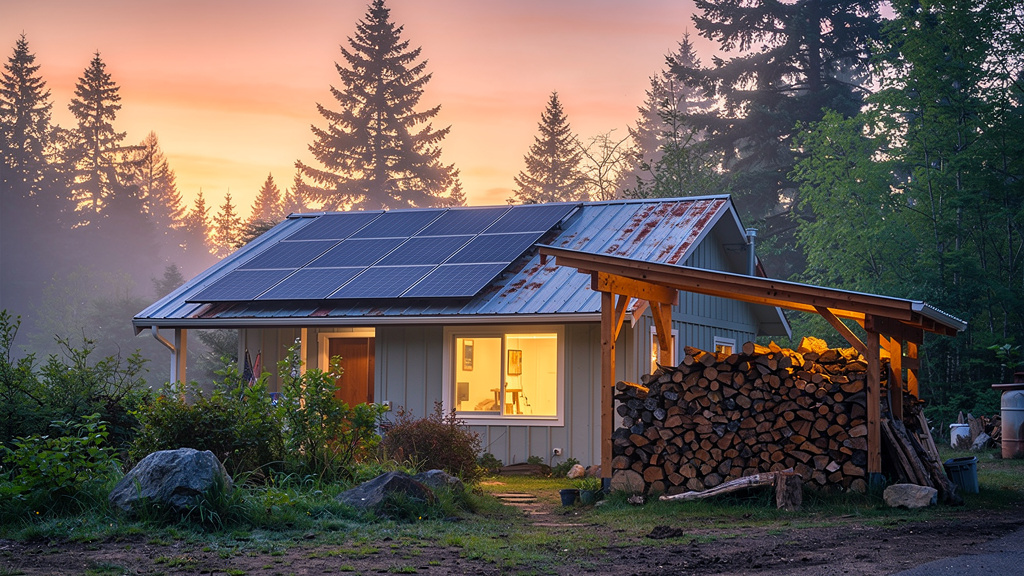
Electricity runs your refrigerator, your well pump, your furnace blower, your phone, and your medical devices. When the grid drops, all of them stop simultaneously. Per US Energy Information Administration (EIA) reliability data, US households averaged 5.6 hours of power interruption in 2022 — but during hurricane, winter storm, and wildfire events, outages routinely stretch to 3–14 days. Your energy plan has three layers: survive the outage (portable backup, lights, phone, critical loads), sustain critical loads (refrigeration, medical devices, well pump for days to weeks), and achieve independence from the utility entirely (off-grid solar / wind / hydro paired with battery storage).
→ Read First 30 Days (energy chapter, 15 min) Solar · Batteries · Generators
When to seek professional help — electrical and combustion thresholds
Energy systems carry life-safety risk that exceeds most other Foundations. These conditions require immediate professional response — fire department, electrician, or 911:
- Carbon monoxide alarm activation with any symptoms (headache, dizziness, nausea, confusion) — evacuate to fresh air, call 911. Per CDC, more people die from generator CO poisoning during winter storms than from the cold. Generators must run outdoors only, minimum 20 ft (6 m) from any window/door/vent per CPSC.
- Smell of natural gas or propane indoors — do not switch any electrical device on or off, evacuate, call gas utility from outside per OSHA combustion-safety guidance.
- Electrical fire behind a wall, in a panel, or from a battery bank — kill the main breaker if safe to do so within 10 seconds, then evacuate and call 911. Lithium battery fires (NMC chemistry especially) cannot be extinguished with water and may reignite hours later.
- Burns from solar wiring or battery work — DC arc faults at MC4 connectors and DC arc flashes from short-circuited battery terminals cause severe burns; seek emergency care per ACEP burn-triage thresholds (>10% BSA adult, >5% child, OR any burn to face/airway/hands).
- Chest pain or shock from electrical contact — even after the contact has ended, internal cardiac effects may develop hours later; call 911 immediately per AHA electrical-injury guidance.
Installation requires permits and licensed electricians in most US jurisdictions. Off-grid solar / battery / inverter work above 48 V DC nominal is regulated by NEC Articles 690 (PV systems), 705 (interconnection), and 706 (ESS / battery systems). Educational content here assumes you are designing systems that will pass AHJ inspection — not bypassing permitting.
Where to start
Three audience-segmented entry paths matching the most common starting positions:
If you're brand-new (apartment / suburban, want 72-hour outage coverage):
- Inventory your critical loads — fridge, phone, internet, CPAP if relevant, 2–3 LED lights, well pump if applicable. Sum the watt-hours per day.
- Acquire a portable power station rated 500–2,000 Wh (moderate investment) paired with a folding 100–200 W solar panel for daytime recharge per FEMA Ready.gov emergency power guidance.
- Buy a battery-backed CO alarm rated to UL 2034 if you don't have one already. Generator CO kills more people than the events that cause the outage.
If you have basics covered (own home, want 1–2 week outage coverage + cost savings):
- Run an efficiency audit — phantom loads, LED upgrades, insulation gap fixes typically cut electrical load 20–40% before any backup investment.
- Decide between generator backup (lower upfront, ongoing fuel) and battery + solar (higher upfront, no fuel). The math becomes straightforward once daily watt-hours are known.
- If gridtied, evaluate a home battery system (Tesla Powerwall 3, Enphase IQ Battery, FranklinWH aPower S) per NEC 706 and your utility's interconnection requirements.
If you're building full independence (rural property, want grid-optional or off-grid):
- Map total annual energy demand by month — load-shedding priorities for winter deficit months are structural per seasonal budgeting.
- Design the full system: panel array + battery bank + inverter / charger + critical-load subpanel per whole-home off-grid. Pull permits before installing.
- Cross-Foundation: route to Water for well-pump backup planning, Food for refrigeration cold-chain math, and Medical for medication-cold-chain and CPAP/oxygen continuity.
Field note
Label every breaker in your electrical panel with what it actually controls — not "bedroom 2" but "bedroom 2 outlets + hallway smoke detector." During an outage, knowing which breakers to kill reduces phantom load and extends generator or battery runtime significantly. A $5 label maker and 30 minutes of testing saves dozens of kilowatt-hours over a multi-day outage.
What this hub covers — and what it doesn't
This page routes to Survipedia energy content spanning short-term outage backup through full off-grid independence. It covers:
- Demand reduction — efficiency, insulation, passive solar
- Generation — solar (panels, DIY, off-grid), wind, micro-hydro, biogas, generators
- Storage and distribution — batteries (LiFePO4 / NMC / AGM / lead-acid), inverters, portable power stations, home battery systems, balcony solar (for renters)
- Thermal energy — wood heat, firewood, rocket stoves
- Logistics — fuel storage, manual power, woodlot management
- Whole-system design — load auditing, autonomy sizing, seasonal budgeting
It deliberately does not cover: grid-scale utility engineering, commercial PV installation (PE-stamped designs for >25 kW), nuclear or geothermal generation, EV charging infrastructure beyond home Level 2, code-bypass DIY guidance (NEC compliance is non-negotiable for permanent installations).
Start here: reduce demand first
The most affordable kilowatt-hour is the one you never use. Before sizing any generation system, cut what you consume.
- Energy efficiency — phantom loads, LED upgrades, audit process that turns daily watt-hours into an actionable target; Kill-A-Watt meter $20–30 finds 80% of the savings in a Saturday afternoon
- Insulation and heating — R-value targets by climate zone per IRC 2024 Table N1102.1.2, air-sealing materials, attic ventilation 1:150 minimum per IRC R806; reducing heating load is the single highest-leverage intervention in cold climates
- Passive solar design — south glazing ratios, thermal mass sizing, overhang geometry that harvests the sun without panels or wiring; works in any climate with unobstructed south exposure
Generate power
- Solar basics — panel types, STC ratings, peak sun hours per NREL PVWatts; the foundation before buying anything
- DIY solar — full installation sequence: load calculation, wiring, NEC 690 compliance, combiner boxes; criticality:high page with electrical-sme accuracy gate
- Off-grid solar — whole-system architecture, autonomy sizing, realistic cost ranges
- Wind — site assessment per AWEA siting guidance, tower height tradeoffs, turbine sizing for exposed locations
- Micro-hydro — head-vs-flow site survey, NREL primer recommends ≥3 ft (0.9 m) head + ≥10 gpm (38 L/min); produces 24-hr power regardless of weather
- Biogas — anaerobic digestion at 68–104°F (20–40°C) mesophilic optimum, digester designs, H2S safety; check state air-quality + local zoning
- Generators — sizing, transfer switches per NEC 702, maintenance, CO safety per CPSC
Generator exhaust kills
Carbon monoxide from generators is odorless and lethal at 800 ppm within 2–3 hours per CDC . Never run a generator indoors, in a garage, or within 20 feet (6 m) of any window, door, or vent. More people die from generator CO poisoning during winter storms than from the cold itself per CPSC reports. Install battery-backed CO alarms rated UL 2034 on every floor — and replace the alarm itself every 5–7 years (the sensor degrades regardless of battery).
Store and distribute
- Batteries — four main chemistries (LiFePO4, NMC, AGM, flooded lead-acid); sizing method from load audit through depth-of-discharge per NEC 690.8(B) to final amp-hour spec
- Inverters — pure sine vs. modified sine tradeoffs, sizing for surge loads, wiring safety per NEC 705.12; criticality:high page with electrical-sme accuracy gate
- Portable power stations — capacity classes and use cases for apartment dwellers and short-term outages
- Home battery systems — whole-home storage sizing per NEC 706.5 (ESS listing requirement), UL 9540 certification, installation, available tax credits
- Balcony solar — 200–400 W plug-in kits for renters; 2026 UL 3700 standard, US state-by-state legality (Utah, Virginia, Maine only as of April 2026), critical caveat that EU-only kits like Anker SOLIX are not UL-certified for North American grid-tie
Thermal energy
Heat is often the most critical energy need and the easiest to decarbonize. In cold climates, the heating system is the single largest electrical / fuel load — a wood stove or rocket mass heater can carry the entire winter heating load with zero electrical input.
- Wood heat — stove types, clearances per NFPA 211 Chapter 9, creosote prevention; CSIA Level 2 inspection required after any chimney fire per NFPA 211 Chapter 15
- Firewood — BTU output by species, cord sizing, seasoning timelines (6–24 months target <20% moisture), covered storage geometry
- Rocket stoves — combustion geometry that makes them fuel-efficient; rocket mass heater extension stores heat in a thermal bench for 24–48 hr release
Logistics
- Fuel storage — shelf life for gasoline (3–6 months with stabilizer per Briggs & Stratton guidance), diesel (12 months with biocide additive), propane (indefinite); container choices, safe rotation
- Manual power — human power output benchmarks (60–80 RPM pedal cadence = 75–100 Wh per 45–60 min session), bicycle generator builds, hand pumps for when no fuel is available
- Woodlot management — cords-per-year calculations, species BTU values, coppicing rotations, sustainable harvest planning per state forestry extension data
Whole-system design
- Whole-home off-grid design — integrated workflow: load auditing → panel array sizing per NREL PVWatts → battery bank calculations per NEC 690.8(B) → inverter selection → hybrid configurations
- Seasonal energy budgeting — solar production in January may be a third of July output; load-shedding priorities, generator run-time budgets, monthly audit templates keep you solvent through deficit months
Common questions
What's the most affordable reliable starting point? A portable power station (500–1,500 Wh, $400–$1,500 USD range) paired with a folding 100 W solar panel covers most apartment + suburban critical loads for 12–48 hours. This is the entry point FEMA Ready.gov recommends. Scale up from there.
Can I install solar myself? In most US jurisdictions, yes for off-grid systems (no utility interconnection); usually no for grid-tied systems (utility approval required). All installations must pass AHJ electrical permit inspection per NEC 690 (PV), 705 (interconnect), 706 (ESS). DIY off-grid is realistic if you're competent with DC electrical work; grid-tied DIY is realistic only in states with explicit DIY pathways (Utah, Vermont, others). See DIY solar.
Is balcony solar legal in my state? As of April 2026, only Utah (HB 340, May 2025), Virginia (HB 395 / SB 250, effective January 2027), and Maine (LD 1730, effective July 2026) have explicit plug-in solar laws — up to 1,200 W per state. All other US states are gray-zone (not explicitly illegal, no enforcement framework, utility may not honor grid-tie). See balcony solar for detail.
How big a battery do I really need? Sum your critical daily watt-hours (refrigerator 1,200 Wh/day + LED lights 200 Wh/day + phone/laptop 200 Wh/day + well pump 500 Wh/day = ~2,100 Wh/day baseline). Multiply by target autonomy days (3 for outage backup, 5–7 for serious winter coverage). Divide by usable depth of discharge (LiFePO4: 80–90%; AGM: 50%). Result: 7 kWh – 30 kWh depending on use case. See whole-home off-grid for the full calculation.
Your single next step: complete the First 30 Days energy chapter — it sequences critical-load inventory, portable backup acquisition, and breaker labeling into a 30-day plan that builds on this hub's three-layer framework.