Emergency food storage
Emergency food storage is the practice of keeping a managed supply of shelf-stable food your household can live on when normal grocery access is disrupted. FEMA now recommends a minimum two-week supply — up from the old 72-hour guidance — and experienced emergency managers push that target to 30–90 days for genuine resilience. A disruption does not need to be dramatic to make grocery stores inaccessible: ice storms, trucking strikes, extended illness, or a job loss all do it just as effectively as a major disaster.
The core principle is simple: buy more of what you already eat, store it properly, and rotate it before it expires. A household that does this consistently builds real security without exotic food, unusual equipment, or a single large purchase.
How much food to store
The baseline caloric requirement for planning purposes is 2,000 kcal per adult per day. That number rises for anyone doing heavy physical labor, and drops modestly for children — a useful reference by age:
| Person | Daily calorie target |
|---|---|
| Adult (sedentary to moderate) | 2,000–2,500 kcal |
| Adult (heavy labor) | 2,500–3,200 kcal |
| Child age 6–12 | 1,400–1,800 kcal |
| Child under 6 | 1,000–1,400 kcal |
Use 2,000 kcal per person per day as your planning number and you will be conservative in the right direction.
From there, depth targets work in three tiers:
72-hour minimum — The bare floor. Three days of food handles most localized emergencies (power outages, severe weather, short-term evacuations). This is the point of entry, not the destination.
2-week target — Covers most regional disruptions: supply chain slowdowns, storm damage, local infrastructure failure. Most preparedness professionals treat this as the realistic practical minimum for a family.
3-month goal — The point at which you are genuinely insulated from most supply disruptions. The Church of Jesus Christ of Latter-day Saints operates one of the most developed family preparedness programs in the United States and recommends a 3-month supply of familiar foods as the practical target, with a 1-year supply as the long-term goal — a benchmark that emergency managers and experienced preparedness communities broadly agree with.
Quick calculation: Multiply the number of people in your household by 2,000 calories by the number of days. A family of four targeting 90 days needs 720,000 calories from their stored supply. One 33-pound (15 kg) bucket of white rice provides roughly 54,000 calories — that family needs about 13 such buckets for the grain portion of their diet alone. Run your own numbers before buying.
Caloric math is easy to underestimate
Many packaged "emergency food" kits advertise a 3-month supply but deliver far fewer than 2,000 calories per day. Always verify calories per day per person against the actual label, not the marketing headline. A 2,000-calorie claim based on three servings of 667 kcal each tells you nothing if you can't confirm what those servings weigh.
The rotation system
The single most important discipline in food storage is FIFO — First In, First Out. Older food is always consumed before newer food. Newer food is always stored behind older food. This is not complicated, but it requires consistent physical discipline.
The associated principle: store what you eat, eat what you store. A pantry full of foods your household never cooks is a pantry that will expire untouched. The most common first-time storage mistake is buying 50 pounds (23 kg) of wheat berries and a grain mill because of shelf life numbers, then never touching either because nobody in the household knows how to bake bread from raw grain.
How to implement FIFO in practice:
- Assign a dedicated storage zone — one shelf or section per food category (grains, canned goods, legumes, oils).
- Label every item at the time of purchase with the purchase date on the front-facing surface. A permanent marker on the can lid or bag top takes three seconds.
- When restocking, move existing inventory forward and place new purchases behind it.
- Set a quarterly audit date — once per season, pull everything forward, check dates, and use items approaching their best-by window in your regular cooking.
- Consume and replace continuously. The goal is a rolling supply, not a time capsule.
Field note
Tape a simple "oldest front / newest back" label to every shelf where you store food. The reminder takes 30 seconds to make and prevents the most common rotation failure: new cans piled in front of old ones because it was easier in the moment.
Shelf-stable foods by category
Grains
Grains are the caloric foundation of any long-term storage system. White rice is the most efficient: 1,640 kcal per pound (3,615 kcal/kg), indefinite shelf life when sealed correctly, and universal cooking familiarity. Rolled oats are next — 1,720 kcal per pound (3,790 kcal/kg) and edible without cooking if needed. Pasta stores 20–25 years in Mylar with oxygen absorbers and requires only boiling water. Hard wheat berries last 25–30 years but require a grain mill to use — factor that requirement into your plan before buying.
| Grain | Shelf life (bulk packaging) | Shelf life (Mylar + O2) |
|---|---|---|
| White rice | 2–5 years | 25–30 years |
| Rolled oats | 1–2 years | 10–15 years |
| Pasta (dry) | 2–3 years | 20–25 years |
| All-purpose flour | 1–2 years | 10 years |
| Hard wheat berries | 3–5 years | 25–30 years |
Legumes
Dried beans and lentils deliver protein and fiber at very low cost. Dried lentils are especially practical: they cook in 20–30 minutes without soaking, unlike most beans which require overnight soaking before a long simmer. Pinto, black, and kidney beans store 25–30 years in Mylar with oxygen absorbers, though texture and flavor degrade noticeably after the 10-year mark even when the food is still safe and nutritious.
At roughly 1,540–1,590 kcal per pound (3,395–3,505 kcal/kg), dried legumes pair with grains to form complete proteins — a critical consideration when animal protein sources become limited.
Freeze-dried and dehydrated options
Freeze-dried food retains up to 97% of its original nutrients and has a rated shelf life of 25 years. It requires only water to prepare, is lightweight, and offers far more variety than bulk staples — fruits, vegetables, cooked meats, and full meals are all available. The trade-off is cost: a 3-month supply of freeze-dried food per person represents a significant investment.
Dehydrated food is more affordable than freeze-dried and stores 5–15 years depending on product and packaging. Rehydration takes longer and requires more water. For pages covering these methods in depth, see dehydrating and freeze-dried food.
Freeze-dried and dehydrated items are best used to supplement bulk staples with variety and nutrition, not to replace them entirely.
Canned goods
Commercial canned goods are the easiest entry point into food storage — no special packaging required, no equipment, and most households already have some. High-acid foods (tomatoes, citrus, fruit) last 1–3 years at best quality. Low-acid foods (beans, corn, tuna, chicken, soups) last 3–5 years at rated best-by, and are commonly safe for 7–10 years beyond that if cans are undamaged, without swelling, and free of rust or dents on the seam.
Prioritize canned goods with nutritional and culinary versatility:
- Canned tomatoes (diced, crushed, paste) — base for dozens of meals
- Canned beans (black, pinto, garbanzo) — ready protein without soaking
- Canned fish (tuna, salmon, sardines) — complete protein, affordable per calorie
- Canned vegetables (corn, green beans, mixed) — micronutrient coverage
- Canned soups and stews — ready-to-eat with no fuel required
Field note
Sardines are one of the most underrated storage foods: roughly 190 kcal per can, high in omega-3 fatty acids and calcium, inexpensive, and ready to eat without cooking. A case of sardines stored with grains and beans covers protein and fat requirements efficiently.
Container systems
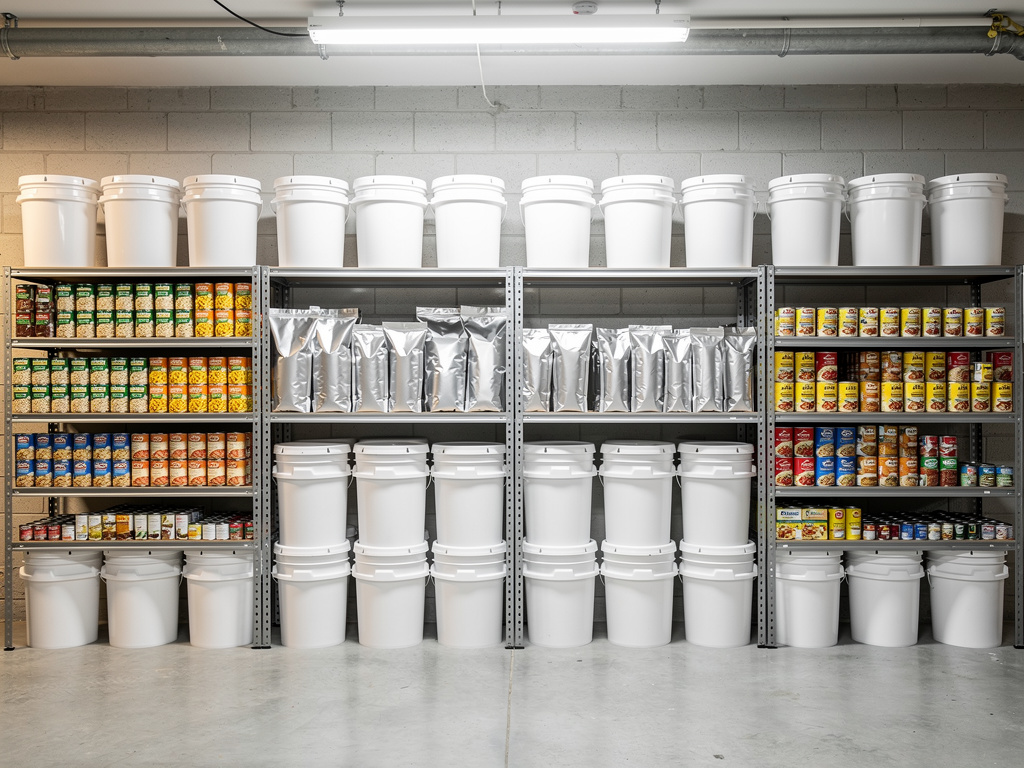
The container you choose determines shelf life. Three systems cover most storage scenarios:
Mylar bags + oxygen absorbers in food-grade buckets — The standard for long-term storage. Mylar is a multi-layer laminated foil that blocks oxygen, moisture, and light. Sealed with an iron or heat sealer and paired with a 2,000–2,500cc oxygen absorber, a 5-gallon (18.9 L) Mylar bag inside a food-grade bucket is the correct container for grains and legumes you want to store 10–30 years. See long-term storage for the complete step-by-step packing procedure.
Food-grade 5-gallon buckets alone (no Mylar) — Appropriate for the active pantry tier (1–5 years) with gamma-seal lids for easy access. HDPE plastic buckets marked with a food-safe symbol (#2 plastic) are the only acceptable type. Non-food-grade buckets will leach chemicals. Do not use buckets that previously held paint, cleaning chemicals, or pool supplies regardless of how thoroughly they appear to be cleaned.
Vacuum-sealed bags — Practical for 1–5 year storage of smaller quantities. Does not match Mylar for long-term oxygen elimination but extends shelf life significantly over open-air storage. Useful for dehydrated produce, coffee, and specialty items you cycle regularly.
Commercial #10 cans — The format used by most major long-term food storage brands (Mountain House, Augason Farms, LDS Home Storage). A #10 can holds approximately 13 cups (3 liters) — the industry-standard large can used in commercial food service and long-term storage. 6-serving to 12-serving capacity, nitrogen-flushed, rated 25–30 years. More expensive than DIY Mylar packing but consistent and reliable.
Non-food-grade plastic contaminates stored food
Only containers rated for food contact are acceptable for storage. HDPE (#2), PETE (#1), and PP (#5) plastics are food-safe. PVC (#3), PS (#6), and PC (#7) are not. If the bucket previously held a non-food product and is not explicitly marked food-grade, do not use it regardless of cost or convenience.
Storage environment
Proper packaging extends shelf life dramatically. Proper environment determines whether that extended shelf life is achieved in practice.
Temperature — The single most important variable. Aim for 60–70°F (15–21°C). Every 10°F (5.5°C) rise in temperature roughly doubles the rate of nutrient and quality degradation. Attics routinely reach 120–140°F (49–60°C) in summer — they destroy food storage. Unconditioned garages in hot climates are nearly as bad. An interior closet, basement, or interior room on the north side of a house is the correct location.
Humidity — Keep the storage space below 15% relative humidity. The Mylar bag provides its own moisture barrier, but chronic high humidity corrodes metal lids, degrades label adhesive, and compromises bucket integrity over years. A damp basement is acceptable for 5–10 year storage; for 25+ year storage, a drier environment is worth prioritizing.
Light — Store away from direct sunlight. Ultraviolet light degrades vitamins and accelerates lipid oxidation. Opaque buckets block light from their contents, but transparent containers require a dark location or covering.
Off the floor — Place buckets and canned goods on pallets or shelving at least 2 inches (5 cm) off concrete. Concrete wicks moisture. Elevated storage also allows visual inspection for pest entry at floor level.
Away from strong odors — HDPE plastic absorbs odors over years. Do not store food adjacent to fuel, paints, cleaning chemicals, or fertilizers.
Calculating your supply
Use this table to estimate the calories you need to store, then convert to pounds of food using the caloric density values above.
| Household | 72 hours | 2 weeks | 3 months |
|---|---|---|---|
| 1 adult | 6,000 kcal | 28,000 kcal | 180,000 kcal |
| 2 adults | 12,000 kcal | 56,000 kcal | 360,000 kcal |
| Family of 4 (2 adults + 2 children) | 21,750 kcal | 101,500 kcal | 652,500 kcal |
Children's estimate uses 1,625 kcal/day average (ages 6–12). Adjust upward for teenagers, pregnant or nursing adults, and anyone doing sustained physical labor.
Converting calories to weight example (white rice at 1,640 kcal/lb / 3,615 kcal/kg):
- 2 adults, 90 days, rice component (50% of calories): 180,000 kcal ÷ 1,640 = approximately 110 lbs (50 kg) of rice
- That fills roughly 3–4 standard 5-gallon (18.9 L) buckets
Replicate this calculation for each food category in your storage plan. A food inventory system makes ongoing tracking manageable.
Special considerations
Dietary restrictions — Celiac, nut allergies, lactose intolerance, and religious dietary requirements all need to be reflected in your storage plan. Do not assume you can "work around" a serious allergy during a stressful emergency. Stock alternatives from the start.
Infants — Formula and baby food require their own dedicated stock. Formula has a shelf life of roughly 12–18 months; rotate it actively. Breast-fed infants require that the nursing parent has adequate caloric intake — add at least 500 kcal/day to the nursing adult's total.
Pets — Animals are often overlooked in emergency food calculations. A medium-sized dog requires roughly 1,000–1,500 kcal/day depending on size and activity. Stock dry pet food alongside human food, applying the same FIFO rotation.
Medications — Some medications require refrigeration. If any household member depends on a refrigerated medication, cold-chain contingency planning needs to happen alongside food storage — not as an afterthought.
Comfort foods — Emergency conditions are psychologically demanding. A storage plan built exclusively on beans and rice sustains the body but damages morale. Stock chocolate, coffee, tea, hard candies, familiar sauces, and spice mixes alongside staples.
Field note
Reserve 5–10% of your storage budget for foods that make meals enjoyable, not just survivable. Morale degrades faster than most people expect under sustained stress, and familiar flavors are one of the cheapest ways to maintain it.
Emergency food storage checklist
- Calculate your household's total calorie target (people × 2,000 kcal × target days)
- Build a 72-hour supply first — enough to get to 2 weeks progressively
- Stock at least 10 lbs (4.5 kg) of white rice and 5 lbs (2.3 kg) of dried beans per person per month of target supply
- Label all items with purchase date at time of purchase (before they go on the shelf)
- Establish FIFO zones: one shelf or section per food category, oldest at front
- Store grains and legumes beyond 5 years in Mylar bags with oxygen absorbers inside food-grade buckets
- Verify storage location stays below 70°F (21°C) year-round
- Include at least a 2-week supply of canned proteins (tuna, beans, salmon)
- Account for infants, pets, dietary restrictions, and medications separately
- Set a quarterly audit calendar event to rotate, verify dates, and fill gaps
With quantities established and a rotation system running, the next step is mastering the preservation methods that let you add home-canned and home-preserved foods to your supply — extending variety and reducing long-term costs significantly.