Freeze-Dried Food
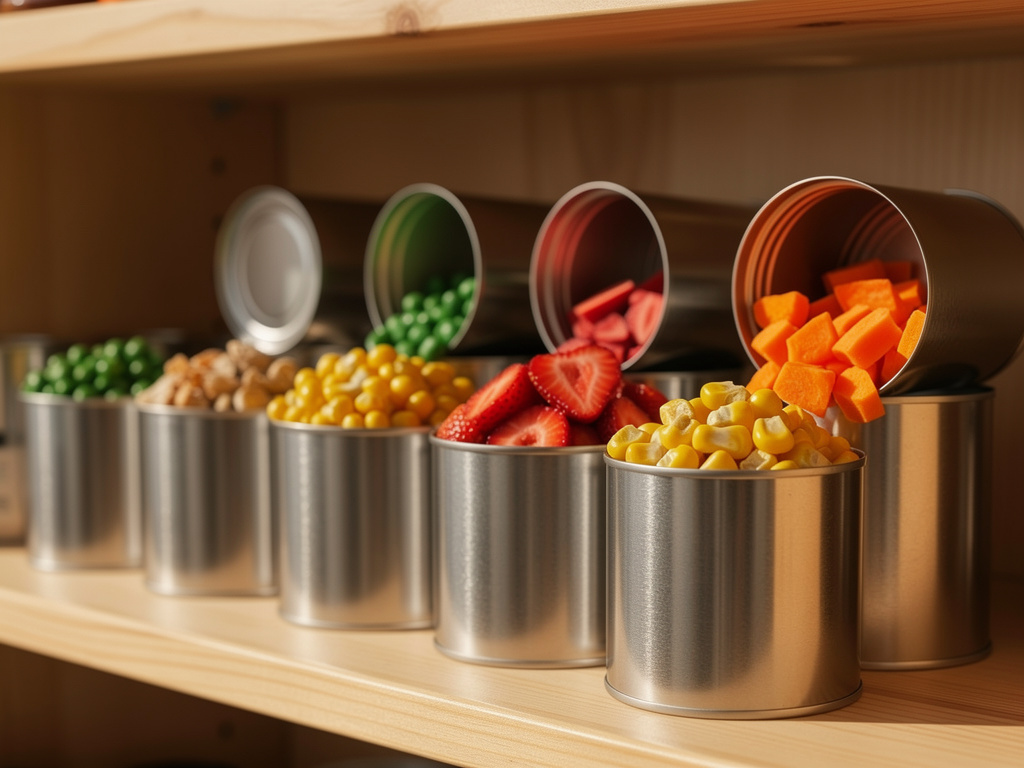
Freeze-drying removes 98–99% of moisture from food by freezing it solid and then sublimating the ice under vacuum — turning ice directly to vapor without passing through liquid. The result is a product that weighs 70–90% less than fresh, retains close to its original shape and most of its nutritional profile, and stores at room temperature for decades. For preparedness, freeze-dried food occupies a specific role: it is not a budget staple, but it is the best option for portable nutrition, specialty items that resist other preservation methods, and meals that require nothing but hot water.
How Freeze-Drying Works
Commercial freeze-drying proceeds in three phases:
- Freezing — food is rapidly frozen to −40°F (−40°C) or below, locking cellular structure
- Primary drying — pressure drops below 0.006 atm; ice sublimates, removing ~95% of moisture
- Secondary drying — temperature rises gently to remove residual bound water, bringing final moisture below 2%
This process preserves cell walls better than heat dehydration, which collapses them. The intact structure means freeze-dried food rehydrates more completely and more quickly than dehydrated food — typically 5–15 minutes in hot water versus 20–45 minutes for dehydrated equivalents.
Nutrition retention: Freeze-dried food retains approximately 97% of original nutritional content. Heat-sensitive vitamins (C, B1, B5) survive better than in canning or dehydration because no heat is applied during primary drying. Fat-soluble vitamins (A, D, E, K) are fully retained. Protein quality and carbohydrate content are unchanged. Canning, by contrast, loses 20–50% of heat-sensitive vitamins due to the high-temperature processing required to achieve shelf stability.
Best candidates for freeze-drying: Fruits, vegetables, cooked meats, eggs, dairy (cheese and yogurt), herbs, and complete cooked meals. These retain texture and rehydrate well because their cellular structure survives sublimation.
Poor candidates: Foods with high fat content — butter, oils, peanut butter, fatty meats — do not freeze-dry well. Fat does not sublimate and remains as the dominant component after processing; it goes rancid well before any advertised shelf life is reached. Commercially freeze-dried butter exists but requires a dedicated oxygen-free seal. Home-processed high-fat foods should not be expected to hit the 15-year mark.
Shelf Life Comparison
Commercially sealed freeze-dried food has a rated shelf life of 25–30 years when stored at 60°F (15°C) or below in sealed #10 cans with oxygen absorbers. This assumes the original factory seal is intact and storage temperature is consistent — every 10°F (5.5°C) rise roughly halves shelf life.
| Preservation Method | Sealed Shelf Life | Notes |
|---|---|---|
| Freeze-dried (commercial, #10 can) | 25–30 years | Best at 50–60°F (10–15°C); oxygen absorber required |
| Freeze-dried (home-processed, Mylar) | 15–20 years | Lower confidence due to variability in final moisture |
| Dehydrated (commercial) | 10–15 years | Texture degrades; higher residual moisture than freeze-dried |
| Dehydrated (home) | 5–10 years | Moisture content varies; add 1-year safety margin |
| Commercially canned (low-acid: beans, vegetables) | 3–5 years | Taste and texture degrade past 3 years |
| Commercially canned (high-acid: tomatoes, fruit) | 1.5–2 years | Acidity accelerates can corrosion |
| Frozen (home freezer) | 6–12 months | Quality dependent; requires continuous power |
Temperature is the real shelf-life variable
A #10 can rated for 25 years stored at 85°F (29°C) — a common garage or attic temperature in warm climates — may deliver only 8–10 years of effective shelf life. Always store freeze-dried food in the coolest, most temperature-stable location available. A basement beats a pantry; a pantry beats a garage.
| Storage Temperature | Estimated Shelf Life |
|---|---|
| 50°F (10°C) | 30+ years |
| 60°F (15°C) | 25–30 years |
| 70°F (21°C) | 20–25 years |
| 80°F (27°C) | 10–15 years |
| 90°F (32°C) | 5–8 years |
Once opened, reseal the can lid tightly and consume within 2–4 weeks. The oxygen absorber is spent once the seal is broken — moisture and oxygen begin degrading the food immediately. Opened pouches should be sealed with a clip and consumed within 1–2 weeks.
Commercial Brands — Caloric Density and Coverage
Most freeze-dried entrees deliver 200–500 kilocalories per labeled serving, but "serving size" is set by the manufacturer, not by real-world consumption needs. Under physical stress, a 310-calorie serving of beef stroganoff is not a meal — it is a side dish. Mountain House's own 1-year emergency supply provides approximately 1,730 kcal/day, which is below the 2,000 kcal baseline for a sedentary adult and well below the 2,500–3,500 kcal range for someone doing physical labor or managing sustained stress.
Field note
Check the "servings per container" label carefully — a can listed as "6 servings" may provide only 1,200–1,400 calories total, not a full day's supply. Evaluate freeze-dried food by total calories per container, not per serving. A single #10 can should deliver at minimum 1,500–2,000 calories to count as one person-day of food coverage.
Major commercial brands differ meaningfully in calorie density, packaging size, and cost per calorie:
Mountain House (Oregon Freeze Dry): Industry benchmark for taste and texture. #10 cans typically provide 250–600 calories per serving, with roughly 134 calories per ounce (4.7 kcal/g) across the lineup — the highest caloric density of major brands. A significant investment per person for a month's supply, but the quality premium is real.
Augason Farms: Budget-oriented, widely available at major retail chains. Heavier on grains and pasta. Per-calorie cost is lower than Mountain House. Acceptable for bulk filler calories; taste and texture are noticeably different. Affordable individually.
Wise Company / ReadyWise: Entry-level brand with 25-year shelf life claims. Calorie counts per serving are sometimes as low as 100–200 kcal, meaning effective cost per calorie is higher than the container price suggests. Always calculate total calories per container before purchasing at scale.
Legacy Food Storage: Mid-tier brand with competitive calorie density. Entrees average 370–400 kcal per serving across most offerings. Affordable to moderate investment for multi-month buckets.
Thrive Life: Subscription-based, freeze-dried individual ingredients rather than complete entrees. Good ingredient quality and useful for augmenting home cooking with stored-food components. Moderate investment per ingredient category.
Cost Comparison Across Preservation Methods
| Method | Approx. cost per 100 calories |
|---|---|
| White rice (bulk, Mylar-packed) | $0.03–$0.06 |
| Dried beans (bulk) | $0.05–$0.10 |
| Canned goods (commercial) | $0.08–$0.20 |
| Dehydrated food (home) | $0.08–$0.18 |
| Freeze-dried (commercial) | $0.20–$0.50 |
| Home freeze-dried (amortized equipment) | $0.10–$0.25 |
Freeze-dried food costs roughly 4–10x more per calorie than bulk grain staples. Plan your store accordingly — use freeze-dried strategically, not as the foundation.
Rehydration Ratios and Water Requirements
Every calorie of freeze-dried food requires water to reconstitute. In a water-constrained scenario, a freeze-dried-heavy food plan has a real embedded water cost that most preparedness guides underemphasize.
Standard rehydration ratios (water volume to dry food volume):
| Food Type | Ratio | Water per Serving |
|---|---|---|
| Vegetables | 5:1 to 6:1 | 3/4–1 cup (180–240 mL) |
| Fruit | 3:1 to 4:1 | 1/2–3/4 cup (120–180 mL) |
| Cooked meat | 1:1 to 1.5:1 | 1/4–1/2 cup (60–120 mL) |
| Complete entrees | 1.5:1 to 2:1 | 1–2 cups (237–473 mL) |
| Scrambled eggs | 2:1 | 1/4 cup (60 mL) per 2-egg serving |
A household consuming 2,000 calories/day from freeze-dried meals exclusively needs approximately 2–3 liters of extra water daily just for rehydration, beyond drinking water. See Water Containers for storage capacity planning.
Field note
Cold-water rehydration works for all freeze-dried products — it takes 2–4x longer than hot water but uses no fuel. In a fuel-scarce situation, pre-soak freeze-dried vegetables in cold water for 20–30 minutes before adding to a pot. Most major-brand entrees fully rehydrate in cold water in about 45 minutes if you're patient.
Home Freeze-Dryers
Harvest Right manufactures the only widely available home freeze-dryers in the US market. Three models as of 2026:
- Small (4-tray): processes 6–10 lbs (2.7–4.5 kg) per batch, approximately 840 lbs (381 kg)/year at three batches/week — a significant investment
- Medium (5-tray): processes 10–15 lbs (4.5–6.8 kg) per batch, approximately 1,450 lbs (658 kg)/year — significant investment
- Large (6-tray): processes 18–27 lbs (8.2–12.2 kg) per batch, approximately 2,500 lbs (1,134 kg)/year — significant investment; requires a dedicated 20A circuit
Each batch runs 24–36 hours and consumes 1.0–1.5 kWh/hour. Running 3 batches per week amortizes the hardware cost in 3–5 years compared to purchasing equivalent commercial freeze-dried product — but this math only works if you run the machine consistently.
What home freeze-drying does well: fresh produce at peak season, leftovers, custom meals, raw and cooked meats, dairy (cheese, butter, yogurt), herbs, and foods that cost more commercially than bulk pricing reflects.
What it handles poorly: high-sugar items (jam, honey, candy — they don't crystallize properly and tend to be sticky and fragile after processing), carbonated liquids, and alcoholic beverages.
For home freeze-dried product, seal in Mylar bags with 300–500cc oxygen absorbers — the same approach used for bulk grain storage. See Long-Term Storage for sealing procedures. Shelf life for home-processed food is conservatively estimated at 15–20 years due to variability in final moisture content versus commercial processing.
Home unit economics
The break-even point depends heavily on what you freeze-dry. Processing fresh produce at peak harvest — when prices are lowest — accelerates the return. Freeze-drying items you'd otherwise buy commercially at full retail (meats, berries, eggs) shortens the payback window significantly compared to freeze-drying low-cost grains you could store more cheaply in Mylar.
Integration Strategy
Freeze-dried food should not be a complete diet — it fills specific gaps in a layered food plan.
Role 1 — Bug-out nutrition: A 72-hour kit loaded with freeze-dried entrees weighs 2–4 lbs (0.9–1.8 kg) and provides full calorie coverage without cooking infrastructure. No refrigeration, no rotation headaches, ready when you leave.
Role 2 — Protein and variety supplement: Bulk calorie staples (rice, beans, oats) dominate long-term storage economically. Freeze-dried proteins (chicken, beef, eggs) and vegetables fill the variety and nutrient gap at reasonable cost.
Role 3 — Comfort and morale: Familiar meal formats matter psychologically in high-stress situations. Recognizable entrees provide a morale function that bulk grains cannot replicate.
Role 4 — Skill gap coverage: For households that haven't yet built Canning or Dehydrating skills, commercial freeze-dried provides immediate nutritional coverage while those skills develop.
Recommended allocation for a 3-month food plan:
- 60–70%: Bulk dry staples (grains, legumes, oats)
- 15–20%: Freeze-dried proteins, vegetables, and specialty items
- 10–15%: Home-canned or commercially canned goods
- 5%: Comfort items (freeze-dried fruit, specialty entrees)
Nutritional Gaps to Watch
Even with 97% nutrient retention, freeze-dried-heavy plans develop predictable deficiencies if not managed:
- Vitamin C: Freeze-dried citrus and bell peppers retain it well, but entree-dominant plans lack it. Stock freeze-dried bell peppers or supplement with vitamin C tablets.
- Vitamin D: No stored food source is adequate without sun exposure. Supplement separately — 1,000–2,000 IU/day.
- Iodine: Unless using iodized salt or freeze-dried seafood, iodine levels drop in long-duration stored-food diets. Stock iodized salt or kelp tablets.
- Fiber: Freeze-dried entrees are typically low in fiber. Add freeze-dried beans and whole grain options to compensate.
See Nutritional Math for complete micronutrient planning across your full food store.
Buying and Testing Protocol
- Never buy bulk without taste-testing first. Order single-serving pouches of any entree before committing to a case or bucket. Palate compatibility matters more than price per calorie.
- Check calories per can, not per serving. Serving counts on the label are often 2.5–3 per can — real-world consumption at crisis-level activity is 1–1.5 servings per meal.
- Verify oxygen absorber presence. Open a can. There should be a small packet inside and the lid should be slightly depressed (vacuum indicates integrity).
- Cross-reference best-by dates at purchase. Buying on clearance can mean 15 years of shelf life instead of 25.
- Maintain rotation records. Use Inventory procedures — oldest cans front, newest back. Label opened cans with the date opened and a 2–4 week consume-by target.
- Store opened cans in a cool, dry, dark location. Once the factory seal is broken, treat the container as pantry food, not long-term storage. Avoid garages, attics, or any space with temperature swings beyond 60–80°F (15–27°C).
Freeze-Dried Readiness Checklist
- Calculate caloric needs: total calories per person per day × number of people × number of days covered
- Audit freeze-dried inventory by total calories per container, not by serving count
- Taste-test any new brand before buying in bulk — single-serving pouches are available from all major brands
- Check storage location temperature — interior basement or closet preferred over garage or attic
- Account for embedded water cost: 2–3 extra liters per person per day needed for rehydration
- Stock at least 2–4 weeks of freeze-dried protein (chicken, beef, or eggs) per person to supplement bulk grain stores
- Label all opened cans with date opened and a 2–4 week consume-by date
- Integrate freeze-dried into Long-Term Storage rotation using FIFO (first in, first out)
The caloric density advantage and 25-year shelf life make freeze-dried the best choice for bug-out kits and protein supplementation, but the cost premium means it should never be your only strategy. See food storage planning for how freeze-dried fits into a complete layered food system alongside bulk grains, home canning, and dehydrated options.