Weather monitoring
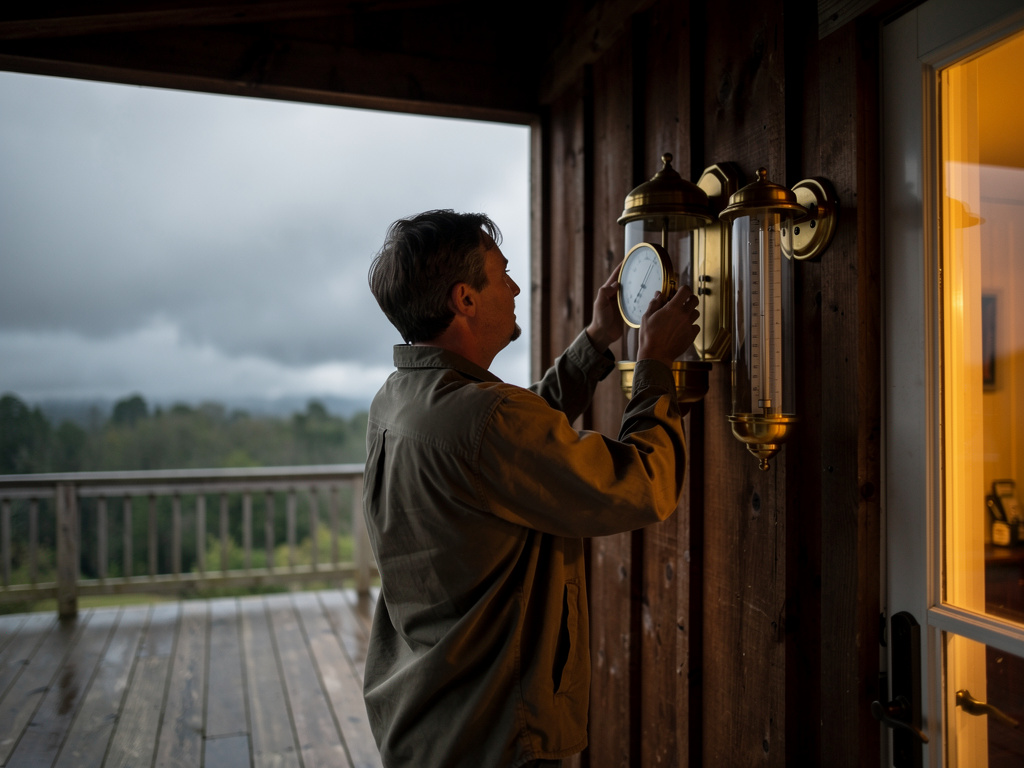
Weather is one of the few hazards you usually get warning for. The difference between inconvenience and disaster is often whether a household acted 24 hours earlier. Good weather monitoring is not about watching one app. It is about building a repeatable process that turns forecasts into decisions — using official alert systems, local instruments, and a clear trigger table that removes argument when conditions deteriorate.
Build a layered weather picture
Use at least three source types:
- Official forecasts and alerts (National Weather Service, local emergency management)
- Radar and model trends (storm movement, precipitation bands, temperature drops)
- Ground truth from local observers and neighborhood reports
One source can be wrong. Layering reduces surprise. During a power or internet outage, National Oceanic and Atmospheric Administration (NOAA) Weather Radio and direct observation become your primary inputs — the rest of the stack disappears first.
NOAA Weather Radio and SAME codes
NOAA Weather Radio All Hazards (NWR) transmits on seven dedicated frequencies across the US:
162.400 — 162.425 — 162.450 — 162.475 — 162.500 — 162.525 — 162.550 MHz
Your local frequency depends on which transmitter covers your area. Most weather alert radios scan all seven and lock onto the strongest signal automatically. The NWS maintains a county coverage lookup to find the exact frequency and transmitter for your location.
SAME (Specific Area Message Encoding) is the county-level filtering system built into alert radios. Without SAME, your radio activates for any alert broadcast by your local transmitter — which may cover several counties. With SAME programmed, the radio only activates for your specific county or counties.
To find and program your SAME code:
- Look up your county's 6-digit SAME code at weather.gov/nwr/usingsame or by calling 1-888-NWR-SAME (1-888-697-7263).
- Access the SET LOCATION menu on your radio and select your county code.
- If you live near a county line or have family in adjacent counties, program codes for additional counties — most radios support multiple SAME codes simultaneously, though capacity varies by model (check your radio's manual).
- Test the setup: NWS transmits a weekly test signal every Wednesday between 11 a.m. and noon local time in most areas.
Field note
Program SAME codes for your home county plus any county where family members regularly travel or work. A tornado watch in the next county is actionable information even if your own county is not under watch.
An affordable NOAA weather alert radio with SAME capability is the single most reliable piece of weather monitoring equipment a household can own. It activates automatically on severe alerts — no internet required, no app to check, and it runs on batteries when the grid is down.
Wireless Emergency Alerts (WEA) on your phone
The Wireless Emergency Alert system pushes geotargeted alerts directly to your phone without requiring an app or subscription. There are four WEA categories, each with different opt-out rules:
| Alert tier | Triggered by | Can opt out? |
|---|---|---|
| National Alert | National emergency (issued by President or Federal Emergency Management Agency (FEMA) Administrator) | No — cannot be blocked |
| Imminent Threat Alert | Extreme weather, active threats — current or emerging; meets NWS urgency/severity/certainty thresholds | Yes (carrier dependent) |
| AMBER Alert | Verified child abduction emergency | Yes (carrier dependent) |
| Public Safety Message | Essential safety advisory, not necessarily life-threatening | Yes |
The practical takeaway: you will always receive National Alerts regardless of your phone settings. Imminent Threat Alerts — which include tornado warnings, flash flood emergencies, and active shooter notifications — can be blocked on some devices. Do not block them. WEA complements NOAA Weather Radio; it does not replace it, because WEA delivery depends on cell network availability.
Cell networks fail in regional disasters
During a major storm or grid outage, cell towers may be overloaded or lose power. WEA alerts that arrive 20 minutes late or not at all have been documented in past major disasters. Treat WEA as your first-notification layer, not your only one.
Alert categories: Watch, Warning, and Advisory
The National Weather Service uses three categories that require different responses. Confusing them wastes preparation time or causes people to under-react.
Watch — Hazardous conditions are possible. Timing and location are uncertain but risk has increased significantly (around 50% confidence of meeting warning criteria). A watch is issued hours to days in advance to allow preparation time. Action: review your plan, check supplies, monitor more frequently.
Warning — Hazardous conditions are occurring, imminent, or highly probable. Conditions pose a threat to life or property. Travel will become difficult or impossible. Action: execute your plan now. Shelter, evacuation, or protective action should begin immediately.
Advisory — Significant inconvenience but not life-threatening if caution is exercised. Action: adjust activity level and travel plans; conditions may still escalate.
The memory aid: a Watch means watch for it, a Warning means act now.
Special Statements and Outlooks
NWS also issues Special Statements (significant but non-warning conditions), Outlooks (general risk 3–7 days out), and Hazardous Weather Outlooks (daily summary of significant conditions for the next 7 days). These are useful for the 5–7 day planning horizon but do not require immediate action.
Barometric pressure as a storm indicator
A barometer adds local situational awareness that no app can replicate — it reads the atmosphere directly above your location, with no network required.
Normal sea-level pressure range: 29.80–30.20 inHg (1009–1023 hPa). Under these readings, expect stable or improving conditions.
Storm approach signals:
| Pressure trend | Reading | Interpretation |
|---|---|---|
| Slow fall | Dropping 0.01–0.02 inHg (0.3–0.7 hPa) per hour | Weather change likely within 24–48 hours |
| Rapid fall | Dropping >0.06 inHg (>1.5 hPa) per hour | Approaching storm; conditions can deteriorate within hours |
| Very rapid fall | Drop of 10+ hPa in 3 hours | Strong low-pressure system or frontal passage; expect significant wind, precipitation, and severe weather potential |
| Below 29.40 inHg (996 hPa) | — | Very low pressure; storm conditions likely or already present |
A rapid fall does not tell you what kind of storm is coming — it tells you something is coming. Cross-reference the barometer trend against the NWS forecast and radar to interpret correctly.
An aneroid (mechanical) barometer requires no power and no batteries, which makes it useful precisely when conditions are most severe. Entry-level digital weather stations that include barometric pressure, temperature, and humidity are an affordable addition to a home monitoring kit.
Field note
Trend matters more than absolute reading. A steady 29.60 inHg is less alarming than a reading that dropped from 30.10 to 29.80 in two hours. Mark the reading every hour when a storm is possible and track the direction of change.
Forecast horizons and decisions
Treat forecast windows differently:
- 5–7 day: Planning posture — check supplies, test equipment, review storm-type playbook
- 48–72 hour: Staged preparation — top off fuel, secure outdoor items, review trigger table
- 12–24 hour: Execution — final hardening, communication checks, brief household
- 0–6 hour: Operations — shelter decisions, welfare checks, activate neighborhood net
Shorter horizons should trigger more concrete actions. Waiting for certainty before acting is one of the most common preparation mistakes — the forecast window for effective action closes faster than most people expect.
Trigger thresholds
Define thresholds before a storm. A trigger table converts a condition into an action automatically, removing the judgment call under stress.
| Trigger | Action |
|---|---|
| Wind forecast >40 mph (64 km/h) | Secure loose objects, trim immediate hazards |
| Barometer falling >0.06 inHg (1.5 hPa) per hour | Increase monitoring frequency; check 12-hour forecast |
| Hard freeze warning | Protect pipes, stage alternate heat |
| Rainfall exceeds local flood threshold | Move gear above grade, pre-plan evacuation routes |
| Heat index >local danger threshold | Open cooling support plan, hydration checks |
| NWS Watch issued | Review plan, confirm communications, brief household |
| NWS Warning issued | Execute plan — shelter, evacuate, or take protective action |
Equipment that improves outcomes
Start with the alert radio and add capability as needed:
- NOAA weather alert radio with SAME — the reliable, affordable baseline; activates automatically without internet; runs on batteries; requires programming your county SAME code
- Analog aneroid barometer — no batteries, no configuration, reads pressure trend directly; inexpensive and lasts decades
- Digital weather station — tracks temperature, humidity, and pressure; entry-level units are affordable; the Davis Vantage line is the serious-monitor standard and a significant investment
- Rain gauge — standard 4-inch (10 cm) diameter tube with measurement increments; inexpensive; useful for tracking rainfall accumulation against local flood thresholds
- Anemometer (wind meter) — optional but useful during severe weather preparation; confirms forecast wind estimates against actual site conditions
- AM/FM emergency radio — supplements weather radio with local broadcast coverage during grid outages
- Offline map of local flood-prone routes — works when cell data fails
If power and internet fail, weather radio and direct instrument readings become your primary data.
Neighborhood weather watch rhythm
For community groups, use scheduled updates:
- Normal conditions: daily summary
- Elevated risk: every 6 hours
- Active severe event: every 2 hours
Each update should include:
- What changed since the last update
- What is likely in the next period
- What action is required now
- Time of next update
Keep updates factual and brief. Two sentences are better than two paragraphs when neighbors are making decisions. Use this rhythm alongside your communications plan and signals protocols.
Field note
A neighborhood group where two or three households have different quality weather stations covers a wider area and provides cross-validation when readings diverge. Coordinate before buying to avoid duplication.
Storm-type playbooks
Wind storm
- Remove projectile hazards (furniture, bins, loose metal)
- Test backup lighting and charging
- Identify safe interior rooms away from windows
Flood risk
- Move documents, electronics, and medications above expected waterline
- Stage sandbags or barriers where practical
- Pre-plan no-go roads and alternate routes
Extreme heat
- Shift activity to cooler hours
- Pre-position water and electrolytes
- Check vulnerable neighbors twice daily
Winter storm
- Harden pipes and heating backups
- Stage traction and travel kits
- Assume travel interruption for 24–72 hours
For deeper threat-specific preparation, see the hurricane preparedness, tornado, and winter storm pages.
Common mistakes
- Waiting for certainty before preparing
- Ignoring local terrain effects (flood basins, wind tunnels, heat islands)
- No offline fallback for alerts when cell and internet fail
- Confusing model noise with actionable risk
- Failing to program SAME codes — the radio alerts for the whole transmitter region, not just your county
- Treating WEA phone alerts as a reliable primary system when cell networks are the first thing to overload
Practical checklist
- Program your county SAME code into your NOAA weather alert radio
- Look up your local NWR transmitter frequency at weather.gov/nwr/counties
- Confirm WEA Imminent Threat Alerts are enabled on all household phones
- Define weather trigger thresholds for your area (use the table above as a starting point)
- Build a 3-source monitoring stack (NWR, radar/NWS forecast, barometer/local observation)
- Print a severe-weather action checklist and post it where your household will see it
- Run one household weather drill each season
- Add weather update cadence to your communications plan
Weather monitoring is one of the highest-return preparedness habits: low cost, high warning value, and directly actionable if your thresholds and checklists are already defined. For broader information verification during extended disruptions, see news and satellite for out-of-area coordination when local networks fail.