Gear
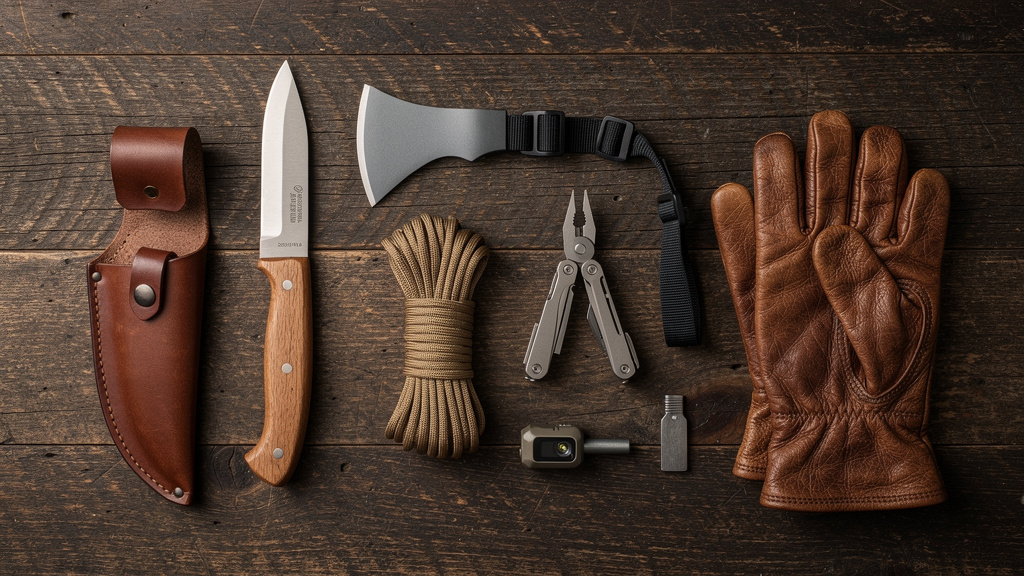
A person with a sharp axe, a fixed-blade knife, and 50 feet (15 meters) of cordage can build a shelter, process firewood, prepare food, and signal for help. A person with bare hands and a garage full of freeze-dried food cannot. Tools are force multipliers — they convert effort into results at a ratio that bare hands can't match.
Tool preparedness has three layers: essential tools (the core items that handle 80% of tasks), kits (purpose-built loadouts for specific scenarios), and maintenance (keeping everything sharp, functional, and ready).
Essential tools
Knives for preparedness covers the single most used tool in any field or emergency scenario. A quality fixed-blade knife with a 4–5 inch (10–13 cm) blade, full tang construction, and a flat or Scandi grind handles everything from food prep to batoning firewood to first aid tasks. An affordable fixed blade is the foundation. A folding knife rides in your pocket daily as a backup. Don't buy one knife — buy a system: a fixed blade for heavy work, a folder for daily carry, and a multitool for the tasks neither handles well.
Axes process wood — splitting firewood, felling small trees, shaping timber, driving stakes. A 2-pound (0.9 kg) boy's axe or hatchet handles camp tasks. A 3.5-pound (1.6 kg) splitting axe handles firewood for home heating. Both require regular sharpening and handle maintenance to stay safe and effective.
Hand saws cut faster and more precisely than axes with less effort. A 21-inch (53 cm) bow saw clears trail, bucks logs, and processes lumber. A folding saw fits in a pack — both are inexpensive. A chainsaw handles storm cleanup and firewood processing at scale but depends on fuel and maintenance; it's a moderate investment for serious wood processing.
Hand tools for home repair — hammer, screwdriver set, pliers, adjustable wrench, tape measure, level, pry bar — handle 90% of residential maintenance and emergency repairs. A complete basic set is affordable and pays for itself the first time you can't call a contractor.
Garden tools for food production — a pointed shovel, a hoe, a garden rake, and a pair of bypass pruners — are the minimum for food production. A broadfork breaks compacted soil without a rototiller. Quality matters: a mid-grade shovel with a fiberglass handle outlasts a budget one by years.
Emergency lighting and measuring tools round out the essentials. A headlamp for hands-free work, a lantern for camp or shelter use, and a chemical backup light are the three-tier lighting system. Tape measures, levels, and squares are required for any structural repair.
Come-along and rigging covers mechanical advantage for moving loads that no single person can shift — stuck vehicles, downed trees, structural beams. A hand winch and 20 feet (6 m) of rated rigging chain solve problems that nothing else does.
Fasteners and repair supplies — adhesives, tapes, wire, and cordage stocks — are the consumables that hold everything together. Stock them before you need them.
Field note
Buy the best quality you can afford for the three tools you'll use most: your knife, your axe, and your primary saw. These are the tools that get used under stress, in bad conditions, when failure has real consequences. Save the budget options for screwdrivers and tape measures.
Kits
A kit is a pre-packed collection of tools and supplies built for a specific scenario. Packing one in advance means you grab it and go rather than searching your house during an emergency.
Everyday carry (EDC) is what rides on your person or in your pockets daily: a folding knife, a small flashlight, a lighter, and a multitool. Some people add a tourniquet, a pen, and a handkerchief. The principle is: if you walked out of your house right now with only what's in your pockets, could you handle a flat tire, a minor injury, or a power outage?
A bug-out bag is a 72-hour pack that sustains you away from home: shelter (tarp, sleeping bag), water (filter, container), food (bars, dehydrated meals), fire (lighter, ferro rod), first aid (IFAK), navigation (compass, map), and communication (radio, whistle). Target weight: 25–35 pounds (11–16 kg). Heavier than that and you sacrifice the speed that makes a bug-out bag useful.
A get-home bag is smaller and focused on one task: getting from your workplace to your home. Walking shoes, water, a snack bar, a flashlight, a phone charger, cash, and a paper map of your route. It lives in your car or under your desk.
A vehicle emergency kit stays in your trunk permanently: jump starter or cables, tire inflator, basic tools, first aid, 1 gallon (3.8 liters) of water, blanket, and a paper map. An inexpensive kit is no investment compared to being stranded.
Maintenance
Tools that aren't maintained are tools that fail when you need them. Tool maintenance and repair is a scheduled activity, not a reaction to a problem.
Edged tools need sharpening after every significant use. A dual-grit whetstone and 10 minutes of practice maintains every knife, axe, and hoe you own. Oil carbon steel blades after each use to prevent rust.
Power tools and small engines need fuel system cleaning, spark plug inspection, air filter checks, and oil changes on a seasonal schedule. A generator that hasn't been started in 8 months is a generator that won't start when the grid goes down.
The ability to build improvised tools from scrap — a pry bar from rebar, a mallet from a hardwood billet, a needle from a fish bone — matters when manufactured replacements aren't available.
Inspect before you need it
A cracked axe handle, a rusted blade, or a dead headlamp battery discovered during an emergency is a crisis on top of a crisis. Inspect every critical tool quarterly: check handles for cracks, blades for chips, batteries for charge, and moving parts for function.
Where to start
- Get a quality fixed-blade knife and learn to sharpen it on a whetstone
- Assemble a basic home repair toolkit: hammer, screwdriver set, pliers, adjustable wrench, tape measure
- Buy a headlamp and a set of rechargeable batteries for every household member
- Build a vehicle emergency kit: jump starter, tire inflator, first aid, water, blanket, paper map
- Create a quarterly maintenance calendar for your top five tools: inspect, sharpen, oil, test
Tools and skills are two halves of the same foundation. A sharp axe and the skill to use it safely — that combination solves problems that neither half handles alone.