Sharpening knives and tools
A dull edge is a safety problem as much as a performance problem. Dull tools require more force, which means more chance of slipping and less control over where the blade goes. The time to sharpen is before a task, not during one. Every field knife, axe, chisel, and garden hoe you own will eventually need the stone, and the technique is transferable across all of them.
Understanding the edge
Before you sharpen anything, it helps to understand what you are trying to create. The bevel is the angled surface ground into each side of the blade. The apex is the line where both bevels meet — the actual cutting edge. The burr (also called a wire edge) is a thin curl of metal that forms on the opposite side of the edge as you grind one side. It is the most reliable sign that you have sharpened that side far enough: a consistent burr along the full edge length means you have reached the apex.
The goal of sharpening is to create two even bevels that meet at a consistent apex, then remove the burr. Every technique below serves that goal.
Choosing the right angle
The angle between the blade and the stone determines how the edge behaves. Lower angles are sharper but more fragile. Higher angles are more durable but less refined.
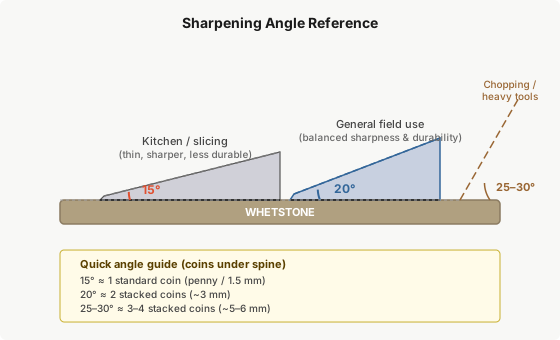

| Use case | Angle per side | Notes |
|---|---|---|
| Kitchen slicing, filleting | 15° | Fine, acute — chips under hard use |
| General field knife, pocket knife | 20° | Best balance of sharpness and durability |
| Chopping tools, axes, cleavers | 25–30° | Robust edge that resists rolling on hard impacts |
| Hatchets, splitting mauls | 30–35° | Near-wedge geometry for maximum durability |
Setting 20°: Stack two standard coins (each about 1.5 mm / 1/16 inch thick) under the blade spine while the edge rests flat on the stone. That elevation approximates 20°. For 15°, use one coin. Practice matching this elevation without coins as your muscle memory develops.
Stones and abrasives
Water stones (also called whetstones) are traditional ceramic or natural stones that use water as a lubricant. Soak them for 5–10 minutes before use — you will see bubbles as water penetrates. They cut efficiently and provide tactile feedback through the stroke.
Diamond stones (DMT-style) have industrial diamond particles bonded to a steel plate. They require only a light rinse of water — no soaking. They cut faster than water stones and stay flat, but they are more expensive and provide less feedback. A quality diamond stone is a moderate investment but outlasts multiple water stones.
Oil stones (Arkansas, India stones) use honing oil as lubricant. They are slower but produce a refined edge. Avoid mixing lubricants — an oil stone used with water will clog.
The working grit progression:
| Stage | Grit | Purpose |
|---|---|---|
| Coarse | 120–400 | Re-profiling chipped or very dull edges |
| Medium | 800–2,000 | Routine sharpening from moderate dullness |
| Fine | 2,000–6,000 | Refining the edge, removing medium-grit scratches |
| Extra fine / strop | 8,000+ or leather | Final polish, deburring |
Most field sharpening does not start at coarse. A knife that is maintained regularly only needs medium and fine work. Reserve coarse grit for edges that have visible nicks or have been neglected for months.
Setting up the stone
- Place the stone on a non-slip surface — a damp cloth or a purpose-made rubber holder works well. The stone should not move during strokes.
- For water stones: soak for 5–10 minutes, then set on the holder. Keep a small cup of water nearby to rewet the surface every few minutes.
- For diamond stones: wet lightly and begin.
- Note the stone's orientation. Stones are used lengthwise — the blade travels across the length of the stone.
Sharpening stroke — numbered procedure
This procedure is for a standard flat-ground or hollow-ground knife. Scandi-grind knives follow the same logic but the entire bevel is registered flat on the stone, eliminating the angle-holding step.
- Hold the knife handle firmly in your dominant hand. Place two or three fingers of your other hand flat on the blade near the edge to apply even downward pressure.
- Set the spine elevation at your target angle (2 coins for 20°, 1 coin for 15°).
- Maintain that angle throughout the stroke. This is the only part that requires practice — consistency matters more than perfection. A stroke that varies by 2–3° is acceptable; a stroke that rocks 10° loses the bevel shape.
- Push the knife edge-first across the stone in a smooth arc, moving from the heel of the blade toward the tip as you traverse the stone's length. Think of it as trying to slice a thin layer off the stone's surface.
- Complete each stroke at the tip of the blade — the tip is the section most frequently under-sharpened because it is tempting to lift early.
- Apply moderate, consistent downward pressure. Heavy pressure removes metal faster but creates a coarser scratch pattern and risks heat buildup. Light pressure at the end of the progression removes the burr cleanly.
- Complete 10–15 strokes on one side. Then repeat on the other side.
- Alternate sides every 5 strokes until you can feel a burr forming.
Cutting-edge direction during the stroke
Some sharpen with a "spine-leading" stroke (edge trailing), pulling the blade toward you with the spine going first. Both directions work. The critical rule: never lift the edge abruptly at the end of a push stroke or you can roll the very tip of the apex back on itself, undoing the previous strokes. Complete each stroke fully across the stone before lifting.
Detecting the burr
The burr is the sharpener's progress indicator. You cannot skip this detection step — without it, you cannot know when to switch sides or move to a finer grit.
- Rest the tip of your thumb on the flat of the blade, near the spine.
- Slide your thumb slowly toward the edge — stopping when you reach it, never running along it.
- At the edge, sweep your thumb across the bevel, from the flat face of the blade outward over the apex. Do not slide along the edge — sweep across it.
- A burr feels like a very slight roughness or catch, as if there is a tiny lip of metal you can snag with your thumbprint.
- Test the full length of the edge from heel to tip. A burr that only appears on part of the edge means those sections are not yet fully sharpened — continue working until the burr runs the full length.
- Once you feel a complete burr on one side, switch and sharpen the other side until a burr appears there too.
Field note
In low-light conditions or without time to feel carefully, run the blade lightly across your thumbnail at a shallow angle. A sharp edge catches and grabs; a dull or over-burnished edge slides across the nail without resistance. This is not a safety technique — do it slowly and with the edge perpendicular to your nail, not sliding along it.
Progressing through grits
- After developing a full burr on both sides with the coarse or medium stone, move to the next finer grit.
- Reduce pressure by roughly half at each grit step. You are now refining the surface, not removing metal in bulk.
- Alternate sides with every 3–5 strokes.
- Continue until the scratch pattern from the previous grit is replaced by the finer one. Under direct light at a flat angle to the blade, you can see the scratch lines — finer grit leaves finer lines.
- A burr will continue to form and reform at each grit step. Alternate sides and reduce pressure until the burr is very fine and barely detectable.
Stropping
Stropping removes the final micro-burr and aligns the apex. It does not remove metal — it only refines what the stones have created. A leather strop, the back of a leather belt, denim, or even cardboard all work.
- Pull the blade spine-first across the strop surface, with the edge trailing. This is the opposite direction from the sharpening stroke — the edge is never pushed into the strop.
- Maintain the same angle as sharpening, or 1–2° lower.
- Use very light pressure. The strop is doing delicate work — force will roll the apex over rather than align it.
- Complete 10 light strokes per side, alternating sides.
- A strop charged with honing compound (a fine abrasive paste) will refine the edge further toward a mirror polish. This step is optional for field knives but worthwhile for kitchen blades.
Testing sharpness
Use at least two tests before concluding the edge is ready:
The light test: Hold the blade up at 45° to a lamp or bright window, with the edge facing you. Rotate slowly. Any flat spot on the edge — a section that has not been sharpened fully to the apex — reflects light as a distinct white glint. A truly sharp edge has no reflective flat spots. This test catches weak sections that feel and cut fine in casual use but will fail first under load.
The arm hair test: Present the blade flat against the hairs on your forearm, then lift the spine slightly to engage the edge at a shallow angle. Drag lightly. A sharp edge shaves the hair cleanly without any pressure. A dull edge pushes through without cutting. If the blade catches and pulls rather than shaves, return to stropping.
The paper slice test: Hold a sheet of copy paper at the top and slice downward from the corner with the full edge. A sharp knife produces a clean, controlled slice with an even line. Tearing, snagging, or uneven cuts indicate sections of the edge that need more attention.
Common failure modes
| Symptom | Cause | Fix |
|---|---|---|
| Burr forms on only part of the edge | Inconsistent pressure — heel or tip getting less contact | Focus additional strokes on the problem section |
| Edge sharpens but dulls immediately | Angle too low for steel hardness, or over-polished bevel | Go back to medium grit and establish a slightly steeper bevel |
| Edge chips on first use | Angle too steep, creating a fragile apex | Lower the angle and rework from coarse grit |
| Blade scratches stone but edge stays dull | Angle too high — only the secondary bevel is contacting the stone | Lower the spine, reduce the angle |
| Strop makes edge worse | Pressure too heavy — rolling the apex | Use only the lightest touch, no downward force |
Field maintenance without a stone
When a stone is not available, these surfaces provide emergency edge maintenance — not a replacement for the stone, but enough to extend usability:
- Smooth river stone: Works as a slow, medium-grit stone. Use water as lubricant.
- Back of a ceramic coffee mug: The unglazed foot ring is a fine abrasive. Draw the edge along it at your sharpening angle.
- Car window glass edge: The rolled edge of a car window is a consistent fine abrasive. Use the top edge of the glass in a partially-lowered window.
- Leather belt: Functions as a field strop. Remove the burr and align the apex when no honing surface is available.
Sharpening checklist
- Select correct stone grit for the edge's current condition (routine = medium; neglected = coarse)
- Soak water stone for 5–10 minutes before use
- Set target angle: 20° for field knives, 15° for kitchen slicers, 25–30° for chopping tools
- Maintain consistent angle throughout each stroke
- Work one side until a full, consistent burr forms along the entire edge
- Mirror on the second side until burr transfers consistently
- Progress to finer grit with reduced pressure
- Strop with edge-trailing strokes, light pressure, 10 strokes per side
- Confirm sharpness with the light test and arm hair test before returning to service
Sharpening is the skill that makes every other knife and tool task work better. A blade maintained on a stone every few uses never needs coarse rescue work, and the habit takes less time than most people expect — 5 minutes on a medium stone keeps a working edge on any field knife. For the companion topic covering blade geometry and steel selection, see knives. For tool maintenance in context, the tools foundation and skills overview provide the broader framework.