Essential knots for preparedness
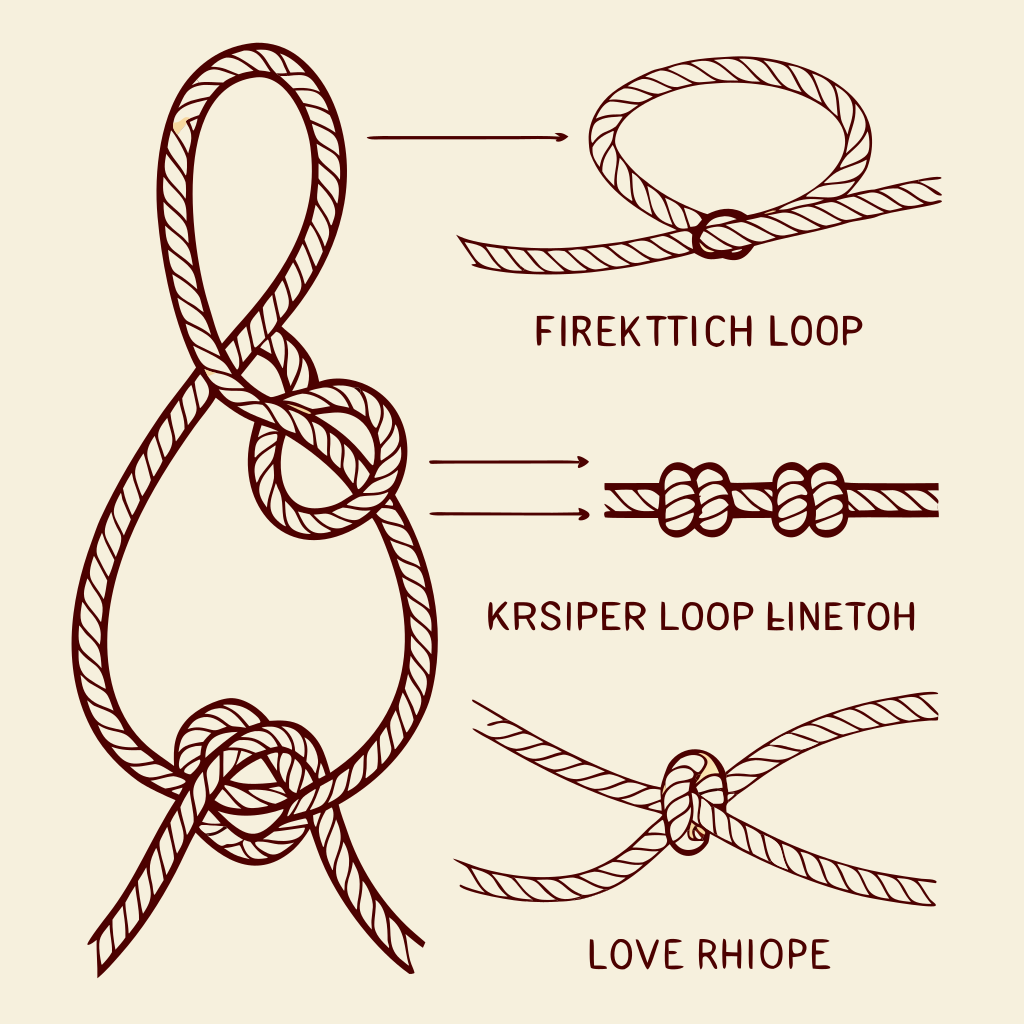
A rope without the right knot is just rope. A person who knows five reliable knots can pitch a tarp, secure a load, ascend a line, join two mismatched ropes, and tie a rescue loop in the dark with cold hands. The goal is not to memorize 50 knots — it is to tie eight correctly every time, in any conditions, without looking. Each knot here solves a distinct problem. Knowing which knot to reach for is half the skill.
These eight knots connect to everything else in the skills foundation. The lashing techniques for shelter and structure all begin with a clove hitch. The natural cordage you make from dogbane or nettle behaves differently from synthetic rope — it holds friction knots better, so the prusik and taut-line hitch are especially reliable with it.
Knot selection by task
Before the individual procedures, here is the decision logic:
| Task | Best knot |
|---|---|
| Fixed loop at rope end (rescue, rigging, mooring) | Bowline |
| Quick attachment to post, stake, or branch | Clove hitch |
| Joining two ropes of equal diameter | Square knot |
| Adjustable tension on tent lines or ridgelines | Taut-line hitch |
| Joining two ropes of different diameter | Sheet bend |
| Friction grip on a loaded rope (safety, ascending) | Prusik |
| Stopper knot, or joining to a harness/anchor | Figure-eight on a bight |
| Tensioning and lashing a load (tarp, cargo, firewood) | Trucker's hitch |
Never use a square knot for life-safety loads
The square knot retains only 43–47% of rope strength and can capsize (invert and release) under sudden or uneven load. It is a binding knot for equal-diameter ropes only — bandages, package tie-down, bundling. It is not a joining knot for any situation where failure causes injury.
Bowline

Use: creating a fixed loop that will not tighten under load. The standard knot for rescue loops, mooring lines, rigging attachment points, and tarp corner ties. Retains approximately 60–65% of rope strength.
- Hold the rope with about 18 inches (45 cm) of working end. With your right thumb, form a small clockwise loop in the standing line about 12 inches (30 cm) from the working end — the standing line passes over the working end at the crossing point.
- Pass the working end up through this small loop from below.
- Bring the working end around behind the standing line — the upright part above the loop.
- Pass the working end back down through the small loop, going in the same direction it came up.
- Hold the loop you want as the final bowline loop in your non-dominant hand. Pull the working end and the standing line in opposite directions to set the knot. The small loop should close around the working end.
Dressed correctly: the working end exits on the inside of the bowline loop, running parallel to the loop's leg. If the working end is on the outside, the knot is tied backward.
Failure sign: the knot slips when loaded. This means the working end was threaded the wrong direction through the small loop, or the knot was not set (pulled fully tight). Always set a bowline before trusting it with weight.
Field note
The rabbit-hole mnemonic: the working end is the rabbit. The small loop is the hole. The standing line is the tree. The rabbit comes up out of the hole, runs around the tree, and goes back down the hole. Tying it this way 50 times until it takes under 10 seconds is the only practice that counts.
Clove hitch
Use: quick, adjustable attachment to a post, stake, branch, or railing. Holds under steady sideways load. The starting knot for all lashing techniques. Retains approximately 60–65% of rope strength but can slip under alternating or lifting loads.
- Pass the working end over the post and bring it across the standing line, forming an X.
- Wrap the working end around the post a second time, going in the same direction as the first wrap.
- Pass the working end under the X — tuck it through the gap between the two wraps.
- Pull both ends to tighten.
Quick version (if the post has a free end): form two identical clockwise loops in the rope. Stack them — place the second loop directly behind the first. Slide both loops simultaneously onto the post.
Failure sign: the hitch rotates around the post, sliding along its length when loaded parallel to the post. The clove hitch holds lateral load well but is not a stopper against along-the-post tension. Add a half-hitch below it if sliding is a concern.
Square knot
Use: binding together two ropes of equal diameter where the load is even and constant — securing a bandage, tying bundle twine, closing a bag. Not for joining ropes that support dynamic or directional loads.
- Hold one end in each hand. Cross the right end over and then under the left end. Pull snug.
- Cross the left end (now on the right) over and then under the right end. Pull to tighten.
- The knot is correct when both loops are parallel and both working ends exit on the same side as their adjacent standing line. Squeeze the knot — both loops should nest cleanly side by side.
Granny knot failure: if the working ends exit on opposite sides, you tied a granny knot, which slips under load. This is the most common error. Verify that the first and second crossings alternate direction (right over left, then left over right).
Taut-line hitch
Use: an adjustable knot that slides freely when untensioned but locks under load. The standard knot for tent and tarp guy lines. Allows you to tension or slack a line without untying.
- Pass the working end around the anchor post or stake. Bring the working end back parallel to the standing line, running toward the load.
- Make two wraps around the standing line in the direction of the load, working away from the anchor.
- After the two wraps, make one additional wrap around the standing line on the far side (toward the anchor side) of the first two wraps.
- Tuck the working end through the final wrap and pull to tighten.
- Test by gripping the wraps and sliding the hitch along the standing line — it should slide freely. Pull load on the standing line — the hitch should lock immediately.
Failure sign: the knot slides under light load. The two wraps must encircle the standing line from the correct direction. If the hitch was built in reverse, add one more wrap around the standing line inside the existing wraps.
Sheet bend
Use: joining two ropes of different diameters or materials where the bowline or square knot would be unreliable. The sheet bend does not rely on equal thickness. Releases easily after loading.
- Form a bight (a U-shape, not a full loop) in the thicker or stiffer rope. Hold it in your non-dominant hand.
- Pass the working end of the thinner rope up through the bight from below.
- Bring the working end around behind both legs of the bight — travel around the outside of the U.
- Tuck the working end under its own standing part. It should pass between the standing part and the bight.
- Pull the thicker rope bight and the thin rope standing line apart to set.
Double sheet bend: for very unequal diameters or slippery materials, make two wraps of the thin rope around the bight before tucking under the standing part. The double version is significantly more secure.
Failure sign: the knot unties when the load is removed. The sheet bend is not meant for permanent connections — it releases easily by design. If the knot fails under load (not just when slack), the working end was not tucked under its own standing part.
Prusik
Use: a friction hitch on a larger rope that grips under load and releases when the knot is squeezed and unloaded. Used for ascending a fixed line, as a safety backup while rappelling, and as a mid-line attachment that can be repositioned. Requires a separate cord loop (the prusik cord) of roughly half the diameter of the main rope.
- Fold the prusik cord in half to find the midpoint. Hold the main rope vertically.
- Place the midpoint of the prusik cord behind the main rope.
- Pull both free ends of the prusik cord through the folded bight — both ends pass through the fold in the same direction. This creates one wrap around the main rope.
- Wrap the ends around the main rope again, passing them through the bight a second time.
- Wrap a third time in the same manner. Three complete wraps is the standard for a reliable grip.
- Dress the three wraps: slide all wraps together so they are neat, touching, and parallel. Both legs of the prusik cord should exit from the same side and be equal length.
- Apply load to both legs of the prusik cord — the wraps cinch around the main rope and hold. Grip the wrapped section of the prusik and push toward the load to release and slide.
Failure sign: the prusik slides under load without locking. The cord is likely too thick relative to the main rope — use a cord no more than 60% of the main rope's diameter. For a 1/2-inch (12 mm) main line, use a prusik cord no thicker than 5/16 inch (8 mm).
Prusik fails on icy or wet ropes
A prusik hitch depends on friction. Ice, mud, or a coated synthetic rope dramatically reduces grip. In wet or cold conditions, add a fourth wrap and test the grip with your full body weight before trusting the hitch for life-safety use.
Figure-eight on a bight
Use: a stopper knot that also creates a fixed loop usable for anchor attachment, harness tie-in, and anywhere a bowline would be used but with higher strength retention. Retains approximately 75–80% of rope strength versus 60–65% for a bowline.
- Measure out 18–24 inches (45–60 cm) of working end, depending on the loop size needed.
- Fold the working end back alongside the standing line to form a bight (double strand).
- Hold the bight and the standing line together. Form a clockwise loop in the doubled rope by passing the bight over the standing line.
- Pass the bight through the loop from the front, going under the standing line.
- Pull the bight loop and the standing line apart to set the figure-eight shape.
On a finished rope (trace-eight): if the rope is already rigged and you cannot fold a bight, tie a figure-eight knot in the working end as a stopper, then trace the path back through the knot with the working end going in reverse to recreate the loop shape around the anchor.
Failure sign: the knot has an extra crossover or a twisted loop — it looks like a pretzel rather than a clean figure eight. Back out and verify the bight passes through the loop cleanly without additional wraps.
Trucker's hitch
Use: tensioning a ridgeline, securing cargo, lashing tarps, and any application requiring high tension with easy release. Provides 3:1 theoretical mechanical advantage (typically 1.5–2:1 in practice due to friction). Can generate more tension than most people can create with direct pulling.
- Run the rope from the load to the anchor point with enough working line to complete the hitch.
- In the mid-section of the rope, form a slipped overhand loop: take a small bight of rope about 12 inches (30 cm) from the anchor, form an overhand loop, and pull a new bight (not the working end) through the loop. This creates a loop-on-a-bight that will release by pulling the working end.
- Pass the working end around the anchor point (a stake, tree, or vehicle tie-down point).
- Feed the working end back up through the slipped loop — this is the pulley element.
- Pull down on the working end to tension the system. The mechanical advantage multiplies your pulling force.
- While maintaining tension, secure the working end with two half-hitches around the standing line below the slipped loop.
- The slipped loop releases the whole system when you pull the working end free from the half-hitches and pull on the loop's tail.
Failure sign: the slipped loop capsizes or pulls through the overhand knot rather than holding. Use the alpine butterfly loop as an alternative pulley element — it is more stable under alternating load but slightly harder to form quickly.
Practice and retention
Knowing the steps is not the skill. The skill is tying each knot correctly in under 20 seconds, without a diagram, in conditions that are not ideal.
- Tie each of the 8 knots correctly 10 times in sequence before moving to the next
- Practice tying the bowline, clove hitch, and prusik with eyes closed until consistent
- Tie the taut-line hitch onto an actual tent or tarp line and test adjustment under load
- Rig a trucker's hitch across two trees or posts and tension a ridgeline to walking-on-it tightness
- Join two ropes of different diameters with a sheet bend and load-test the connection
- Practice the figure-eight on a bight until it takes less than 15 seconds
These eight knots directly enable the lashing techniques that turn poles into shelters and platforms. Square lashing and shear lashing both begin with a clove hitch and finish with a clove hitch — the clove hitch is the only knot you need to build most lashed structures from scratch. Master it first.