Cooking over fire and coals
A hardwood coal bed reaches 700–900°F (370–480°C) — hot enough to cook a full meal without a stove, a fuel canister, or a grid connection. The gap between "fire lit" and "meal ready" is mostly waiting: 45–60 minutes for hardwood to collapse into usable coals. That waiting time is where most people go wrong. They cook too early, over flames, and produce food that is charred on the outside and raw in the middle. Everything else on this page follows from understanding that distinction.
This skill connects directly to the food foundation: safely cooking what you grow, hunt, or forage requires the same coal-bed discipline whether the kitchen is unavailable for a day or a month. It is also one of the skills most frequently practiced casually, which means habits form early. Build good ones now.
Fire to coal bed
The cooking fire is not the fire you start — it is the fire that results after the first fire burns down. Work in two stages.
Building a cooking fire
-
Choose hardwood. Oak, hickory, ash, maple, or fruit woods (apple, cherry) produce dense, long-lasting coals. Avoid softwoods — pine, spruce, and fir burn fast, produce minimal coals, and leave resinous smoke that flavors food poorly. Softwood coals last only a few minutes; hardwood coals hold usable heat for 45–90 minutes.
-
Build a dense log-cabin or tepee structure. Loosely stacked wood burns unevenly. Pack logs close enough to feed each other. Use thumb-diameter kindling at the center, finger-diameter sticks around that, then wrist-diameter split hardwood on the outside.
-
Light and leave it. A cooking fire does not need management while it burns down. Poking and rearranging disrupts the internal burn pattern and slows coal formation.
-
Wait for the collapse. Hardwood takes 45–60 minutes to fully transition from flames to a coal bed. The fire cycles through stages: active flame, dying flame, glowing ember pile. Do not start cooking during stages one or two.
-
Recognize a ready coal bed. A usable coal bed glows uniformly orange-gray with a white ash crust forming at the surface. There are no active flames licking above the coal surface. The bed looks quiet and steady. If you see significant flames, wait longer.
-
Size the coal bed to your method. For grilling, a flat bed 2–3 inches (5–8 cm) deep with surface area slightly larger than your cooking zone is ideal. For dutch oven work, plan to generate more coals than you think you need and set a pile aside for replenishment.
Field note
The fire looks hottest right before the coals are ready. That moment — dramatic flames, visible heat shimmer — is exactly when you should wait another 15 minutes. Coals radiate; flames scorch.
Reading heat zones
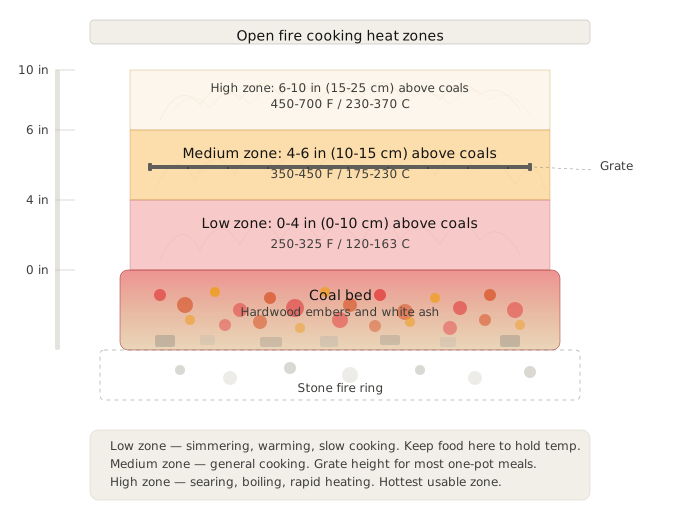
The height between your food and the coal surface controls cooking temperature. This is the primary tool for heat management over an open fire.
Hand test procedure
- Hold your open palm face-down, 4 inches (10 cm) above the coal surface.
- Count seconds until the heat becomes genuinely uncomfortable — the point where you must pull your hand away.
- Match your count to the zone table below.
- Adjust your cooking grate height or spread and consolidate coals before you start cooking. Repositioning food after cooking starts means uneven results.
| Zone | Height above coals | Temperature | Best for |
|---|---|---|---|
| High | 0–4 in (0–10 cm) | 550–700°F (290–370°C) | Searing, boiling water quickly |
| Medium | 4–6 in (10–15 cm) | 350–450°F (175–230°C) | Most proteins, vegetables |
| Low | 6–10 in (15–25 cm) | 250–325°F (120–160°C) | Slow cooking, keeping warm |
The hand test is a practical approximation. Wind, coal density, and altitude all affect actual temperatures. Always verify internal doneness with a thermometer — the hand test tells you the fire is cooking, not that the food is safe.
Direct coal cooking
Cooking directly in the coals works for dense, moisture-rich foods — root vegetables, corn, and wrapped proteins. The coal bed acts as an oven; foil protects food from ash contamination.
Foil pack procedure
-
Establish a clean coal bed with no active flames. Active flames burn through foil.
-
Prepare food for even cooking. Cut vegetables to roughly equal sizes. Cuts thicker than 1 inch (2.5 cm) need longer cook times or pre-scoring to allow heat penetration.
-
Double-wrap in heavy-duty aluminum foil. First layer: fold food in foil, crimp edges tight. Second layer: wrap again in the opposite direction so the seams are covered. Single-layer foil tears on coal edges and allows ash contamination.
-
Nestle packets at the coal edge, not buried in the center. The edge of the coal bed is slightly cooler and more forgiving. Burying packets deep in a hot coal bed chars the outside before the interior cooks through.
-
Flip packets at the halfway mark to equalize heat exposure on both sides.
-
Test doneness before unwrapping. Pierce the packet with a skewer — it should slide through dense vegetables without resistance. If it stops, close the packet and continue cooking.
Timing by food type
| Food | Total time | Flip at |
|---|---|---|
| Whole potato (medium) | 45–60 min | 25 min |
| Halved or quartered potato | 25–35 min | 15 min |
| Corn (husked, wrapped) | 20–30 min | 10 min |
| Fish fillet (1 in / 2.5 cm thick) | 12–15 min | No flip needed |
| Chicken thigh (boneless) | 30–40 min | 18 min |
| Whole onion | 30–40 min | 18 min |
Torn foil means ash in your food
A single tear in a foil pack dumps hot ash directly onto food. Ash is not merely unpleasant — it carries impurities from burned wood. There is no recovering a contaminated packet. Always double-wrap, inspect packets before placing, and replace any packet that develops a visible tear.
Dutch oven cooking
A camp dutch oven — flat-bottom cast iron with a lipped flat lid designed to hold coals on top — functions as a field oven. Coals on top provide top heat; coals underneath provide bottom heat. Temperature is controlled by coal count, not flame intensity.
Dutch oven sizes
| Diameter | Volume | Serves |
|---|---|---|
| 10 in (25 cm) | 4 qt (3.8 L) | 2–3 people |
| 12 in (30 cm) | 6 qt (5.7 L) | 4–6 people |
| 14 in (36 cm) | 8–10 qt (7.6–9.5 L) | 8–12 people |
The 12-inch (30 cm) is the standard for family-sized cooking and the basis for most published coal count formulas. A quality camp dutch oven is a moderate investment — the cast iron will last decades with basic maintenance.
Coal count procedure
This procedure assumes standard charcoal briquettes. Wood coals work but vary in size and heat output — start with the formula and adjust by feel on subsequent cooks.
-
Preheat the dutch oven. Place 6–8 coals in a ring under the empty oven for 10 minutes before adding food. Cold cast iron creates temperature gradients that cook food unevenly.
-
Count coals for 350°F (175°C) — the standard target for baking, stews, and casseroles:
- 10-inch oven: 6 coals bottom, 13 coals top (19 total)
- 12-inch oven: 8 coals bottom, 16 coals top (24 total)
- 14-inch oven: 10 coals bottom, 20 coals top (30 total)
The formula: oven diameter in inches × 2 = approximate total coals. Distribute roughly 1/3 under the oven, 2/3 on the lid.
-
Adjust for higher temperatures. Add 2 coals to the lid (top only) for each 25°F (14°C) increase above 350°F (175°C). Do not add coals to the bottom to raise temperature — it scorches the base of the food.
-
Rotate every 15 minutes. Rotate the oven body 90° clockwise and the lid 90° counterclockwise at each interval. This moves any hot spots through a full rotation over an hour, producing even heat distribution across the bottom and sides.
-
Replenish coals every 45–60 minutes for long cooks. Fresh coals take 10–15 minutes to come to full heat — add them in advance of when you think they are needed.
-
Resist opening the lid. Every lift drops the internal temperature by 25–50°F (14–28°C). It takes several minutes to recover. Check no more than once per 20 minutes during the first hour.
Cast iron retains heat far longer than it looks
A cast iron dutch oven and lid remain hot enough to cause severe burns for 15–20 minutes after removing all coals. Do not touch bare-handed. Use leather gloves, heavy welding gloves, or a folded cloth of at least 2–3 layers. A damp cloth is dangerous: moisture conducts heat rapidly and causes steam burns. Set the hot oven on a rock or log, never directly on dry grass or forest duff.
Spit and skewer roasting
Spit roasting positions food above the coal bed and rotates it for even heat exposure. It requires no cookware and works for everything from skewered vegetables to whole small animals.
Skewer and spit procedure
-
Cut a green hardwood branch. Green (living, freshly cut) wood resists burning because of its moisture content. Select a straight branch from a non-toxic hardwood species — avoid anything with a strong smell, milky sap, or brightly colored berries, which can indicate toxins in the wood. A skewer for small food should be roughly thumb-diameter (3/4 to 1 inch / 19–25 mm) and 18–24 inches (45–60 cm) long. A spit for whole animals needs 1–1.5 inch (25–38 mm) diameter to support weight without flexing. Dead dry wood catches fire and drops your food.
-
Sharpen one end to a point. Angle cuts from four directions to create a symmetrical tip. A blunt end crushes food and makes threading difficult.
-
Thread food leaving 2 inches (5 cm) clearance at each end. The clearance prevents food from sliding off under its own weight during rotation.
-
Position over the medium zone — 4–6 inches (10–15 cm) above coals. High heat chars the surface before the interior cooks through. Low heat lets fat drip slowly onto coals and can cause flare-ups.
-
Rotate every 2–3 minutes, one quarter-turn at a time. Irregular rotation produces one charred side and one undercooked side.
-
Support the spit if needed. Two forked stakes driven into the ground on opposite sides of the coal bed let you rest the spit horizontally without stopping the cooking.
Whole animal timing
At medium heat (350–450°F / 175–230°C), use these as starting estimates:
- Chicken (3–4 lb / 1.4–1.8 kg): 60–90 minutes
- Rabbit (2–3 lb / 0.9–1.4 kg): 45–60 minutes
- Small fish (under 1 lb / 450 g): 15–20 minutes per side
The rough ratio: 1 lb (450 g) ≈ 20–25 minutes at medium heat. This is an approximation. Always verify doneness with a thermometer.
Field note
Balance the spit before cooking. Rotate the loaded spit in your hands — if the heavy side always falls to the bottom, the food cooks one-sided regardless of how often you rotate it. Thread a counterbalance stick through the carcass or redistribute food before you start. An unbalanced spit is the most common reason spit-roasted whole animals arrive unevenly cooked.
Safe internal temperatures
Heat zone estimates and visual cues tell you the fire is cooking — they do not confirm the food is safe. These pathogens are destroyed by reaching the correct internal temperature, not by appearance, the color of juices, or estimated cook time:
| Food | °F | °C | Visual indicator (backup only) |
|---|---|---|---|
| Poultry (all) | 165 | 74 | Juices run clear; no pink at bone |
| Pork | 145 | 63 | Slight pink acceptable; 3-min rest |
| Ground meat | 160 | 71 | No pink throughout |
| Fish | 145 | 63 | Flesh flakes easily, fully opaque |
| Eggs | 160 | 71 | Yolk and white fully set |
Source: USDA Food Safety and Inspection Service.
Field note
An inexpensive instant-read probe thermometer is the most important piece of fire-cooking equipment after the fire itself. Visual cues are backup confirmation only. A food-borne illness without nearby medical access is a serious problem. Buy one before you need it.
Fire cooking failure modes
These are the most common failure modes in fire cooking, in order of frequency:
Cooking over active flames. Flames produce intense, uneven, direct heat that chars food externally while leaving the interior raw. Coals produce steady radiating heat that cooks from all sides. Wait for the coals.
Starting too early. A fire that looks ready after 20–30 minutes still has volatiles burning off. The coal bed is not ready until it shows uniform gray-orange glow with no visible flame above the surface.
Single-layer foil. Standard aluminum foil tears on coal edges. One tear means ash contamination that cannot be fixed. Double-wrap every packet, with seams on opposite sides.
Overcrowding the dutch oven. A dutch oven packed to the brim has poor heat circulation — food at the top is undercooked while the bottom scorches. Leave at least 1 inch (2.5 cm) of headspace.
Skipping dutch oven rotation. Even carefully placed coals create hot spots. Without the 15-minute rotation schedule, biscuits burn on one side and stew scorches at one edge.
Forgetting cast iron stays hot. Cast iron looks cool before it is cool. Burns from an unwrapped dutch oven handle or lid are a consistent field injury. Treat cast iron as hot until verified with a gloved touch.
Readiness checklist
- Fire built with dense hardwood; softwoods avoided
- 45–60 minutes allowed for coal bed formation before cooking starts
- Coal bed shows uniform orange-gray glow; no active flames visible
- Heat zone verified with hand test; grate height or coal spread adjusted
- Foil packs double-wrapped with seams on opposite sides
- Dutch oven preheated 10 minutes before adding food
- Coal count matched to oven diameter and target temperature
- Dutch oven rotation scheduled every 15 minutes
- Skewer cut from green hardwood (not dry wood; no toxic species)
- Instant-read thermometer available
- All proteins verified at USDA minimum temperatures before serving
- Cast iron handled with leather gloves or 2–3 layers of heavy cloth
For the tools that support open-fire cooking — dutch ovens, cast iron grates, and camp kitchen organization — see Gear. For getting that coal bed started reliably in rain or cold, the fire-starting page covers ignition methods with natural and improvised tinders across multiple techniques.