Blacksmithing
When a hinge cracks, a bracket shears, or a blade chips beyond salvage, most people reach for a parts catalog. In a long-term grid-down scenario, that catalog may not exist. Blacksmithing lets you fabricate brackets, hooks, hinges, knives, and repair tools from raw stock — replacing parts that can no longer be purchased. It is slower than ordering a replacement, and it requires practice, but it works when nothing else does.
Equipment
Forge types
The first decision is fuel: coal or propane.
A coal forge is a firepot connected to an air supply (hand-cranked or electric blower). The fire zone is open, which means you can heat stock of any length at any point along its length. Coal produces a focused, intense fire that reaches forge-welding temperatures — above 2,300°F (1,260°C) — more easily than propane. It is an affordable setup to build or buy.
The tradeoffs are real: coal fires require constant management, generate clinker (solidified ash waste that must be removed), produce smoke, and need a chimney or hood. Coal itself requires sourcing from a blacksmithing or heating supplier — not always straightforward in every region.
A propane forge is an insulated chamber with one or two burners. Turn the gas on, light it, and in 15 minutes you have a consistent working temperature. Propane forges are portable, clean-burning, and have a lower learning curve for beginners. A commercial propane forge is a moderate investment; a DIY build from a propane cylinder can be done for less.
The limitation: the chamber constrains stock length, and reaching forge-welding temperatures requires a well-tuned burner and good insulation. Propane also presents a fuel-supply dependency that coal avoids if you have local sourcing.
Which to start with: If you have outdoor or well-ventilated shop space, reasonable access to blacksmithing coal, and want full temperature range, start with coal. If you are working in a smaller space, want immediate heat-on-demand, or are primarily focused on knife and small tool work, propane is the more forgiving entry point.
Coal forge anatomy
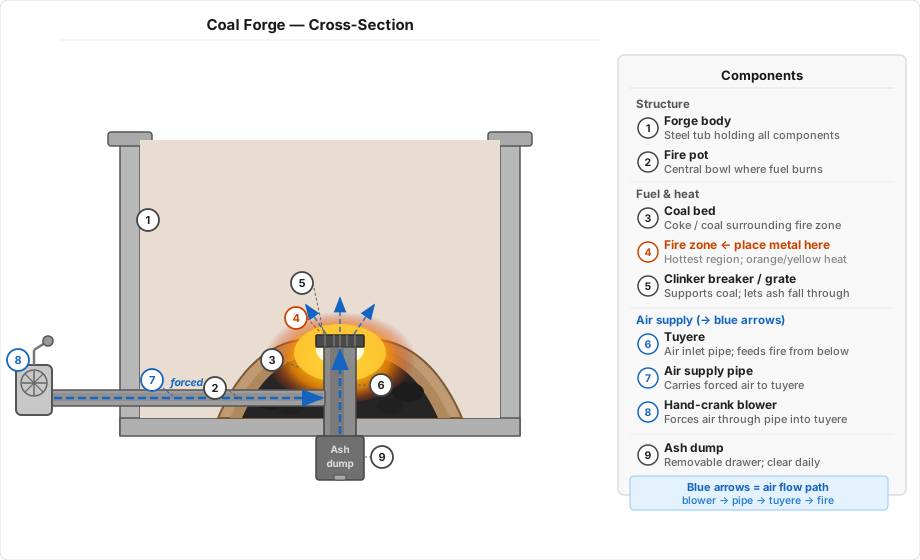
The fire pot is the bowl-shaped depression at the center of the forge table where the fire burns. Below it, the tuyere (pronounced "twee-air") is the air inlet pipe through which the blower forces air into the fire zone. A clinker breaker — a rotating grate or paddle — sits just above the ash dump and lets you break apart and drop clinker without disturbing the fire above. The ash dump collects ash and clinker for removal. The working metal is placed horizontally through the center of the fire, directly above the tuyere, surrounded by burning coke.
Anvil
An anvil of 100–150 lbs (45–68 kg) handles the full range of beginner through intermediate work. The face (flat top surface) is your primary work surface. The horn (tapered cone at the front) shapes curves and scrolls. The hardy hole (square socket, typically 1 inch / 25 mm) accepts hardy tools — a hardy cut, a bottom swage, a bick. The pritchel hole (round hole near the hardy) supports punching operations.
Set the anvil so the face is at knuckle height: stand beside it, let your arm hang straight with a relaxed fist, and the anvil face should meet your knuckles. For most adults this falls between 28–32 inches (71–81 cm). An anvil set too high forces awkward shoulder mechanics. Too low, and you bend your back and overextend your arm on every blow.
Mount the anvil on a hardwood stump or fabricated steel stand. The stand must be massive enough to absorb rebound — a light stand rings and wastes energy that should go into the work.
Hammer selection
A 2 to 3 lb (0.9–1.4 kg) cross-peen or straight-peen hammer handles nearly all beginner and intermediate forging. The peen (the wedge-shaped face opposite the flat face) is used to spread metal in one direction — useful for drawing out and for starting tapers. Do not start with a 4 lb (1.8 kg) hammer: the extra weight compounds technique errors and causes fatigue and injury before skill develops.
Tongs and support tools
You need at least two pairs of tongs matched to your stock size. V-bit bolt tongs grip square and round stock from 3/8 to 5/8 inch (10–16 mm). Wolf jaw tongs grip flat bar, rounds, and squares more universally. Tongs that don't fit the stock will drop hot metal — this is not a recoverable error.
A quench bucket — any metal container holding 3–5 gallons (11–19 liters) of water — belongs 2 steps from the anvil, always within reach.
Fire and heat
Building a coal fire from scratch
The first few times you start a coal forge, the sequence feels awkward. It becomes reliable once you understand what you are building: a bed of coke (coal that has already burned off its volatiles) surrounding the fire zone, with raw green coal banked on the edges waiting to convert.
-
Clean the fire pot. Remove all clinker and ash from the previous session. Even small clinker pieces disrupt airflow through the tuyere. If this is your first fire, inspect the tuyere for blockages.
-
Gather your coke. If you have leftover coke from a previous fire, keep it in a pile at the side of the forge table. Coke pieces should be roughly 1 inch (25 mm) or smaller. If starting fresh with no prior coke, use charcoal as your starter — it lights easily and converts quickly.
-
Make a paper ball. Crumple newspaper into a tight ball. Keep the loose ends folded inward so the ball holds its density and burns slowly.
-
Place the paper in the fire pot and light it. Hold the ball by the top, light the bottom in two or three places, and lower it into the center of the fire pot.
-
Give it just enough air. Turn on the blower at its lowest setting — you want barely a breath of air, just enough to keep the paper from going out. Too much air now blows the paper apart before the coke catches.
-
Cover immediately with coke. Quickly cover the burning paper with your coke, filling the fire pot. The goal is to trap the paper's heat energy inside the fuel pile. If the coke is not covering the paper within 30 seconds, you lose the ignition.
-
Watch for ignition. Peer down through the coke and look for pieces beginning to glow red on their own. This takes 2–5 minutes. Once you see coke glowing independently, increase the air slightly.
-
Bank green coal around the edges. Shovel raw coal onto the back and sides of the fire — not directly into the burning center. This green coal will slowly coke as the fire's heat drives off its volatiles. You are building the next generation of fuel while the current fire burns.
-
Build to working temperature. Gradually increase air and add more coke to the center as needed. A working coal fire at forging temperature glows bright orange-yellow in the center and burns with a clean blue flame. A fire with too much air goes white and burns the metal. A fire starved of air smokes heavily and stays too cool to work.
Reading clinker
Clinker is the glassy, slag-like residue that forms as coal burns. It looks reddish and almost molten at temperature, which makes beginners mistake it for live coke. The difference: press a poker against it — coke springs back with a faint crackle, clinker is dense and dead. Clinker sitting over the tuyere restricts airflow and drops your fire temperature. Break it with the clinker breaker and drop it to the ash dump every 30–45 minutes of continuous work, or whenever the fire begins to feel sluggish.
Reading heat color
The temperature of your steel is visible. Learn to read it — your forge thermometer is your eyes.
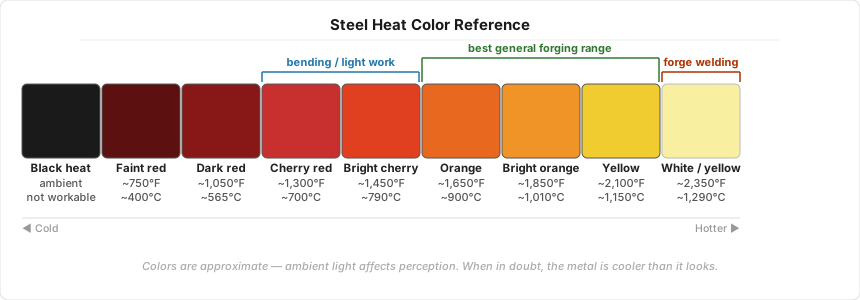
| Color | Temperature | What it means |
|---|---|---|
| Black heat | Below 900°F (480°C) | Not visible in daylight; steel is still very hard |
| Faint red | ~1,000°F (540°C) | Visible only in dim light; too cool to work most stock |
| Dark red | ~1,100–1,300°F (590–700°C) | Minimum for bending mild steel; high-carbon tool steel can be forged here |
| Cherry red | ~1,400–1,500°F (760–815°C) | Good for scrolling and bending; limited drawing out |
| Bright cherry | ~1,500–1,600°F (815–870°C) | Solid general forging range begins |
| Orange | ~1,650–1,800°F (900–980°C) | Primary forging range; metal moves well under the hammer |
| Bright orange | ~1,900–2,000°F (1,040–1,095°C) | Ideal for most drawing out and shaping |
| Yellow | ~2,100°F (1,150°C) | Near welding heat; mild steel has maximum malleability here |
| White-yellow | ~2,300°F+ (1,260°C+) | Forge welding temperature; scale flies, surface starts to look wet |
Rule for beginners: Work mild steel in the orange to bright orange range. If the steel has gone below bright cherry, put it back in the fire. Hammering cold steel work-hardens it and can crack it. The metal tells you when it is ready; do not rush that conversation.
Field note
A piece of steel going into the fire will pass through colors on the way up and on the way out. The trip out is what matters. Watch the piece in the forge: when it reaches bright orange, count to five, pull it, and strike. You have roughly 15–30 seconds before it drops to cherry — less on thin stock, more on heavy section.
Hammer technique
Stance and grip are not stylistic preferences — they determine how accurately your hammer lands and how long you can work without injuring yourself.
Stance. Stand at roughly 45 degrees to the anvil, dominant foot back, feet shoulder-width apart. You want to see your work clearly without twisting your neck. Never stand square to the anvil — you block your view of where the hammer is landing.
Grip. Hold the hammer near the end of the handle, not choked up toward the head. A choked grip reduces speed and control. Your grip should be firm but not white-knuckle tight: squeeze firmly at the moment of impact, then let the handle rotate slightly back as the hammer rebounds. This snap-and-rebound action concentrates force at the strike point and lets the hammer do the work rather than your shoulder.
Swing. Drive the hammer with your shoulder. Your elbow moves freely; your wrist follows. The hammer should never rise above ear level — above that, you are wasting energy and stressing the rotator cuff. A well-timed shoulder swing with a 2 lb (0.9 kg) hammer moves more metal than a wild overhead swing with a 4 lb (1.8 kg) hammer, and it will not leave you unable to forge the next day.
Where to strike. The anvil face is your canvas, not a static target. To move metal away from you, strike the near edge of the work against the anvil face. To move metal toward you, strike the far edge. To spread metal sideways, rotate 90 degrees and repeat.
Flat face blows flatten and spread. Peen blows draw out along the axis of the peen.
Never strike the anvil face directly
Striking the bare anvil face with a hammer is how hammer faces and anvil faces get chipped. Always have metal between hammer and anvil. This rule also applies to punches and chisels — always have stock under the tool.
Core operations
Drawing out
Drawing out lengthens and thins a piece of stock. It is the operation you use to taper a point, thin a blade profile, or extend a bar.
- Heat to bright orange — the piece needs to be as hot as you can work it for efficient drawing.
- Place the stock flat on the anvil face at a slight angle (about 30 degrees to the anvil's long axis).
- Strike with the flat face of the hammer, landing blows about 3/4 inch (19 mm) apart, progressing toward the end of the stock.
- After 6–8 blows, rotate the stock 90 degrees and repeat. Alternate between faces to keep the bar rectangular rather than drifting to a diamond cross-section.
- If you want a round taper instead of a square one, rotate 45 degrees after every two or three blows to knock down the corners.
- Reheat whenever the piece drops below bright cherry. Never continue hammering stock that has gone dull red.
Upsetting
Upsetting shortens and thickens a section — the reverse of drawing out. You use it to build up mass at the end or middle of a bar.
- Heat only the section you want to upset to bright orange. The rest of the bar should stay relatively cool; cool metal resists compression and keeps the mass where you want it.
- Stand the bar vertically on the anvil face, hot end up, and strike downward on the cool end. The hot section collapses on itself rather than buckling sideways.
- If the bar begins to bend rather than upset, straighten it with flat blows before continuing. Bent upsetting spreads metal unpredictably.
- For upsetting the middle of a bar rather than an end, use the hardy cut to mark a shoulder on each side of the section first, then heat only between the shoulders.
Bending
- Heat the section to be bent to bright cherry or higher.
- For a sharp angle bend, place the stock over the edge of the anvil at the exact bend point and strike down on the unsupported side. The anvil edge acts as the bend die.
- For a curve, use the horn. Place the hot metal over the horn and strike downward while moving the stock toward or away from you to control the arc radius.
- To close a curve tighter, move the work toward the tip of the horn. To open it, move toward the base.
- Check the angle or radius immediately after each heat — the geometry changes with every blow, and it is easier to correct at working temperature than to reheat and redo.
Punching
Punching drives a hole through hot metal without cutting or drilling. Essential for eyes, slots, and any through-hole in forged work.
- Heat the section to be punched to bright orange — you need maximum plasticity.
- Place a punch centered over your mark and strike firmly with one decisive blow, driving it about halfway through the stock.
- Flip the work. A visible bulge will show exactly where the punch tip sits beneath the surface.
- Position the work over the pritchel hole in the anvil. Strike the punch from the original side. The slug drops through the pritchel hole when the punch breaks through.
- Reheat and use a drift — a tapered round or oval tool — to size and clean the hole. The punch only makes a rough opening; the drift shapes it.
Quenching and tempering
What quenching does
Rapid cooling hardens high-carbon steel by trapping its crystal structure in a hard but brittle state called martensite. Mild steel (low carbon content) does not harden significantly by quenching — it only normalizes. If you are working mild steel for hooks, brackets, and structural shapes, you typically do not harden. For tool steel — blades, chisels, punches — hardening and then tempering creates the balance of hardness and toughness the tool needs.
Normalizing is different from hardening: heat the steel to non-magnetic (roughly 1,425°F / 775°C), then let it cool in still air. This relieves internal stress built up during forging and gives you a consistent, predictable crystal structure before you harden.
Hardening procedure
-
Normalize first. Heat the piece to bright orange, then set it on a firebrick and let it cool in still air. Do this twice. This removes stress from forging and gives you a consistent starting structure.
-
Prepare your quench medium. Fill your quench container deep enough to submerge the entire piece in one motion — at least 8 inches (20 cm) of fluid. If using oil, warm it to roughly 120°F (49°C) by heating a piece of scrap metal in the forge and dropping it in the oil. Warm oil quenches more evenly than cold.
-
Attach a small magnet to a wire. This is your temperature gauge for hardening. Clip or tie a small magnet near the forge so you can touch the piece to it while heating. Steel loses its magnetism at the critical hardening temperature — called the Curie point, roughly 1,425°F (775°C) for most carbon steels. When the magnet no longer attracts the steel, you are at or above critical temperature.
-
Heat slowly and evenly to non-magnetic. Bring the piece up through orange, watching it and checking the magnet every 20–30 seconds as you approach temperature. The goal is an even, consistent orange along the entire piece — no hot spots, no cool ends. Uneven temperature causes uneven hardness and warping.
-
Quench immediately. Pull the piece from the fire the moment it passes non-magnetic and plunge it into the quench medium in one decisive motion. For a blade, enter edge-down at a slight angle (about 15 degrees off vertical) — this reduces warping by cooling the thicker spine and thinner edge more evenly. Move the piece slowly back and forth in the fluid to break up the vapor barrier that forms on the surface and slows cooling.
-
Test hardness. Once cooled, draw a file across the surface. A properly hardened piece will feel glassy — the file skates across without biting. If the file cuts, the steel did not harden; repeat from step 4 with a longer soak at temperature.
-
Temper immediately. Hardened steel is brittle enough to shatter. Do not leave a hardened piece overnight before tempering.
Water vs. oil
Water quenches faster than oil and produces maximum hardness in high-carbon steel. The speed is also a risk: rapid, uneven cooling creates thermal shock that cracks brittle or thick cross-sections. Water is appropriate for simple low-alloy steels like 1084 used in beginner blades.
Oil — mineral oil, canola, or commercial quench oil — cools more slowly and evenly, reducing the risk of cracking. Most knife and tool steels quench better in oil. Keep the oil in a deep metal container with a lid (oil fires are a real possibility — a lid smothers them). Warm oil around 120°F (49°C) quenches more predictably than cold oil.
Tempering color sequence
After hardening, steel is at maximum hardness and maximum brittleness. Tempering reduces brittleness by reheating to a lower temperature and allowing some martensite to convert to tougher phases. The color sequence on a polished steel surface tells you the temperature:
| Color | Approximate temperature | Suitable for |
|---|---|---|
| Pale straw | 400–440°F (205–227°C) | Scrapers, lathe tools, razors |
| Dark straw | 440–480°F (227–249°C) | Drill bits, milling cutters |
| Bronze / brown | 480–520°F (249–271°C) | Chisels, plane irons, punches |
| Purple | 520–560°F (271–293°C) | Swords, springs, large knives |
| Dark blue | 560–600°F (293–316°C) | Screwdrivers, springs, structural parts |
For a working blade or chisel, target bronze. For a spring, target purple to dark blue. When the color reaches your target, quench immediately in water to freeze it there.
Your first project: the S-hook
An S-hook is the standard first forge project because it requires exactly three skills — tapering (a form of drawing out), bending, and heat management — and produces something immediately useful. It takes about 20–30 minutes of work time once you can light a fire reliably.
Stock: One piece of 1/4-inch (6 mm) round or square mild steel rod, approximately 8–10 inches (20–25 cm) long. 3/8-inch (10 mm) stock makes a heavier-duty hook.
Step 1 — Taper both ends. Heat one end to bright orange. Using drawing out technique, taper the last 2 inches (50 mm) to a gradual point over three heats. Rotate the stock after each sequence of blows to keep the taper symmetrical. Repeat on the other end. You are making two matching tapers — these become the tips of the S.
Step 2 — Form the first curl. Heat the tapered end to bright orange. Position the tip at the edge of the horn, roughly 2 inches (50 mm) from the tip. Strike downward to begin curling the tip around the horn. Reposition slightly and continue, rotating the work around the horn with each blow.
You are forming a hook approximately 3/4 inch (19 mm) in diameter. The taper should follow the inside of the curve smoothly.
Step 3 — Check your hook. Before the piece goes cold, confirm the curl is tight and even. A poorly formed first curl will make the second curl harder to align. Correct any flat spots while still in the orange-red range.
Step 4 — Form the second curl. Heat the opposite tapered end to bright orange. Repeat the curling process, but orient this curl in the opposite direction from the first. This is what creates the S shape. Keep the center of the bar straight while you form the second hook.
Step 5 — Adjust and align. Heat the entire piece to cherry red. Hold one hook against the anvil face and use light hammer blows to fine-tune the alignment. Both hooks should lie in the same plane and open in opposite directions.
Step 6 — Optional twist. Heat the center section of the bar to bright orange. Grip one end with tongs, the other with a wrench or vice grip, and rotate a half-turn (180 degrees) to add a decorative twist. This also slightly work-hardens the middle section.
Step 7 — Cool and inspect. Set the hook on the fire bricks to air-cool. Do not quench mild steel S-hooks — rapid cooling adds nothing and may cause surface cracking at thin tapers. Inspect the finished hook: both curls should be smooth arcs, the tapers should flow into the curves without a shoulder, and the piece should feel solid with no sponginess at the tips.
Safety
Blacksmithing is a discipline where the hazards are all present simultaneously: fire, molten scale, sharp edges, heavy objects, and combustion gases. None of these require drama — they require habits.
Coal forge carbon monoxide risk
Coal and coke fires produce carbon monoxide (CO) — a colorless, odorless gas that incapacitates before you recognize you are affected. Work in a space with active ventilation: either outdoors, or in a shop with an industrial hood and chimney that creates a strong draw. Install a CO detector at breathing height near the work area. Propane forges also produce CO under conditions of incomplete combustion. A CO detector is not optional.
Eye protection. Wear ANSI Z87.1-rated safety glasses at minimum whenever forging. Flying scale — the thin iron oxide crust that spalls off hot steel with every hammer blow — moves fast and goes everywhere. Add a face shield during grinding and cutting operations. Shade 3–5 welding glasses or a flip-up shade lens help when looking directly into a bright forge.
Clothing. Wear natural fiber clothing — cotton, wool, or leather. Synthetic fabrics (polyester, nylon) melt onto skin when hit by sparks. A leather apron protects your torso and thighs from sparks and accidental contact with hot stock.
Gloves — the controversy. Experienced smiths frequently work without gloves because gloves reduce grip sensitivity and can catch on tong handles. The tradeoff is real: bare hands get burned by radiant heat on long heats and by accidental contact. If you are new, leather welding gloves on the non-tong hand are a reasonable compromise while you develop spatial awareness. Never wear synthetic or rubber gloves near a forge.
Fire extinguisher. Keep a Class ABC dry chemical extinguisher within 10 feet (3 m) of the forge, mounted where you can reach it without reaching over the fire. Check it annually.
Propane handling. Before lighting a propane forge, check the hose and fittings with soapy water for leaks. Never light the forge inside an enclosed space without checking for propane accumulation first. If you smell gas, stop — ventilate before proceeding.
Startup checklist
- Forge and work area established with at least 6 feet (1.8 m) of clear space on all sides
- Anvil set at knuckle height and stable with no rocking
- CO detector installed at breathing height; battery tested
- Fire extinguisher (Class ABC) within 10 feet (3 m), charged
- Quench bucket filled with 3–5 gallons (11–19 liters) of water, 2 steps from anvil
- Two pairs of tongs sized to your stock on hand
- Safety glasses and leather apron on before fire is lit
- Natural fiber clothing only — no synthetic fabrics
- Coal forge: chimney draw confirmed before lighting; green coal and coke stock on hand
- Propane forge: hose and fittings checked for leaks; ventilation confirmed
- First project stock measured and cut before heating the forge
Blacksmithing connects directly to the broader skills foundation: the steel hooks, brackets, and edge tools you make here depend on your ability to sharpen them once they leave the anvil. The two skills reinforce each other — you cannot maintain what you cannot make, and there is little point making tools you cannot keep sharp.