Food
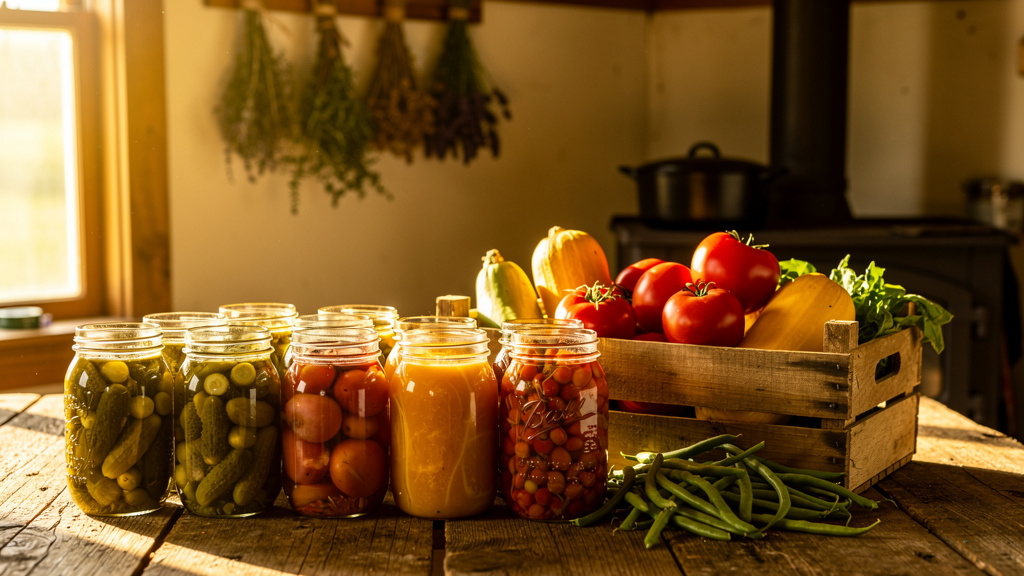
Grocery stores operate on a 3-day resupply cycle. When that cycle breaks — trucking disruptions, panic buying, regional disasters — shelves empty faster than most people believe possible. The 2020 supply chain shocks proved this wasn't theoretical. Stores that were fully stocked on Monday had bare shelves by Wednesday.
Food preparedness works in three layers: pantry stock you eat and rotate daily, long-term storage that lasts years without refrigeration, and production capability that makes you independent of supply chains entirely. Each layer buys time for the next. A stocked pantry handles a 2-week disruption. Long-term storage extends that to months. Growing, preserving, and harvesting your own food removes the ceiling.
Pantry stock (days to weeks)
The simplest starting point is buying extra of what you already eat. Two cans instead of one. An extra bag of rice. A spare bottle of cooking oil. Over a few weeks of normal shopping, you build a 2-week surplus without changing your diet or your budget by more than 10-15%.
Store what you eat and eat what you store. The most common beginner mistake is buying 50 pounds (23 kg) of hard red wheat with no idea how to cook it. White rice, dried beans, pasta, canned vegetables, peanut butter, oats, salt, sugar, and cooking oil form a practical baseline that your household will actually consume. A well-organized pantry uses FIFO rotation and category grouping to prevent waste and forgotten inventory.
For meal ideas built entirely from shelf-stable ingredients, pantry meals provides tested recipes that require no refrigeration. Comfort classics covers the morale-boosting dishes — breads, stews, and desserts — that sustain willpower as much as calories.
Field note
Run a "pantry weekend" — turn off the grocery store for 48 hours and feed your household from stored food only. You'll immediately discover what's missing. Most people find they have plenty of carbs but almost no fats, spices, or comfort items like coffee.
Long-term storage (months to years)
When properly packaged, white rice, dried beans, rolled oats, hard wheat, sugar, salt, and powdered milk last 10-30 years. The method matters: mylar bags with oxygen absorbers inside 5-gallon (19-liter) food-grade buckets is the standard. A month's calories for one adult (roughly 60,000 kcal) is inexpensive in bulk staples.
Freeze-dried food offers variety and convenience at a higher price point — a significant investment per month of supply depending on the brand. It's lightweight, requires only hot water, and has a 25-year shelf life. It supplements bulk staples well but replacing your entire supply with freeze-dried gets expensive fast.
Track what you have with an inventory system. At minimum, label every container with contents, weight, calorie count, and packaging date. A simple spreadsheet beats memory once you're past 30 containers.
Production (independence)
Gardening is the transition from consumer to producer. A 200 square foot (19 square meter) raised bed garden produces meaningful vegetable volume for a household — not full caloric independence, but a significant supplement that also builds critical skills. In an apartment, container gardening on a balcony or windowsill grows herbs, greens, peppers, and tomatoes year-round.
Seed saving from open-pollinated and heirloom varieties closes the loop — you're no longer dependent on buying seeds each season. Soil building through composting turns kitchen waste into the fertility that feeds next year's garden. A greenhouse extends your growing season by 2–4 months in most climates, enabling year-round production of greens and cold-hardy crops.
Preservation converts seasonal abundance into year-round supply. Canning (water bath for high-acid foods, pressure canning for everything else), dehydrating, smoking, fermenting, and salting each have strengths. See Water Bath vs Pressure Canning if you're deciding where to start. Root cellaring works for produce that needs no processing at all — just cool, humid, dark storage.
Nutrition planning prevents the most common long-term mistake: building calorie reserves with major micronutrient gaps. Sprouting, foraging, and vitamin supplementation fill the gaps that bulk staples leave.
Cooking without power is a prerequisite for using your stored food when the grid fails. Rocket stoves, Dutch ovens, and solar ovens each serve different scenarios. Outdoor cooking covers open-fire, camp stove, and Dutch oven techniques for when indoor cooking isn't available. The recipe hub organizes grid-down cooking by method and ingredient type.
At scale, small livestock — chickens for eggs, rabbits for meat, goats for milk — provides animal protein on minimal land. Foraging and fishing supplement from wild sources. Hunting and trapping are viable where regulations and environment permit. Permaculture design integrates all of these into a self-reinforcing system that requires less input each year.
Caloric math is unforgiving
An active adult needs 2,000-2,500 kcal per day. A family of four needs 8,000-10,000 kcal daily. A single 50-pound (23 kg) bag of rice contains roughly 82,000 kcal — about 8-10 days for that family. Do the math before you assume your supply is sufficient.
Where to start
- Buy 2 extra of every shelf-stable item during your next 4 grocery trips — this builds a 2-week surplus inexpensively
- Purchase 25 pounds (11 kg) of white rice and 25 pounds (11 kg) of dried pinto beans — store in food-grade buckets with oxygen absorbers
- Run a "pantry weekend" — eat only from stored food for 48 hours and note every gap
- Start one container garden this week: a 5-gallon (19-liter) bucket with drainage holes, potting soil, and a tomato or pepper plant
- Learn one preservation method: water bath canning is the easiest entry point (starter kit is affordable)
With your pantry stocked and a garden started, the next priority is understanding long-term storage methods that keep bulk staples safe for a decade or more.