Community
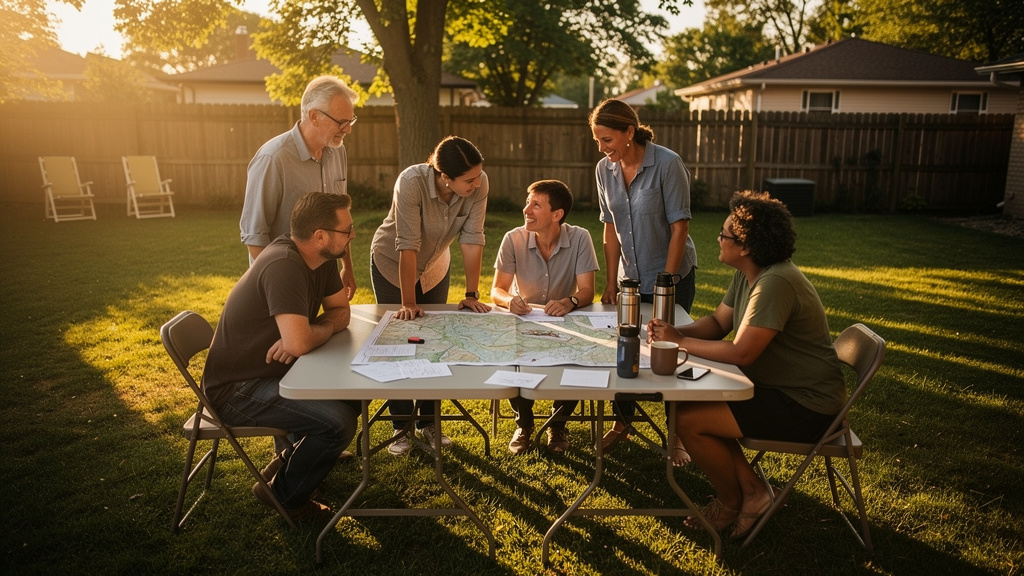
Every disaster after-action report reaches the same conclusion: the people who had relationships with their neighbors before the event fared dramatically better than those who didn't. You cannot stand watch 24 hours a day. You cannot grow every crop, fix every engine, and treat every wound. A single household hits a hard ceiling on capability no matter how well-stocked it is.
Community preparedness has three parts: people (who you trust and what they can do), communication (how you reach them when phones are down), and organization (how the group makes decisions and shares resources under pressure).
People
Start with the ten households closest to yours. You don't need to recruit a prepper group — you need to know your neighbors. Who has medical training? Who has a generator?
Who has small children or elderly family members who'll need help? A simple skills inventory answers these questions and reveals gaps before they become emergencies.
Mutual aid circles formalize this. A group of 3-8 households that agree to share specific resources and check on each other during disruptions. No dues, no hierarchy, no uniforms — just a standing agreement that when something goes wrong, you don't wait for outside help. A skills inventory maps who knows what so the group can identify blind spots and cross-train. If your circle includes families, the children and education page covers how to keep learning and structure continuous during extended disruptions — keeping children engaged also keeps group morale stable.
Field note
The best time to meet your neighbors is before you need them. Bring over food during a holiday. Help shovel a driveway. These small gestures build the trust that mutual aid runs on — you can't manufacture it during a crisis.
Communication
Cell towers fail under load within minutes of a regional event. Landlines depend on the same power grid. Your communication plan needs at least one method that works without infrastructure.
| Method | Range | License needed | Cost |
|---|---|---|---|
| Family Radio Service (FRS)/GMRS handheld radios | 1-5 miles (1.6-8 km) | General Mobile Radio Service (GMRS): yes ($35 USD, 10-year) | Inexpensive per pair |
| CB radio | 5-15 miles (8-24 km) | No | Affordable |
| HAM radio (VHF/UHF) | 5-50+ miles (8-80+ km) | Yes (Technician exam, free) | Inexpensive to affordable |
| Mesh network (Meshtastic/LoRa) | 1-10+ miles (1.6-16+ km) | No | Inexpensive per node |
| Satellite communicator | Worldwide | No (subscription required) | Moderate investment + subscription |
A comms plan ties this together: agreed-upon frequencies, check-in times, code words, and a fallback schedule if the primary method fails. Write it on a laminated card that lives in every household member's kit. For GMRS specifically, the GMRS page covers repeater networks that extend range across entire neighborhoods. Signals covers low-tech alerting options — flags, mirrors, chalk marks — that work when batteries are dead, and weather monitoring helps the group time movement and decisions around incoming conditions.
Don't rely on a single communication method
Every method in the table above has failure modes. Radios need charged batteries. Mesh nodes need line of sight. Satellites need a clear sky and a subscription. Plan for at least two independent methods.
Organization
Groups without agreed-upon roles and decision-making processes fall apart under stress. Establish leadership structure before it's needed — who coordinates, who makes medical decisions, who handles logistics. Consensus works for planning. During an active emergency, one designated coordinator makes calls and the group follows.
Bartering becomes relevant when disruptions extend beyond a few weeks. The items that hold the most trade value are consumables people run out of first: coffee, batteries, lighters, over-the-counter medications, hygiene supplies, and ammunition. A barter items stockpile doesn't need to be large — an inexpensive investment in trade goods gives you significant leverage. Local economy strategies — community-supported agriculture, credit unions, local purchasing — build the same resilience networks during normal times that barter relies on during disruptions.
When group stress builds over time, the conflict resolution protocols your group establishes beforehand are what keep a useful alliance from fracturing over a disagreement about watch schedules. Community news practices help the group assess information quality and resist the rumor spread that accelerates panic during regional events.
Where to start
- Introduce yourself to your 5 nearest neighbors by name — learn one useful fact about each household
- Buy a pair of FRS/GMRS handheld radios and test them at realistic distances in your neighborhood
- Write a one-page household communication plan: rally point, backup contact, check-in frequency
- Identify 3-5 trusted people and propose a mutual aid agreement over coffee
- Create a simple skills inventory for your circle: medical, mechanical, gardening, armed, communications
Building community is the single highest-leverage preparedness action most people skip. With a trusted network and working comms, every other Foundation — from security to medical — becomes dramatically more effective.