Skills
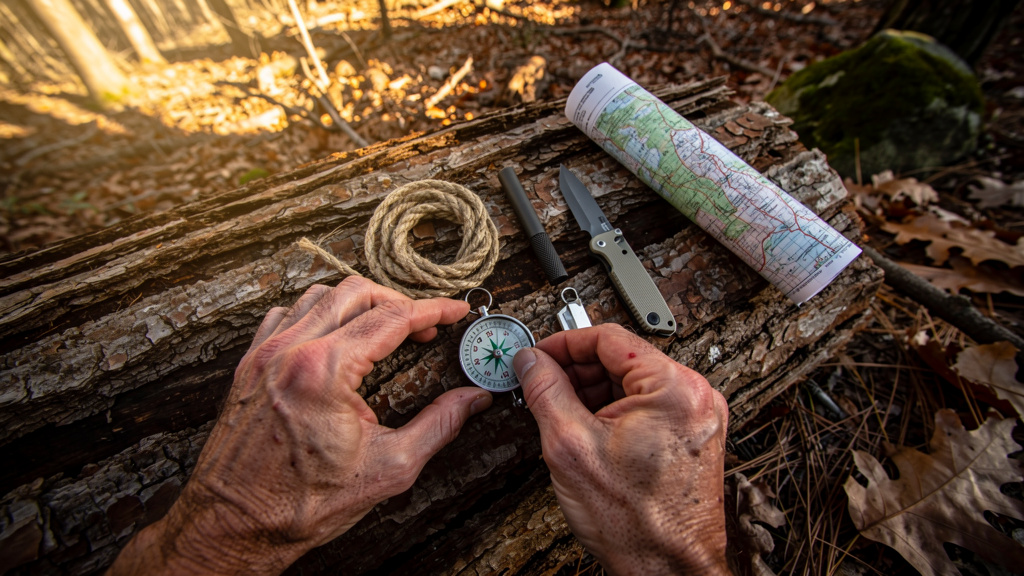
A $300 knife is a prying tool in the hands of someone who can't sharpen it. A ferro rod is a paperweight if you've never struck one in the rain. Gear extends capability, but skill is capability. The distinction matters most exactly when it's hardest to buy replacements — during prolonged disruptions where supply chains are broken and what you know becomes more valuable than what you own.
The skills that matter for self-reliance fall into three categories: field skills (fire, navigation, rope work), craft skills (carpentry, metalwork, sewing), and maintenance skills (sharpening, engine repair, welding). Each category has a few foundational abilities that unlock everything else in that domain.
Field skills
Fire starting with at least three methods — lighter, ferrocerium rod, and one friction or magnification method — is the baseline. More important than starting fire is managing it: building the right fire type for the situation (a Dakota hole for concealment, a long fire for warmth along your body, a keyhole fire for simultaneous cooking and heating) and cooking over open flame without burning food or wasting fuel.
Map and compass navigation works when GPS doesn't. Triangulating your position from two landmarks, following a bearing through dense forest, and accounting for magnetic declination are skills that take an afternoon to learn and a few practice sessions to make reliable. GPS devices extend that capability — knowing how to use waypoints, tracks, and offline maps makes navigation faster and more precise when batteries and signal hold. Natural navigation — reading the sun, stars, prevailing wind, and vegetation patterns — supplements instruments when you have nothing else. Weather reading ties into navigation: understanding cloud formations, pressure changes, and wind shifts lets you anticipate conditions rather than react to them.
Knots are the interface between you and every rope, cord, or line you'll ever use. Five knots handle 90% of real-world situations: the bowline (creates a fixed loop that won't slip under load), the trucker's hitch (mechanical advantage for tensioning), the clove hitch (quick attachment to posts or stakes), the taut-line hitch (adjustable tension for tent lines), and the square knot (joining two ropes of equal diameter). Lashing extends this into structural territory — binding poles together to build shelters, rafts, and elevated platforms. Cordage making closes the loop: if you run out of rope, plant fibers, bark strips, and animal sinew can be twisted into functional line using techniques that predate manufactured cord.
Tracking and swimming round out field competency. Tracking — reading ground sign, gaits, and disturbance patterns — has direct applications for hunting, security, and search and rescue. Swimming is a safety baseline: open-water crossings, flash flooding, and vessel failures are scenarios where the skill is either there or it isn't.
Field note
Learn knots with your eyes closed. In a real situation you'll be tying them in the dark, in the cold, with wet hands, under stress. If you can tie a bowline behind your back by feel, you can tie it anywhere.
Craft skills
Carpentry with hand tools — a saw, a hammer, a chisel, and a square — lets you build and repair structures without electricity. Understanding basic joinery (butt, lap, mortise-and-tenon) and framing principles turns lumber into shelves, doors, raised beds, and animal pens. Most residential repairs after storms involve carpentry: patching holes, replacing broken framing, building temporary barriers.
Sewing by hand repairs torn clothing, patched tarps, damaged packs, and canvas covers. A basic sewing kit — needles, heavy thread, a thimble, and a few patches — weighs almost nothing and prevents small tears from becoming useless gear. Leather stitching extends this to belts, sheaths, straps, and footwear repair. Fiber arts — spinning, weaving, and felting — take that further: processing raw wool, plant fiber, or animal hair into usable yarn and fabric without manufactured inputs.
Blacksmithing is the ability to shape metal with heat and force. A basic coal or propane forge — affordable to moderate investment to build — an anvil or anvil substitute, and a hammer let you make hooks, brackets, hinges, blades, and repair broken metal tools. It's a deeper investment than most skills here, but in a prolonged grid-down scenario, the person who can forge and repair metal tools holds enormous value.
Pottery — hand-built and pit-fired — creates functional vessels for cooking, storage, and water treatment without any manufactured inputs. It's one of the oldest human technologies and one of the most undervalued in modern preparedness thinking.
Maintenance skills
The ability to keep existing tools and machines running is often more valuable than building new ones. Knife selection and use is the entry point — choosing a blade geometry and steel for the tasks you actually face, and learning to control a knife safely under field conditions. Sharpening with a whetstone maintains every edged tool you own — knives, axes, chisels, hoes, mower blades. A dull tool is slower, more dangerous, and more tiring than a sharp one. Learning proper angles and technique takes 30 minutes; maintaining the habit saves significant replacement cost over time.
Small engine repair keeps generators, chainsaws, tillers, and water pumps operational. Most small engine failures come down to fuel system issues (carburetor cleaning, fuel line replacement), ignition problems (spark plug replacement), and air filter maintenance. An inexpensive spark plug kit and a basic understanding of how a 4-stroke engine works covers the majority of field repairs.
Welding — even basic stick welding — joins and repairs metal structures, vehicles, gates, equipment, and tools. A stick welder is a moderate investment and runs on standard household power, handling mild steel up to 1/4 inch (6 mm). It's the most versatile repair skill for anyone with metal infrastructure.
Practice with real conditions, not ideal ones
Starting a fire in your backyard on a dry afternoon teaches you the mechanics. Starting a fire in the rain with soaked wood after hiking 5 miles (8 km) teaches you the skill. Every skill on this page has a gap between knowing the steps and performing them under field conditions. Close that gap before you need to.
Where to start
- Start a fire using a ferrocerium rod and natural tinder — practice until you can do it reliably in 3 attempts
- Tie the 5 essential knots (bowline, trucker's hitch, clove hitch, taut-line, square knot) until you can do each in under 30 seconds by feel
- Navigate a 2-mile (3.2 km) route using only a map and compass — no phone
- Sew a patch onto a piece of clothing or gear by hand using a needle and heavy thread
- Sharpen a kitchen knife on a whetstone to shaving-sharp — practice the angle and pressure until it's consistent
Skills compound. The person who can start a fire, tie a trucker's hitch, navigate by compass, and sharpen a blade has a foundation that makes every other Foundation — from shelter to food to tools — dramatically more effective.