Herbal preparation methods
Herbal preparation methods determine whether a plant's active compounds reach the body at a useful concentration — or not at all. The same herb prepared as a weak tea, a concentrated tincture, or an infused oil serves completely different purposes. Getting the ratios right is the difference between a preparation that works and one that spoils on the shelf.
Educational use only
This page provides general educational information for emergency preparedness scenarios when professional medical care is unavailable. It is not a substitute for professional medical advice, diagnosis, or treatment. Always seek the advice of a qualified healthcare provider. Use this information at your own risk.
Equipment you need before starting
You do not need a professional apothecary setup, but you do need clean, dedicated equipment. Cross-contamination and improper storage are the two most common sources of failure.
- Glass jars with tight lids — wide-mouth mason jars in pint (475 mL) and quart (950 mL) sizes
- Dark glass bottles — 1–4 oz (30–120 mL) amber dropper bottles for finished tinctures
- Double boiler — a heatproof bowl set over a saucepan of simmering water; never heat oils directly over flame
- Cheesecloth or muslin — for straining; a fine-mesh stainless steel strainer removes larger material first
- Kitchen scale — weight-based ratios are more accurate than volume for herb quantities
- Labels and permanent marker — this is non-negotiable; unlabeled preparations are unsafe
- Candy thermometer or instant-read thermometer — for oil infusions
- Small metal tins or glass jars — for finished salves
Labeling discipline: Every preparation you make must be labeled immediately — before it goes on the shelf. Label includes: herb name and plant part used, preparation type, alcohol percentage or carrier oil type, date made, batch size, and any intended use. An unlabeled jar of brown liquid is useless and potentially dangerous.
Standard infusion (tea)
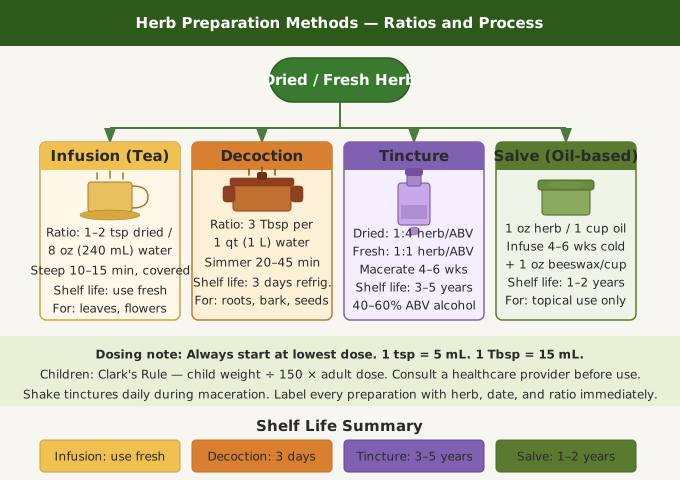
A standard infusion extracts volatile oils, flavonoids, and water-soluble compounds from leaves and flowers. It is the gentlest and fastest preparation method. Because it has no preservatives, brew it fresh at each use.
Best for: chamomile (Matricaria chamomilla), peppermint (Mentha piperita), lemon balm (Melissa officinalis), thyme (Thymus vulgaris), yarrow (Achillea millefolium)
Ratio: 1–2 tsp dried herb (or 2–3 tsp fresh herb) per 8 oz (240 mL) water
- Bring water to a full boil, then remove from heat.
- Place measured herb in a cup or heatproof vessel.
- Pour the boiling water over the herb — do not add herb to still-boiling water on the stove.
- Cover immediately with a lid or small plate. Volatile oils — the compounds responsible for thyme's antimicrobial properties and peppermint's menthol — evaporate into steam. Covering the cup captures them.
- Steep for 10–15 minutes for leaves and flowers. Steep for 20–30 minutes for tougher material like dried roots cut into smaller pieces.
- Strain and drink while warm. Do not leave infusions sitting at room temperature for more than a few hours — they have no shelf life.
Field note
If you are working with a large batch — say, a quart (950 mL) — use a mason jar with a lid as the steeping vessel. The sealed jar holds heat longer and prevents oil loss better than an open pot.
Decoction (roots, bark, seeds)
A decoction extracts compounds from dense plant material that requires sustained heat to release. Roots, bark, and hard seeds will not give up their active compounds in a 10-minute steep.
Best for: valerian root (Valeriana officinalis), echinacea root (Echinacea purpurea), black cohosh root (Actaea racemosa), hawthorn berries, rosehips, ginger root
Ratio: 3 tbsp (approximately 1 oz / 28 g) dried material per 1 quart (1 L) water
- Place measured herb in a small saucepan and cover with cold water — starting cold allows the material to hydrate and soften before heat extraction begins.
- Bring slowly to a gentle simmer. Do not allow a rolling boil. High heat degrades some compounds and drives off volatile constituents.
- Maintain the simmer, partially covered, for 20–45 minutes. Denser material (dense roots, hard bark) needs the longer end of this range. Check periodically and add small amounts of water if needed to prevent scorching.
- The finished decoction should be reduced by approximately one-third from the starting volume.
- Strain while hot — material strains more easily when warm. Press firmly with the back of a spoon or squeeze through cheesecloth to extract the liquid held in the spent herb.
- Allow to cool before using or storing.
Shelf life: Refrigerate and use within 3 days. Unlike tinctures, decoctions have no preservative and will ferment.
Alcohol tincture
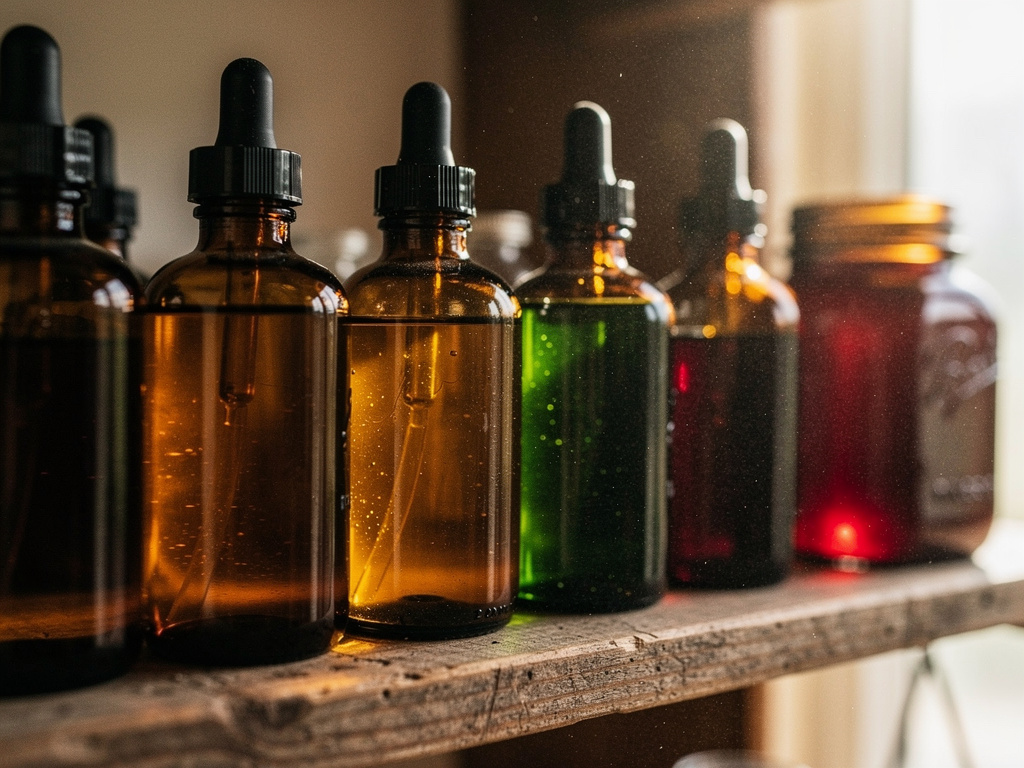
A tincture is an alcohol extraction with significantly greater concentration and shelf life than a tea or decoction. Alcohol dissolves both water-soluble and fat-soluble compounds, making it more complete as an extraction menstruum. A well-made tincture stored in dark glass at room temperature lasts 3–5 years.
Best for: echinacea (Echinacea spp.), valerian root (Valeriana officinalis), St. John's Wort (Hypericum perforatum, fresh flowers), elderberry (fresh berries), and most medicinal roots
Alcohol content and household restrictions
Tinctures are 40–60% alcohol by volume. They are not appropriate for children, people in recovery, or anyone with a medical or religious objection to alcohol. For those individuals, glycerites (glycerin-based extractions) are an alternative, though with shorter shelf life and narrower compound solubility.
Ratios
Ratios for tinctures are expressed as herb weight : menstruum volume (weight-to-volume method):
- Dried herb: 1:4 ratio — 1 part herb by weight to 4 parts menstruum by volume. Example: 1 oz (28 g) dried herb to 4 fl oz (120 mL) alcohol.
- Fresh herb: 1:1 ratio — 1 part fresh herb by weight to 1 part menstruum by volume. Fresh herb contains significant water content; the higher menstruum ratio compensates for this.
Alcohol percentage by herb type
- 40–50% ABV (80–100 proof vodka): suitable for most dried leaves, flowers, and roots
- 60% ABV (120 proof): better for roots and harder material that benefits from stronger extraction
- 95% ABV (Everclear): required for resins, gums, and oleoresins (e.g., propolis, myrrh). Dilute with distilled water if needed to reach target percentage.
Procedure
- Weigh your dried or fresh herb on a kitchen scale. Finely chop or grind dried roots and bark to increase surface area.
- Calculate the menstruum volume from the ratio above.
- Place measured herb in a clean glass jar.
- Pour measured alcohol over the herb, ensuring all material is submerged with at least 1 inch (2.5 cm) of alcohol above the plant material.
- Seal the jar tightly. Label immediately: herb name, alcohol percentage, ratio, date, batch weight.
- Store in a cool, dark location — a cupboard or pantry, away from heat and light. Heat degrades tinctures and accelerates alcohol evaporation.
- Shake daily if possible. If you miss days, it is not critical — the extraction will still proceed.
- Macerate for 4–6 weeks. The liquid will darken and take on the color and scent of the herb.
- After maceration, strain through cheesecloth. Press or wring the material thoroughly — fresh herb especially holds a large volume of finished tincture in the spent material. Every drop counts.
- Transfer to labeled dark amber glass bottles. Store at room temperature, away from light.
Shelf life: 3–5 years in dark glass at room temperature.
Dosing guide
Tinctures are concentrated. Always start at the low end of the dose range.
- Typical adult dose: 1–3 mL (20–60 drops) diluted in a small amount of water, 2–3 times per day
- Start at 1 mL (20 drops) and observe for 1–2 days before increasing
- Children's dosing requires age- and weight-specific adjustment — consult a trained herbalist or qualified healthcare provider before giving tinctures to children
Field note
Write the batch weight on the label. When you strain and press, note the final yield volume. Over multiple batches you will learn how much a given herb yields — that data helps you plan future harvests or purchases.
Herbal-infused oil (for topical use)
An infused oil is the foundation for salves, lip balms, and wound-support preparations. It extracts fat-soluble compounds — resins, waxes, and fat-soluble constituents — into a carrier oil that can be applied directly to skin or used to make a salve.
Best for: calendula (Calendula officinalis — wound and skin support), comfrey (Symphytum officinale — bruises and joint support, topical use only), lavender (Lavandula angustifolia)
Comfrey is topical only
Comfrey contains pyrrolizidine alkaloids (PAs) that cause cumulative liver damage when taken internally. Use comfrey-infused oil and comfrey salve on intact skin only — never on open wounds, and never internally. It is banned for internal use in several countries.
Ratio: 1 oz (28 g) dried herb per 1 cup (240 mL) carrier oil
Carrier oil options: - Olive oil: excellent shelf life (12 months), deeply penetrating, good for most applications - Coconut oil: 18–24 months shelf life; solid at room temperature, useful when a firmer texture is needed - Jojoba oil: technically a wax; 5-year shelf life; ideal for facial preparations
Critical rule: The herb must be completely dry before infusing. Any water content in the herb creates pockets where bacteria and mold can grow. Wilted or slightly damp herb will ruin a batch.
Cold method (sun infusion)
- Verify herb is thoroughly dry — if in doubt, spread on a tray and leave in a warm, airy location for another 48 hours.
- Fill a clean, dry glass jar with the measured dried herb.
- Pour measured carrier oil over the herb, filling to cover with at least 1 inch (2.5 cm) of oil above plant material.
- Seal the jar tightly. Label with herb, oil type, and date.
- Place in a warm, sunny window or a consistently warm spot (a shelf above a water heater works well).
- Leave for 4–6 weeks, shaking or stirring every day or two.
- Strain through cheesecloth; press thoroughly. Bottle in clean dark glass.
Warm method (double boiler)
This method produces a finished oil in 4–8 hours rather than 4–6 weeks. The tradeoff is that heat can degrade heat-sensitive compounds; it is better suited to calendula and comfrey than to more volatile herbs.
- Combine measured herb and oil in the top of a double boiler or a heatproof bowl set over a saucepan of simmering water.
- Maintain oil temperature at 100–120°F (38–49°C). Use a thermometer. At or above 140°F (60°C), heat-sensitive compounds begin to degrade and the oil will smell cooked rather than herbal.
- Hold at temperature for 4–8 hours, stirring occasionally. The oil will change color as extraction proceeds.
- Remove from heat and allow to cool slightly before straining — hot oil poured through cheesecloth can cause burns.
- Strain and press thoroughly. Bottle in clean dark glass with label.
Shelf life: 12 months for olive oil base; 18–24 months for coconut oil base. Signs of spoilage: rancid smell (sharp, acrid, or "crayon-like"), visible mold, or unusual cloudiness.
Salve (from infused oil)
A salve is an infused oil solidified with beeswax. It stays on the skin longer than liquid oil and provides a protective barrier. The ratio of beeswax to oil determines the final texture.
Ratio: 1 oz (28 g) beeswax per 1 cup (240 mL) infused oil — standard salve consistency, firm but spreadable at room temperature
Adjust texture: - More beeswax → firmer (lip balm texture at approximately 1 oz / 28 g beeswax per ½ cup / 120 mL oil) - Less beeswax → softer body butter texture
Procedure
- Measure your infused oil into a heatproof measuring cup. Have your tins or small glass jars ready and open on a flat surface before you begin — you need to pour quickly once the wax melts.
- Place the measured beeswax in the top of a double boiler or a heatproof bowl over simmering water.
- Melt the beeswax completely, then add the warm infused oil. Stir gently to combine.
- Consistency test: Drop a small amount — half a teaspoon — onto a cold plate or a spoon that has been chilled in the freezer for a few minutes. Wait 60 seconds. If the test spot is softer than you want, add a small amount more beeswax and re-melt. If it is too hard, add a small amount more infused oil and re-melt.
- Once the consistency is correct, pour immediately into containers. Beeswax firms quickly as it cools; if you wait too long it will begin to set in the pouring vessel.
- Do not move the containers until the salve is fully set, approximately 20 minutes. Moving them while partially set creates air pockets and uneven texture.
- Label containers immediately: herb(s), oil type, date made.
Shelf life: 12–18 months. Signs of spoilage: rancid smell or visible mold spots. If either appears, discard and do not use on skin.
Good combinations: - Calendula + comfrey: wound support and bruise salve (topical only — see comfrey warning above) - Lavender: lip salve and skin soothing - Plantain: sting and minor wound first aid
Elderberry syrup
Elderberry (Sambucus nigra) syrup is a well-established home preparation with documented antiviral activity. Several small clinical trials have shown it reduces the duration and severity of influenza. The preparation is straightforward, but two safety rules are non-negotiable.
Never use raw elderberries
Raw elderberries, leaves, and bark contain sambunigrin, a cyanogenic glycoside that causes nausea, vomiting, and diarrhea. Cooking at a sustained simmer for 45 minutes neutralizes this compound. Never use raw or undercooked elderberries in any preparation.
Honey and infants under 12 months
Raw honey can contain Clostridium botulinum spores. In infants younger than 12 months, the immature gut allows these spores to germinate and produce botulinum toxin — a potentially fatal illness. Never give honey-containing preparations to infants under 12 months. For infants, substitute maple syrup or omit sweetener entirely.
Ingredients
- 1 cup (140 g) dried elderberries
- 3 cups (720 mL) water
- 1 cinnamon stick
- 4 whole cloves
- 1 tsp fresh ginger, grated (or ½ tsp dried)
- 1 cup (340 g) raw honey (added after cooking — not for infants under 12 months)
Procedure
- Combine elderberries, water, cinnamon, cloves, and ginger in a saucepan. Do not add honey yet.
- Bring to a boil, then reduce to a gentle simmer.
- Simmer uncovered for 45 minutes, until the liquid has reduced by approximately half. Stir occasionally.
- Remove from heat. Allow to cool until you can comfortably handle the pot — target below 100°F (38°C). This is critical: honey added to liquid above 100°F (38°C) will destroy its enzymes and antimicrobial properties, reducing it to plain sweetener.
- Strain through cheesecloth or a fine mesh strainer into a bowl. Press the berry solids firmly to extract all liquid. Discard solids.
- Add honey to the warm (not hot) liquid and stir thoroughly until dissolved.
- Pour into sterilized glass bottles or jars. Seal and label with date and contents.
Shelf life: 2–3 months refrigerated. To extend to approximately 6 months, add 2 tbsp of brandy or vodka as a natural preservative before bottling.
Dosing
- Adults (preventive): 1 tbsp (15 mL) daily
- Adults (acute illness): 1 tbsp (15 mL) four times per day until symptoms resolve
- Children 1 year and older: 1 tsp (5 mL) daily preventive; 1 tsp (5 mL) three times daily when ill
- Infants under 12 months: elderberry tea or honey-free syrup only, and consult a healthcare provider
Poultice (topical fresh herb application)
A poultice is the simplest and most direct form of herbal application — plant material applied directly to the skin, held in place with a bandage. It requires no equipment beyond your hands.
Best for: plantain (Plantago major — insect stings, splinters, minor skin irritation), yarrow (Achillea millefolium — fresh wounds, to assist with bleeding control), comfrey (bruises and joint injuries — topical use only, avoid open wounds)
Using fresh herb
- Identify the plant with confidence. Do not use a plant you cannot positively identify.
- Wash your hands.
- Pick a clean leaf or stem, free from visible dirt or insect damage.
- Bruise the herb: chew briefly (the traditional method; saliva contains enzymes that begin extraction), or mince finely with a clean knife, or crush between two clean stones. The goal is to break the cell walls and release the plant's juices.
- Apply the bruised material directly over the affected area.
- Cover with a clean bandage or cloth to hold in place.
- Change every 2–4 hours for active wounds or stings.
Using dried herb
- Measure a small amount of dried herb into a clean bowl.
- Add just enough water to moisten — a few drops at a time — and mix to a paste consistency. It should hold together when pressed but not drip.
- Apply and bandage as above.
Field note
Plantain (Plantago major) is one of the most useful and widely available wild herbs for poultice use. It is not the tropical fruit — it is a flat-leafed weed that grows in lawns, gravel paths, and disturbed soil across most of North America and Europe. The broad-leafed form and narrow-leafed form (Plantago lanceolata) are both useful. Learn to identify it; it will be within walking distance of most readers.
Shelf life reference
| Preparation | Storage | Shelf life |
|---|---|---|
| Fresh tea / infusion | None | Brew fresh each use |
| Decoction | Refrigerated | 3 days |
| Tincture | Dark glass, room temperature | 3–5 years |
| Infused oil (olive oil base) | Dark glass, cool location | 12 months |
| Infused oil (coconut oil base) | Dark glass, cool location | 18–24 months |
| Salve | Tin or jar, room temperature | 12–18 months |
| Elderberry syrup | Refrigerated | 2–3 months (6 months with alcohol preservative) |
Preparation checklist
- Gather equipment: glass jars, dark bottles, cheesecloth, double boiler, scale, thermometer, tins, labels
- Verify herb is from a trusted source: correctly identified, free of mold or insect damage, and thoroughly dried before any oil-based preparation
- Label every preparation immediately after making it — herb, type, date, batch size
- Test salve consistency on a cold plate before pouring final batch
- Cool elderberry syrup below 100°F (38°C) before adding honey
- Store tinctures and infused oils in dark glass away from heat
- Refrigerate decoctions and elderberry syrup promptly; use within stated shelf life
- Inspect all preparations quarterly for mold, rancidity, or off-odors; discard anything suspect
Building on these preparations
These methods are the foundation of a home apothecary. Before making anything, review the herbalism overview for plant identification guidance, safety limits, and the important distinctions between herbs with clinical evidence and those with only traditional use. Understanding which herbs are safe for internal use — and which, like comfrey, are topical only — is the prerequisite for working with any preparation in this guide.
The preparations here pair directly with the alternatives medicine page, which covers improvised wound care, honey dressings, and the clinical evidence behind each approach. For a complete picture of what belongs in your home medical setup, the home kit guide shows how herbal preparations fit alongside conventional supplies — neither replacing them nor being replaced by them.
