Medicinal garden design and layout
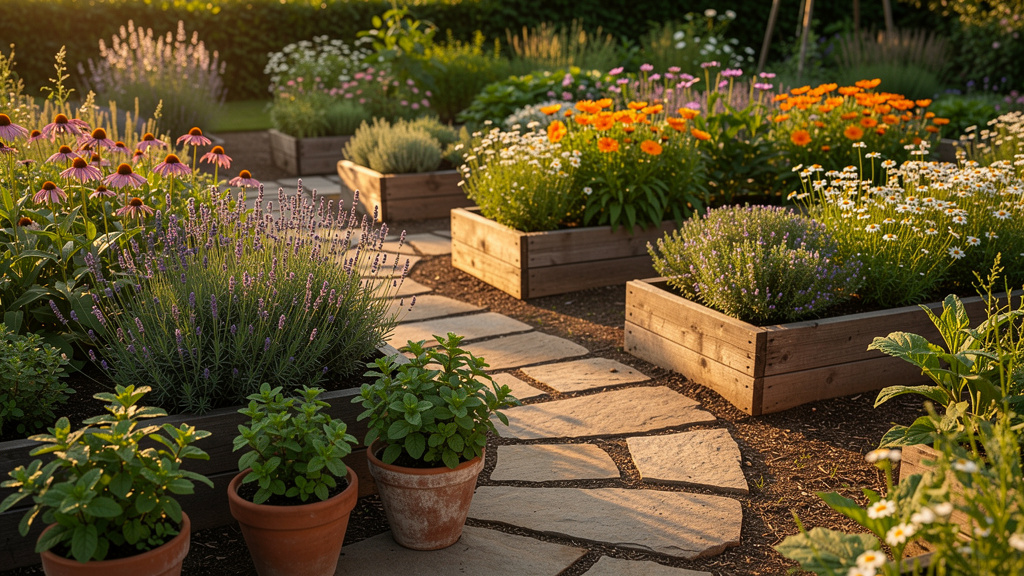
A medicinal garden that produces reliable, harvestable quantities of useful plants requires planning before the first seed goes in the ground. Random placement leads to shade conflicts, root competition, and invasive spreaders colonizing the entire bed within two seasons. A garden laid out with harvest workflow in mind — accessible paths, height-organized beds, container zones for spreaders — produces better material and less frustration every year.
This page covers design and layout. For what to do with plants once harvested, see harvesting, drying, and storing medicinal herbs.
Educational use only
This page provides general educational information for self-reliance and preparedness gardening. Medicinal herb preparations can interact with medications and vary in potency. Consult a qualified healthcare provider before using herbal preparations to treat illness or injury. Nothing on this page constitutes medical advice.
Site assessment
Before selecting plants or drawing bed layouts, evaluate the site itself. A mediocre plant selection in the right site outperforms a perfect plant list in the wrong one.
Light
Most medicinal herbs require 6–8 hours of direct sun daily. Assess your site in mid-summer when the sun is highest — that is when shading from trees and structures is least, so if a location is partially shaded in July it will be more shaded in spring and fall.
Exceptions that tolerate partial shade (3–5 hours direct sun): - Black cohosh (Actaea racemosa) — prefers dappled woodland edge - Valerian — tolerates afternoon shade in hot climates - Lemon balm — produces well in partial shade; may actually stay less invasive with reduced light
Herbs that perform poorly in partial shade: lavender, echinacea, St. John's Wort, calendula, ashwagandha. These need full sun or they will produce thin, weak growth and poor oil concentration.
Soil
Most medicinal herbs prefer well-drained, loamy soil at pH 6.0–7.0. Black cohosh is the notable exception at pH 5.5–6.5.
Amending clay soil: work in a 4-inch (10 cm) layer of compost, tilled to 10–12 inches (25–30 cm) depth. Clay soils that stay wet after rain will rot root crops and favor fungal problems. Raised beds bypass this issue entirely if native soil is too heavy.
Amending sandy soil: add compost at the same depth to improve water retention. Sandy soils drain too fast, stressing young transplants and causing drought stress in summer.
Test soil pH with an inexpensive kit before planting. Amend with agricultural lime to raise pH or sulfur to lower it. Make adjustments at least four weeks before planting to allow the amendment to react with the soil.
Water access
Locate your medicinal bed within 50 feet (15 m) of a water source. New plantings — transplants and first-year seedlings — require approximately 1 inch (2.5 cm) of water per week until established, which typically means the first full growing season. After establishment, most medicinal perennials are drought-tolerant, but a water source within reasonable distance matters during dry summers and for seedling establishment.
If running a hose is a problem, a single 55-gallon (208 L) rain barrel positioned near the bed can supply several weeks of hand-watering during a dry period.
Wind exposure
Tall plants need wind protection or staking: - Black cohosh: 4–6 feet (1.2–1.8 m) tall, can topple without staking - Elderberry: 8–12 feet (2.4–3.7 m), needs a sheltered location or regular pruning to maintain a manageable shrub form - Valerian: 4–5 feet (1.2–1.5 m), benefits from staking in exposed sites
Site tall plants on the north or east side of the bed where they shade-protect themselves from hot afternoon sun and position lower plants to the south where light access is unimpeded.
Field note
A slope assessment matters for drainage and harvest accessibility. A gentle 2–5% slope away from the bed improves drainage naturally without raised bed construction. Steeper than 10% means terracing or raised beds to prevent erosion during heavy rain.
Raised bed layout
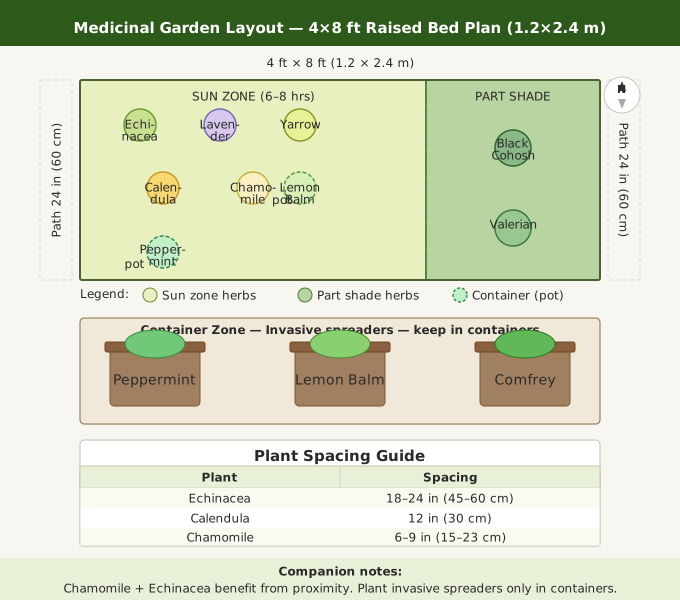
The standard 4 feet × 8 feet (1.2 m × 2.4 m) raised bed is the practical unit for medicinal gardens. This dimension lets you reach the center from either long side without stepping in — critical for plants like black cohosh and valerian that need undisturbed root systems. Work from the path, never from inside the bed.
Bed construction
- Minimum depth: 8 inches (20 cm) of growing medium for shallow-rooted species like chamomile, calendula, and thyme.
- Preferred depth for root crops: 12 inches (30 cm) or more for valerian, echinacea, and black cohosh. These plants develop deep tap roots or spreading root systems. Shallow beds constrain them and reduce harvestable root mass.
- Materials: untreated cedar or Douglas fir resist decay without chemical leaching. Avoid pressure-treated lumber with CCA (chromated copper arsenate) in medicinal garden beds — the arsenic and chromium can migrate into plant tissue.
- Fill: a mix of 60% topsoil, 30% compost, and 10% coarse sand or perlite drains well and holds nutrients. Avoid straight potting mix — it compacts in a raised bed and hydrophobicity develops within one to two seasons.
North-to-south height arrangement
Arrange plants by mature height within each bed, tallest at the north end and shortest at the south end. This prevents taller plants from shading shorter ones as the sun tracks south.
North end (4–8 ft / 1.2–2.4 m at maturity): - Black cohosh — 4–6 ft (1.2–1.8 m); best as a dedicated bed at woodland edge - Elderberry — grows as a shrub, 8–12 ft (2.4–3.7 m); better in its own corner, not a standard raised bed - Valerian — 4–5 ft (1.2–1.5 m); excellent north-end anchor
Middle band (2–4 ft / 0.6–1.2 m at maturity): - Echinacea (coneflower) — 2–4 ft (0.6–1.2 m) - St. John's Wort — 2–3 ft (0.6–0.9 m) - Yarrow — 2–3 ft (0.6–0.9 m) - Ashwagandha — grown as an annual in Zone 6 and colder; 2–4 ft (0.6–1.2 m), needs heat
South end (under 2 ft / under 0.6 m): - Chamomile — 10–24 in (25–60 cm) - Calendula — 12–18 in (30–45 cm) - Plantain (Plantago major) — 6–12 in (15–30 cm) - Thyme — 6–12 in (15–30 cm)
Path width
Maintain 18–24 inches (45–60 cm) of clear path between beds. This is wide enough to pass through with a small wheelbarrow or harvest basket. Narrower paths are difficult to navigate when plants overhang the edges in midsummer, and they become muddy channels after rain.
Mulch paths with wood chips, straw, or gravel to prevent weeds and mud. Bare-earth paths in a medicinal garden compact over time and become drainage problems.
Container zone for invasive spreaders
Three commonly used medicinal plants spread aggressively by underground rhizome and must not be planted directly in a bed or in open ground:
Peppermint (Mentha × piperita): spreads by runners and rhizomes. A single plant can cover 4–6 square feet (0.4–0.6 sq m) of ground in a single season. Contains menthol and is one of the most useful digestive and topical herbs.
Lemon balm (Melissa officinalis): spreads by root and seeds prolifically. One uncontrolled plant produces hundreds of volunteers. A calming herb, carminative, useful for wound washes.
Comfrey (Symphytum officinale): the most aggressive of the three. Every root fragment becomes a new plant. Deep, brittle tap roots make full removal nearly impossible once established. Highly useful topically for bruises and inflammation — contains allantoin. Do not plant in open ground under any circumstances.
Container requirements
- Peppermint and lemon balm: minimum 5-gallon (19 L) pot per plant. Use a pot with a drainage hole, but check annually that roots haven't escaped into the soil below.
- Comfrey: minimum 10-gallon (38 L) container. Comfrey's root system is substantial and will root-bind a 5-gallon container within one full season, reducing growth and harvestable leaf mass.
- Container soil: equal parts potting mix and compost. Top-dress with 1 inch (2.5 cm) of compost each spring to replace nutrients depleted by heavy-harvesting herbs.
- Sinking containers: you can sink containers into the ground flush with the bed surface for aesthetic integration. This also reduces soil temperature swings. Check through-drainage holes annually — roots escaping through the bottom holes into native soil defeats the containment purpose.
- Winter management: in Zone 6 and colder, comfrey containers should be moved to a sheltered location or insulated with straw before hard freezes (below 15°F / -9°C). Peppermint and lemon balm are more cold-hardy; they die back to the roots but survive Zone 5–6 winters even in containers if the root mass doesn't freeze solid.
Field note
Even in containers, comfrey produces more leaf biomass than most people expect. A single 10-gallon (38 L) comfrey container can provide enough leaf material for multiple batches of infused oil and several poultices per season. This makes containment worth the slight setup cost.
Companion planting table
Companion planting in a medicinal garden is more ecological than mystical — it's about matching sun/moisture needs, managing pollinator activity, and using a few plants with documented pest-deterring chemical profiles.
| Herb | Good companions | Poor companions | Notes |
|---|---|---|---|
| Echinacea | Black-eyed Susan, yarrow, native coneflowers | None significant | Shares pollinator base with native perennials; both benefit |
| Chamomile | Most vegetables, brassicas, most herbs | None significant | Traditional "physician of the garden" — improves essential oil yield in some neighbors |
| Lavender | Roses, vegetables, drought-tolerant herbs | Shade-loving plants | Deer-resistant; strong pollinator magnet; dislikes wet crowns |
| Yarrow | Most herbs and vegetables | None significant | Research suggests yarrow increases essential oil production in nearby herbs; also accumulates minerals in deep soil via tap root |
| Calendula | Tomatoes, peppers, asparagus | None significant | Repels aphids and whiteflies with sticky trichomes; safe to grow near most edibles |
| Elderberry | Standalone or with native shrubs | Close root-sensitive plants | Deep, spreading root system competes; give at least 6 ft (1.8 m) clearance from other root crops |
| Valerian | Vegetables, root crops | None significant | Deep tap root loosens soil; attracts earthworms; some evidence of improved vegetable growth nearby |
| St. John's Wort | Full-sun native plants | Shade plants, heavy feeders | Self-seeds vigorously in some soils — deadhead after flowering if you don't want volunteers |
What companion planting cannot do
Companion planting does not replace soil management, watering, or pest monitoring. Treat companion relationships as supporting factors, not primary pest control. A calendula border around aphid-prone plants reduces, not eliminates, aphid pressure.
Seasonal planting calendar
Using USDA Hardiness Zone 6 as the baseline (last frost approximately April 15–May 1; first fall frost approximately October 15). Adjust three to four weeks earlier for Zone 7, three to four weeks later for Zone 5.
| Season | Activity |
|---|---|
| Late winter — Feb to early Mar | Start chamomile, echinacea, calendula, lavender, and thyme indoors 8–10 weeks before last frost. Use bottom heat (70–75°F / 21–24°C soil temp) for germination. |
| Early spring — Mar to Apr | Pot up seedlings into 4-inch (10 cm) pots when first true leaves appear. Harden off outdoors for 7–10 days before transplanting. Divide established perennials (echinacea, valerian, yarrow) before new growth begins. |
| Spring — Apr to May | Transplant hardened seedlings after last frost. Direct sow calendula and chamomile into prepared beds — both germinate well in cool soil. Plant bare-root elderberry or transplants. |
| Late spring to early summer — May to Jun | Ashwagandha needs warm soil — plant out seedlings when soil temperature reaches 70°F (21°C) at 4 inches (10 cm) depth. Any earlier invites transplant shock. Sink container herbs (mint, lemon balm, comfrey) into their outdoor positions after frost risk ends. |
| Midsummer — Jul to Aug | Primary harvest window for leaves, aerial parts, and flowers. Deadhead calendula regularly to extend bloom period through fall. Manage comfrey by harvesting leaves before they shade other container herbs. Monitor mints for any root escape from containers. |
| Late summer to fall — Aug to Oct | Harvest seeds as pods rattle (dill, fennel, echinacea seed). Harvest roots of echinacea year 2+, valerian year 1+, black cohosh year 2+. Collect elderberries when fully black-purple, not before — unripe elderberries cause nausea. Plant garlic cloves (fall planting for spring bulb). |
| Late fall — Oct to Nov | Mulch perennial beds with 3–4 inches (7.5–10 cm) of straw or shredded leaf mulch to protect root crowns from freeze-thaw cycling. Move container herbs to a sheltered location before temperatures drop below 20°F (-7°C). Save seeds in labeled envelopes, stored dry and cool. |
| Winter | Review the prior season's harvest notes. Adjust bed layout if plants competed or shaded each other. Order seeds and bare roots for next year. |
Zone 6 notes for challenging species
Black cohosh: slow to establish; the first year produces only foliage. Do not expect a harvestable root until year three minimum. Patience is the cost of entry. Once established, plants persist for decades.
Ashwagandha: treated as an annual in Zone 6. Start indoors 10–12 weeks before last frost. It needs the long, warm season — in short-summer locations, use black plastic mulch to warm the soil and extend the effective growing season by two to three weeks. Harvest roots in fall before frost.
Lavender: marginally hardy in Zone 6. Select cold-hardy varieties (Lavandula angustifolia 'Hidcote' and 'Munstead' are the most reliable). Avoid wet winter soil — crown rot in wet, cold conditions kills lavender faster than cold temperatures alone. Excellent drainage at the planting site is the most important survival factor.
Planning and layout checklist
- Assess sun hours at the proposed site in July — use an hourly observation log for two to three days if uncertain
- Test soil pH and amend at least four weeks before planting
- Build or prepare raised beds with minimum 8 inches (20 cm) depth for most species; 12 inches (30 cm) for root crops
- Map height zones: tallest plants to the north end, shortest to the south
- Assign containers to peppermint, lemon balm, and comfrey before purchasing plants — do not plant them in open ground
- Mark perennial root plants in their first year for fall harvest in year two
- Plan path width at 18–24 inches (45–60 cm) minimum before building any beds
- Set a calendar reminder for ashwagandha soil temperature check (70°F / 21°C) before planting out
- Order echinacea and black cohosh as transplants or divisions rather than seed — both are slow from seed and require stratification
A well-planned medicinal garden connects directly to your preparation process. Once you have harvestable material, consult harvesting, drying, and storing medicinal herbs for timing and drying technique, and herbalism for preparation methods including tinctures, infused oils, and salves.