Harvesting, drying, and storing medicinal herbs
Drying medicinal herbs at the wrong stage or temperature is the most common way to produce a jar of material that looks right but does nothing. Volatile oils — the active compounds in aromatic herbs like peppermint, thyme, and lavender — degrade rapidly under excess heat and improper storage. A batch dried at 150°F (65°C) in a hot oven may be fully desiccated but medicinally inert. The difference between useful medicine and inert plant matter comes down to harvest timing, drying temperature, moisture testing, and container choice.
Educational use only
This page provides general educational information for emergency preparedness scenarios when professional medical care is unavailable. It is not a substitute for professional medical advice, diagnosis, or treatment. Always seek the advice of a qualified healthcare provider. Use this information at your own risk.
Harvest timing by plant part
The chemistry of a medicinal plant changes across the season. Harvesting at the wrong time doesn't just reduce potency — for some plants it means the target compounds haven't yet formed at all.
Leaves and aerial parts
Harvest leaves and stems just before the plant reaches full flower — the moment when buds are swelling but petals have not yet fully opened. This is peak volatile oil concentration. Once the plant commits energy to seed production, oil content in the leaves declines sharply.
- Check plants in the morning, after dew has dried but before midday heat.
- Identify stems with developing buds showing color but not yet open.
- Cut stems to no more than one-third of the plant's total height at any single harvest. This allows the plant to recover and produce a second flush.
- For annuals like basil: harvest the top four to six inches (10–15 cm) of stem before any flower stalk elongates.
- For perennials like mint or lemon balm: cut just above a leaf node, leaving two to four leaf sets below the cut.
Roots and rhizomes
Roots store the plant's energy reserves — starches, alkaloids, and polysaccharides that build up over the growing season. For most medicinal roots, maximum compound concentration occurs in the fall of the second year or later, after aerial growth has died back and the plant has drawn energy downward.
- Mark root plants in their first year so you can find them the following fall.
- Harvest after the first killing frost has caused aerial dieback but before the ground freezes hard.
- For spring harvest (acceptable alternative): dig before new growth resumes, when stored energy hasn't yet been redirected to shoot development.
- Loosen soil with a fork or spade at least 8 inches (20 cm) out from the crown to avoid cutting roots. Lift gently.
- Shake off excess soil and rinse with cold water. Do not soak — prolonged water contact leaches soluble compounds.
- Split large roots lengthwise to reduce drying time and prevent molding in the interior.
Minimum age before harvesting roots: echinacea and black cohosh require a minimum of two full growing seasons. Valerian can be harvested after one full year. American ginseng should not be harvested before year four.
Flowers
Harvest flowers as they reach full open — petals fully extended, center accessible to pollinators. For chamomile, this means the petals have reflexed back from the yellow center disk. Pick in the morning after dew dries.
- Pinch individual flower heads off by hand, or use scissors for speed.
- Pick only fully open blooms. Buds and spent flowers have lower active compound concentrations.
- Avoid flowers that show signs of browning, insect damage, or fungal spotting.
- Harvest before midday heat to preserve fragrant compounds.
Seeds
Seeds should be fully ripe but not yet dispersed. The shake test is reliable: grip the seed head and shake near your ear — a clear rattle means the seeds have hardened and are ready. A soft thud means they need more time.
- Watch the seed heads daily as they approach maturity.
- Shake test each head individually — timing varies even on a single plant.
- Cut the entire seed head stem and invert into a paper bag, then hang. Seeds will continue to dry and fall into the bag without loss.
- For small-seeded species (dill, fennel, coriander), tie a paper bag over the seed head before cutting to capture any early-dispersing seeds.
Bark
Bark harvesting follows a different calendar and has a hard safety rule.
- Spring harvest (preferred): harvest bark when sap is actively flowing, typically two to four weeks after leaves emerge. The cambium layer separates easily from the wood at this stage, making strips peel cleanly.
- Fall harvest (acceptable): sap concentrates in the root zone; spring is more accessible.
- The girdle rule: never remove bark in a complete ring around any trunk or branch. A complete ring — called girdling — cuts off the vascular system and kills the tree or branch within one season. Take strips no wider than one-third of the branch circumference, spacing cuts along different branches.
- Cut 6- to 10-inch (15–25 cm) strips lengthwise with a sharp knife, prying the outer bark and cambium away from the wood.
- Use branches 1–3 inches (2.5–7.5 cm) in diameter. Avoid the main trunk.
Drying methods
Match your drying method to the plant material. Aromatic herbs with volatile oils need the lowest possible temperature. Dense roots and bark tolerate higher heat.
Hang drying
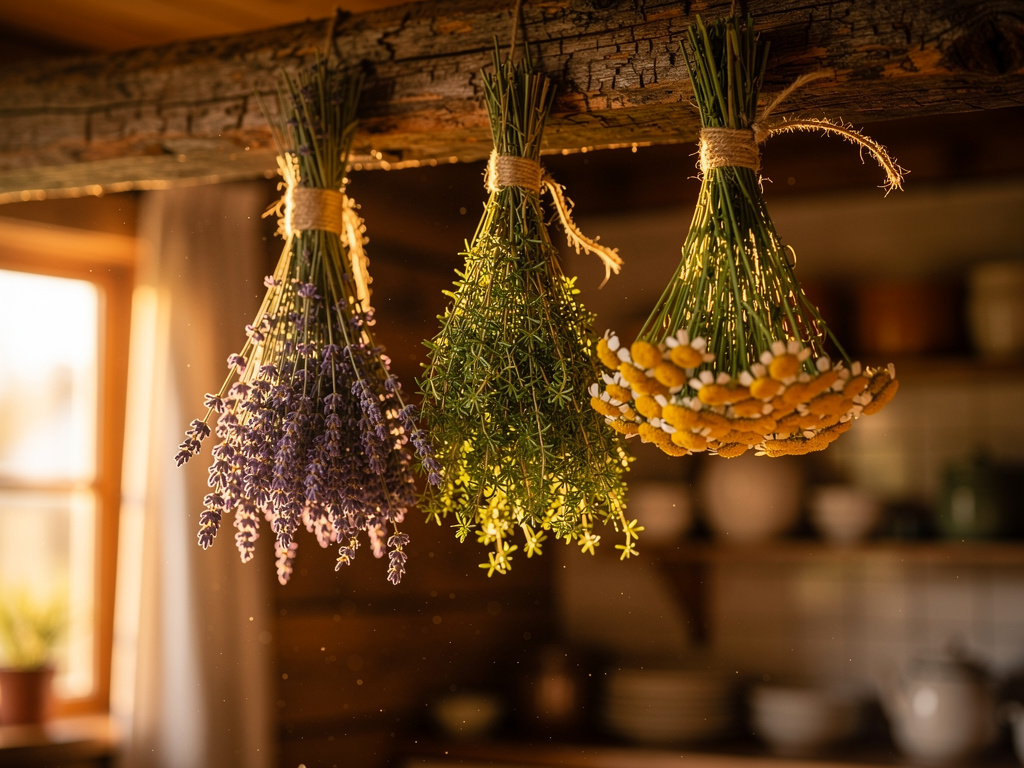
Hang drying is the most forgiving method for leafy stems and requires no equipment.
- Gather stems into small bundles, no more than 1 inch (2.5 cm) in diameter at the base. Thicker bundles retain moisture in the center and mold from the inside out before the outside shows any sign.
- Secure with a rubber band, not twine. Rubber bands contract as stems shrink during drying, keeping the bundle tight. Twine loosens, and bundles fall.
- Hang upside-down so oils migrate toward the leaves rather than dripping to the floor.
- Choose a location that is warm, dark, and well-ventilated: 70–90°F (21–32°C), below 60% relative humidity, with no direct sun. A covered porch, a dry attic corner, or a room with a circulating fan all work.
- Allow one to three weeks for full drying. Thin-leafed herbs like thyme dry faster. Thick-stemmed herbs like basil or comfrey take longer.
Field note
Hang bundles far enough apart that they don't touch. Touching bundles trap humidity between them, which promotes mold in exactly the spot you can't see. Six inches (15 cm) of clearance between bundles is the working minimum.
Screen drying
Screen drying is best for flowers, individual leaves, thin plant material, and anything that would be damaged by hanging upside down.
- Lay material in a single layer on a mesh screen — standard window screen material is perfect and inexpensive.
- Space pieces 1–2 inches (2.5–5 cm) apart. Overlapping pieces dry unevenly and the contact points hold moisture.
- Elevate the screen on supports so air circulates beneath it as well as above.
- Maintain the same temperature and humidity targets as hang drying: 70–90°F (21–32°C), below 60% RH.
- Turn material once daily for the first three days to expose all surfaces.
- Drying time: thin flowers (chamomile, calendula petals) — three to seven days. Leafy material — five to ten days.
Dehydrator drying
A food dehydrator gives the most control over temperature and is the fastest method for larger batches.
- Set the dehydrator to 95–115°F (35–46°C) for all aromatic herbs — peppermint, lavender, thyme, oregano, chamomile, lemon balm. This preserves volatile oils. Temperatures above 120°F (49°C) begin degrading heat-sensitive terpenes measurably.
- For non-aromatic roots, barks, and dense material: temperatures up to 130°F (54°C) are acceptable and speed drying without significant compound loss.
- Arrange material in a single layer on each tray with space between pieces.
- Run for 2–6 hours depending on material thickness and starting moisture content. Check at 2 hours and test for dryness.
- Rotate trays front-to-back and top-to-bottom midway through the run if your dehydrator has uneven airflow.
Oven drying
Most kitchen ovens run too hot for aromatic herbs and should be a last resort.
- Set the oven to its lowest possible setting, typically 170°F (77°C) or lower.
- Prop the oven door open 2–3 inches (5–7.5 cm) to allow moisture to escape and reduce effective temperature near the material.
- Place material on a baking sheet lined with parchment in a single layer.
- Check every 30 minutes. Thin leaves can overdry and crumble to dust within an hour.
- Acceptable for roots and bark, where compound loss from higher heat is less severe. Not recommended for aromatic herbs.
Moisture testing (the crumble and snap tests)
Do not rely on elapsed time to judge dryness. Humidity, bundle thickness, and plant density vary too much. Use physical tests instead.
For dried leaves: - Pinch a leaf between your fingers and apply firm pressure. - Pass: crumbles cleanly to powder. - Fail: bends, flexes, or springs back. Return to drying.
For dried roots: - Bend a root piece between both hands. - Pass: snaps cleanly with a crisp crack. - Fail: bends or flexes without breaking. Return to drying.
For dried flowers: - Pinch a flower head. - Pass: petals fall away completely, everything feels papery and dry. - Fail: any softness or adhesion between petals. Return to drying.
Failure modes to catch during testing:
- Musty or sour smell: mold is already growing inside the bundle. Discard the entire batch. Do not dry further and store — mold spores are present throughout.
- Condensation on the inside of a test jar: if you seal a small sample in a glass jar and condensation forms on the inside within 24 hours, the material is not dry enough. Return to drying.
Discard moldy batches entirely
A batch that smells musty cannot be rescued by additional drying. Mold penetrates the plant tissue and the spores remain bioactive even after the visible mold dries out. Consuming moldy herbal preparations can cause respiratory reactions and mycotoxin exposure. The cost of replacement material is less than the cost of a health problem.
Storage conditions
Properly dried material can still lose potency rapidly if stored incorrectly. The four enemies of stored herbs are light, heat, humidity, and oxygen.
Container choice
- Amber or dark glass jars (Mason jars with dark paint, pharmaceutical amber glass) are the gold standard. Dark glass blocks the UV wavelengths that break down chlorophyll, volatile oils, and alkaloids. Clear glass jars stored in a dark cabinet are acceptable.
- Avoid plastic long-term for aromatic herbs. Aromatic compounds migrate into plastic over months, and plastic is not fully airtight. Acceptable for short-term use (under three months) if no glass is available.
- Metal tins work well for dried leaves and roots if fully opaque and airtight. Avoid for acidic preparations.
- Jar size should match your typical use quantity. A half-full jar contains more headspace air than a full jar — oxygen exposure is greater. Use smaller jars for small quantities.
Temperature and location
- Target: 50–70°F (10–21°C).
- Avoid: above stoves, near hot water pipes, in attics, on shelves in direct sun, in car dashboards.
- Acceptable: a dedicated pantry shelf, a closed cabinet in a climate-controlled room, a root cellar (if humidity is controlled).
- A 10°F (5.5°C) reduction in storage temperature roughly doubles the chemical stability of most compounds. Cool storage genuinely extends shelf life.
Humidity
- Target: below 60% relative humidity.
- Avoid: bathrooms, basements without a dehumidifier, areas near a kitchen sink.
- If humidity is borderline, place a small food-safe silica gel desiccant packet inside the jar, replaced annually.
Labeling
Label every jar immediately after packing — before you move on to the next task. An unlabeled jar is dangerous in a medical context. Labels must include:
- Common name (e.g., "Echinacea root")
- Plant part ("root," "leaf," "flower," "seed")
- Harvest date (month and year)
- Source if wild-crafted vs. garden-grown
Permanent marker on tape works. Printed labels from a label maker are more durable. The format doesn't matter — what matters is that six months from now, you do not have an anonymous jar of brown plant material.
Field note
Store your herbal pharmacy in alphabetical order in the same cabinet, always. When you reach for valerian root at 2 a.m. with a headache, you will not want to read twelve labels in bad light.
Shelf life reference table
These ranges apply to material that was properly dried and is stored in dark glass at 50–70°F (10–21°C) below 60% relative humidity. Poor storage conditions reduce shelf life substantially.
| Form | Storage conditions | Shelf life | Signs of potency loss |
|---|---|---|---|
| Whole dried leaf | Dark glass, cool, dry | 12–18 months | Faded color, flat smell, no bitterness |
| Whole dried root | Dark glass, cool, dry | 18–36 months | Woody texture, tasteless, pale color |
| Dried flower | Dark glass, cool, dry | 12 months | Crumbled, absent scent |
| Dried seed | Dark glass, cool, dry | 24–36 months | Bitter taste gone, no aroma |
| Tincture (60%+ alcohol) | Dark glass, room temp | 3–5 years | Cloudiness, off smell, color fades to pale yellow |
| Tincture (30–50% alcohol) | Dark glass, room temp | 1–3 years | Same as above, faster timeline |
| Glycerin tincture | Dark glass, cool | 6–12 months | Cloudiness, fermentation smell |
| Infused oil | Dark glass, cool | 12 months (olive base) | Rancid smell — discard immediately |
| Salve | Tin or jar, room temp | 12–18 months | Rancid smell, oil separation, graininess |
| Elderberry syrup | Refrigerated | 2–3 months | Fermentation bubbles, off taste, mold |
| Dried bark | Dark glass, cool, dry | 24–36 months | No taste, sawdust-like texture |
Potency degradation signs by herb category
Not all herb degradation looks the same. Match the warning signs to the category.
Aromatic herbs (peppermint, lavender, thyme, rosemary, chamomile): The smell test is definitive. These herbs should produce an immediate, strong scent when you open the jar. A faint or absent smell means the volatile oils have evaporated or oxidized. The material is no longer medicinally useful, even if it looks intact and the color appears normal.
Roots and barks (valerian, echinacea root, black cohosh, willow bark): Taste is the indicator. Fresh-dried echinacea root produces a pronounced tingling numbness on the tongue from its alkylamides. Valerian root has a distinctive, earthy-pungent smell that some find unpleasant — that smell is the active compound. When roots taste bland or woody with no astringency, the active compounds are gone.
Tinctures: Correctly prepared alcohol tinctures age well in dark glass. The first warning sign is a shift from deep amber or green-gold color to pale yellow. A cloudy tincture that was clear may indicate contamination. A rancid or fermented smell in an alcohol tincture is a discard signal.
Infused oils and salves: Rancidity is the primary failure mode. Trust your nose — rancid oil smells noticeably off, sometimes sharp or paint-like. Do not use rancid oil on skin or wounds. There is no recovery from rancidity.
Practical harvest and processing checklist
- Identify the harvest window for each plant: bud stage for leaves, full open for flowers, fall dieback for roots, spring sap-flow for bark
- Harvest leaves and aerial parts in the morning after dew dries, before midday heat
- Keep bundle diameter at or under 1 inch (2.5 cm) for hang drying
- Set dehydrator to 95–115°F (35–46°C) for aromatic herbs; verify with an oven thermometer if the dehydrator's dial is not calibrated
- Test every batch with the crumble or snap test before storage — time alone is not sufficient
- Discard any batch with a musty or sour smell, even if it passed time-based estimates
- Pack into amber or dark glass immediately and label before moving to the next task
- Store below 70°F (21°C) in a dark location below 60% relative humidity
- Note the shelf life category for each jar and calendar a rotation or potency check
A well-stocked herbal pharmacy requires more than good intentions — it requires the plant material to still be potent when you need it. With proper drying and storage discipline in place, the next step is designing your medicinal garden to produce consistent harvests, and consulting herbalism for identification and use profiles once your dried material is ready. Before making any oil, tincture, or salve, review herbal preparation methods for the ratios and temperature controls that determine whether a preparation works or fails.
