UV Water Treatment
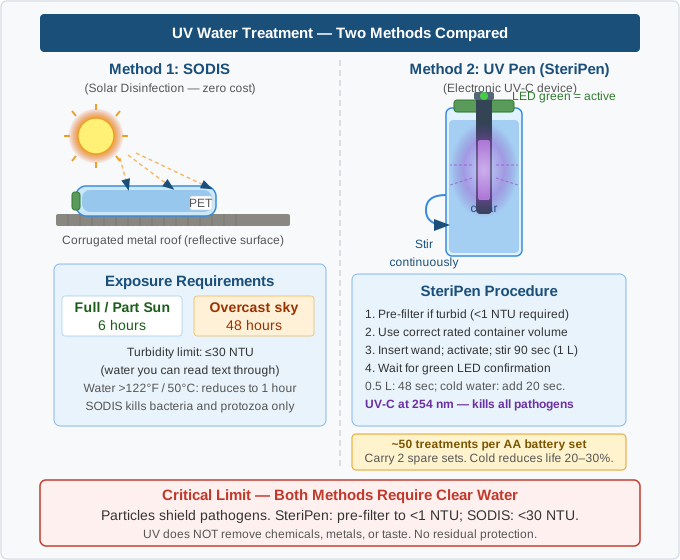
UV (ultraviolet) treatment is the fastest pathogen-inactivation method available for clear water. A SteriPen can disinfect 1 liter (1 quart) of clear water in 48 seconds. The SODIS method — filling a clear plastic bottle and leaving it in sunlight — costs nothing and requires no equipment beyond a transparent container. Both approaches work by the same mechanism: UV-C light at 254 nanometers penetrates pathogen cells and chemically damages their DNA and RNA, preventing reproduction and rendering them unable to cause infection.
UV treatment is not universal. It has specific operating requirements and limitations that make it the wrong tool in certain scenarios. Understanding those limits — especially the turbidity threshold — is the difference between effective treatment and false security.
How UV Disinfection Works
Ultraviolet light in the UV-C band (200–280 nm) is germicidal. The 254 nm wavelength is specifically absorbed by nucleic acids (DNA and RNA). When a microorganism's DNA absorbs UV-C radiation at sufficient intensity, the photons create pyrimidine dimers — chemical crosslinks that prevent the organism's genetic machinery from replicating. The pathogen is effectively inactivated: it cannot reproduce, and cannot cause disease, even though it is not "killed" in the classical sense.
UV treatment at proper doses is effective against: - All bacteria, including E. coli, Salmonella, Vibrio cholerae - All protozoa, including Giardia lamblia and Cryptosporidium parvum - All viruses, including norovirus, rotavirus, Hepatitis A
This last point is significant: UV treatment addresses viruses that most mechanical filters miss. When combined with pre-filtration to address sediment, UV plus a hollow-fiber filter provides broad-spectrum coverage across all biological threat categories.
Critical limitation — turbidity:
UV light is scattered and absorbed by particles suspended in water. At turbidity levels above approximately 1 NTU (Nephelometric Turbidity Unit), particles physically shield pathogens from UV exposure. A pathogen sheltering in the shadow of a suspended particle may receive insufficient UV dose to be inactivated. This means:
- Clear water (below 1 NTU): UV treatment is highly effective
- Slightly hazy water (1–10 NTU): UV effectiveness is significantly reduced
- Turbid/cloudy water (above 10 NTU): UV treatment is not reliable; do not use UV as sole treatment
Pre-filter turbid water through a ceramic or hollow-fiber filter (see Filtration) before UV treatment. The combination — mechanical filtration to 0.1–0.2 microns, then UV — addresses both turbidity-dependent biological threats and viruses that filters miss.
Method 1: Electronic UV Devices (SteriPen, Grayl)
SteriPen
Cost: Affordable, depending on model What it treats: All bacteria, protozoa, and viruses in clear water Power: AA batteries or rechargeable USB (model-dependent); battery life approximately 50 treatments per set of AAs
The SteriPen is the most widely used field UV purifier. It consists of a handheld wand containing a UV-C lamp rated at 254 nm. The user inserts the wand into a clear-sided container of water and stirs continuously while the lamp runs.
SteriPen operating procedure:
-
Assess turbidity. If water is visibly cloudy, pre-filter before UV treatment. See Filtration for pre-filtering options.
-
Use a clear container. Opaque containers block UV penetration. Use a clear Nalgene, a clear water bottle, or the SteriPen's included adapter cup. Colored or tinted containers reduce UV transmission and reduce effectiveness.
-
Fill to the rated volume. Most SteriPen models have a 0.5 L and 1 L setting. Overfilling means the outer water receives insufficient UV dose. Use exactly the rated volume.
-
Insert the lamp and activate. Press the power button. The LED confirmation indicator should show green (ready). Insert the lamp fully into the water — the sensors must be submerged or the device may not activate.
-
Stir continuously in a circular pattern. Stirring ensures all water volumes pass near the UV lamp and receive the required dose. If you hold the wand still, water near the far edges of the container may receive an insufficient dose. Keep the lamp moving.
-
Complete the full treatment cycle. SteriPen models run for 48 seconds (0.5 L) or 90 seconds (1 L) and emit a confirmation signal (green flashing or beep). Do not remove the lamp before the cycle completes.
-
Consume promptly or store in clean container. UV treatment leaves no residual disinfectant in the water. Recontamination is possible. Store treated water in a covered, clean container and consume within a few hours. For longer storage, combine UV treatment with a chemical dose — see Chemical Treatment for small residual-chlorine doses.
Battery management: A pair of fresh lithium AA batteries provides approximately 100–150 treatments. At 1 liter per treatment, a pair of batteries processes 100–150 liters. For a group of four using 2 liters per person per day, that is approximately 12–19 days of drinking water per battery set. Carry at least 2 spare sets. In cold conditions (below 32°F / 0°C), battery capacity drops 20–30%; carry more spares.
SteriPen failure modes: - Lamp indicator shows red: UV lamp has reached end of life (typically 8,000 uses) or battery is critically low. Replace batteries first; if red persists, the lamp must be replaced. - Device does not activate when submerged: Confirm liquid sensors are fully submerged. In very clean, pure water, conductivity may be too low to trigger the sensors. Add a tiny pinch of salt (1/16 tsp / 0.3 g per liter) to raise conductivity just enough. - No response after battery replacement: Check battery orientation and contacts. SteriPen devices are sensitive to battery contact corrosion.
Grayl UltraPress
Cost: Affordable What it treats: Bacteria, protozoa, viruses, particulates; rated to 0.003 microns Method: Press-filtration through filter element
The Grayl UltraPress is not strictly a UV device — it is a press filter with an electroadsorption element that addresses viruses through ion capture rather than UV. It is included here because it solves the same problem (virus removal in clear water, compact and field-ready) and is often compared with UV devices. The filter element is an affordable replacement with a rated life of 65 gallons (250 L).
Method 2: SODIS (Solar Disinfection)
Cost: $0 Equipment required: Clear PET plastic bottles (not glass, not colored, not printed with UV-blocking inks) Validation: WHO-validated; studied in over 50 countries
SODIS uses solar UV and thermal energy to inactivate pathogens in water stored in transparent bottles. It is the lowest-cost water treatment method ever documented and requires zero infrastructure. It is a genuine life-saving technology used by millions of people globally.
How SODIS works:
Sunlight contains UV-A (315–400 nm) and UV-B (280–315 nm) radiation that, at high enough intensity, inactivates biological pathogens. At temperatures above 122°F (50°C), thermal inactivation synergizes with UV — the combination is more effective than either alone. Under full sun with water temperature reaching 122°F (50°C) or above, treatment time drops to 1 hour (vs. 6 hours at ambient temperature).
SODIS procedure:
-
Use clear, undamaged PET bottles. Look for the recycling symbol with "PET" or "1" inside it. Bottles must be clear, not tinted. Scratched or cloudy bottles reduce UV transmission significantly — use bottles in good condition. Standard 1–2 liter soda bottles work well. Do not use glass (blocks UV-A), polyethylene (opaque or semi-opaque), or polycarbonate.
-
Pre-filter turbid water. SODIS requires water at or below 30 NTU turbidity (roughly: water you can read text through). If water is too turbid, double the exposure time (12 hours sunny, 4 days cloudy) or pre-filter. For reference, water that appears light tan rather than brown is generally below 30 NTU.
-
Fill the bottle to 90% capacity. Leaving a small air gap allows gentle mixing. Rinse the bottle with source water before filling.
-
Lay the bottle on a reflective surface in direct sun. A corrugated metal roof, aluminum foil, or a white reflective surface increases UV exposure by 20–40%. Bottles lying flat receive more UV than bottles standing upright.
-
Exposure times:
| Conditions | Exposure Time |
|---|---|
| Full sun (at least 6 hours of direct sunlight) | 6 hours |
| Partly cloudy (less than 50% cloud cover) | 6 hours |
| Overcast (more than 50% cloud cover) | 2 days (48 hours) |
| Rainy / no direct sun | SODIS is not reliable — use boiling |
-
Mark treated vs. untreated bottles. Use a rubber band, tape, or marker to distinguish filled-and-exposed bottles from untreated ones. Confusion is dangerous.
-
Let the bottle cool before drinking if heated by sun. Store treated water in its sealed bottle in a shaded area. Consume within 24 hours of treatment.
Field Note
SODIS is most useful for ongoing treatment of rainwater or relatively clear surface water when fuel is scarce and you have time to plan ahead. Its weakness is inflexibility — you cannot SODIS your way through a cloudy week without pre-filtering and waiting 48 hours. In a multi-day grid-down scenario with mixed weather, SODIS is one tool among several. Keep bleach or iodine as your cloudy-day backup. The best SODIS operators keep a 24-hour advance supply: always have yesterday's treated bottles available while today's are still treating.
What UV Does Not Do
UV treatment is biologically thorough but chemically inert:
- No chemical removal: Pesticides, herbicides, industrial solvents, heavy metals, nitrates, and fluoride are not affected by UV radiation. If your source may have chemical contamination, UV alone is insufficient — add Distillation or Filtration with activated carbon.
- No taste or odor improvement: UV does not address dissolved organics, sulfur, iron, or chlorine taste. Activated carbon post-filtration addresses these.
- No residual disinfection: Water treated by UV can be recontaminated immediately upon contact with a contaminated surface. There is no "safety margin" after treatment the way chlorine-treated water has hours of residual disinfection.
- Battery/power dependency: Electronic UV devices are inoperable when batteries are dead. SODIS bypasses this but requires clear weather and long lead times.
Building a Redundant UV-Based Water System
For reliable water safety, UV treatment should be one layer of a multi-barrier system:
| Layer | Purpose | Method |
|---|---|---|
| Pre-filtration | Remove turbidity, most bacteria/protozoa | Ceramic filter, hollow-fiber, or settling |
| Disinfection | Inactivate residual pathogens including viruses | SteriPen, SODIS, or chemical treatment |
| Storage | Prevent recontamination | Covered, clean containers |
| Residual protection | Maintain safety in storage | Small bleach dose (optional) |
This combination — filter then UV — is used in commercial water treatment systems worldwide. At the household or field scale, a Sawyer Squeeze plus a SteriPen covers every biological threat category at an affordable total equipment cost. Maintain batteries and filter integrity, and this system processes clear water at a negligible cost per liter.
For source water identification, see Sourcing and Surface Water. For assessing chemical contamination risk, see Testing. If illness develops despite precautions, see Medical — Infection.
Field Checklist
- Turbidity assessed before UV treatment — pre-filtered if above 1 NTU (slightly hazy)
- Clear container confirmed (PET for SODIS; clear Nalgene or adapter cup for SteriPen)
- SteriPen: battery level checked, lamp indicator green before use
- SteriPen: full rated volume used — not overfilled
- SteriPen: stirred continuously through full treatment cycle
- SODIS: bottle integrity checked — no deep scratches, no tinting
- SODIS: 6-hour exposure in full/partly-cloudy sun, or 48 hours if overcast
- Treated water labeled and stored separately from untreated
- Backup chemical treatment available for cloudy-day SODIS failures
- Spare batteries carried for SteriPen (minimum 2 sets)