Water Testing
Clean-looking water can be lethally contaminated. Colorless, odorless, and clear water has killed hundreds of people in recent history from cryptosporidium outbreaks, arsenic exposure, and nitrate poisoning in infants. Conversely, water with a slight mineral smell or slight turbidity may be perfectly safe after simple treatment. The only way to know is to test.
When to Test Water
| Situation | Test Frequency | What to Test |
|---|---|---|
| Well water (primary supply) | Annually at minimum | Full panel: coliform, nitrates, arsenic, pH, hardness, lead |
| Well water after a flood | Immediately | Coliform, E. coli, turbidity |
| Stored water (rotation) | At each 6-month rotation | pH, free chlorine, coliform if any visual concern |
| Rainwater before first use | Before use | Coliform, pH, turbidity, heavy metals if urban collection |
| Spring or surface water | Before every use | Coliform, turbidity, nitrates |
| Emergency source (creek, pond) | Before any consumption | Full screen: coliform, turbidity, nitrates, pH |
| Municipal tap water concern | When notice issued | Per boil-water notice instructions; coliform if persistent concern |
The CDC recommends well owners test annually for coliform bacteria, nitrates, pH, and total dissolved solids as a minimum panel. Additional tests depend on local geology and land use — arsenic is a concern in parts of the Southwest and New England; agricultural areas have elevated nitrate risk; old homes have lead risk from plumbing.
Level 1: The Visual and Smell Test
Before spending money on a test kit, conduct a basic sensory assessment. This catches the most obvious problems immediately and requires nothing but your eyes and nose.
Turbidity (Visual Clarity)
Fill a clear glass with water. Hold it up to a light source.
- Clear with no particles: Passes visual test
- Slight haze or cloudiness: May indicate suspended particles, sediment, or biological growth — do not drink without treatment
- Milky white, cloudy: Air bubbles (harmless, clear in 30 seconds) OR elevated turbidity (does not clear). If it does not clear, do not drink.
- Brown or yellow tint: Iron or manganese (treat); tannins from soil (usually harmless but treat anyway); or rust from pipes
- Green or blue-green: Algae growth; do not drink without treatment
Odor Test
Smell the water immediately after opening a container or drawing from a tap.
| Odor | Likely Cause | Action |
|---|---|---|
| Rotten egg / sulfur | Hydrogen sulfide (H2S) — sulfur bacteria in well or pipes | Do not drink; test and treat |
| Chlorine | Residual disinfectant from municipal supply | Normal and acceptable at low levels |
| Musty / earthy | Algae or biological growth | Do not drink; treat |
| Chemical / plastic | Container leaching or industrial contamination | Do not drink; identify source |
| Gasoline / solvent | Fuel spill or industrial contamination | Do not drink; discard |
| No odor at all | Normal — but odorless water can still be contaminated | Continue to test chemically |
H2S detail: Hydrogen sulfide smells like rotten eggs and is produced by sulfur-reducing bacteria metabolizing sulfates in groundwater. Concentrations above 0.05 mg/L are detectable by smell. At 0.3 mg/L the smell is strong; at higher levels in confined spaces, H2S is toxic. Do not use water with a strong sulfur odor without lab testing and specific treatment (shock chlorination and aeration).
Level 2: Home Test Kits
Home test kits are the primary screening tool for most preparedness scenarios. They produce results in 10–15 minutes and cost far less than lab testing.
What Kits Test and What They Cost
| Kit Type | Tests Included | Cost | Best For |
|---|---|---|---|
| Basic pool/spa strip ($5–$10) | Free chlorine, pH | $5–$10 | Stored water chlorine check |
| Water quality strip (basic) | pH, hardness, chlorine, nitrate, nitrite | $10–$20 | Quick stored water screen |
| Well water test kit | Coliform, E. coli, nitrates, pH, hardness, lead, iron | $20–$50 | Well water annual screen |
| Comprehensive home kit | 9+ parameters including arsenic, copper, bacteria | $35–$80 | First-time well test or emergency source |
Recommended kits by scenario:
-
Stored water rotation check: Pool test strips (inexpensive for 50 strips). Check pH (target 6.5–8.5) and free chlorine (target 0.5–2.0 ppm). If both are in range, the water is likely fine. If chlorine reads zero, the pretreatment has degraded — re-dose and let sit 30 minutes before re-testing.
-
Well water annual check: A dedicated well water home test kit covers coliform, E. coli, nitrates/nitrites, pH, hardness, iron, lead, and copper. The First Alert WT1 and Health Metric kits are widely available at an inexpensive to affordable price. Follow the included instructions exactly — contamination of the sample itself is the most common reason for false-positive coliform results.
-
Emergency source screening: Use a multi-parameter kit that includes coliform, nitrates, pH, and turbidity. This gives you enough information to decide whether treatment makes the source viable.
How to Collect a Sample Without Contaminating It
Improper sample collection is the single most common source of false results on bacterial tests.
Procedure for coliform sample collection:
- Do not touch the inside of the sample bottle or the water opening. Handle the bottle by the exterior only.
- Remove the cap without setting it face-down on any surface. Hold it in your hand or face-up.
- For tap water: Run cold water for 2 minutes to flush the supply line before collecting. Do not sample water that has been sitting in the pipe.
- For well water: Run the hand pump or electric pump for 5 minutes to flush the well casing before collecting.
- For stored containers: Open the container just enough to pour, avoiding any contact with the rim by your hands.
- Fill to the line marked on the sample bottle — not to the top.
- Cap immediately.
- Process within the kit's time limit — most coliform tests must be incubated within 24 hours of collection.
Never Use a Dirty Container
Do not rinse sample bottles with tap water before use — most kits pre-treat bottles with sodium thiosulfate to neutralize chlorine, and rinsing removes it. Use the bottles exactly as packaged.
Interpreting Results
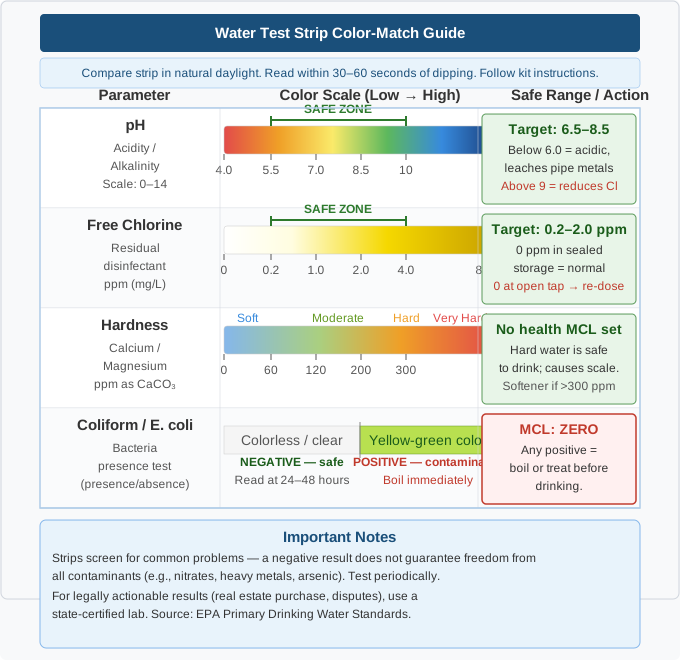
pH: Target range 6.5–8.5 for drinking water. Below 6.0 increases lead and copper leaching from pipes; above 8.5 reduces the effectiveness of chlorine disinfection.
Free chlorine: Should be 0.2–4.0 ppm in municipal water at the tap. Below 0.2 ppm, the water may lack adequate disinfection residual. Zero is acceptable in stored water that was properly treated and sealed — it means the chlorine has done its job.
Nitrate/Nitrite: EPA maximum contaminant level (MCL) is 10 mg/L nitrate-nitrogen and 1 mg/L nitrite-nitrogen. Above this level, water causes methemoglobinemia ("blue baby syndrome") in infants under 6 months and is dangerous for pregnant women. Test result above the MCL means do not drink or cook with this water — period.
Total coliform: Any detection of total coliform bacteria means the water has been contaminated by bacteria from soil, fecal matter, or biofilm. It does not necessarily mean fecal contamination — but it means the water is not safe to drink without treatment. Treat with boiling or chemical treatment before consuming.
E. coli: E. coli detection in any amount indicates direct fecal contamination. This is a serious result. Do not consume this water. Boil for at least 1 minute at elevation below 6,500 ft (1,981 m) or 3 minutes above. Re-test after treatment to confirm.
Level 3: Professional Lab Testing
Home kits screen for common problems but have limits. A professional certified lab provides definitive results, legally defensible documentation, and the ability to test for contaminants no home kit covers (arsenic, mercury, radon, volatile organic compounds, PFAS).
How to Submit a Sample
-
Find a certified lab: Contact your state health department or county extension office for a list of EPA-certified drinking water labs. Many county extension offices will test well water at subsidized or inexpensive rates.
-
Order a test kit from the lab first — do not use random bottles. Labs send pre-treated sterile bottles with instructions specific to their process.
-
Request a specific panel based on your concerns:
- Basic well panel: $25–$60. Covers coliform, E. coli, nitrates, pH.
- Standard well panel: $50–$150. Adds arsenic, lead, copper, iron, manganese, hardness.
-
Comprehensive panel: $100–$400+. Adds VOCs, pesticides, heavy metals, fluoride, radon.
-
Follow the lab's collection instructions exactly. Temperature and timing requirements vary. Many labs require samples to arrive within 24–48 hours of collection and be kept at 4°C (39°F) during transport.
-
Interpret results against EPA MCLs: The lab report lists each parameter, your result, and the EPA maximum contaminant level. Any result above the MCL means the water requires treatment or the source should not be used.
Field Note
County Cooperative Extension offices (land-grant university extensions) often offer discounted or free well water testing for rural residents. Many have seen arsenic and nitrate contamination that surprises owners of "good" wells — testing annually is a minimal insurance investment. A basic coliform and nitrate panel from a county extension lab is inexpensive and returns results in 5–7 business days.
EPA Primary Drinking Water Standards — Key Contaminants
| Contaminant | EPA MCL | Health Effect at Excess | Primary Source |
|---|---|---|---|
| Total Coliform | 0 (zero detections per month) | Gastrointestinal illness | Surface water, shallow wells |
| E. coli | 0 | Gastrointestinal illness, HUS in children | Fecal contamination |
| Nitrate | 10 mg/L | Methemoglobinemia in infants | Agricultural runoff, septic systems |
| Arsenic | 0.010 mg/L (10 ppb) | Cancer (skin, bladder, lung) | Natural geology, mining |
| Lead | 0.015 mg/L (action level) | Neurological damage | Old plumbing (pre-1986) |
| Fluoride | 4 mg/L | Bone damage (dental fluorosis at lower levels) | Natural geology, water additive |
| pH | 6.5–8.5 (secondary standard) | Infrastructure corrosion | Natural acidity, treatment |
Test Frequency Schedule
| Source | Frequency | Test |
|---|---|---|
| Private well | Annually | Coliform, nitrates, pH — minimum |
| Private well | Every 5 years | Full panel including arsenic, lead |
| Private well | After any flood | Coliform, E. coli immediately |
| Stored water | Each 6-month rotation | pH, free chlorine (pool strip) |
| Stored water with any visual concern | Immediately | Coliform home kit |
| Rainwater before first use | Once | Coliform, turbidity |
| Emergency surface water | Before each use | Coliform, turbidity, nitrates |
Decision Tree: Do I Need to Treat This Water?
Is the water visually clear?
  ├── NO → Filter before drinking ([Filtration](filtration.md))
  └── YES → Continue

Does it smell like sulfur, chemicals, or petroleum?
  ├── YES → Do not drink; discard or identify source
  └── NO → Continue

Does free chlorine read > 0.2 ppm? (for stored/municipal water)
  ├── NO → Re-treat with bleach; wait 30 min; re-test
  └── YES → Likely safe — confirm with coliform test if any doubt

Does coliform test show any positive result?
  ├── YES → [Boil](boiling.md) or [chemically treat](chemical.md) before drinking
  └── NO → Safe to drink

Does nitrate read > 10 mg/L?
  ├── YES → Do not give to infants; treat with reverse osmosis or distillation
  └── NO → Safe
Cross-References
- Water Filtration — remove turbidity and pathogens before drinking
- Boiling — most reliable pathogen kill for coliform-positive water
- Chemical Treatment — bleach dosing for disinfection after contamination
- Wells — well maintenance to prevent contamination
- Water Rotation — when to test stored water during rotation cycles
- Rainwater Collection — first-use testing requirements for harvested water