Spring development for permanent water supply
Consult a licensed professional for your jurisdiction
Water rights, permit requirements, and construction standards vary by state and county. The information on this page is educational — not a substitute for professional engineering review or legal counsel. Before developing any spring for household use, verify applicable water rights and permit requirements with your state water resources agency.
A natural spring is one of the most valuable assets a rural property can have. When properly developed, it delivers clean, gravity-fed water with no pumping costs, no electricity dependency, and a service life measured in decades. The difference between a spring you can rely on and one you cannot is almost entirely a construction problem — specifically, whether you built the collection structure to keep surface water out and allow groundwater in.
This page covers the full development workflow: evaluating a spring's capacity, constructing the permanent collection chamber, piping water to your homestead, protecting the source from contamination, managing water rights, winterizing for cold climates, and maintaining the system over time. For identification, dye testing, and initial spring box construction steps, see the companion page Springs — Development, Spring Box Construction, and Safety.
Geological context: what a spring actually is
A spring occurs where an underground aquifer intersects the ground surface. Groundwater under pressure — confined by impermeable rock or clay layers — finds an outlet and emerges. The pressure source is typically an elevated recharge zone uphill: rain and snowmelt infiltrate the soil, percolate down to an aquifer, and the hydrostatic weight of the water column above forces the water to move laterally through rock and soil until it finds a low-resistance exit point.
This matters for development because the spring's flow rate and consistency depend directly on the size and elevation of its recharge zone. A spring fed by a large upland watershed with deep, slow-percolating soils will be more consistent than one fed by a small, shallow catchment. Springs in fractured limestone (karst) terrain tend to have faster but more variable flow, more directly connected to rainfall. Springs in granitic or metamorphic terrain often produce slower but steadier flows from deep, protected aquifers.
Understanding your spring's geology helps you predict its behavior during drought and heavy rain — and informs how aggressively you need to protect it from surface contamination.
Evaluating a spring before you develop it
Committing labor and materials to spring development without first evaluating the source is the most common and expensive mistake. Two springs on the same property can have dramatically different viability as household water supplies.
Flow rate measurement
The bucket-and-stopwatch method is the standard field technique. Dig or redirect the spring outflow into a temporary channel, hold a container of known volume (a 5-gallon / 19-liter bucket works well) under the flow, and time how long it takes to fill.
Converting timing to flow rate: - If a 5-gallon (19 L) bucket fills in 30 seconds: flow = 10 gal/min (38 L/min) — abundant - If the same bucket fills in 10 minutes: flow = 0.5 gal/min (1.9 L/min) — adequate for household - If it takes 30 minutes: flow = 0.17 gal/min (0.64 L/min) — marginal; develop only with storage tank
A household of four people using conservative water discipline needs roughly 20–30 gallons (76–114 L) per day for drinking, cooking, and minimal hygiene. At 0.1 gal/min (0.38 L/min), that is 144 gallons (545 L) per day — far more than enough. But that number is only meaningful at your seasonal minimum.
Seasonal variation is the deciding factor. Measure in late summer — typically August or September in most of the continental U.S. — when the water table is lowest and recharge from snowmelt and spring rains has long since peaked. The flow rate you observe in late summer is your reliable design minimum. A spring that runs at 2 gal/min (7.6 L/min) in April and slows to a trickle in August is not a primary household source without substantial storage buffer.
Measure at least twice across different seasons before finalizing your development plan. Record each measurement with date, weather context (recent rainfall or drought), and location.
Water quality indicators
Before any construction, observe the spring's natural state: - Clarity: True groundwater springs run clear even after rain. Turbidity after rainfall events suggests surface water connectivity — a condition that requires more robust protection design. - Temperature: Groundwater temperature tracks the annual average air temperature for the region — typically 50–55°F (10–13°C) in most of the continental U.S. Water that varies significantly with air temperature is more likely to be shallow or surface-connected. - Odor: Hydrogen sulfide odor (rotten egg smell) indicates sulfur-reducing bacteria in the aquifer — treatable but requires proper filtration and aeration. No odor is the baseline you want. - Surroundings: Note what land use exists uphill — septic systems, livestock areas, agricultural fields, or roads. Every one of these is a potential contamination pathway.
Always submit a water sample to a certified state lab before relying on any spring for drinking water. At minimum, test for total coliform, E. coli, and nitrates. See Water Testing for sampling procedures and how to interpret results.
Field note
If you can access the spring during or just after a heavy rain, watch it carefully. Clear water that stays clear during runoff is a strong indicator of good aquifer protection. Water that turns cloudy, picks up color, or increases dramatically in flow immediately after rain has direct surface connectivity — plan your spring box and contamination control accordingly.
Spring box: the permanent collection chamber
The spring box is a watertight concrete or masonry chamber that captures the spring outflow at the source. It performs three functions: it intercepts groundwater before it contacts surface soil, it allows sediment to settle out of suspension, and it provides a clean, protected access point for inspection and maintenance.
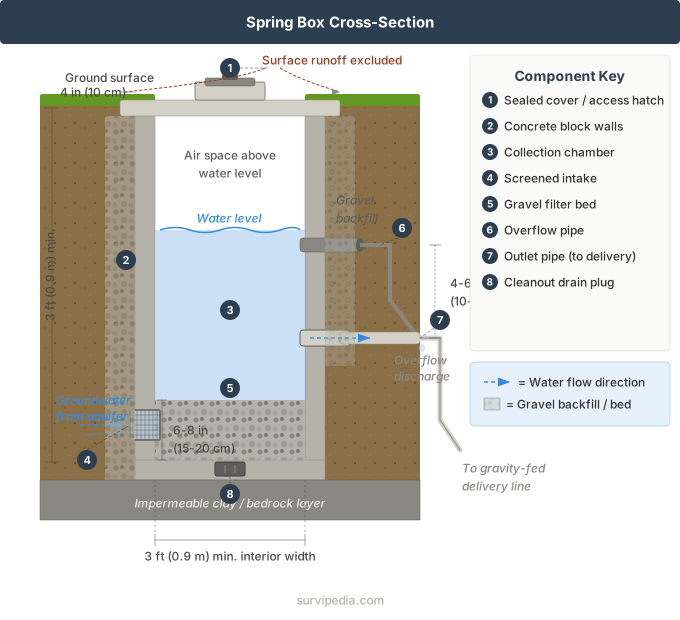
For detailed step-by-step construction procedures including excavation, gravel layering, block laying, and cover installation, see Springs — Development, Spring Box Construction, and Safety. That page covers the full spring box build from initial excavation through first-use disinfection.
Key sizing principle: Build the interior dimensions at least 3 feet × 3 feet × 3 feet (0.9 × 0.9 × 0.9 m). This provides enough internal volume for sediment accumulation between cleaning cycles and enough room to lower a bucket inside for inspection. A spring box that is too small to clean is a spring box you will eventually abandon.
Overflow pipe placement: The overflow pipe must be set 4–6 inches (10–15 cm) above the outlet pipe elevation. This creates a stable operating water level inside the box — the water column above the outlet pipe prevents sediment from being drawn into the delivery line, while the overflow handles high-flow periods without pressurizing the structure.
Cover construction is the single most critical contamination control. Surface water finding its way through gaps in the cover nullifies everything else. Whether you use a poured concrete slab or a pressure-treated timber frame with metal roofing, the cover must overlap the box walls by at least 4 inches (10 cm) on all sides with no gaps, and the access hatch must be elevated above grade to prevent surface water from pooling against it.
Piping water to your homestead
Gravity-fed delivery: head pressure and pipe sizing
Gravity-fed delivery is the first choice for any spring that sits uphill from the point of use. There are no moving parts to fail, no electricity dependency, and no pump maintenance. The only requirement is enough elevation difference between the spring box and the delivery point to generate usable pressure.
Head pressure calculation: Every 1 foot (0.3 m) of vertical elevation drop generates 0.433 PSI of water pressure. A spring box that sits 50 feet (15 m) higher than your kitchen faucet delivers approximately 22 PSI — adequate for most household fixtures, though below the standard municipal range of 40–80 PSI.
| Vertical Drop | Pressure at Delivery |
|---|---|
| 25 ft (7.6 m) | ~11 PSI |
| 50 ft (15 m) | ~22 PSI |
| 100 ft (30 m) | ~43 PSI |
| 150 ft (46 m) | ~65 PSI |
In practice, friction losses in the pipe reduce delivered pressure by 10–20% on a typical run. For gravity systems under 30 PSI, use 1.5-inch (3.8 cm) Schedule 40 PVC as the main delivery line — the larger bore compensates for low head pressure by allowing higher volume flow at lower velocity. For runs delivering more than 40 PSI, 1-inch (2.5 cm) Schedule 40 PVC is sufficient for standard household demand. A pressure-reducing valve (PRV) is required if head pressure exceeds 80 PSI — typically when the spring sits more than 185 feet (56 m) above the delivery point.
Minimum slope for gravity flow: The pipe does not need to slope continuously downhill along its entire run, but the inlet (spring box) must be higher than the outlet (delivery point). Horizontal runs and slight uphill sections mid-run are manageable if the net elevation difference is maintained. Avoid creating high points that trap air — air pockets in a gravity-fed line create intermittent flow and reduce pressure.
Gravity-fed plumbing integration
A gravity-fed spring system integrates well with a storage cistern — size the cistern to buffer between the spring's constant flow and your household's peak demand hours. The spring fills the cistern continuously; you draw from the cistern as needed. A cistern also gives you a volume reserve during seasonal flow dips. For cistern sizing and installation, see the Bulk Water Storage page.
Pumped delivery
If the spring box sits lower than your homestead — or if the vertical drop provides less than 8–10 PSI — you need a pump.
A submersible pump installed in or near the spring box is the most common solution. These are the same pump technology used in wells: a sealed pump and motor submerged in water, with electricity delivered down the drop pipe. A small submersible rated at 1/2 HP (373 W) can deliver 10–15 gallons per minute (38–57 L/min) against a 50-foot (15 m) head — more than enough for household use.
A jet pump (surface-mounted) works for springs with a suction lift of less than 25 feet (7.6 m) — the depth from the pump to the water surface. Beyond 25 feet, suction limitation prevents the pump from drawing water at all. Jet pumps are easier to service (accessible above ground) but more susceptible to priming loss.
For off-grid installations with solar power, a 12V or 24V submersible pump can run directly from a solar panel and battery bank without an inverter. A pump drawing 3–5 amps at 24V can be powered by a single 100W solar panel in adequate sun.
Regardless of pump type, install a pressure tank between the pump and the distribution system. A pressure tank stores 5–20 gallons (19–76 L) of water under pressure, reducing pump cycling and providing short-term supply during pump maintenance or power interruption.
Pipe burial depth
All buried water lines must be installed below the local frost depth to prevent freezing. Frost depth varies significantly by region:
| Region | Typical Frost Depth |
|---|---|
| Deep South, coastal areas | 6–12 in (15–30 cm) |
| Mid-Atlantic, Pacific Northwest | 12–24 in (30–61 cm) |
| Midwest, Great Plains | 36–48 in (91–122 cm) |
| Northern states, mountain elevations | 48–72 in (122–183 cm) |
Contact your county extension office or building department for the frost depth applicable to your specific location — it varies even within a region based on soil type and snow cover patterns. Always bury 12 inches (30 cm) below the local frost line as a margin. For rocky ground where burial is impractical, see the winterization section below.
Use blue potable-water rated polyethylene (PE) pipe (also called poly pipe or agricultural poly) for buried runs where the pipe will flex around obstacles. Use Schedule 40 PVC for straight, trench-buried runs. Both are rated for continuous contact with drinking water. Do not use non-rated irrigation pipe or reclaimed gray pipe — these are not approved for potable water and may leach contaminants.
Water rights: what you need to know before you pump
Spring development is regulated in every U.S. state. The rights framework your state uses determines whether you can use the water on your property and what permits you need.
Riparian doctrine (eastern states)
In most eastern states — generally those east of the Mississippi — water rights are based on the riparian doctrine: the owner of land through which or adjacent to which a spring flows has the right to use that water as long as use is "reasonable" and does not unreasonably interfere with other riparian users downstream.
Under riparian law, you typically do not need a permit to develop a spring on your property for domestic use, but the spring's flow must continue to reach downstream properties if it naturally does so. States with riparian frameworks include Pennsylvania, New York, the New England states, Virginia, the Carolinas, Georgia, and most of the Southeast.
Prior appropriation doctrine (western states)
In most western states, water rights follow the prior appropriation doctrine: water rights are granted by permit based on "first in time, first in right." Water does not belong to the land it crosses — it belongs to the permit holder who first put it to beneficial use. To legally develop a spring for household use in a prior appropriation state, you generally need to apply for a water right permit with your state water resources agency before starting construction.
Prior appropriation states include Colorado, Wyoming, Nevada, Idaho, Utah, Montana, New Mexico, Arizona, Oregon, and Washington. California and some other states operate hybrid systems.
Unpermitted development in prior appropriation states
Developing a spring and diverting water without a valid water right in a prior appropriation state can result in mandatory cessation of use, required stream flow restoration, and fines. In water-scarce western states, enforcement is taken seriously. Consult your state water resources agency before any ground disturbance near a spring.
Practical steps before development
- Identify your state's water rights doctrine (riparian, prior appropriation, or hybrid)
- Contact your state water resources or environmental quality agency — ask specifically about domestic spring development permits
- Check whether your county has any additional permit requirements (many do for sanitary water systems)
- Document the spring's location, estimated flow, and intended use before filing any application
Contamination prevention
A developed spring box is a permanent structure in a fixed location — and everything that happens uphill affects water quality over time. Contamination prevention is not a one-time task; it is an ongoing land management commitment.
Fencing the spring area
Fence a minimum radius of 100 feet (30 m) in all directions around the spring box. This excludes livestock from direct access to the spring area, prevents fecal contamination from animal traffic, and creates a buffer zone between the collection point and grazing land. NRCS Conservation Practice Standard Code 574 requires livestock exclusion from the spring source area and references Fence Code 382 for design — consult your state's Field Office Technical Guide for the jurisdiction-specific minimum setback distance, as the national standard does not prescribe a universal radius.
A woven-wire fence with wood or steel posts is the most durable option. For a small spring protection zone, the materials cost is affordable and the labor is manageable over a weekend. Install a self-closing gate for maintenance access.
Surface water diversion swale
Grade a diversion swale — a shallow earthen channel — starting at least 50 feet (15 m) uphill from the spring box, running perpendicular to the slope to intercept surface runoff and redirect it away from the spring area. The swale does not need to be engineered; a hand-dug channel 6–8 inches (15–20 cm) deep and 12 inches (30 cm) wide is sufficient for most properties.
Pair the swale with uphill grading around the spring box itself — the land surface should slope away from the spring box in all directions to prevent pooling against the cover.
Uphill land use awareness
The spring's recharge zone extends uphill — potentially several hundred acres depending on geology. Periodically survey the uphill land use for: - New septic system installation within 100 feet (30 m) of the spring - New agricultural chemical application areas or fuel storage - Road construction or drainage changes that might redirect runoff toward the spring - Changes in animal stocking density that increase manure load in the recharge zone
A spring that tested clean at installation can become contaminated years later by uphill land use changes. Annual water testing is the early warning system.
Winterization
Cold-climate spring development requires specific design choices to prevent ice damage to the spring box, delivery pipe, and any above-ground components.
Insulating the spring box
The spring box interior is protected by the ground's thermal mass — water entering from the aquifer arrives at a constant 50–55°F (10–13°C) regardless of air temperature. The threat is not the water inside the box but heat loss through the cover and any exposed wall sections.
Spring box insulation approach: 1. Install 2-inch (5 cm) rigid foam insulation board (extruded polystyrene, or XPS — not expanded EPS, which absorbs moisture) on the underside of the spring box cover and on all wall sections within 12 inches (30 cm) of the surface 2. Seal all gaps in the cover with expanding polyurethane foam sealant before winter — this prevents cold air infiltration even more than it prevents heat loss 3. In climates with sustained temperatures below -10°F (-23°C), add a layer of straw bales over the spring box cover as a low-cost additional insulator — remove in spring
Buried pipe transitions
The most vulnerable point in any gravity-fed spring system is not the buried pipe (which is protected by the earth) but the transition zones: where the pipe exits the spring box, where it emerges at the delivery point, and any sections that cannot be buried below frost depth due to rock or other obstacles.
Protecting transition zones: - Wrap all above-grade pipe runs with foam pipe insulation (R-2 minimum) covered by a waterproof outer wrap or UV-resistant tape - For sections that will be exposed for more than a few weeks in winter, install self-regulating heat tape — electrical heat cable that adjusts its own output based on ambient temperature. A 120V self-regulating heat tape draws approximately 3–7 watts per foot (10–23 W/m) in freezing conditions, a very small load for a solar-powered system - Install heat tape on the outlet pipe of the spring box before it transitions to buried pipe, and on the incoming pipe at any building entry point where the pipe transitions from buried to above-grade
Drain-back design
For systems where winterization is a recurring concern, design the delivery line with a slight continuous downward slope from the spring box to the storage point, and install a drain-back valve at the spring box outlet. When you close the inlet valve (at the spring box) and open the drain-back valve, gravity evacuates the entire pipe run. An empty pipe cannot freeze. This is the most reliable freeze protection method for gravity-fed systems — it requires no electricity and no monitoring.
Maintenance schedule
Spring systems are low-maintenance compared to wells or pumps, but they are not maintenance-free. Neglect accumulates as sediment, cracked covers, and undetected contamination.
Monthly
- Visually inspect the spring box cover — look for new cracks, animal damage, or evidence of surface water entry (mud streaking, debris inside)
- Check delivered water clarity — new turbidity after rain indicates a cover seal problem
- For pumped systems: check pump pressure gauge at the pressure tank
Seasonal (spring and fall)
- Spring: Remove any winter insulation additions (straw bales, etc.); inspect cover for freeze-thaw damage; check that the diversion swale is clear and functional; test flow rate and compare to prior years
- Fall: Add winter insulation where needed; check heat tape function; confirm drain-back valve operation; inspect fence for winter damage and repair before snow makes access difficult
Annual
- Submit water sample to certified state lab for total coliform, E. coli, and nitrates
- Inspect spring box interior: clean sediment from the floor, check pipe fittings and screens, verify overflow pipe is unobstructed
- Record flow rate measurement and log it — a declining multi-year trend is early warning of aquifer recharge problems or uphill land use impact
- Survey uphill land use for any new development or activity changes
Spring development checklist
- Flow rate measured in late summer; result meets minimum household demand
- Water sample submitted to certified lab; results reviewed before development
- Water rights doctrine for your state identified; permit requirements confirmed
- Spring box constructed to minimum 3 ft × 3 ft × 3 ft (0.9 × 0.9 × 0.9 m) interior
- Outlet pipe set at correct elevation (6 in / 15 cm above gravel floor)
- Overflow pipe set 4–6 in (10–15 cm) above outlet pipe
- Cover sealed; access hatch elevated above grade
- Delivery pipe sized for available head pressure (1 in or 1.5 in Schedule 40 PVC)
- All buried pipe installed below local frost depth plus 12 in (30 cm) margin
- Fence installed at minimum 100 ft (30 m) radius around spring box
- Diversion swale graded uphill from spring; land slopes away from box
- Winter insulation and heat tape installed on exposed transition zones
- Annual water testing scheduled; first test completed before first use
- Maintenance log started; flow rate baseline documented
Building your permanent water system
Spring development is the foundation of water independence for rural properties. Once the collection chamber is built and the delivery line is in the ground, you have a water supply that operates without electricity, without pumps, and without municipal infrastructure.
For most off-grid homesteads, the complete water independence system combines a developed spring with a gravity-fed bulk storage cistern and appropriate filtration before the tap. Annual water testing closes the loop, confirming year over year that the source remains uncontaminated.
If a spring is not available or provides insufficient flow, a drilled well with hand pump backup is the next-best option — see Wells — Drilling, Digging, and Hand Pumps for a complete comparison of well types and the hand pump installation process.