Finding Water — Decision Guide
Water is the one preparation that cannot be deferred. A healthy adult begins suffering cognitive impairment within 24 hours of dehydration and can be incapacitated in 48–72 hours. Before choosing filtration systems, storage tanks, or any other water infrastructure, you need a sourcing plan — a clear answer to the question: where will your water actually come from?
Minimum Daily Requirements
The U.S. Federal Emergency Management Agency (FEMA) minimum is 1 gallon (3.8 L) per person per day — drinking only, sedentary conditions, no cooking, no hygiene. That number is a survival floor, not a planning target.
A practical planning minimum is 2 gallons (7.6 L) per person per day:
| Use | Quantity per Person per Day |
|---|---|
| Drinking (baseline) | 0.5 gal / 1.9 L |
| Cooking and food prep | 0.5 gal / 1.9 L |
| Hygiene and sanitation | 1.0 gal / 3.8 L |
| Total minimum | 2.0 gal / 7.6 L |
High heat, physical labor, illness, nursing mothers, and children under 12 all increase the drinking requirement. A safe planning number for active adults in summer heat is 3–4 gallons (11–15 L) per person per day when all uses are included.
For a family of four at the 2-gallon minimum: 8 gallons (30 L) per day, 56 gallons (212 L) per week, 240 gallons (908 L) per month.
Source Type Decision Matrix
Before committing to any source, evaluate it against five criteria: reliability, infrastructure dependency, treatment required, legal status, and cost.
| Source | Reliability | Infrastructure Dep. | Treatment Required |
|---|---|---|---|
| Municipal (grid-connected) | High (normal ops) | Critical | None (pre-treated) |
| Private drilled well | High | Moderate (pump power) | Depends on test |
| Dug/driven well | Moderate | Low (hand pump) | Always required |
| Rainwater collection | Variable | Low | Always required |
| Springs | Variable | None | Always required |
| Surface water | Variable | None | Always required |
| Atmospheric (AWG) | Moderate | Electricity required | Recommended |
| Source | Legal Complexity | Setup Cost |
|---|---|---|
| Municipal (grid-connected) | None | None |
| Private drilled well | Permit required | $5,000–$15,000 |
| Dug/driven well | Permit required | $500–$2,500 |
| Rainwater collection | Regulated by state | $500–$3,000 |
| Springs | Varies; land rights | $200–$1,500 |
| Surface water | Minimal | Low |
| Atmospheric (AWG) | None | $1,000–$5,000 |
Priority Order for Emergency Sourcing
When your normal supply fails, work through sources in this order, from most to least reliable:
1. Stored water — What you have already treated and stored. Zero preparation time. See Containers and Bulk Storage.
2. Municipal supply — Even during grid failures, municipal systems often have residual pressure for hours or days. Fill every container the moment you hear of an emergency.
3. Private well with hand pump — Fully grid-independent if you have a manually operable pump. Best long-term rural primary. See Wells.
4. Rainwater collection — Available anywhere it rains. Requires collection surface, storage, and purification. Best as a secondary layer in most climates. See Rainwater.
5. Springs — Excellent quality if properly developed; requires site evaluation, spring box construction, and regular testing. See Springs.
6. Surface water (streams, rivers, lakes) — Always available but highest contamination risk. Never use without treatment. See Surface Water.
7. Atmospheric water generation (AWG) — Energy-intensive, humidity-dependent. Best as a grid-down supplement in humid climates. See Atmospheric Water Generation.
8. Ice and snow melt — Winter-only option; caloric cost to melt, and purification still required. See Ice & Snow.
Contamination First Rule
Never assume any non-stored, non-municipal source is safe to drink without testing or treatment. Groundwater contamination, agricultural runoff, blue-green algae, and industrial pollution are invisible to the eye and odorless at dangerous concentrations. See Water Testing and Filtration.
Finding Water in Nature
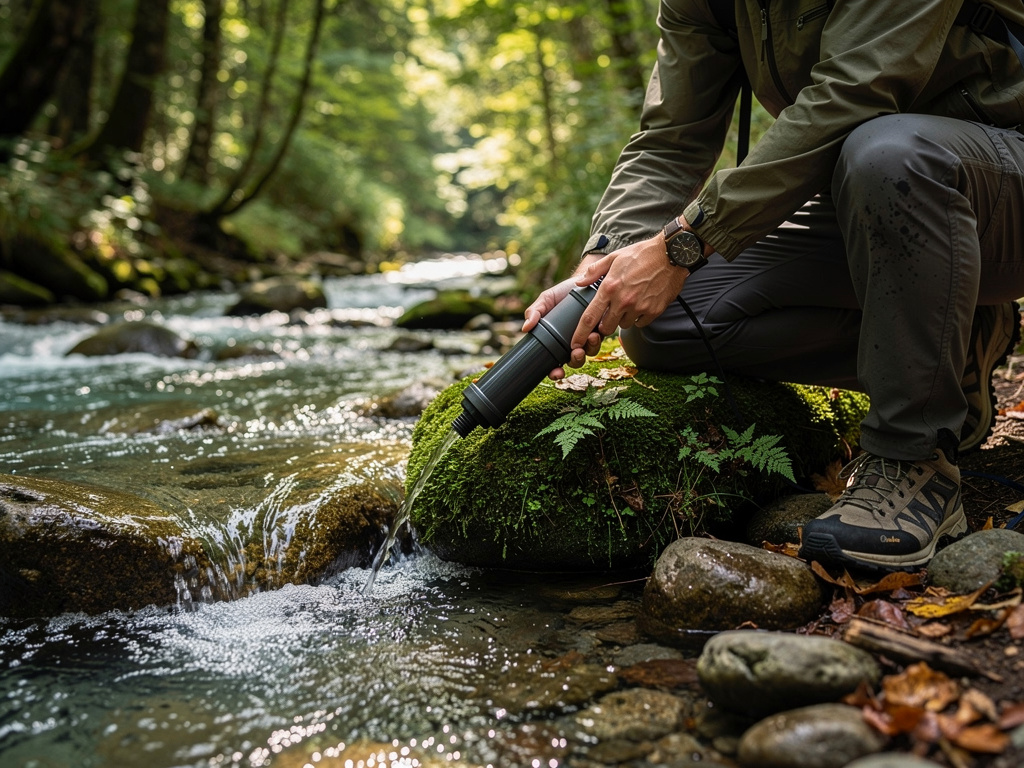
When no stored or infrastructure source is available, read the landscape:
Topographic Indicators
- Valleys and drainages: Water flows downhill. Follow terrain downward; drainage channels often have subsurface water even when dry on the surface.
- Vegetation clusters: Dense green vegetation in an otherwise dry landscape signals subsurface water. Willows, cottonwoods, cattails, and bright-green grass are the most reliable indicators in North America.
- Rock seeps and cliff bases: Porous rock (limestone, sandstone) collects and channels water. Look for dark wet patches on cliff faces, especially on north-facing slopes where evaporation is lower.
- Animal trails: Convergent animal paths often lead toward water. Birds flying low and straight in the morning or evening are typically heading to water.
- Canyon bottoms: In arid regions, dig into dry creek beds at the outside of a bend — subsurface water is often 6–24 inches (15–60 cm) below the surface.
Seasonal Considerations
- Spring snowmelt creates temporary surface water where none exists in summer
- Dry streambeds in summer often have subsurface water reachable by digging
- Morning dew on vegetation can be collected with absorbent cloth before 9 AM
- In coastal regions, moving away from shore reduces salt intrusion in groundwater
Urban Water Sources
- Hot water heaters contain 40–80 gallons (150–300 L) of potable water — drain from the bottom valve
- Toilet tanks (not bowls) typically hold 1.6–3.5 gallons (6–13 L) of clean water
- Swimming pools contain large volumes but require significant treatment for drinking
- Fire hydrants — only access through emergency responders; tap water pressure drops when hydrants are opened without authorization
Contamination Warning Signs
Do not collect from any source that shows these indicators:
- Foam or scum on still water — chemical or biological contamination
- Blue-green or bright green algal mats — cyanobacteria; toxins survive boiling and standard filtration; do not use this water source
- Dead fish, animals, or birds near the water source — acute toxicity event
- Oily sheen on surface — petroleum contamination
- Sulfur or chemical smell — industrial or geothermal contamination
- Unusual colors (orange, red, milky white) — mineral contamination or AMD (acid mine drainage)
- Downstream from agricultural land without buffer zone — nitrate contamination risk; no visual indicator
Field Note
If you find water in an emergency and have no test kit, the simplest field screening tool is observation time: fill a clear container, let it settle for 20 minutes, and look for sediment, color, and surface activity. Odor is your second screen — chlorine-free water with no unusual smell is not "safe," but water with a strong sulfur, chemical, or sewage smell is almost certainly unsafe and should be skipped in favor of a worse-looking but odorless alternative. Odorless does not mean clean; it means the contamination threshold is below your nose's detection.
Building a Layered Sourcing Plan
Resilience comes from depth: multiple independent sources that do not share the same failure mode.
Layer 1 — Stored (72-hour minimum): Pre-treated water in sealed containers that requires nothing from infrastructure. See Bulk Storage.
Layer 2 — On-site production: One source that produces water without municipal infrastructure — well, rainwater, or spring. This is your long-term backbone.
Layer 3 — Emergency fallback: A third source method requiring only portable equipment — filter + chemical treatment + surface water collection. This is your last resort that works anywhere.
Source Redundancy Checklist
- Layer 1: Minimum 2 gallons (7.6 L) per person per day × 14 days stored
- Layer 2: Primary production source identified, installed, and tested
- Layer 2: Treatment train defined (test results on file)
- Layer 3: Portable filter, chemical treatment, and collection containers in bug-out bag
- All household members know the layered plan and can execute Layer 3 independently
- Annual water test scheduled for any well, rainwater, or spring source
- Trigger conditions defined: when to move from Layer 1 → 2 → 3
Legal and Rights Considerations
Water rights are complex and vary dramatically by region:
- Western U.S. states use the Prior Appropriation doctrine ("first in time, first in right"). Surface water diversion may require a permit regardless of land ownership.
- Eastern U.S. states use Riparian Rights — landowners adjacent to water generally have use rights, but commercial diversion may be regulated.
- Rainwater collection is legal in most states but regulated in a few (Colorado historically restricted; Texas actively encourages it with a tax exemption). Check your state water authority before installing a system.
- Well drilling requires a state permit in virtually every U.S. jurisdiction. The permit documents well depth, casing, and location and is required for legal property records.
- Spring use on private land is generally unrestricted; on public land, permits may be required.
Always verify current regulations with your county or state water authority before investing in permanent water infrastructure.
Cross-References
- Purification methods: Boiling — Filtration — Chemical Treatment — UV Treatment — Distillation
- Source-specific guides: Wells — Rainwater — Springs — Surface Water — Atmospheric Water — Ice & Snow
- Testing and safety: Water Testing
- Storage: Containers — Bulk Storage
- Medical: Dehydration Treatment