Security
During Hurricane Katrina, looting began within 24 hours. After the 2021 Texas grid failure, reports of home break-ins spiked as desperate people searched for warmth and water. The pattern repeats in every extended emergency: when normal systems of order are stressed beyond capacity, personal security shifts from the government's responsibility to yours.
Security is a layered system, not a single solution. Each layer reduces the probability that you'll need the next one. Awareness prevents you from walking into problems. Deterrence makes you an unattractive target.
Hardening makes your home difficult to breach. Detection tells you when something's wrong. Response is the last resort when every other layer has failed.
Awareness
Situational awareness is the habit of observing your environment with purpose — not paranoia, but calibrated attention. Cooper's color code provides a useful framework: White (unaware), Yellow (relaxed alert — your baseline), Orange (specific threat identified), Red (action required). Most people live in White. Training yourself to default to Yellow costs nothing and gives you seconds of lead time that matter.
OPSEC — operational security — means controlling what information about your preparations leaks to others. The neighbor who knows you have a year of food and a generator is the neighbor who arrives at your door with his extended family when the grid goes down. Be generous with your community. Be discreet about the depth of your reserves. The grey man concept extends this to public behavior: move through crowds without drawing attention, avoid displays of wealth or capability, dress to blend.
Threat assessment converts vague unease into ranked priorities. Using a probability × impact × vulnerability matrix, you identify which risks actually warrant your time and money — and which you're over-preparing for relative to your real exposure.
Field note
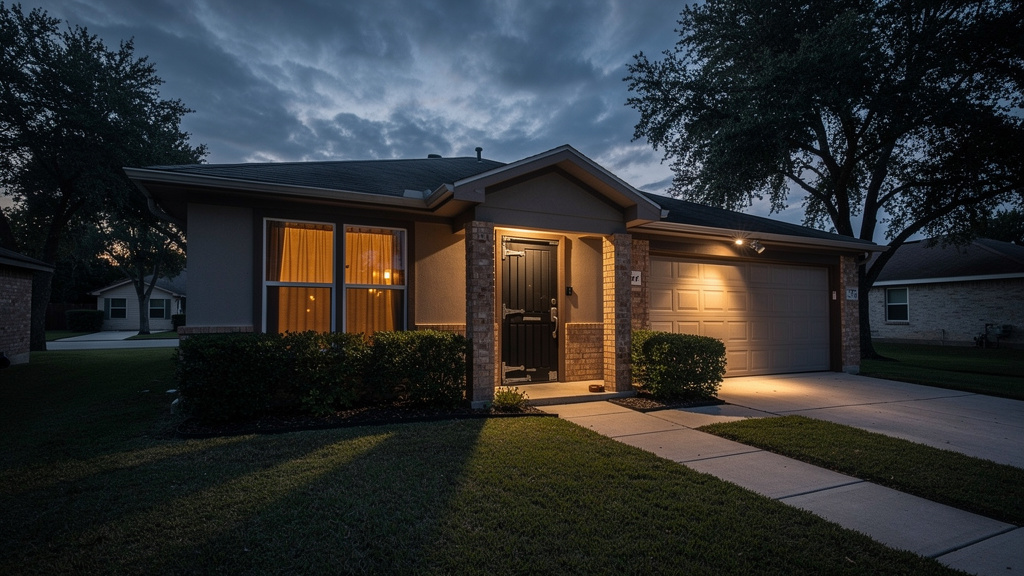
Walk your property at night with the lights on inside and the exterior dark. Look at your home from the street, from the alley, from each neighbor's vantage point. What can someone see? Open food stores, visible electronics, uncovered windows into bedrooms? That ten-minute exercise shows you exactly what your OPSEC profile looks like to an outsider.
Deterrence and hardening
Most opportunistic crime targets the easiest victim. Perimeter lighting and fencing — motion-activated lights covering all four sides of your home — eliminates the darkness that opportunists rely on. A solar LED floodlight on each corner is an inexpensive change that shifts your risk profile more than almost any other single investment.
Door reinforcement is the highest-return hardening step. Most residential doors fail at the strike plate — an inexpensive fix. Replace the short screws in your strike plate and hinges with 3-inch screws that anchor into the wall stud, not just the door frame. Add a quality deadbolt if you don't have one. This turns a door that can be kicked open in one hit into one that resists sustained force.
Window security addresses the other common entry point. Security film — an affordable DIY application — holds shattered glass in place, turning a quick smash-and-enter into a loud, time-consuming effort. For ground-floor windows in higher-risk areas, interior bars or shutters add a physical barrier.
Hardening has legal limits
Booby traps, concealed hazards, and devices intended to injure intruders are illegal in virtually every jurisdiction, even on your own property. Hardening is about barriers and delays — making entry difficult and noisy — not about causing harm to uninvited visitors. Know the self-defense laws in your state.
Detection
Camera systems serve two functions: real-time awareness and post-event evidence. A basic multi-camera NVR setup is an affordable investment; solar-powered cameras add off-grid resilience and send alerts to your phone — or to a dedicated monitor if cellular is down.
Alarms and early warning cover layered sensor design: door and window contacts, motion detectors, glass-break sensors, and backup sirens that operate during a power outage. The goal is to interrupt an intrusion before it becomes an incident, not to respond after the fact.
Night-vision equipment extends your detection capability into hours of darkness — the period when most home intrusions occur. Generation 1 monoculars are an affordable entry point; thermal imaging is a significant investment suited to rural properties with large perimeters.
Dogs remain one of the most effective detection systems ever developed. A dog that barks at unfamiliar presence on the property provides 24/7 alerting, requires no electricity, and is immune to electronic countermeasures. Breeds vary in capability — a livestock guardian breed alerts differently than a trained protection dog — but nearly any dog adds a detection layer that technology alone can't replicate.
Response
Response is the layer you hope never activates. It starts with a communication plan — your household and your neighborhood watch group need to know how to alert each other and coordinate. A rally point inside the home (the designated safe room) and outside (a neighbor's house, a specific intersection) should be pre-established and practiced.
Firearms are a component of response for households that choose to include them. Selection, secure storage, and legal requirements are covered in depth, but the emphasis is on training — hardware without consistent practice is unreliable under stress. Self-defense training addresses the skill layer directly: martial arts, firearms drills, and stress-inoculation exercises that close the gap between owning a tool and being able to use it. Non-lethal options — pepper spray, conducted-energy devices, and personal alarms — provide response capability for those who don't keep firearms or as an escalation step before lethal force.
Digital security protects the information layer. Strong passwords, encrypted backups, and offline copies of critical documents prevent a different kind of intrusion. Privacy practices reduce your attack surface in both digital and physical domains.
When you're away from home or forced to evacuate, travel security and displacement security cover how to maintain your security posture in hotels, shelters, relatives' homes, and vehicles — environments where you can't rely on your own hardware. Self-defense law maps the use-of-force framework that governs every layer of response and should be read before any defensive capability is assembled.
Where to start
- Replace the screws in your front door strike plate and hinges with 3-inch screws — 15 minutes, inexpensive hardware
- Install one motion-sensor LED floodlight on the most exposed side of your home — an inexpensive deterrent with immediate impact
- Practice situational awareness for one week: when you enter any building, identify the exits before you sit down
- Walk your property at night and assess your OPSEC profile from the street — what's visible?
- Establish a family rally point (one inside the home, one outside) and brief every household member
With your home hardened and your awareness sharpened, community becomes your force multiplier — a neighborhood that watches out for each other is a harder target than any individual household.