Tiny Homes
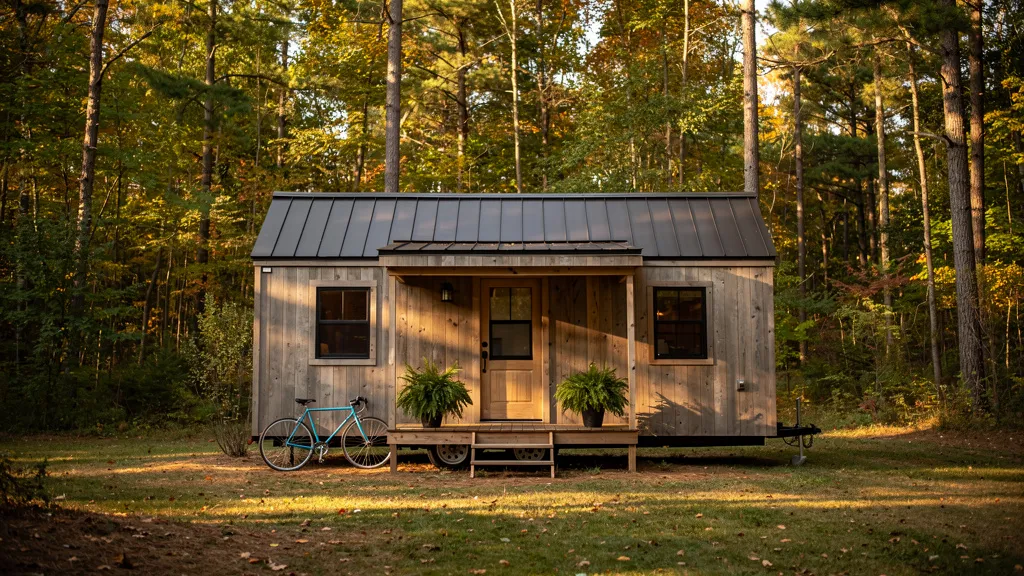
A tiny home — broadly any dwelling under 400 sq ft (37 sq m) — forces every space and system choice to be intentional. That constraint is also why tiny homes are one of the most resilient housing formats available: low cost, low energy demand, highly mobile in the THOW variant, and straightforward to take fully off-grid. This page covers the decision criteria and specs you need to choose the right format, buy or build it correctly, and run it reliably in any condition.
THOW vs. Foundation-Built: Choose the Format First
The first and most consequential decision is whether your tiny home moves or stays put.
Tiny House on Wheels (THOW)
A THOW is built on a purpose-made steel trailer and is classified in most jurisdictions as a recreational vehicle, not a permanent dwelling. This classification is both its legal loophole and its constraint.
Road-legal width: 8 ft 6 in (2.6 m) maximum without a wide-load permit. Most THOWs are built to exactly this width. Length typically runs 16–28 ft (4.9–8.5 m) for a manageable tow profile.
Usable floor area: A 24 ft (7.3 m) THOW yields roughly 200 sq ft (18.6 sq m) of main floor. Add a sleeping loft above a kitchen or bathroom and you reach 250–300 sq ft (23–28 sq m) of total livable space.
Trailer specification: The structural backbone is everything. The minimum usable trailer for a full build carries a 10,000 lb (4,536 kg) GVWR, but most completed builds need more. A finished house weighs approximately 500–550 lb (227–249 kg) per linear foot of trailer, so a 24 ft (7.3 m) trailer carrying a fully finished house will weigh 12,000–13,200 lb (5,443–5,987 kg). That demands a 14,000 lb (6,350 kg) GVWR trailer to maintain a safe margin.
Dense builds (brick veneer, heavy appliances, large batteries) warrant a 16,000 lb (7,257 kg) trailer. Aluminum trailers weigh 30–40% less than steel and cost $7,000–$9,000; comparable steel trailers run $4,500–$5,500.
Drop-axle advantage: A drop-axle trailer lowers the floor deck 6–8 in (15–20 cm) compared to a standard trailer. That recovered height goes directly into interior ceiling clearance — critical for loft designs.
Tie-down requirement: Even when parked semi-permanently, a THOW must be tied down against wind uplift. Use four hurricane strap anchors rated for the roof-sail area, or bolt to concrete piers at each corner of the trailer frame. This is not optional in areas with sustained winds above 50 mph (80 km/h).
Foundation-Built Tiny Home
A foundation-built tiny home — on a slab, piers, or crawl space — is treated as a conventional structure and must meet local residential building codes (IRC in most U.S. states). This means permits, inspections, and minimum square footage laws.
Minimum size laws: Most U.S. jurisdictions set a minimum habitable floor area between 120–400 sq ft (11–37 sq m) for single-family homes. Some states allow smaller if the unit qualifies as an Accessory Dwelling Unit (ADU). Always check local minimums before designing.
ADU pathway: The fastest legal route for a foundation tiny home is ADU classification on a parcel with an existing primary residence. California, Oregon, and many other states have state-level ADU laws that pre-empt local minimums — as low as 150 sq ft (14 sq m) in some jurisdictions. ADUs typically cannot be sold separately from the primary parcel without a lot split, but they can be rented and represent a genuine income-producing preparedness asset.
Zoning and Legal Placement
Where you park or build determines your legal exposure more than any construction detail.
| Placement Option | Typical Requirements | Resilience Notes |
|---|---|---|
| RV / mobile home park | Lot rent $400–$900/month, hookups provided | Least autonomy; subject to park rules |
| Rural private land | Check county rules; many rural counties have no zoning | Maximum autonomy; off-grid viable |
| ADU on family land | Must comply with ADU ordinance; owner may need to live on-site | Low cost, shared land base |
| Urban infill lot | Strict zoning; ADU or variance required | Highest scrutiny; permit costs significant |
| Tiny house community | Community-specific rules; often deed-restricted | Social resilience; shared infrastructure |
In unincorporated rural counties, THOW placement is often regulated only by health code (composting toilet or septic) rather than building code. This is the path of least friction for off-grid preparedness use.
Field Note
Before purchasing land for a THOW placement, call the county health department — not the building department. Health departments regulate waste disposal (composting toilet approval or septic permit), which is the most common obstacle for rural THOW placement. In many counties, the building department has no jurisdiction over a vehicle sitting on private land; the health department is the actual gatekeeper. One phone call can save you from buying land where legal habitation is impossible.
Build vs. Buy: Cost Decision Matrix
DIY Owner-Build
Building yourself from purchased plans takes 4–9 months for a first-time builder working evenings and weekends. Material costs for a 24 ft (7.3 m) THOW run $20,000–$50,000 depending on finish level, appliance choices, and insulation strategy. Add $4,500–$9,000 for the trailer. Quality design plans from reputable designers cost $300–$1,200 and are essential for structural correctness and obtaining insurance.
Realistic DIY all-in total: $25,000–$60,000.
You save 30–60% over a builder-finished unit, but every hour of labor is yours. This path makes sense only with meaningful carpentry, electrical, and plumbing competence — or a willingness to subcontract licensed trades for the critical systems.
Builder-Finished
A professionally built THOW from an established builder runs $60,000–$120,000 for a standard 20–28 ft unit. Custom specifications, full 4-season insulation packages, and complete off-grid systems push the top end to $150,000+. The price premium buys warranty coverage, RVIA certification (required by some lenders and insurers), and experienced troubleshooting of the details that trips up first-time builders.
Used builder-finished units sell for $25,000–$70,000 depending on age, condition, and installed systems. A 5-year-old unit from a reputable builder in good condition is often the best value — expensive first-build mistakes have already been corrected.
Foundation-Built
Site-built tiny homes on a slab or pier foundation using conventional framing run $40,000–$80,000 for experienced owner-builds and $80,000–$180,000 contractor-built, depending heavily on land costs, permit fees, and local labor rates. This format provides greater floor-area efficiency (no wheel-well bumps consuming interior width) and easier code compliance for full-time permitted occupancy.
Key Systems: Specs That Matter
Composting Toilet
The most practical waste solution for off-grid or RV-park situations where septic is unavailable. A self-contained composting toilet (Nature's Head, Air Head, or equivalent) is a moderate investment and handles one to two full-time occupants. Solids require emptying every 4–6 weeks; liquids divert to a separate bottle emptied every 3–5 days, or plumb to a greywater-compatible drain field where legal.
Composting toilets require 12V DC power for a small exhaust fan and adequate roof-vent penetration to prevent odor. Install a 1.5 in (38 mm) vent pipe through the roof with a carbon filter cap. Without positive ventilation, odor is inevitable. See Sanitation for detailed setup and maintenance procedures.
Greywater Management
Two full-time occupants generate 200–300 gallons (757–1,136 liters) of greywater weekly from sink, shower, and laundry. Three approaches in ascending complexity:
- Holding tank + haul-out: Best for mobile THOW use. A 50-gallon (189 L) poly tank under the trailer, pumped every 1–2 weeks at $30–$80 per pump-out.
- Mulch basin: For fixed rural placement. A gravel-filled trench 2 ft (60 cm) deep × 10 ft (3 m) long handles sink and shower greywater for two people. No permit required in most rural counties; do not route laundry water containing detergents near food gardens.
- Code-compliant mini leach field: Required for permitted ADU placement. A system engineered for 75–100 gallons per day (284–379 L/day) typically costs $4,000–$10,000 installed.
For detailed greywater design options, see Greywater.
Heating and Cooling
Propane direct-vent heater: The most reliable off-grid heat source. A wall-mounted direct-vent unit rated 11,000–17,000 BTU costs $400–$700 and heats 200–300 sq ft (18.6–27.9 sq m) down to -20°F (-29°C) when combined with adequate insulation. Annual propane consumption in a cold-climate 4-season setup: 150–300 gallons (568–1,136 L), or $420–$840 at current prices.
Mini-split heat pump: Best when grid power or substantial solar is available. A 9,000 BTU (2.6 kW) unit handles a well-insulated 24 ft THOW and costs $700–$1,200 for the unit plus $300–$600 for professional refrigerant line installation. Efficiency drops sharply below 5°F (-15°C) — always pair with propane backup in cold climates.
Small wood stove: A compact cast iron stove rated 15,000–22,000 BTU adds thermal mass, total off-grid heating independence, and cooking capability. Weight runs 90–130 lb (41–59 kg) plus the floor pad and wall clearance hardware (40–60 lb / 18–27 kg) — factor this into your trailer weight budget. The flue must exit above roofline by at least 2 ft (61 cm) and be NFPA 211-compliant.
Insulation for 4-Season Use
The thin wall cavity of a THOW — typically 2×4 framing (3.5 in / 89 mm) or 2×6 framing (5.5 in / 140 mm) — limits R-value unless you use high-density materials from the start.
| Location | Cold-Climate Minimum | Recommended Product |
|---|---|---|
| Walls | R-21 | Closed-cell spray foam 2 in (51 mm) + batts |
| Roof / ceiling | R-30 | Closed-cell spray foam, full cavity |
| Floor / trailer deck | R-19 | Rigid polyiso board, two layers |
| Stud thermal bridging | Address studs | 1 in (25 mm) exterior foam sheathing |
Closed-cell spray foam achieves R-6.5 per inch (25 mm), so 3.5 in fills a 2×4 stud bay to R-22 with zero air infiltration. At $1.50–$3.00 per board foot installed, a full spray-foam job on a 24 ft THOW runs $2,500–$5,000. This is the single highest-ROI insulation upgrade for 4-season livability in a THOW because it simultaneously solves air sealing, moisture control, and R-value in one pass.
For broader insulation strategy and climate-zone R-value maps, see Insulation and Weatherproofing.
Solar-Ready Electrical
A code-compliant THOW electrical system is wired as either a 120V RV/RVIA system or a conventional 120/240V residential panel, depending on builder certification. Design for off-grid solar from the start rather than retrofitting.
Typical tiny home daily load: 2–4 kWh for lighting, refrigeration, laptop, phone charging, and a small water pump. A mini-split in moderate use adds 1–2 kWh/day.
Off-grid solar sizing: 800W–1,600W of panel capacity (four to eight 200W panels) plus 10–20 kWh of LiFePO4 battery storage handles a 3–4 kWh/day household with 2–3 days of cloudy-weather reserve. A complete installed off-grid system runs $8,000–$18,000. See Solar Basics for panel and array sizing methodology and Batteries for chemistry comparison and bank sizing tables.
Rainwater collection: A 200 sq ft (18.6 sq m) THOW roof at moderate annual rainfall of 30 in (762 mm) yields approximately 3,500 gallons (13,249 L) per year — sufficient for one person's drinking and cooking needs when filtered through a first-flush diverter and carbon block filter. Larger cisterns and catchment areas scale up to household water independence. See Rainwater for collection system design.
For supplementary food production on minimal land, see Composting for building soil around a fixed or semi-fixed tiny home site.
Loft Design and Structural Clearances
Most THOW sleeping lofts sit above the kitchen or bathroom — the zones that only need 7 ft (2.1 m) of ceiling height below them — to preserve standing room in the living space. Critical minimums:
- Below-loft clear height: 6 ft 8 in (2.03 m) minimum for safe ladder access. Less than this creates head-strike risk when stepping off the ladder in the dark.
- Loft sleeping height: 3 ft 6 in (1.07 m) minimum — enough to sit upright in bed, not stand. Plan this into trailer selection; a drop-axle trailer recovers 6–8 in (15–20 cm) of interior height.
- Loft floor load: Design for 40 psf (195 kg/sq m) live load minimum. A 6 ft × 8 ft (1.8 m × 2.4 m) loft at this spec supports 1,920 lb (871 kg) — adequate for two adults, mattress, and gear.
- Ladder pitch: A fixed ladder at 70–75° from horizontal is the practical standard. A staircase with storage drawers underneath requires 8–10 sq ft (0.74–0.93 sq m) of floor plan but is worth building for any occupant with mobility limitations.
Downsizing: What to Cut
Moving into under 300 sq ft (27.9 sq m) is primarily a mental inventory problem, not a space problem. Most households carry 2–3× more possessions than a tiny home can realistically hold. Prioritized reduction sequence:
- Clothing: Reduce to two weeks of functional clothing. A 24 in (61 cm) closet rod and one small 4-drawer dresser is the realistic budget.
- Kitchen gear: One set of nesting cookware, one cutting board, one quality chef's knife, and one cast iron pan covers 95% of cooking. Counter space typically totals 8–12 linear feet (2.4–3.7 m).
- Furniture: Every piece must serve at least two functions. Bed with storage drawers underneath, fold-down wall-mounted dining table, stair-step storage instead of a separate staircase.
- Books and media: Digitize aggressively. A modest 100-book collection weighs 100–150 lb (45–68 kg) and consumes 10–20 linear feet (3–6 m) of shelf — an enormous allocation in 200 sq ft.
- Tools: A curated 50-piece hand-tool set covers most maintenance and repair needs and fits in a single 24 in (61 cm) rolling cabinet weighing under 80 lb (36 kg).
The biggest storage gains come from vertical space: floor-to-ceiling cabinetry in the kitchen, overhead storage above the loft headboard, and under-stair drawers built into every riser.
Comparison: Tiny Home vs. Alternative Shelter Formats
| Format | Cost Range | Mobility | Off-Grid Ease | Zoning Friction |
|---|---|---|---|---|
| THOW (owner-built) | $25K–$60K | High | High | Moderate |
| THOW (builder-finished) | $60K–$120K | High | High | Moderate |
| Foundation tiny home | $40K–$180K | None | High | High |
| Shipping container conversion | $35K–$100K | Low | Moderate | High |
| Earthbag home | $10K–$35K | None | Very high | High |
| RV / travel trailer | $15K–$80K | Very high | Moderate | Low |
For container-based alternatives with similar footprint characteristics, see Containers. For earth-based foundation options with maximum climate resilience, see Earthbag.
Quick-Reference Specs
| Parameter | Value |
|---|---|
| Road-legal THOW width | 8 ft 6 in (2.59 m) max without permit |
| Minimum trailer GVWR | 10,000 lb (4,536 kg); 14,000 lb (6,350 kg) recommended |
| Typical finished weight per linear ft | 500–550 lb (227–249 kg) |
| Loft clear height below | 6 ft 8 in (2.03 m) minimum |
| Wall R-value (cold climate) | R-21 minimum |
| Roof R-value (cold climate) | R-30 minimum |
| Solar array (off-grid, 2-person) | 800W–1,600W panels + 10–20 kWh batteries |
| Composting toilet installed cost | $900–$1,800 |
| Spray-foam insulation (24 ft THOW) | $2,500–$5,000 |
| DIY materials (24 ft THOW) | $20,000–$50,000 + $4,500–$9,000 trailer |
| Builder-finished THOW | $60,000–$120,000 |
| Used THOW | $25,000–$70,000 |