Insulation
Insulation is the single most cost-effective investment in long-term shelter resilience. A well-insulated envelope keeps a structure livable during grid-down winters with minimal supplemental heat, slashes fuel costs during normal operations, and prevents condensation damage that quietly destroys structures over years. This page covers decision criteria, material specifications, cold-climate minimums, and installation rules — enough detail to plan, specify, and supervise a project without guesswork.
Related: Weatherproofing covers air sealing before insulation installation. Wood Heat covers sizing heat output to match your insulated envelope.
R-Value Reference by Material
R-value measures thermal resistance per inch of thickness. Higher is better. These are industry-standard values for common insulation materials:
| Material | R-Value per Inch | Form | Installed Cost |
|---|---|---|---|
| Fiberglass batt (standard) | R-3.2 | Batt/roll | Inexpensive |
| Fiberglass batt (high-density) | R-3.8–4.3 | Batt | Affordable |
| Mineral/rock wool (Rockwool) | R-3.7–4.2 | Batt/board | Affordable |
| Cellulose (blown) | R-3.5–3.7 | Loose fill | Inexpensive to affordable |
| Open-cell spray foam | R-3.7 | Spray-applied | Affordable to moderate |
| Closed-cell spray foam | R-6.5–7.0 | Spray-applied | Significant investment |
| EPS rigid board | R-4.0 | Board | Affordable per R |
| XPS rigid board (Styrofoam blue/pink) | R-5.0 | Board | Affordable per R |
| Polyisocyanurate (Polyiso) | R-6.5 (at 75°F / 24°C) | Board | Affordable to moderate per R |
Polyiso R-value degrades in cold
Polyiso board is rated R-6.5 at 75°F (24°C) but drops to R-5.0 or lower below 0°F (-18°C). For cold-climate exterior continuous insulation, XPS or EPS outperforms polyiso at actual winter temperatures despite lower label R-values.
Cold-Climate R-Value Minimums
These are the U.S. Department of Energy (DOE) Zone 5–7 minimums for existing homes. New construction and gut renovations should target the higher end of the range:
| Assembly | Zone 5 Minimum | Zone 6–7 Minimum | High-Performance Target |
|---|---|---|---|
| Attic (unconditioned) | R-38 | R-49–60 | R-60 |
| Cathedral ceiling | R-30 | R-38 | R-49 |
| Above-grade wall | R-13+5ci | R-20 or R-13+10ci | R-30 effective |
| Floor over unconditioned space | R-25 | R-30 | R-38 |
| Basement wall | R-10+2ci | R-15+5ci | R-20 |
| Slab edge | R-10, 2 ft (0.6 m) deep | R-15, 4 ft (1.2 m) | R-20 |
"ci" = continuous insulation (rigid board, no thermal bridging through studs).
Vapor Barrier and Vapor Retarder Placement
Moisture management is as important as thermal resistance. Getting vapor control wrong causes mold, rot, and structural failure.
The Core Rule
In cold climates (heating-dominated), the vapor retarder belongs on the warm-in-winter side — toward the interior. In hot-humid climates (cooling-dominated), it belongs on the exterior side. Mixed climates require vapor-open assemblies.
Perm Ratings Explained
- Class I vapor retarder: <0.1 perm — polyethylene sheet (6-mil poly), foil-faced insulation
- Class II vapor retarder: 0.1–1.0 perm — kraft-faced batts, some paints
- Class III vapor retarder: 1.0–10 perm — latex paint, unfaced insulation (not a true barrier)
- Vapor-open assembly: >10 perm — allows drying in both directions
Placement by Assembly Type
Attic (cold climate): Air-seal the attic floor thoroughly with acoustical caulk and spray foam before adding insulation. Do NOT install a vapor barrier on attic floor in vented attics — moisture-laden air rises and must escape through the vented attic. Focus on air sealing, not vapor barriers here.
Walls (cold climate, 2×4 or 2×6 framing): Install kraft-faced batts with the kraft facing toward the interior (warm side), or use unfaced batts and cover with 6-mil poly sheeting (Class I). The exterior sheathing must be vapor-open (>1 perm) to allow outward drying. OSB sheathing is roughly 1–2 perm when dry — marginally acceptable. Vapor-open housewraps significantly improve drying potential.
Basement walls: In cold climates, rigid foam on the interior face of foundation walls is the preferred approach. Do NOT put polyethylene against concrete — it traps moisture. Closed-cell spray foam applied directly to concrete creates its own vapor barrier and requires no separate poly.
Field Note
Before any insulation project, do a blower-door air sealing pass first. A typical house has 0.5–1.5 ACH50 of air leakage after sealing; uninsulated homes commonly run 6–10 ACH50. Reducing air changes cuts energy load far faster than adding insulation R-value on an already-leaky shell. Spend an affordable amount on caulk, spray foam cans, and foam gaskets before buying batts.
Installation Decision Framework
Attic Insulation
Best approach for most homes: Blown cellulose over existing insulation. Install blocking at the eave vents before blowing to maintain the ventilation channel (minimum 2 in / 50 mm clearance from soffit to ridge). Blow to the target depth:
| Target R-Value | Cellulose Depth | Fiberglass Blown Depth |
|---|---|---|
| R-38 | 11 in (28 cm) | 14 in (36 cm) |
| R-49 | 14 in (36 cm) | 17 in (43 cm) |
| R-60 | 17 in (43 cm) | 21 in (53 cm) |
A typical 1,200 sq ft (111 m²) attic floor requires 30–40 bags of blown cellulose for R-49. DIY equipment rental runs $30–$50 per day; material cost is $400–$700. Contractor cost: $1,500–$3,000.
Wall Insulation
New construction / open walls: Mineral wool batts are the best all-around choice. They are vapor-open (unlike faced fiberglass in wrong orientation), fire-resistant (melting point >2,000°F / 1,093°C vs. fiberglass 932°F / 500°C), and hold R-value when compressed slightly. Install snugly with no gaps — a 4% void in a batt reduces effective R-value by 50%.
Existing walls (no demo): Blown-in cellulose through holes drilled in exterior siding or interior drywall. A professional rig can fill a typical wall cavity in 30 seconds. Density matters: target 3.5 lb/ft³ (56 kg/m³) for full-fill dense-pack that won't settle. Cost: $1.50–$3.00 per sq ft of wall.
Exterior continuous insulation (existing walls): 2–3 in (50–75 mm) of XPS or EPS over sheathing, lapped and taped, before re-siding. Adds R-10 to R-15 without touching interior framing. This eliminates thermal bridging through studs, which reduces effective wall R-value by 15–30% depending on framing fraction.
Basement and Crawl Space
Unfinished basement walls: Apply 2 in (50 mm) closed-cell spray foam directly to concrete (R-13) then cover with fire protection (drywall or intumescent paint — foam must be protected per most codes). Alternative: 1.5 in (38 mm) polyiso with taped joints, battened to wall, then 2×4 framing with R-13 mineral wool. Total effective R-value: ~R-26.
Crawl spaces: Seal the crawl space as a conditioned space — far superior to vented crawl spaces in most climates. Install 6-mil poly vapor barrier on the ground (lapping 12 in / 30 cm at seams, extending up the walls 6 in / 15 cm), apply 2 in (50 mm) rigid foam to the walls, and seal the vents. A sealed crawl space is a significant investment installed by a contractor.
Thermal Bridging and Why It Matters
Wood studs conduct heat roughly 4× better than insulation. In a standard 2×6 wall with studs every 16 in (41 cm) on center, the framing makes up 23–25% of the wall area and pulls the effective whole-wall R-value from R-21 (cavity only) down to R-15–17.
Solutions: - Add 1–2 in (25–50 mm) continuous rigid insulation over studs - Use advanced framing (24 in / 61 cm stud spacing, 2-stud corners, ladder blocking) to reduce framing fraction to 15% - Use structural insulated panels (SIPs) which eliminate stud cavities entirely
Sleeping System R-Values
The insulation principles governing your walls apply directly to your sleeping system — and in a grid-down or field scenario, your sleeping system is the envelope you live in for eight hours every night. Understanding the rating system prevents the most common cold-weather mistake: choosing a bag for its labeled temperature and discovering at 2 a.m. that the label and reality differ significantly.
Sleeping bags tested under ISO 23537-1 (formerly EN 13537) carry four rated temperatures. The two that matter most are comfort and lower limit. Comfort is the temperature at which an average adult woman sleeps warmly in a relaxed position. Lower limit is the temperature at which an average adult man can sleep for eight hours in a curled position without waking from cold. The extreme (survival) rating is not a performance floor — it is the temperature threshold below which hypothermia risk becomes life-threatening even in the bag. Never plan around the survival rating; treat it as a hard stop.
Practical field categories map to these labels as follows:
| Category | Comfort Rating | Lower Limit | Intended Use |
|---|---|---|---|
| Winter expedition | 0°F (-18°C) or lower | -20°F (-29°C) | Sub-zero shelters, sustained cold |
| 3-season | 20°F (-7°C) | 5°F (-15°C) | Spring, fall, cool summer nights |
| Summer | 40°F (4°C) | 25°F (-4°C) | Warm nights, mild elevations |
Cold sleepers — typically smaller-framed individuals, women, and anyone calorie-deficient — should buy to the comfort rating, not the lower limit. A person shivering in a bag rated to their ambient temperature is not insulated; they are slowly depleting core temperature.
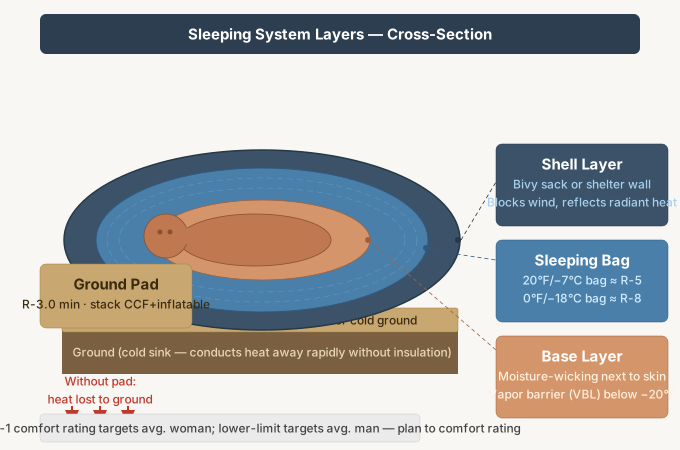
Sleeping pad R-values are not optional insulation. Conductive heat loss to the ground exceeds convective heat loss to the air in cold conditions. A sleeping bag provides almost no insulation on its compressed underside. Standard pad categories:
| Pad Type | Typical R-Value | Best Use |
|---|---|---|
| Closed-cell foam (CCF) | R-2.0 | Summer, ultralight layering base, bombproof durability |
| Self-inflating | R-3.5–5.0 | 3-season backpacking, base camps |
| Inflatable insulated | R-4.0–7.0 | Winter camping, cold-floor shelters |
For winter conditions, stack a CCF foam pad beneath an inflatable for combined R-values exceeding R-6.0 without risking puncture failure at critical moments. See the shelter index for how sleeping system insulation integrates with the broader shelter-warmth hierarchy.
Sleeping System Decision Tree
Use this sequence to determine what you need for a given night:
- What is the expected overnight low? Match your sleeping bag's comfort rating (not lower limit) to that temperature. If your bag's comfort rating is higher than the expected low, you need additional layers.
- Will you be on the ground or a cold floor? If yes, you need a sleeping pad with R-value 3.0+ for temperatures below 40°F (4°C), and R-5.0+ below 20°F (-7°C). Stack pads if needed.
- Is it wet, windy, or exposed? Add a bivy sack — it blocks wind convection and splash, adding 5–10°F (3–6°C) of effective warmth.
- Is it dry but cold? Add a sleeping bag liner instead — it adds 5–15°F (3–8°C) of warmth with less condensation risk than a bivy.
- Will temperatures stay below 20°F (-7°C) for multiple nights? Add a vapor barrier liner (VBL) as the innermost layer to prevent moisture from freezing inside insulation. Skip the VBL above 25°F (-4°C).
- Emergency improvisation — no sleeping bag available: layer wool blankets (two minimum), stuff newspaper or dry leaves between layers for dead air, use an emergency space blanket as the outermost shell with the reflective side facing inward.
Bivy Sack vs. Sleeping Bag Liner
Both a bivy sack and a sleeping bag liner extend your bag's thermal envelope, but they solve different problems. Choosing the wrong one wastes money and pack weight.
A sleeping bag liner is a thermal layer worn inside your bag — silk, fleece, or synthetic fill — that adds dead air space between you and the bag shell. A quality liner adds 5–15°F (3–8°C) of effective warmth. Silk liners weigh around 4 oz (113 g) and add roughly 5–8°F (3–4°C); fleece liners weigh 10–14 oz (283–397 g) but add up to 15°F (8°C). Liners also keep the bag cleaner, reducing how often you need to wash down insulation. Their weakness: they add no wind or precipitation protection, and they can shift uncomfortably inside the bag during the night.
A bivy sack is a waterproof or water-resistant outer shell that encases the entire sleeping bag. A basic emergency bivy (the aluminized Mylar type) adds 5–10°F (3–6°C) of warmth through radiant reflection alone, plus wind and splash protection. A purpose-built breathable bivy adds similar warmth with significantly less condensation buildup inside. The tradeoff is weight and cost — a quality breathable bivy is a moderate investment versus the inexpensive emergency foil type.
| Feature | Sleeping Bag Liner | Bivy Sack |
|---|---|---|
| Warmth added | 5–15°F (3–8°C) | 5–10°F (3–6°C) |
| Wind protection | None | Yes |
| Splash/precipitation | None | Yes |
| Condensation risk | Low | Moderate (foil) / Low (breathable) |
| Weight | 4–14 oz (113–397 g) | 8–20 oz (227–567 g) |
| Best use | Clean base-layer warmth boost | Exposed shelters, wet conditions |
Condensation management with a foil bivy: the aluminized surface is vapor-impermeable, so moisture from your breathing and skin accumulates on the interior surface. In temperatures above 25°F (-4°C), this becomes uncomfortable within a few hours. Vent the bivy at the foot or head to allow airflow exchange. Below 20°F (-7°C), condensation freezes quickly on the bivy interior and becomes less of an issue for comfort, though ice accumulation adds weight by morning.
Body Heat Conservation Sequence
Effective thermal management in a cold sleeping environment follows a three-layer logic identical to the building science principles governing your walls: control moisture at the skin, trap air in the middle, and block wind and radiation at the outside. Reversing the order makes each layer less effective.
The vapor barrier liner (VBL) is the innermost layer — worn directly against skin or over minimal base layers. It blocks your body moisture from migrating into insulation layers where it condenses and freezes. A functional VBL is any vapor-impermeable material: a silnylon bag liner, a plastic bag in a genuine emergency. In sustained sub-zero conditions below 0°F (-18°C), a VBL can add an effective 10–15°F (6–8°C) of perceived warmth by preventing the progressive wetting of insulation over multiple nights. Without a VBL, down insulation in particular can lose 30–50% of its loft after three consecutive nights in the field at hard-cold temperatures.
The insulation layer — sleeping bag, quilts, wool blankets — sits over the VBL. This layer's only job is trapping dead air. It does that job poorly once wet, which is exactly why the VBL precedes it.
The shell layer — bivy, tent inner/outer, shelter wall — blocks wind convection and reflects radiant heat back toward the sleeper. An emergency space blanket used as a bivy shell can reflect up to 90% of radiated body heat back inward, which is why the aluminized surface faces the body, not the exterior.
Field note
The body heat sequence matters most in a debris shelter or improvised winter camp where you have no tent to rely on. Sleep in your insulation in this order: vapor barrier next to skin, sleeping bag or insulation layer over that, bivy or emergency blanket outside. If you reverse the shell and insulation layers — bivy on first, bag over it — the bivy's waterproofing traps your moisture inside the insulation and the bag becomes progressively wetter through the night.
Thermal Layering for Shelter Walls
The same principles that govern wall assemblies in residential construction apply directly to field shelters — dead air space insulates, radiant barriers reflect, and gaps destroy performance. Understanding the physics gives you reliable field improvisation.
Debris insulation thickness: Natural debris (dry leaves, pine duff, grass, bracken) has an R-value roughly equivalent to fiberglass batt — approximately R-3.0 to R-3.5 per foot (0.3 m) when loosely piled. A debris hut with walls and roof at minimum 2 ft (60 cm) thickness achieves roughly R-6 to R-7 — adequate to retain body heat at temperatures down to about 10–15°F (-12 to -9°C) on calm nights. For temperatures below 0°F (-18°C) or in wind, target 3 ft (90 cm) of debris thickness. The debris works because it traps millions of small pockets of still air; compress it and you destroy its insulating value. The floor layer deserves equal attention — ground conduction strips heat far faster than the air. Pile at least 12–18 in (30–45 cm) of dry debris beneath your body.
Reflective barriers: An emergency space blanket (aluminized polyester, Mylar) positioned on the interior shelter wall between the debris and the sleeping space reflects up to 90% of radiant body heat back toward the occupant. Position the reflective face inward. In a debris shelter, a single emergency blanket stapled or draped against the interior ridge pole adds effective warmth equivalent to several inches of additional debris without added bulk. This is the same principle used in radiant barrier products applied in residential attic decking to reduce summer heat gain. See weatherproofing for how radiant barriers integrate into permanent wall assemblies.
Dead air space: Insulation is not about the material itself — it is about preventing air movement. Whether you are packing debris around a shelter or installing XPS rigid board in a wall cavity, the goal is identical: maximize still air volume, minimize thermal bridging, and prevent convective loops. A debris shelter that is too large loses this air retention advantage; the internal volume exceeds what your body heat can maintain. Build tight to your body.
Vapor Barrier Condensation Risk
A vapor barrier liner is one of the most effective cold-weather sleeping system tools available — and one of the most misused. The same vapor physics that make a VBL valuable below 0°F (-18°C) make it actively harmful in wrong conditions.
When VBLs work: In sustained hard cold — consistently below 20°F (-7°C) — body moisture migrating into insulation freezes before it can escape. Over multiple nights this ice accumulates and progressively destroys loft. A VBL stops this migration entirely. The moisture stays against your skin, your insulation stays dry, and the bag maintains its rated performance through a multi-day expedition. This is the condition for which VBLs were designed — polar travel, winter mountaineering, extended cold-weather camps where you cannot dry your bag during the day.
When VBLs create problems: At temperatures above 25°F (-4°C), or in wet cold near the freezing point (28–35°F / -2 to 2°C), a VBL traps liquid moisture against your skin rather than vapor migrating into insulation. The result is a clammy, sweat-soaked interior that feels far colder than the ambient temperature warrants. In wet conditions, the moisture that would otherwise slowly migrate outward through your insulation has nowhere to go. Hypothermia risk increases, not decreases. The rule of thumb: use a VBL only when you are confident temperatures will stay below 20°F (-7°C) through the night.
Management techniques: If you are using a VBL in marginal temperatures, wear a thin wool or polypropylene base layer next to skin inside the VBL — it wicks sweat away from direct skin contact without allowing moisture to pass through the VBL. Vent the VBL at the neck to allow some vapor exchange on warmer parts of the night. In the morning, wipe down the VBL interior and hang it to air-dry; it dries in minutes because it holds no moisture itself.
Never use a VBL in wet conditions near freezing
At 28–36°F (-2 to 2°C) in rain or wet snow, a VBL traps liquid sweat and rain moisture against the body with no exit path. Core temperature drops faster than in the same bag without a VBL. If conditions are wet and near-freezing, rely on a breathable moisture-wicking system rather than a vapor barrier.
Cost Summary
| Project | DIY Cost | Contractor Cost | Energy Payback |
|---|---|---|---|
| Attic air sealing (1,200 sq ft / 111 m²) | $150–$300 | $400–$800 | 1–3 years |
| Attic insulation to R-49 (blown) | $600–$900 | $1,500–$3,000 | 3–7 years |
| Dense-pack walls (existing home) | Not recommended DIY | $2,000–$5,000 | 8–15 years |
| Basement wall insulation | $800–$1,500 | $2,000–$4,500 | 10–20 years |
| Crawl space conditioning | $1,000–$2,000 | $2,500–$6,000 | 8–15 years |
Federal 25C tax credit covers 30% of insulation labor and materials costs for energy-efficiency improvements, up to $1,200 per year (verify current program status at energystar.gov before claiming).
Implementation Checklist
- Perform or commission a blower-door test to locate major air leaks
- Seal all attic penetrations (top plates, recessed lights, plumbing chases) before insulating
- Verify existing attic insulation R-value and depth
- Confirm vapor barrier class and placement matches climate zone
- Block eave ventilation channels before blowing attic insulation
- Check for thermal bridging at rim joists, sill plates, window headers
- Verify any spray foam is protected from ignition per local code
- Test for moisture issues in basement before insulating walls